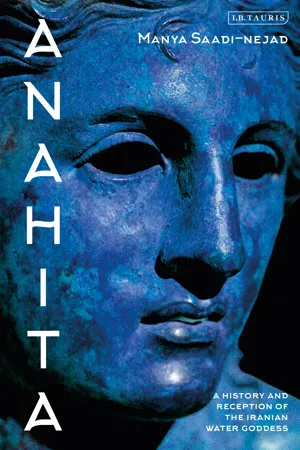
Anahita was the most important goddess of pre-Islamic Iran. From her roots as an ancient Indo-European water deity her status was unrivalled by any other Iranian goddess throughout the course of three successive Iranian empires over a period of a thousand years.
The first scholarly book on Anahita, this study reconstructs the Indo-European water goddess through a comparison of Celtic, Slavic, Armenian and Indo-Iranian myths and rituals. Anahita's constantly-evolving description and functions are then traced through the written and iconographic records of Iranian societies from the Achaemenid period onwards, including but not limited to the Zoroastrian texts and the inscriptions and artistic representations of the great pre-Islamic Iranian empires. The study concludes by tracing survival of the goddess in Islamic Iran, as seen in new Persian literature and popular rituals. Manya Saadi-nejad demonstrates the close relationship between Iranian mythology and that of other Indo-European peoples, and the significant cultural continuities from Iran's pre-Islamic period into the Islamic present.
- 264 pages
- English
- ePUB (mobile friendly)
- Available on iOS & Android
eBook - ePub
About this book
Information
1
Goddesses in the Ancient World
The worship of goddesses was central to the religious practice of the various early societies that predated the migration of the Iranians into central and southwest Asia during the second half of the second millennium BCE, when Iranian speakers began moving into these regions.1 These pre-Iranian societies included those of the Bactriana-Margiana Archaeological Complex (BMAC) in Central Asia (c. 2300 and 1700 BCE), the Elamites in Southwestern Asia, the various peoples of Mesopotamia, and numerous pastoral-nomadic groups of the Zagros Mountains and the plateau further east.
Goddesses and their functions and rituals in any tradition transform themselves over time, and always represent a composite drawn from a range of sources. Thus, Anāhitā, as a composite goddess (as will be discussed in Chapter Five), shows many different characteristics, which may have been absorbed from goddesses who existed before her arrival on the Iranian plateau. The existence of these goddesses from prehistoric time will be discussed shortly, with the aim of better understanding Anāhitā’s functions, features, and rituals, which may represent a combination of Iranian and non-Iranian origin and the goal of contextualizing her within the larger framework of goddesses.
“Venus” Figurines
The best-known visual representations of women from the ancient period are figurines, generically referred to as “Venuses,” which have been found over a wide territory across western Eurasia and cover a vast historical time span, from the Upper Paleolithic Age (c. 25000 BCE) to the Bronze Age (c. 2000 BCE).2 Venus figurines are usually nude, having different shapes but usually featuring prominent breasts (or sometimes the opposite), large buttocks, and thick thighs. Some appear to be pregnant. These features have led many archaeologists to assume that they might represent mother goddesses and are connected to fertility rites.3 A number of other explanations are possible, however.4
Although there exists some measure of agreement among scholars regarding the rather broad scope of what these figurines may represent and the possible functions of them—which include ancestor worship, successful agriculture, sex objects or guides to the underworld for the dead, substitutes for human sacrifice, and teaching social codes to children or simply as toys for them5—these functions most likely differed from one spatio-temporal context to another.
Venus Figurines in Iran
As the Indo-European-speaking peoples began to migrate outward from their presumed home on the southern Russian steppes beginning some 5,000 to 6,000 years ago,6 their dispersal among a wide range of other cultures led to transformation, adaptation, and assimilation with the beliefs and practices of the latter. At the same time, all of the peoples descended from the proto-Indo-Europeans retained aspects of their ancestors’ language and culture, allowing us to speak of a common Indo-European heritage.
The presence of Venus figurines throughout the territory of the Iranian plateau, including Tappeh Sarāb, east of Kermanshah in north-west Iran, Giyān Tappeh, near Nahāvand in the west, Tappeh Alī-kosh, near Dēzfūl in Khuzestan to the southwest, Tappeh Sīalk, near Kāshān in central Iran, Kalūraz, near Tappeh Jalāliyeh in Gilan in north,7 and Turang Tappeh, near Gorgan in the northeast,8 may attest to the existence of a goddess worship across the region prior to the arrival of the Indo-European-speaking Iranians by the end of the second millennium BCE.
Contemporary studies of Iranian history have combined archeology, linguistics, and textual approaches in an attempt to fill out the historical narrative for Western Asia. Referring to the history of this region “Iranian,” however, tends to obscure the fact that there were already people living in the area before the Iranians arrived, in some cases, with long-established civilizations of their own. Cultural exchanges between their culture(s) and that of the newcomers (Indo-Iranians, with their own goddesses) can be assumed and, in many cases, demonstrated.
As Iranians migrated southward and then westward onto the Iranian plateau during the second millennium BCE,9 one may assume some level of mutual influence between the new arrivals and the preexisting local peoples of the region. Nasab and Kazzazi have detected distinct changes in style and body proportions between figurines over both time—from the Paleolithic to the Neolithic periods—and space, that is, between those from Central Europe and those found in Iran. These changes likely reflect an ongoing process of cultural encounter and mutual influence among different ancient peoples.10
Pre-Iranian Goddess Worship in the Iranian Lands
Much of the material culture from the historical Iranian heartlands identified with goddess worship dates to the period prior to the arrival of Iranian speakers in the region. Moreover, the fact that we do not know for sure how any given artifact should be interpreted means we can only guess at the extent to which female figurines might have been connected to any kind of goddess worship.
In some cases, textual materials can be connected with physical evidence such as objects or rock reliefs. Perhaps the most promising connection between written and material sources for ancient goddess worship can be found in western Anatolia, where female figures from Çatal Hüyük—a site occupied from around 6250 to 5400 BCE—appear compatible with a prominent goddess-centered fertility cult, which persisted in the region well into historical times.11 As Ehrenberg notes, “the worship of a fertility goddess is attested in historical records in Anatolia, some several thousand years after the Neolithic figurines were produced in the area, and this strengthens the possibility that the earlier Anatolian figurines are representations of the same goddess, particularly when their form and context are examined.”12
Elam
Of the various pre-Iranian inhabitants of Western Asia, the Elamites are among the most significant. The “Persian” society that developed during the Achaemenid period (550–330 BCE) was in essence a hybrid between the native Elamites and intrusive Iranians associated with the Parsa tribe.13 The Elamite presence covered a wide area, from their homeland in the southern Zagros Mountains and Khuzestan at the southeastern edge of the Mesopotamian plain to the east, as far as Kerman on the southeastern part of the Iranian plateau. Their culture was heavily influenced by those of Mesopotamia—the Sumerian, Babylonian, and Assyrian civilizations—and at the beginning appears to have been goddess-centered,14 suggesting the possibility that ancient Elamite society was initially goddess-centered.15
The Elamites were a major political force in the region for more than 2,000 years, from around 2600 to 640 BCE. Their home territory is named as “Elam” (the “high land,” referring to its position within the southern part of the Zagros Mountain range) in the Hebrew Bible (from the Sumerian transcription elam(a), Akkadian elamtu, Elamite haltamti). In their own cuneiform texts, the Elamites referred to their country as “Ha(l)-tamti”; this may have been pronounced something like “Haltamti,” meaning “gracious lord-land” or just “high land.”16 It has been suggested that since Hal means “land,” and tamti means “god,” it would seem that they called their place “God’s Country.”17
Two specific features of Elamite belief are the ritual importance of women and the holiness of the snake, both possibly vestiges of an earlier goddess-centered period. Representations of the snake are found in inscriptions, seals, and various objects such as water containers. Snakes were seen as offering protection from evil powers. They were symbols of fertility and wealth. In Iranian folkloric tales even today, snakes have two-sided features: beneath their generally frightening appearance, snakes can also be symbols of treasure and wisdom.
The prevalence of Elamite figurines of the so-called “naked goddesses”18 indicates that goddesses were important in this area. This hypothesis is supported by written sources, such as a contract from 2280 BCE on which the list of Elamite deities begins with the goddess Pinikir.19 She was the great mother-goddess of Elam, and the Babylonians identified her with their own goddess Ištar.20 Pinikir’s importance appears to have decreased somewhat over the subsequent millennium, perhaps reflecting changing gender relations within Elamite society. At some point, she was displaced as the head of the Elamite pantheon by a male deity, Humban, yet she remained an important object of devotion, as is shown in later Elamite texts.21 Hinz argues that “the fact that precedence was given to a goddess, who stood above and apart from the other Elamite gods, indicates a matriarchal approach in the devotees of the religion.”22
The existence of a large number of female figurines dating from around 2000 BCE suggests that Pinikir was still very important at that time. She gradually came to be worshipped mostly in the south of Elam, where she was conflated with an existing local goddess, Kiririša, “the Great Goddess,” who was Humban’s wife. Kiririša was also known as the local goddess of a place near Bushehr on the northern side of the Persian Gulf. Shrines were dedicated to her at Susa, Čoga Zanbīl, and Tappeh Liyān, all three of which came to be part of Persian territory. She often was referred as Kiririša-of-Liyān. Some evidence exists regarding ceremonies connected to water and flowing streams in Elamite religion, particularly the rock relief at Dā o Doḵtar in western Fars province which Potts associates with Kiririša.23
Over time Susa became more and more important as a center for Elamite culture, and Susa’s patron deity, In-Šušin-ak, rose in importance as well. Humban, as the great creator god, Kiririša, the goddess, and In-Šušin-ak thus came to constitute the supreme triad within the Elamite pantheon.24 It would seem that this relationship was later transposed onto the Persian pantheon and influenced the triad Ahura Mazdā–Anāhitā–Miθra, as will be discussed in Chapter Seven. Hinz states that In-Šušin-ak “occasionally replace Kiririša in second place after Humban,”25 but neither he nor Miθra ever gained complete supremacy.
Sumer and Mesopotamia
The Sumerians, like the Elamites, a non-Semitic people of Western Asia, who called themselves ùĝ saĝ gíg-ga, literally meaning “the black-headed people,”26 are credited with establishing one of the earliest urban civilizations by around 5000 BCE. Like their neighbors, the Elamites, their racial and linguistic affiliations remain open to debate, and their geographic origins are rather unclear.
Establishing themselves between the Tigris and Euphrates rivers, in modern Iraq, to the Persian Gulf in Iran27 and Syria, the Sumerians built a large number of cities, each of which had its own local gods and goddesses. They built their temples, called “ziggurats,” to resemble mountains rising up above the flat Mesopotamian plain, and imagined their gods on top. This practice suggests that they may originally have come from a mountainous area.28 The Sumerian worldview, enshrined in their myths which were written down as the earliest cuneiform texts, formed the basis of later Mesopotamian civilization.
The Sumerian creation myth centers on a primordial couple, a god and a goddess who produced the younger generation of gods.29 This myth first appears in cuneiform clay tablets dated to the end of fourth millennium BCE, found in a temple dedicated to the goddess Inanna (nin-an-ak, “Lady of Heaven”), in the city of Uruk. Scholars have pondered the location of the mythical city of Dilmun mentioned in the Sumerian creation myth. Some have associated it with excavations of ruins on the island of Bahrain30 in the Persian Gulf. Since the Elamit goddess Kiririša was the goddess of the southern coastal region by the Persian Gulf,31 can this be taken as a possible cultural exchange between these goddesses?
Mesopotamian civilization affected the development of Iranian culture both indirectly through the Elamite population, which the Persian polity ultimately absorbed, and directly through ongoing encounters between Iranians and Mesopotamians. The economic and political dimensions of their relat...
Table of contents
- Cover
- Halftitle Page
- Title Page
- Contents
- List of Illustrations
- Acknowledgments
- A Note on Transcriptions
- Abbreviations
- Introduction
- 1 Goddesses in the Ancient World
- 2 Indo-European Water Goddesses
- 3 Arəduuī Sūrā Anāhitā in the Avesta
- 4 Other Iranian Goddesses: Comparisons with Anāhitā
- 5 Anāhitā: A Composite Goddess
- 6 Anāhitā in the Historical Period
- 7 Anāhitā in the Pahlavi Texts
- 8 Traces of Anāhitā in Islamic Iran
- Conclusion
- Epilogue
- Notes
- Bibliography
- Index
- Imprint
Trusted by 375,005 students
Access to over 1.5 million titles for a fair monthly price.
Study more efficiently using our study tools.
Frequently asked questions
Yes, you can cancel anytime from the Subscription tab in your account settings on the Perlego website. Your subscription will stay active until the end of your current billing period. Learn how to cancel your subscription
No, books cannot be downloaded as external files, such as PDFs, for use outside of Perlego. However, you can download books within the Perlego app for offline reading on mobile or tablet. Learn how to download books offline
Perlego offers two plans: Essential and Complete
- Essential is ideal for learners and professionals who enjoy exploring a wide range of subjects. Access the Essential Library with 800,000+ trusted titles and best-sellers across business, personal growth, and the humanities. Includes unlimited reading time and Standard Read Aloud voice.
- Complete: Perfect for advanced learners and researchers needing full, unrestricted access. Unlock 1.5M+ books across hundreds of subjects, including academic and specialized titles. The Complete Plan also includes advanced features like Premium Read Aloud and Research Assistant.
We are an online textbook subscription service, where you can get access to an entire online library for less than the price of a single book per month. With over 1.5 million books across 990+ topics, we’ve got you covered! Learn about our mission
Look out for the read-aloud symbol on your next book to see if you can listen to it. The read-aloud tool reads text aloud for you, highlighting the text as it is being read. You can pause it, speed it up and slow it down. Learn more about Read Aloud
Yes! You can use the Perlego app on both iOS and Android devices to read anytime, anywhere — even offline. Perfect for commutes or when you’re on the go.
Please note we cannot support devices running on iOS 13 and Android 7 or earlier. Learn more about using the app
Please note we cannot support devices running on iOS 13 and Android 7 or earlier. Learn more about using the app
Yes, you can access Anahita by Manya Saadi-nejad in PDF and/or ePUB format, as well as other popular books in Theology & Religion & Middle Eastern History. We have over 1.5 million books available in our catalogue for you to explore.