Reza Shah's authoritarian and modernising reign transformed Iran, but his rule and Iran's independence ended in ignominy in 1941. In this book, Shaul Bakhash tells the full story of the Anglo-Soviet invasion which led to his forced abdication, drawing upon previously unused sources to reveal for the first time that the British briefly, but seriously, toyed with the idea of doing away altogether with the ruling Pahlavis and considered reinstalling on the throne a little-regretted previous dynasty. Bakhash charts Reza Shah's final journey through Iran and into his unhappy exile; his life in exile, his reminiscences; his testy relationship with the British in Mauritius and Johannesburg; and the circumstances of his death. Additionally, it reveals the immense fortune Reza Shah amassed during his years in power, his finances in exile, and the drawn-out dispute over the settlement of his estate after his death.
A significant contribution to the literature on Reza Shah and British imperialism as it played out in the case of one critical country during World War II, the book reveals the fraught relationship between a once powerful ruler in his final days and the British government at a critical moment in recent history.
eBook - ePub
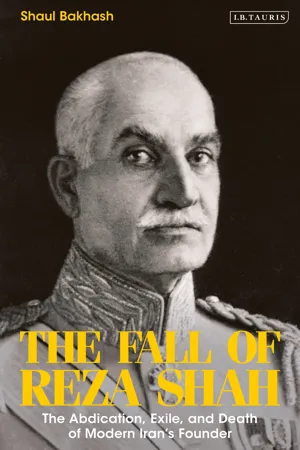
The Fall of Reza Shah
The Abdication, Exile, and Death of Modern Iran’s Founder
- 184 pages
- English
- ePUB (mobile friendly)
- Available on iOS & Android
eBook - ePub
About this book
Information
1
Soldier and King, Reformer and Autocrat
At the turn of the Iranian New Year in March 1941, Reza Shah, the autocratic ruler of Iran for sixteen years and the virtual master of Iran for even longer—twenty years—could look back with some satisfaction at what he had already accomplished: nothing less than the transformation of his country. Yet, ever restless, he was pushing for more—more modern factories, more railroad lines, more paved roads, more electrification, more equipment for his beloved army. The one cloud on the horizon was the war raging in Europe; but by declaring Iran’s neutrality, he believed he had protected Iran from entanglement in the conflict and its ravages. In this, he gravely misjudged what lay ahead for his country and for himself.
Reza Shah’s rise to the pinnacle of power in Iran had been stunning. Born in 1876 or 1877 to a family of modest means, he grew up in Alasht, a small village nestled on the slopes of the Alborz Mountains north of Tehran. His father, who had served as an officer in the Qajar army, died when Reza was still an infant. He was raised by his mother, a woman whose family had immigrated to Iran from the Caucasus. She was helped by an uncle then serving in the Cossack Brigade. The brigade was a Russian-trained, Russian-officered outfit of about three thousand men, established in 1878 and the only effective military force in the country. Reza joined the Cossacks in his early teens and rose rapidly through the ranks. By age 40, Reza Khan, as he was then known, was commander of the Hamadan otryad (detachment) of the Cossacks.
He took part in a number of campaigns against unruly tribes and, later, local breakaway movements. It was in this period that he grew acutely aware of the unhappy state of his country.
The Iran Reza Khan would take over in 1921 was in a state of disorder and decline. The problems were legion. The young Ahmad Shah Qajar was inexperienced, timorous, greedy for money, and always impatient to leave Iran, preferring the pleasures of Paris to the drabness of Tehran. The central government was weak, and the large tribal areas were beyond its control. The leading politicians running the government and ministries were divided and ineffective; six cabinets changed hands in a brief nineteen-month period. Revenues were inadequate to meet even basic expenses, and the government relied on British subsidies both to keep the government going and to pay and maintain the Cossack Brigade. Plans to establish a national army had gone nowhere, despite the assignment of British advisers and the injection of British money.
Russian officers commanding the Cossack Brigade often acted in the interests of their own government, not in the interest of Iran. Aside from the Cossack Brigade and a small Central Brigade stationed in the capital, Iran had no military forces to speak of. The Cossack Brigade, as noted, was Russian-officered; the gendarmerie, a force charged with maintaining internal order in the countryside, was Swedish-officered. Its pay was often in arrears; the men were ill-clothed and ill-equipped and, according to a British diplomat, by 1920 the gendarmerie had practically “ceased to exist.” Reviewing the men of the Cossack Brigade in October 1920, the new British commander of British forces in Iran, General Edmund Ironside, found even the men of this favored unit to be “in a pitiable condition.” Both officers and men lacked winter clothing; many lacked boots and had wrapped their feet in sacking.11 The roads between major cities were unsafe for travelers or the transport of goods.
Iran’s great power neighbors, Britain and Russia, interfered in internal affairs, including, in the case of Britain, in the making and unmaking of cabinets and the selection of the prime minister. During the First World War, the government proved unable to prevent British, Russian (then Bolshevik), and, briefly, Ottoman troops from using Iranian territory to pursue their own strategic interests. The British established the South Persia Rifles (SPR) to maintain order and protect British interests in the south; the East Persia Cordon to guard the approaches to India against incursions from Central Asia; and the North Persia Force (Norperforce), with headquarters in Qazvin, just north of the capital, to guard against possible Bolshevik intrusions from the Caucasus and to keep secure the border area and roads leading from Iraq to Iran. Only in the case of the SPR had the British bothered to secure the Iranian government’s formal (and very grudging) agreement. The turmoil of the Russian revolution spilled over into Iran. When the White Russian officer Anton Denikin fled with his ships to take refuge in the Iranian port of Enzeli in the spring of 1921, Bolshevik forces attacked and occupied the port. Fear of a full-scale Bolshevik invasion was widespread; and Europeans were already fleeing the capital. In brief, Iran was not master of its own fate.
Domestic forces also threatened the central government. A rebel with radical leanings, Mirza Kuchik Khan, had raised the banner of rebellion in the city of Rasht. He wrote an admiring letter to Lenin, received Bolshevik assistance, declared a “soviet republic” in the whole of the province of Gilan, and threatened to spread his movement across the entire Caspian littoral. In the northeastern province of Azarbaijan, Mohammad Khiabani, a socialist, a nationalist, and a former member of the Majlis, or Parliament, seized control of the provincial capital, Tabriz, renamed the province Azadistan (the land of freedom), and, before he was defeated and killed, progressed from advocating provincial autonomy to flirting with separation from Iran. In Khorasan, in northwestern Iran, a gendarmerie officer, Mohammad Taqi Pesyan, also rebelled against the central government.
Corruption was widespread. Provincial governors squeezed the peasants to recoup the money they had paid the shah and officials to secure their appointments. Funds the British had advanced to maintain the Cossack Brigade went into the pockets of the shah and the brigade’s Russian officers. The officers skimmed the pay of the soldiers to line their own pockets and to share with politicians in Tehran, and the commanding officer kept on the books one thousand men who received pay but did not exist.2 A particularly striking example of the depth of corruption was the negotiation leading to the Anglo-Persian Agreement of 1919.
The agreement, the brainchild of the British foreign secretary, Lord Curzon, and his minister in Tehran, Percy Cox, envisaged extensive involvement of England in the affairs of Iran. The British were to appoint advisors with wide powers to reorganize the finances and revamp virtually all major government departments. Military advisers would help train and equip a proper military force, and a £2,000,000 British loan would help finance economic development and railway and other transportation projects. Britain’s chosen instrument on the Iranian side to form a government friendly to Britain and to negotiate, conclude, and implement such an agreement was Hassan Vosuq, a prominent politician who believed Iran’s interests were best served by a close alliance with Britain.
To agree to appoint Vosuq as prime minister, Ahmad Shah demanded and received from Britain a payment of 15,000 tomans a month (amounting to about £48,000 a year) for as long as he kept Vosuq in office. When the agreement was finalized, to approve the agreement, Ahmad Shah demanded the continuation for life of the subsidy he was receiving from England and additional British guarantees for himself and his dynasty (the British agreed to pay the subsidy for only so long as Vosuq remained prime minister). Meantime, Vosuq and the two cabinet ministers who had negotiated the agreement with Cox asked for an “advance” of £200,000 on the British loan—money they said they needed to win support for the agreement from members of Parliament and other officials. There was no question in the minds of Curzon, Cox, and British officials who agreed to pay this sum that they were being asked for a bribe. In fact, Vosuq shared the “advance” with his two ministers. (When details of the agreement and the bribe money became public, it predictably proved highly unpopular and parliamentary approval impossible to secure. Eventually, a new Iranian government cancelled it in 1921.)3
By 1920, feeling was widespread among politically aware Iranians that something fundamental had to be done: Iran needed an army capable of protecting the country’s borders and bringing unruly tribes to heel; and it needed a strong central government that would end the chaos, undertake fundamental reforms, revive the economy, and inculcate among the people a sense of national unity and purpose. Members of the political elite met, sometimes openly, sometimes in private, to ponder means of bringing a strong government to office. A number were in touch with British diplomats in Tehran who were thinking along the same lines. Among these was Seyyed Zia ad-Din Tabataba’i, a journalist and political activist with high ambitions. He was on friendly terms with British diplomats in Tehran and often served as intermediary between the legation and Iranian politicians. His newspaper, Ra’ad, advocated a range of sweeping reforms. The Pulad (Steel) Committee he founded and led brought together intellectuals, reform-minded politicians, and gendarmerie officers for discussions on means to cure the nation’s ills. He had big plans and ideas; what he lacked were the means to realize them.
We can only guess at Reza Khan’s state of mind at this critical moment in Iran’s modern history; but he was certainly touched by these same currents. He had grown contemptuous of the politicians in Tehran who talked endlessly but took no action, and who enriched themselves in office while the soldiers who fought for the country went barefoot. He resented the fact that his own Cossack Brigade was officered by Russians. Judging by his policies when finally in power, we can conclude that he was aware that Iran had fallen behind the West. He later wrote that he found himself “sunk in grief” at prevailing conditions.4 He was eager to do something for his country; and an unanticipated turn of events gave him the opportunity.
The Russian revolution had broken the link between the Cossack Brigade’s Russian officers and the Russian government, allowing the British to achieve their long-sought goal and to rid the brigade of its Russians. The shah agreed to send home the Russian commander and officers of the brigade. The brigade was now effectively in the hands of General Ironside and the British military adviser, Col. C. D. Smythe. Their attention had been drawn to the men under Reza Khan’s command. Unlike troops in other detachments, the men were cheery, their training was advanced, and they went about their duties with energy. Reza Khan, too, impressed them: a well-built man, over 6 feet tall, with piercing eyes, self-assured, and with a commanding presence. He appears to have spoken openly to Ironside about his ambitions for Iran. The shah had appointed a feckless royal prince with no military experience as the brigade’s commander; but before withdrawing from Iran with his British troops in February 1921, Ironside, with the shah’s approval, had placed effective command of the brigade in Reza Khan’s hands.5 Reza Khan was now in control of the only real military force in the country.
The Coup
At a moment when the air was full of rumors of impending change and the country appeared on the edge of a major upheaval, intermediaries brought Seyyed Zia and Reza Khan together: the ambitious political activist and schemer, who had political connections but no power, and the soldier who had few political connections but troops under his command had joined hands. On the night of February 20, 1921, Reza Khan, with Seyyed Zia at his side, marched the Cossacks into the capital and occupied it with virtually no resistance. A thoroughly frightened Ahmad Shah agreed to name Seyyed Zia prime minister and Reza Khan commander of the armed forces, with the title of Sardar-e Sepah.
The two men came to office with ideas for sweeping reform—in effect the rejuvenation of Iran: to end corruption, internal divisions, and foreign interference; to create a strong government and army; to revive the economy; and to bring Iran into the modern world. In their first steps, they arrested some twenty prominent notables, in part to squeeze them for money to help finance government operations; they cancelled the still unratified Anglo-Persian Agreement; and they concluded an agreement with the new Soviet government. In exchange for an undertaking not to allow any foreign forces hostile to the Soviet Union to establish military bases on Iranian soil, the Soviet government cancelled all the privileges and concessions (except for the fisheries concession) Tsarist Russia had acquired in Iran and all debts Iran owed to Russia. Seyyed Zia, however, did not survive politically to carry out the rest of the duumvirate’s ambitious program. Reza Khan had his own plans, wanted power in his hands alone, and, of the two men, proved to be the firmer of purpose and the more skillful politician. Within three months, he had become war minister and had forced Seyyed Zia into exile; two years later, he was prime minister; and Ahmad Shah, thoroughly cowed by Reza Khan’s rising power, left for Europe never to return.
With the shah out of the way, the men around Reza Khan, no doubt with his concurrence, launched a campaign for the declaration of a republic with Reza Khan as president. They were inspired by the example of another military man, Kemal Ataturk in neighboring Turkey, who in 1922 had abolished the Ottoman sultanate, established a republic, and, as president, was energetically transforming his country in a program of modernization, Westernization, and reform. Republicanism and Kemalism, however, did not sit well with Iran’s senior clergy. Along with the sultanate, Ataturk had also abolished the Ottoman caliphate; he was not only modernizing but also secularizing his country. Faced with adamant clerical opposition, and after a meeting with the senior clergy in the shrine city of Qum, Reza Khan asked his followers to end all talk of a republic. Yet, Reza Khan was already the undisputed master of Iran; to the political class he had become indispensable for maintaining order and effective government. When he resigned as prime minister in April 1923 and retired to the village of Rudehen outside Tehran, the result, according to the historian, L. P. Elwell-Sutton, “was panic.”6 The Majlis voted overwhelmingly to ask him to return and sent a high-powered delegation to persuade him to do so. In October 1925, the Parliament passed a bill deposing the Qajar dynasty and appointing Reza Khan temporary head of state. In December, a constituent assembly, packed with Reza Khan’s supporters, voted to amend the constitution and to vest the monarchy in Reza Shah and his descendants. He was crowned shah in April 1926.
In the two decades that followed the 1921 coup, as military strongman, prime minister, and king, Reza Khan/Reza Shah reshaped Iran in myriad ways. He did not do so alone. He attracted and recruited into his service a number of highly capable men who shared with him the desire to turn Iran into a modern nation-state. The ideas that shaped the extensive reforms that these men carried out were already current among the Westernized intelligentsia, and were echoed in articles in the reformist press and in the programs of the reformist political parties.
In brief, the reformers believed Iran needed to bring into being a strong, well-organized state, a strong army, and a merit-based, modern bureaucracy—to expand commerce, build factories, lift its peasants out of poverty, and put in place a progressive income tax. It needed to educate its children, including girls, and to improve the status of women. Some intellectuals, impressed by the role women played in European societies, advocated for the abolition of the veil. Anti-clericalism—a conviction that the clergy, with their fixation on shari’a law, traditionalism, and superstition, constituted a major obstacle to reform—constituted a strong undercurrent in reformist thought. “The corruption existing in Iran is entirely the fault of the clergy,” asserted the newspaper, Rastakhiz.7
Also widespread was the conviction that Iran’s maladies were rooted in its tribal, ethnic, sectarian, linguistic, and communal divisions. Iranians were divided into tribes as Turks, Kurds, Arabs, Qashqa’is, and Lurs; each of these groups wore a different headdress and costume; each spoke its own language. Iranians were most likely to identify themselves by their regional backgrounds, as Isfahanis, Shirazis, or Azarbaijanis, rather than as Iranians. Many spoke a local dialect rather than pure Persian. So went the argument. According to the intellectual and historian, Ahmad Kasravi, such divisions accounted for Iran’s backwardness and weakness; and the Constitutional Revolution of 1906 itself was wrecked on the rocks of this fragmentation. “The worst calamity that can befall a nation is disunity … Factionalism is one of the worst maladies afflicting Iran,” he wrote.8 Iran needed to inculcate in its people the same nation-state sentiments that helped create modern Italy, Germany, and Poland, wrote the newspaper Ayandeh;9 Iranians needed to be forged into a nation, and this required the instruction of all Iranians in the Persian language and its history and culture, the eradication of tribal and regional costumes, and the replacement of non-Persian with Persian terms and place names. Deeply nationalistic, the men around Reza Shah were also Westernizers. Iran had fallen behind the advanced nations of Europe; and it had to be transformed, and where appropriate, on the European model. They believed that the state must be the instrument by which Iran could be transformed into a modern country; and once in power, it was through the government—by extending the reach of the state into the furthest corners of the country and even into the private lives of Iranians—that Reza Shah and his lieutenants sought to achieve their goals.
A striking number of the men drawn to Reza Khan and the later Reza Shah had studied in the West; some came from clerical backgrounds but had abandoned clerical studies and family traditions to study abroad; others had played a role in the Constitutional Revolution and now saw an opportunity to realize, through Reza Khan and then Reza Shah, the disappointed hopes of the constitutionalists. That such individuals were drawn to, supported, and served a military man who, from the start, displayed strong authoritarian tendencies is not difficult to explain. By 1920, internal weakness, a failed political system, and disappointed hopes had led many to conclude that Iran nee...
Table of contents
- Cover
- Half-title Page
- Dedication Page
- Title Page
- Contents
- Acknowledgments
- 1 Soldier and King, Reformer and Autocrat
- 2 Britain and the Abdication of Reza Shah
- 3 “Dear Anthony,” “Dear Leo”: Britain’s Quixotic Flirtation with Dynastic Change
- 4 The Journey into Exile
- 5 Mauritius: “This Is a Prison … a Death in Life”
- 6 Johannesburg and the Death of Reza Shah
- 7 Wrapping Up
- 8 “Where Do I Go without Money?” Reza Shah’s Finances in Exile
- 9 “A Matter of Political Expediency”: The Settlement of Reza Shah’s Estate
- A Brief Epilogue
- Notes
- Bibliography
- Index
- Copyright Page
Trusted by 375,005 students
Access to over 1.5 million titles for a fair monthly price.
Study more efficiently using our study tools.
Frequently asked questions
Yes, you can cancel anytime from the Subscription tab in your account settings on the Perlego website. Your subscription will stay active until the end of your current billing period. Learn how to cancel your subscription
No, books cannot be downloaded as external files, such as PDFs, for use outside of Perlego. However, you can download books within the Perlego app for offline reading on mobile or tablet. Learn how to download books offline
Perlego offers two plans: Essential and Complete
- Essential is ideal for learners and professionals who enjoy exploring a wide range of subjects. Access the Essential Library with 800,000+ trusted titles and best-sellers across business, personal growth, and the humanities. Includes unlimited reading time and Standard Read Aloud voice.
- Complete: Perfect for advanced learners and researchers needing full, unrestricted access. Unlock 1.5M+ books across hundreds of subjects, including academic and specialized titles. The Complete Plan also includes advanced features like Premium Read Aloud and Research Assistant.
We are an online textbook subscription service, where you can get access to an entire online library for less than the price of a single book per month. With over 1.5 million books across 990+ topics, we’ve got you covered! Learn about our mission
Look out for the read-aloud symbol on your next book to see if you can listen to it. The read-aloud tool reads text aloud for you, highlighting the text as it is being read. You can pause it, speed it up and slow it down. Learn more about Read Aloud
Yes! You can use the Perlego app on both iOS and Android devices to read anytime, anywhere — even offline. Perfect for commutes or when you’re on the go.
Please note we cannot support devices running on iOS 13 and Android 7 or earlier. Learn more about using the app
Please note we cannot support devices running on iOS 13 and Android 7 or earlier. Learn more about using the app
Yes, you can access The Fall of Reza Shah by Shaul Bakhash in PDF and/or ePUB format, as well as other popular books in History & Political Biographies. We have over 1.5 million books available in our catalogue for you to explore.