This Handbook covers a wide range of historical perspectives, realities, research and practice of internationalization of higher education (IHE) in the global south and makes comparisons to IHE issues in the global north. Drawing on the expertise of 32 academics and policy makers based in and originating from four key regions of focus: Sub-Saharan Africa; North Africa and the Middle East; Asia Pacific; Latin America and the Caribbean. Across 24 chapters the editors and contributors provide a diverse and unparalleled expose of the status and future aspirations of institutions and nations in relation to IHE. This is the first comprehensive analysis of this growing field and expands the scope of research in the field of comparative and international education in terms of theory and policy development.
Includes 36 chapters written by: Hadiza Kere Abdulrahman, Salem Abodher, Giovanni Anzola-Pardo, Aref Al Attari, Norzaini Azman, Teklu Abate Bekele, Abdellah Benahnia, Andrés Bernasconi, Daniela Craciun, Hans de Wit, Futao Huang, Jocelyne Gacel-Ávila, Evelyn Chiyevo Garwe, Javier González, Gifty Oforiwaa Gyamera, Xiao HAN, Mohamed Salah Harzallah, Bola Ibrahim, Annette Insanally, Sunwoong Kim, Aliya Kuzhabekov, Kamel Mansi, Simon McGrath, Francisco Marmolejo, Georgiana Mihut, Sabelo J. Ndlovu-Gatsheni, Ibrahim Ogachi Oanda, Bandele Olusola Oyewole, Rakgadi Phatlane, Francisca Puyol, Laura E. Rumbley, Chika T Sehoole, Wenqin SHEN, Luz Inmaculada Madera Soriano, Wondwosen Tamrat, Juliet Thondhlana, Julie Vardhan, Chang Da Wan, Anthony Welch, Ayenachew A. Woldegiyorgis, Renée Zicman.
eBook - ePub
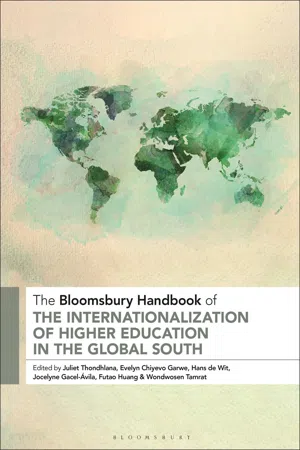
The Bloomsbury Handbook of the Internationalization of Higher Education in the Global South
- 664 pages
- English
- ePUB (mobile friendly)
- Available on iOS & Android
eBook - ePub
The Bloomsbury Handbook of the Internationalization of Higher Education in the Global South
About this book
Information
CHAPTER ONE
Introduction
Internationalization of Higher Education in the Global South: Setting the Scene
JULIET THONDHLANA, EVELYN C. GARWE, AND HANS DE WIT
RATIONALE
This introduction presents an overview of the key concepts discussed in the chapters to follow. This edited handbook, compiled by a unique team of established and emerging experts, gives a comprehensive account of internationalization of higher education (IHE) in the Global South, including some virgin contexts not commonly found in the literature. It responds to the urgent and emerging call for solutions on sustainable internationalization of higher education (IHE) that go beyond the traditional Western models (e.g., de Wit, Gacel-Ávila, Jones, and Jooste, 2017; Proctor and Rumbley, 2018).
Internationalization per se is not a completely new concept, but as a strategic dimension (De Wit, 1995, 2015; Delgado-Márquez, Hurtado-Torres, and Bondar, 2011; Vavrus and Pekol, 2015) it has taken the higher education fraternity by storm while gaining recognition as a critical tool for fostering sustainable national and international development through producing quality globally competent human capital (Hunter et al., 2006). Internationalization has varying socio-economic, cultural, and technological impacts depending on context (Maringe, Foskett, and Woodfield, 2013), as well as political, economic, social-cultural, and academic rationales (de Wit, 2002).
This way it has effectively transformed its conceptual framework, scope, magnitude, and significance, and redefined international relationships (Alemu, 2014). Accordingly, the ability of a higher education institution (HEI) to internationalize its campuses, curriculum, and activities has become a key measure of the institution’s success and competitiveness locally and globally (Green and Schoenberg, 2006).
Within the context of the Global South, it can be said that this supposedly “new” IHE concept is in actual fact as old as its dominant higher education systems. “International” characteristics have always been evident in higher education since the Middle Ages (de Wit, 2002; Zeleza, 2005) in terms of intellectual mobility and its local genesis, and one of the key characteristics has been the export of higher education systems from the North to the colonies in the South. As a result, the tension or duality between local and international is even more evident in nations that have a history of colonialism, some of which are subjects of study in the handbook. In response to this tension, De Wit (2013) argues that while it is true that universities have always been international, operating within a broader international community of HEIs, academics, and research, the realities of the twenty-first century have brought internationalization to the fore, in the Global North but increasingly also in the Global South context.
This handbook therefore sheds more light on IHE developments and trends from multiple perspectives focusing on a wider range of contexts from the four Global South regions, namely: Asia Pacific; Latin America and the Caribbean (LAC); North Africa and the Middle East; and Sub-Saharan Africa (SSA). In addition to focusing on the understandings, puzzles, policies, agendas, challenges, strategies, specific activities, processes, and outcomes of IHE, the authors also critically explore the broader historical and socio-political contexts, methodological developments, and forces shaping internationalization in the context of theoretical as well as regional and international IHE developments and frameworks. This is premised on the fact that such contexts influence the opportunities available for students’ and faculties’ participation in international programs and the development of internationalization strategies and policies (Vavrus and Pekol, 2015). It will make it possible to draw informative comparisons across regions and nations as well as the Global North in a way that enables a more holistic understanding of the complexities driving as well as generated by internationalization. It will also provide a roadmap for future direction in this context.
A BRIEF UNPACKING OF THE INTERNATIONALIZATION OF HIGHER EDUCATION
Internationalization refers to the symbiotic inter-relationships that exist amongst nations towards the achievement of quality in higher education. There is generally no consensus on the definition of internationalization with different people, describing it in differing ways depending on their contexts (e.g., van der Wende, 2001). The various definitions are based on activity, competency, ethos, and process perspectives. Knight (2004) used five lenses to define IHE, namely: programs, rationales, ad hoc, policies, and strategy approaches. Most IHE literature uses this definition by Knight (2004: 11), which sees internationalization occurring abroad or at home as “the process of integrating an international, intercultural, and global dimension into the purpose, functions (teaching, research and service) and the delivery of higher education.”
Internationalization involves cross-border physical and virtual interactions between academics, students, academic programs and providers; partnerships and collaborative ventures for teaching, learning, and research in the following domains:
1.Outbound and inbound student mobility
2.Academic staff mobility
3.International collaborative research, conferences, and journals
4.Institutional linkages
5.International presence/Cross border education/International branch campus
6.Internationalization at home and of the curriculum
7.Regional and local connectivity
8.Ranking
9.National policies for internationalization
10.Curriculum/educational program.
Internationalization is also viewed as a transformative phenomenon which is moving key stakeholders including academic institutions and policymakers to adjust their frames of references and policies in response to the demands of the phenomenon. This is evidenced in the preoccupation with incorporating internationalization elements into policy and strategic documents at various levels including institutional, national, and regional (Rumbley, Altbach, and Reisberg, 2012).
The motivations behind IHE for institutions and nations also vary widely (de Wit, 2002; Knight, 2004) and have been reported to change with the passage of time (Luijten-Lub, 2007) but largely fall into interconnected variations of academic, socio-economic, political, and cultural intentions (de Wit, 2002; Knight, 2004). Existing literature, largely from the Global North, mentions rationales relating to inter alia: international academic standards of research and teaching, institutional and national human resource development, strategic alliances, technical assistance, resource mobilization, socio-economic growth, and competitiveness (Knight, 2008).
Studies have noted, though, that these understandings are not always put into practice. While internationalization may now highly feature as a priority on strategies of HEIs that may also have elaborate internationalization strategies and structures in place, these may not always translate into practice (Warwick and Moogan, 2013). There is, however, a clear acknowledgement that internationalization extends beyond mere student recruitment; it is a complex and continuous process, which includes curriculum development, staff capacitation, teaching and learning, teaching and research collaborations, staff–student exchanges, support services, and much more. The focus in some contexts of the Global North, for example, seems to continue to be very much on student recruitment (Warwick and Moogan, 2013). In their study of UK institutions, Warwick and Moogan (2013) observed that few universities have attempted to internationalize their curricula to match discourses of international experiences and student mobility. While some universities may sell internationalization on their websites and with other marketing tools, their staff may have no idea about their institutional strategy and what their responsibilities and obligations will be in the implementation of the strategy. In addition, institutions themselves may lack the necessary resources to develop their staff for the purpose, and the funding to provide appropriate support for the increasing international student numbers (e.g., language support).
Internationalization of the curriculum expert, Betty Leask (2015), has argued that what is needed is not a globalized curriculum (which privileges dominant knowledges and groups), but one that would enable the development in all students (both foreign and home), of the critical attitudes, knowledge, and skills needed to empower them to effectively make a living as well as contribute to development in a fast changing and increasingly complex and interconnected global community. This buttresses Knight’s (2008) claim that how this is achieved will differ depending on particular features of diverse contexts including disciplinary, institutional, regional, national, and other contexts in which students may find themselves (Leask, 2015). These considerations show that internationalization is fraught with challenges and complexities that require particular understandings, appropriate strategic approaches, and commitment at all relevant levels.
In this handbook our understanding of internationalization of higher education, including its definition, genesis, and evolution as a concept is aptly discussed by Hans de Wit in Chapter 2 and will thus not be explored in much detail here. In that thematic chapter, de Wit importantly observes that more countries across the globe are increasingly engaging in internationalizing their academic practices, leading to the emergence of new voices and perspectives of the concept as new players come onto the scene. He calls for the revisiting of internationalization as a concept to accommodate emerging and new understandings of the concept and suggests that a more inclusive updated definition might be:
The intentional process of integrating an international, intercultural or global dimension into the purpose, functions and delivery of post-secondary education, in order to enhance the quality of education and research for all students and staff and to make a meaningful contribution to society.
—de Wit, Hunter, Howard, and Egron Polak, 2015: 29
In Chapter 3, de Wit et al. highlight the critical need to go beyond seeing internationalization as a by-product of globalization but rather as a planned activity requiring national involvement in steering the process. This is more aptly demonstrated in the findings of Crăciun’s (2018) National Tertiary Education Internationalization Strategies and Policies (NTEISPs) survey, presented by de Wit et al. As shown, the typology of NTEISPs is drawn from case studies and can form the basis of harmonization at various levels including institutional, national, regional, and global. Not surprisingly the issue of national policy is an important subject for some of the chapters in this handbook. However a more inclusive typology requires the study and inclusion of diverse case types. The NTEISPs typology presented by de Wit et al. presents a good starting point that future studies can continue to build on. What clearly emerges is that the need for a more global understanding of internationalization including the nature of South–South and North–South collaborations cannot be emphasized enough.
Internationalization of higher education literature reveals that, although there exists great variation with respect to the drivers, mix of activities, and extent of engagement across institutions globally, the impact of internationalization is increasingly becoming more noticeable at the local level. Internationalization activities are dominated by international mobility of students, staff, and programs, but internation...
Table of contents
- Cover
- Half-Title Page
- Series Page
- Title Page
- Contents
- List of Figures
- List of Tables
- 1 Introduction: Internationalization of Higher Education in the Global South: Setting the Scene
- Thematic Chapters
- 2 Internationalization in Higher Education: The Challenging Road from a Western Paradigm to a Global and Inclusive Concept
- 3 International Mapping of National Tertiary Education Internationalization Strategies and Plans (NTEISPs)
- Section I: Asia Pacific
- 4 Introduction to Asia Pacific Chapters
- 5 Internationalization in China’s Higher Education: Trends, Achievements, and Challenges
- 6 Internationalization of Japan’s Higher Education
- 7 Internationalization of Korean Higher Education (1945–2018): A Success Story
- 8 Internationalization as a Mechanism of Higher Education Modernization in Kazakhstan
- 9 The Rhetoric and Reality of Malaysian Higher Education Internationalization Policy and Its Strategic Initiatives
- 10 Internationalization of Indian Higher Education: Aligning with the Mission of Knowledge Enhancement
- 11 Conclusion: The Shift to the East, and the Changing Face of Internationalization
- Section II: Latin America and the Caribbean
- 12 Introduction: Higher Education, Internationalization, and Integration in Latin America and the Caribbean
- 13 Internationalization of Higher Education in Brazil
- 14 Internationalization of Higher Education in the Caribbean
- 15 Internationalization of Chilean Higher Education: Research, Innovation, and Human Capital Formation in a Globalized Era
- 16 Colombian Higher Education Internationalization and Social Sustainable Development: From Meaning to Practice
- 17 Internationalization of Higher Education in Mexico: An Unfinished Agenda
- 18 Conclusion: Latin America and the Caribbean Internationalization Process: Main Achievements and Shortcomings
- Section III: North Africa and the Middle East
- 19 Introduction to MENA Chapters
- 20 Internationalization of Higher Education in the GCC Region: Emerging Patterns and Challenges
- 21 Higher Education in Jordan: At the Confluence of Nationalization and Internationalization
- 22 Internationalization and Globalization in Libyan Higher Education
- 23 Internationalization of Higher Education in Morocco: Current Processes, Practices, and Challenges
- 24 Internationalization of Higher Education in Egypt: Modalities and Policy Provisions
- 25 The Internationalization of Higher Education in Tunisia: Bridging Gaps and Cross-border Cooperation
- 26 Internationalization of Higher Education in Palestine
- 27 Conclusion: Enhancing Outcomes through Internationalization: An Overview of the Higher Education Sector in the MENA Region
- Section IV: Sub-Saharan Africa
- 28 Introduction: Internationalization of Higher Education in Sub-Saharan Africa
- 29 Internationalization of Higher Education in Ethiopia: From a Fragmented Dispensation to a Cohesive Path
- 30 Two Decades of Internationalizing Higher Education in South Africa
- 31 Internationalization of Higher Education in Zimbabwe
- 32 Internationalizing Higher Education: An Exploratory Analysis of Policy Frameworks, Challenges, and Opportunities
- 33 Accounting for Internationalization in Kenya’s Higher Education System
- 34 The Internationalization of Higher Education in Nigeria
- 35 Conclusion: The State of Internationalization of Higher Education in Sub-Saharan Africa
- 36 Salient Issues in the Internationalization of Higher Education in The Global South: Concluding Observations
- Notes on Contributors
- Index
- Copyright
Trusted by 375,005 students
Access to over 1.5 million titles for a fair monthly price.
Study more efficiently using our study tools.
Frequently asked questions
Yes, you can cancel anytime from the Subscription tab in your account settings on the Perlego website. Your subscription will stay active until the end of your current billing period. Learn how to cancel your subscription
No, books cannot be downloaded as external files, such as PDFs, for use outside of Perlego. However, you can download books within the Perlego app for offline reading on mobile or tablet. Learn how to download books offline
Perlego offers two plans: Essential and Complete
- Essential is ideal for learners and professionals who enjoy exploring a wide range of subjects. Access the Essential Library with 800,000+ trusted titles and best-sellers across business, personal growth, and the humanities. Includes unlimited reading time and Standard Read Aloud voice.
- Complete: Perfect for advanced learners and researchers needing full, unrestricted access. Unlock 1.5M+ books across hundreds of subjects, including academic and specialized titles. The Complete Plan also includes advanced features like Premium Read Aloud and Research Assistant.
We are an online textbook subscription service, where you can get access to an entire online library for less than the price of a single book per month. With over 1.5 million books across 990+ topics, we’ve got you covered! Learn about our mission
Look out for the read-aloud symbol on your next book to see if you can listen to it. The read-aloud tool reads text aloud for you, highlighting the text as it is being read. You can pause it, speed it up and slow it down. Learn more about Read Aloud
Yes! You can use the Perlego app on both iOS and Android devices to read anytime, anywhere — even offline. Perfect for commutes or when you’re on the go.
Please note we cannot support devices running on iOS 13 and Android 7 or earlier. Learn more about using the app
Please note we cannot support devices running on iOS 13 and Android 7 or earlier. Learn more about using the app
Yes, you can access The Bloomsbury Handbook of the Internationalization of Higher Education in the Global South by Juliet Thondhlana, Evelyn Chiyevo Garwe, Hans de Wit, Jocelyne Gacel-Ávila, Futao Huang, Wondwosen Tamrat, Juliet Thondhlana,Evelyn Chiyevo Garwe,Hans de Wit,Jocelyne Gacel-Ávila,Futao Huang,Wondwosen Tamrat in PDF and/or ePUB format, as well as other popular books in Didattica & Didattica comparata. We have over 1.5 million books available in our catalogue for you to explore.