Winner of the 2022 CHOICE Outstanding Academic Titles
Samizdat, the production and circulation of texts outside official channels, was an integral part of life in the final decades of the Soviet Union. But as Josephine von Zitzewitz explains, while much is known about the texts themselves, little is available on the complex communities and cultures that existed around them due to their necessarily secretive, and sometimes dissident, nature.
By analysing the behaviours of different actors involved in Samizdat – readers, typists, librarians and the editors of periodicals in 1970s Leningrad, The Culture of Samizdat fills this lacuna in Soviet history scholarship. Crucially, as well as providing new insight into Samizdat texts, the book makes use of oral and written testimonies to examine the role of Samizdat activists and employs an interdisciplinary theoretical approach drawing on both the sociology of reading and book history. In doing so, von Zitzewitz uncovers the importance of 'middlemen' for Samizdat culture.
Diligently researched and engagingly written, this book will be of great value to scholars of Soviet cultural history and Russian literary studies alike.
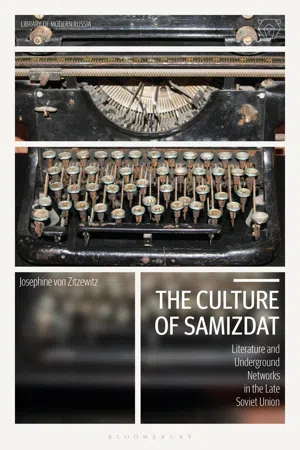
eBook - ePub
The Culture of Samizdat
Literature and Underground Networks in the Late Soviet Union
- 264 pages
- English
- ePUB (mobile friendly)
- Available on iOS & Android
eBook - ePub
The Culture of Samizdat
Literature and Underground Networks in the Late Soviet Union
About this book
Information
1
Samizdat: A culture of readers and networks
What was samizdat?
Samizdat developed in the second half of the 1950s on the crest of the poetry boom that saw newly famous poets such as Evgenii Evtushenko perform to full stadiums. Enthusiasm for poetry inspired cultural initiatives that were organized by interested citizens rather than any official structure, such as the weekly gatherings on Mayakovsky Square from 1958 onwards, where large groups of young people would read poetry out loud. In the centrally organized Soviet cultural sphere that had just emerged from Stalinism, such spontaneous initiatives were a novelty.
Poets who came onto the scene after Stalin’s death, such as Evtushenko, Andrei Voznesenskii, Bella Akhmadulina, Robert Rozhdestvenskii and others, represented one group that captured the attention of the reading public. Another such group were the poets of the Silver Age who had been popular in the years preceding the 1917 revolution. In many cases their work had not been republished under Soviet rule, and some, notably Anna Akhmatova, Osip Mandelshtam and the returned émigré Marina Tsvetaeva, produced a significant body of work after the revolution that was never available in print. Silver Age texts re-emerged slowly during the late 1950s and 1960s; they had a huge influence on reading tastes and ultimately on the writing techniques of new poets.1 New official editions notwithstanding – and such editions were always selective – Silver Age poets were not widely published. Readers who had access to their texts – for example because they owned pre-revolutionary editions – would copy out poems, frequently by hand, and share them with their acquaintances. Samizdat was born. This process is described in many written first-hand accounts, and the respondents to our online survey of samizdat readers, discussed in detail in Chapter 2, confirm its basic mechanics. Respondent #22 (b.1976) remembers that ‘my first [samizdat] texts were my mum’s handwritten copies of Esenin’s poetry’.2 One respondent dutifully recorded the characteristic mixture of old and new poetry: ‘A lot of poetry was circulating. People were copying Tsvetaeva, by hand, from the books published in tiny print runs in the 1920s, and [Nikolai] Gumilev, but also [Naum] Korzhavin and [Joseph] Brodsky. I myself copied little, but provided many texts for people to copy.’3
The term ‘samizdat’ became attached to this phenomenon in the 1960s, but it predates the mass practice of circulating texts in this way. Its origin is commonly attributed to Nikolai Glazkov who, as early as the 1940s, would give self-bound typescripts of his prose miniatures to his friends, adorned with the word samsebiaizdat (‘self-published’ or ‘self-publishing house’) in the place where you would expect to find the name of the publishing house. Samsebiaizdat was a pun on the abbreviated names of official publishing houses such as Litizdat (Literary Publishing House) or Gosizdat (State Publishing House).4 This means that samizdat was, from the very beginning, also an outlet for contemporary writers who could not, or did not try to, publish their texts in the official press. Some of the best-known Russian writers of the late twentieth century owe all, or most, of their reputation to samizdat. Among them are Alexander Solzhenitsyn (1918–2008) – whose Arkhipelag Gulag (The Gulag Archipelago, published in Paris in 1973) eclipsed the fame of the earlier, officially published Odin den’ Ivana Denisovicha (One Day in the Life of Ivan Denisovich, 1962) – and the poet Joseph Brodsky (1940–1996). Both are Nobel Prize winners. Others include Venedikt Erofeev (1938–1990), Elena Shvarts (1948–2010) and Dmitrii Alexanderovich Prigov (1940–2007).
From the mid-1960s onwards, samizdat began to include material relating to history, religion, politics, public affairs and other topics. The non-literary texts that made samizdat famous to an international audience were generated by the members of the growing human rights movement (known as ‘dissidents’) and included letters of protest and news items, including the periodical human rights bulletin Khronika tekushchikh sobytii (Chronicle of Current Events, 1968–1983). The Chronicle was smuggled out to the West and republished in English.5 Western radio stations, such as the BBC, Voice of America, Deutsche Welle and Radio Liberty (RL)/Radio Free Europe (RFE), the latter founded for the purpose of broadcasting to the Eastern bloc countries, broadcast such materials back to the Soviet Union, hugely increasing the audience for samizdat.6 Samizdat proper, that is – textual material produced inside the Soviet Union – was increasingly supplemented by texts published abroad and smuggled back into the Soviet Union, a practice known as tamizdat (published over there). Many iconic texts, including Solzhenitsyn’s novels and Brodsky’s poetry, were published abroad, often decades before the first Soviet or Russian editions.
Samizdat texts today
The texts circulated in samizdat have been scrupulously collected and, in many cases, reproduced in print form. By now, lesser-known literary texts and political writings have been collected, too. The following overview of sources is indicative, but does not make a claim to completeness.
Two major sources exist in both book form and online: Viacheslav Igrunov’s Antologiia samizdata (Anthology of Samizdat) is divided into sections for poetry, prose and social journalism (publitsistika).7 The section on unofficial poetry collected in Samizdat veka (The Samizdat of the Century) has been incorporated into the Russkaia virtual’naia biblioteka (Russian Virtual Library).8 The archives and records of Radio Liberty, which broadcast samizdat back to the Soviet Union, are at the Hoover Institution Library and Archives, with additional material held in the Open Society Archive at the Central European University in Budapest; many of the items of samizdat broadcast were made accessible online in 2016.9 Different branches of the Memorial Society hold extensive samizdat archives, many of them from private collections.10 The archive of the Forschungsstelle Osteuropa (Research Centre for East European Studies) at the University of Bremen holds a sizeable samizdat collection, sourced from private archives, alongside what might well be the largest existing collection of samizdat periodicals.11 The University of Toronto’s Project for the Study of Samizdat and Dissidence offers a database of Soviet samizdat periodicals, illustrated timelines of dissident movements, interviews with activists, and maps, attempting to render part of the process visible. Of particular value are the digital reproductions of samizdat periodicals, some of which have been made fully searchable.12 The Keston Center at Baylor University, Texas, now holds the archives of Keston College/the Keston Institute, an organization founded in the UK in 1969 with the aim of researching religion in communist societies; the Institute amassed a large amount of religious samizdat.13 The Tsentr Andreia Belogo (Andrei Belyi Centre) in St Petersburg is continuing to expand its digital archive of literary samizdat.14 The ImWerden project, which set itself the ambitious goal of becoming the online library of the RuNet, the Russian internet, maintains a special section for ‘Second Literature’: namely, texts not officially published in the Soviet Union; the collection is large and texts are downloadable.15 The now-defunct website of the International Samizdat Association published a list of archives holding samizdat collections.
Thus, if we consider samizdat to be merely a body of texts, the scholar or interested layperson will find plenty of sources. However, this is a reductive interpretation. Indeed, the question ‘What was samizdat?’ is hotly debated. A roundtable at the Memorial Society in 2014 asked researchers to consider precisely this question – ‘Chto takoe samizdat?’ (What is samizdat?).16 Contemporary research has evolved beyond the focus on samizdat as a sociopolitical phenomenon that is often fixated solely on the content transmitted by the texts. In the introduction to the essay collection Samizdat, Tamizdat and Beyond, editors Friederike Kind-Kovacs and Jessie Labov invite their contributors to ponder whether samizdat was a publishing practice, a reading practice, a set of texts, or a state of mind; the collection stresses the function of samizdat as a media form.17 The Russian historian Alexander Daniel calls samizdat a ‘mode of existence of the text’,18 while the historian and archivist Elena Strukova discusses its importance as a ‘memorial to book culture in the late 20th century’.19 The Canadian researcher Ann Komaromi, who runs the Project for the Study of Samizdat and Dissidence, asks whether samizdat was a medium, a genre, a corpus of texts, or a textual culture,20 an approach she developed further in her recent monograph.21 The Italian scholar Valentina Parisi has produced a richly illustrated volume focusing on the samizdat reader that considers literary and cultural theory alongside the paratextual aspects of samizdat periodicals.22
Moreover, there are several dedicated outlets and discussion forums for questions relating to samizdat: the Memorial Society publishes a biannual almanac, Acta Samizdatica: Zapiski o Samizdate (Acta Samizdatica: Notes on Samizdat), which includes new research alongside archival publications. There are several bespoke Facebook groups facilitating the exchange of information, including the International Samizdat [Research] Association community and the Samizdat group.23 This means that there is plenty of material available on the content transmitted by samizdat as well as on the material medium. Yet, surprisingly, little research has been conducted on the process of reading, and even less on the ordinary reader of samizdat. Or perhaps this should not come as a surprise, because the largest group involved in samizdat is notoriously difficult to research.
Samizdat readers
Are samizdat readers dissidents?
The literature – and public opinion, too – commonly understands samizdat as a function of ‘dissidence’, namely, the many forms in which different groups or individuals protested against the Soviet regime’s practices. This is true in one direction only: all dissidents were involved in samizdat, which provided them with alternative social and communication networks. Indeed, reading samizdat was often the first step towards dissidence. To put it differently, reading uncensored texts inspired ‘uncensored’, independent thought. For a significant minority, the next logical step was the writing and circulation of their own texts, and/or various forms of activism, from the dissemination of texts to the creation of entire samizdat periodicals. Some actions were more or less political, such as the letters intellectuals wrote to protest against the arrest, in 1965, of Andrei Siniavskii and Yulii Daniel for publishing abroad;24 the demonstration on Red Square on 25 August 1968, by eight people, against the Soviet occupation of Czechoslovakia in 1968;25 or the foundation of the Moscow Helsinki Group, the oldest human rights group still operating in Russia, in 1977.26
One example of how reading forbidden literary texts led to a critical reassessment of Soviet ideology is the story of Sergei Khodorovich, who read Polish author Stanislaw Lem’s 1971 collection The Star Diaries. His gradual move towards active dissidence saw him becoming one of the managers of the (unofficial and illegal) Public Foundation for Political Prisoners and their Families (Solzhenitsyn Foundation) in 1977, and culminated in arrest and a prison camp sentence.27 The historian Leonid Zhmud’ remembers how samizdat literature formed his political opinion, ‘and so my modest role as a distributor of anti-Soviet literature was exceptionally beneficial for my subsequent work as a historian’.28 The art historian Igor Golomshtok, who did not consider himself an active dissident, also remembers his own disagreement with the regime in the 1960s as being inspired by literature: ‘We did not protest against the regime, but against the regime’s lies … This we learned from the songs of [Alexander] Galich and [Bulat] Okudzhava, the poems of [Joseph] Brodsky, the stories and later, the novels of [Vladimir] Voinovich, not to mention the Russian classics from Pushkin to Mandelshtam, Tsvetaeva and [Andrei] Platonov.’29 Much of Soviet dissent was even more restrained and often did not directly engage with the regime at all. The poet Olga Sedakova remembers the mature cultural underground of the 1970s as follows: ‘For us, culture in its broadest historical aspect signified the very freedom and soaring height of spirit denied to us by the Soviet system … We all emerged from some kind of protest movement, which was not so much political as aesthetic or spiritual resistance.’30 The degree to which samizdat was persecuted depended on the nature of the texts circulated. Naturally, texts engaging with the political situation and human rights abuses in the Soviet Union past or present, such as Solzhenitsyn’s The Gulag Archipelago and the Chronicle of Current Events, were more likely to lead to reprisals than ‘purely’ literary texts.31
Samizdat texts and the channels by which they circulated were instrumental to the functioning of informal networks, including those that readers, both Russian and Western, have in mind when they say ‘dissidents’. Dissidents are ‘all those who actively protested against the regime in one way or another: by signing protest letters, participating in demonstrations, or serving a camp sentence or term of exile’.32 Most often, dissidents are equated with the Soviet human rights activists (pravozashchitniki, literally ‘defenders of rights’). The human rights activists acted on a moral imperative but did not have a vision or indeed the desire to fight the system; indeed, their first ‘action’ was accompanied by an iconic slogan exhorting the authorities to ‘Respect the Soviet Constitution’.33 The activity of most groups that were critical of aspects of the official system was characterized by an emphasis on the provision of information and education via the written word.
It is in this function, as an information channel for dissidents, that ...
Table of contents
- Cover
- Halftitle Page
- Title Page
- Contents
- List of figures
- List of tables
- Acknowledgements
- Note on the text
- Introduction
- 1 Samizdat: A culture of readers and networks
- 2 Readers: An online survey for samizdat readers
- 3 Manufacturers: Samizdat typists
- 4 Collectors: Samizdat libraries
- 5 Patrons: Samizdat journal editors
- 6 Institutions: Literary samizdat and official culture
- Conclusion
- Notes
- Bibliography
- Index
- Imprint
Trusted by 375,005 students
Access to over 1.5 million titles for a fair monthly price.
Study more efficiently using our study tools.
Frequently asked questions
Yes, you can cancel anytime from the Subscription tab in your account settings on the Perlego website. Your subscription will stay active until the end of your current billing period. Learn how to cancel your subscription
No, books cannot be downloaded as external files, such as PDFs, for use outside of Perlego. However, you can download books within the Perlego app for offline reading on mobile or tablet. Learn how to download books offline
Perlego offers two plans: Essential and Complete
- Essential is ideal for learners and professionals who enjoy exploring a wide range of subjects. Access the Essential Library with 800,000+ trusted titles and best-sellers across business, personal growth, and the humanities. Includes unlimited reading time and Standard Read Aloud voice.
- Complete: Perfect for advanced learners and researchers needing full, unrestricted access. Unlock 1.5M+ books across hundreds of subjects, including academic and specialized titles. The Complete Plan also includes advanced features like Premium Read Aloud and Research Assistant.
We are an online textbook subscription service, where you can get access to an entire online library for less than the price of a single book per month. With over 1.5 million books across 990+ topics, we’ve got you covered! Learn about our mission
Look out for the read-aloud symbol on your next book to see if you can listen to it. The read-aloud tool reads text aloud for you, highlighting the text as it is being read. You can pause it, speed it up and slow it down. Learn more about Read Aloud
Yes! You can use the Perlego app on both iOS and Android devices to read anytime, anywhere — even offline. Perfect for commutes or when you’re on the go.
Please note we cannot support devices running on iOS 13 and Android 7 or earlier. Learn more about using the app
Please note we cannot support devices running on iOS 13 and Android 7 or earlier. Learn more about using the app
Yes, you can access The Culture of Samizdat by Josephine von Zitzewitz in PDF and/or ePUB format, as well as other popular books in History & 20th Century History. We have over 1.5 million books available in our catalogue for you to explore.