In examining the re-emergence of Russia's White Movement, Memory Politics and the Russian Civil War gets to the heart of the rich 20th-century memory debates going on in Putin's Russia today.
The Kremlin has been giving preference to a Soviet-lite nostalgia that denounces the 1917 Bolshevik revolution but celebrates the birth of a powerful Soviet Union able to bring the country to the forefront of the international scene after the victory in World War II. Yet in parallel, another historical narrative has gradually consolidated on the Russian public scene, one that favours the opposite camp, namely the White movement and the pro-tsarist groups defeated in the early 1920s. This book offers the first comprehensive exploration of this 'White Revenge', looking at the different actors who promote a White and pro-Romanov rehabilitation agenda in the political, ideological and cultural arenas and what this historical agenda might mean for Russia, both today and tomorrow.
eBook - ePub
Memory Politics and the Russian Civil War
Reds Versus Whites
- 168 pages
- English
- ePUB (mobile friendly)
- Available on iOS & Android
eBook - ePub
About this book
Information
CHAPTER 1
THE WHITE OFFICER: HISTORICAL ROMANTICISM IN SOVIET CULTURE
In 1980–81, Soviet viewers were enjoying the blockbuster mini-series, State Border, which was devoted to the history of the Soviet border troops. Displaying the courage of border guards at the edges of the country, from Western Ukraine to Central Asia and the Far East, the series was awarded the KGB prize for showing the work of law enforcement agencies in an epic way. The first episode, set during the October Revolution, depicts the story of a young tsarist officer who rallies the Bolshevik regime in the name of patriotism. Interestingly, the hero’s main mission is to educate the Bolsheviks, presented as dangerous utopian internationalists, ready to make peace with Germany, and who do not believe in the need for the country to secure its borders. In contrast to them, the White hero appears as a genuine patriot concerned for the future of Russia: he regularly mentions the fact that he is Russian (russkii) and therefore serves his country whatever its political regime. He will succeed in transforming the Bolsheviks into authentic étatists and instilling in them the notion of a strong state (gosudarstvennichestvo). Not only did the first episode of the series highlight the Whites as Russia’s real patriots against unpatriotic Bolsheviks, but it also showed an Orthodox wedding (mentions of religion were infrequent in Soviet cinema) and openly discussed the killing of the imperial family (a very rare topic at the time). And indeed, the film’s scriptwriter was none other than a certain Gely Ryabov, who discovered the remains of Nicholas II’s family the year before.
As one can guess from that vignette, nostalgia for the White movement in today’s Russia did not appear from scratch after the collapse of the Soviet Union: it has deep roots in the Soviet culture of the second half of the twentieth century. Indeed, contrary to a simplistic vision in which the Soviet Union purely and simply eradicated memory of its prerevolutionary past, many cultural niches kept some traces of that history: obviously the Orthodox dissidence, whose ideological principles were anchored into prerevolutionary Russia, but also more official circles that were nostalgic of the autocracy or worried about the preservation of everything Russian, supposedly submerged by the Soviet federal construction. More broadly, Soviet cinema and music gradually reintroduced topics inspired by the prerevolutionary and the Civil War periods, nurturing in the wider Soviet audience the romanticized image of the White officer as a Russian patriot who deserved as much respect as his Bolshevik opponent.
The Russian Civil War
The Civil War devastated Russia from 1918 to 1921. In November (or October, according to the Julian calendar) 1917, the Bolsheviks seized power and overthrew the Provisional Government. The latter was born out of the February Revolution, which removed the last tsar Nicholas II from power and put an end to three centuries of Romanov dynastic continuity. Working in a chaotic environment, the weak Provisional Government under Alexander Kerensky’s leadership was unable to make decisive policy decisions—it proclaimed a Russian republic only in September 1917, a few weeks before its collapse—and could not stop the disorganization of the Russian army, gradually losing ground against Germany and its allies. Lacking popular legitimacy, Kerensky was challenged both by conservatives who wanted the empire to be restored and by revolutionary groups who called for a workers’ and peasants’ revolution.1
The Bolshevik Revolution catapulted the country into a multilayered civil war that not only pitted Whites against Reds but also featured many pro-independence movements among the empire’s ethnic minorities. The war ultimately killed around 7–8 million people, most of whom were civilians. The imperial family was clandestinely executed in Yekaterinburg in July 1918, as the Bolshevik authorities were afraid that advancing White armies could take back the city and rescue the fallen emperor. But the White armies were progressively defeated: first those led by Anton Denikin in Southern Russia and Ukraine and those led by Admiral Alexander Kolchak in Siberia in 1919. A second segment of the Civil War symbolically ended in November 1920 with the epic “Russian exodus”—the White troops led by Pyotr Wrangel (1878–1929), defeated by the Red Army, evacuated from Crimea about 150,000 people, sailing to Constantinople. Resistance to the Bolsheviks persisted in Siberia and the Far East for one more year while, in Central Asia, violence episodically continued until the end of the 1920s.2
Why did the Whites lose the Civil War? Historians attribute it to the confluence of several factors. The Reds were numerically superior, had higher quality leadership and unified strategies, controlled the two capital cities and the main heartland territories, and featured a more attractive political program. The Whites were less numerous and divided geographically, unable to merge their armies, combative on different fronts, North, South, and Siberia, and sometimes competitive with each other. They lacked a clear political program: although united by their desire to overthrow the Bolsheviks, they were divided on almost everything else. Some favored the restoration of tsarism, while others defended the republican model embodied by the Provisional Government. The Whites alienated both a large part of rural population by refusing to give land to peasants and ethnic minorities by denying them the right to self-determination and promoting a Russian-centric perspective on the empire. Moreover, they allied with external forces and contributed to the massive foreign intervention of European powers, the United States, and Japan on Russian territory to rescue the failing regime (see Figure 1).
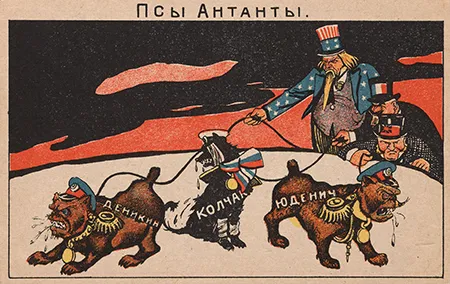
Figure 1 The dogs of the Entente: Denikin, Kolchak, Yudenich, 1919. © Heritage Image Partnership Ltd/Alamy Stock Photo.
An Increasingly Diversified Soviet Society
During the 1920s and 1930s, the Soviet regime interpreted the White movement as the embodiment of everything it rejected ideologically and as its central political enemy, ready to put the Revolution down. The memory of the Civil War was still vivid, with many Bolshevik leaders recalling their years of battles against White opponents. Abroad, Russian émigrés were politically active, trying to reenter the country to continue the struggle on the Soviet territory itself and inviting European countries to keep their original anti-Soviet stance and not recognize the legality of the new state. The main émigré association, the National Alliance of Russian Solidarists (NTS), born in 1931 as the youth branch of White General Pyotr Wrangel’s Russian All-Military Union (ROVS), promoted a muscular ideology inspired by Italian fascism and theories of the “Third Way.”3 In the 1930s and during the war, some segments of the Russian émigré population supported Nazi Germany, which confirmed the Soviet leadership’s belief in the White movement’s alliance with a mortal enemy of the Soviet Union—fascism.4
During the second half of the century, the political salience of the Russian émigré movement diminished. Many White leaders had passed away, and dreams about a military invasion of the Soviet Union faded. Émigré associations continued to promote their anti-Soviet agenda, joining various anti-communist initiatives and participating in Cold War-era ideological fronts. Beginning in the 1960s, the NTS also focused on establishing contacts with Soviet dissidents and feeding them forbidden literature. Its magazine Grani invited Soviet writers to publish their banned literary work and helped structure samizdat (publications circulating in the Soviet underground) and tamizdat (publications abroad imported clandestinely to the Soviet Union) further by transporting underground newspapers, articles, and books back and forth. One of the organization’s chairmen, Vladimir Poremsky, reported that, in the late 1970s, the NTS leadership was happy to see emergent circles of like-minded individuals “search[ing] for the future, tied not only to abstract theories of freedom and human rights, but to ideas rooted in the way of life, history, and traditions of the Russian people” in the Soviet Union.5
But even if Russian émigré associations were still active, the status acquired by the Soviet Union after its 1945 victory against Nazi Germany gave the country a legitimacy that it had never obtained during the interwar period. Even the most radical émigré groups could not deny that the USSR had not only returned its borders to those of imperial Russia, but had also expanded its influence in Central Europe and in Asia, thus acting like the empire so many émigrés longed for. The widespread impression of the USSR as a normalized country transformed by the war experience caused several tens of thousands of former émigrés to return home voluntarily. The Allies also forcibly repatriated to the Soviet Union about 2 million Soviet citizens who found themselves in Allies-occupied territories.6 All of them brought with them their personal or familial memory of the interwar and war periods in Europe, and therefore some components of White culture. At home, meanwhile, three historical turning points gradually created a space for a future rehabilitation of the Whites.
The first—and earliest—turning point was the so-called Great Turn, when Stalin decided in 1929 to abandon the New Economic Policy in favor of radical collectivization and industrialization. By initiating such changes, the Soviet Union followed a more classic great power model that will later help a partial cultural reconciliation with the Whites. After the internationalist policies of the Bolshevik regime and Lenin’s scathing assessment of “Great Russian chauvinism,” Stalin, then fighting with Trotsky and the old Bolsheviks, revived a more traditional form of Russian nationalism.7 Russian history was rewritten in a more conventional way: in 1934, historical arguments were revised by official historiography in favor of the tsarist empire; in 1937, the 125th anniversary of the Battle of Borodino against Napoleon was celebrated as a victory of Russian patriotism; and in 1939, Sergei Eisenstein screened his famed film paying tribute to Alexander Nevsky and his victory against the Teutonic Knights, who embodied a timeless Western enemy. Stalinism culture thus reconciled with many features of the former empire that émigrés idealized too.
The second turning point was the Second World War, a transformative event for Soviet society as well as for the regime itself: the Soviet Union was fighting not only for proletarian internationalism but for its own survival against a foreign enemy. Advised by Russian émigrés, the Nazis tried to instrumentalize the population’s outrage regarding the persecution of religious organizations and forced collectivization by presenting their invasion of the USSR as a kind of Christian crusade against the godless Bolsheviks.8 After its first defeats, the desperate Soviet regime sought to reinstate classic patriotism and rehabilitate the ROC (as well as Islam) in the hope of motivating Soviet citizens to fight for their homeland. In 1942, Stalin restored the Moscow Patriarchate, which had been suspended in 1925, and allowed for the revitalization of religious life throughout the country.9 The Orthodox Church suddenly found itself a welcome companion in the highest reaches of power, offering prayers for victory during state ceremonies, even pleading for Stalin’s health, and boosting patriotic feelings in the Red Army and throughout the population.
The war also reinforced the patriotic cultural production that had been launched a decade before: several movies celebrating Russia’s main historical victories and figures such as Suvorov (1941), Bogdan Khmelnitsky (1941), Kutuzov (1943), and Ivan the Terrible (1945), were shot. Stalin also authorized the rediscovery of Slavophile thinkers, and previously criticized writers such as Fyodor Dostoevsky got entirely rehabilitated.10 The war, in other words, reintroduced to the Soviet Union many of the classic Russian authors, heroes, and ideas Russian émigrés had embraced.
The third turning point was Stalin’s death in 1953 and subsequent destalinization. The power struggle among Nikita Khrushchev, Lavrenty Beria, and Georgy Malenkov, followed by the former’s famous destalinization speech at the 20th Congress of the Communist Party of the Soviet Union in 1956, opened the door for the expression of a greater plurality of opinions at the official level. Legally, the Soviet state revoked Article 58-1, which had been used to punish counter-revolutionary activities, in 1961.11 The Thaw that followed destalinization divided those taking advantage of the changes and pushing for more plurality—the “cosmopolitans,” who were sometimes liberal, sometimes socialist and/or Leninist—and those refusing to accept the changes—the more conservative, nationalist, and Stalinist factions. Khrushchev’s decision to return to Leninism, seen as the embodiment of authentic revolutionary spirit before Stalin’s “perversion” of Marxism-Leninism, contributed to the reframing of the memory of the Revolution and Civil War.
Post-Stalinist changes affected not only the political and cultural elite but the Soviet society as a whole.12 The release of millions of camp prisoners compelled society to reflect upon the regime and brought home millions of people. For a small portion of them, the cult of prerevolutionary Russia and the Orthodox Church had been intrinsic elements of penitentiary counterculture. Indeed, a large number of post-1945 political prisoners had been jailed (rightly or wrongly) for cooperation with the fascist enemy during the war, for surrendering to German troops, or for living in Nazi-occupied territories. Prisons thus preserved the memory of Nazi slogans, the collaborationist Vlasov army, and the White past longer than the rest of Soviet society did. Many zeks—the colloquial term used to describe Gulag prisoners—proclaimed themselves as either monarchists, fascists, or capitalists in order to demonstrate their rejection of the Soviet system. Representations of Hitler, Nazi uniforms, and SS helmets, as well as slogans about Jews’ domination of Russia, were numerous among convicts’ tattoos, a key component of the criminal body language. Orthodox crosses, churches, Nicholas II, and famous White officers were even more frequently represented.13
The gradual liberalization of the Soviet regime created many “holes” in the official policy of censorship through which non-conformist views could be expressed. Forbidden books that were considered politically subversive could suddenly be accessed, and some members of the cultural elite were allowed to enter the Spetskhran, or “special collection” of prohibited books, at the Lenin State Library. The first trips abroad also permitted a rediscovery of Western literature, and the growing number of foreigners visiting and living in the Soviet Union helped circulate émigré literary products.
Last but not least, in the 1950s and 1960s, many Soviet citizens could still remember their youth in prerevolutionary Russia and transmit memory of it to their children. Some were from former aristocratic families, some from the bourgeois middle classes. All were often nicknamed “has been” or “former” (byvshie), a metaphor of their “non-proletarian” origins. The Orthodox Church constituted another node of figures oriented around the prerevolutionary era.14 Several of the postwar clergy were indeed formed by prerevolutionary figures, many of whom were members of the far-right, antisem...
Table of contents
- Cover
- Halftitle Page
- Title Page
- Contents
- List of Figures
- Introduction
- 1. The White Officer: Historical Romanticism in Soviet Culture
- 2. White Renaissance: Cultural Rediscovery without Judicial Rehabilitation
- 3. White Memory Activism around the Russian Orthodox Church
- 4. The Russian State’s Search for National Reconciliation
- Conclusion
- Notes
- Selected Bibliography
- Index
- Imprint
Trusted by 375,005 students
Access to over 1.5 million titles for a fair monthly price.
Study more efficiently using our study tools.
Frequently asked questions
Yes, you can cancel anytime from the Subscription tab in your account settings on the Perlego website. Your subscription will stay active until the end of your current billing period. Learn how to cancel your subscription
No, books cannot be downloaded as external files, such as PDFs, for use outside of Perlego. However, you can download books within the Perlego app for offline reading on mobile or tablet. Learn how to download books offline
Perlego offers two plans: Essential and Complete
- Essential is ideal for learners and professionals who enjoy exploring a wide range of subjects. Access the Essential Library with 800,000+ trusted titles and best-sellers across business, personal growth, and the humanities. Includes unlimited reading time and Standard Read Aloud voice.
- Complete: Perfect for advanced learners and researchers needing full, unrestricted access. Unlock 1.5M+ books across hundreds of subjects, including academic and specialized titles. The Complete Plan also includes advanced features like Premium Read Aloud and Research Assistant.
We are an online textbook subscription service, where you can get access to an entire online library for less than the price of a single book per month. With over 1.5 million books across 990+ topics, we’ve got you covered! Learn about our mission
Look out for the read-aloud symbol on your next book to see if you can listen to it. The read-aloud tool reads text aloud for you, highlighting the text as it is being read. You can pause it, speed it up and slow it down. Learn more about Read Aloud
Yes! You can use the Perlego app on both iOS and Android devices to read anytime, anywhere — even offline. Perfect for commutes or when you’re on the go.
Please note we cannot support devices running on iOS 13 and Android 7 or earlier. Learn more about using the app
Please note we cannot support devices running on iOS 13 and Android 7 or earlier. Learn more about using the app
Yes, you can access Memory Politics and the Russian Civil War by Marlene Laruelle,Margarita Karnysheva in PDF and/or ePUB format, as well as other popular books in History & Russian History. We have over 1.5 million books available in our catalogue for you to explore.