Since the early 4th century, Christian pilgrims and visitors to Judea and Galilee have worshipped at and been inspired by monumental churches erected at sites traditionally connected with the life and ministry of Jesus of Nazareth. This book examines the history and archaeology of early Christian holy sites and traditions connected with specific places in order to understand them as interpretations of Jesus and to explore them as instantiations of memories of him.
Ryan's overarching aim is to construe these places as instantiations of what historian Pierre Nora has called "lieux de mémoires," sites where memory crystallizes and, where possible, to track the course and development of the traditions underlying them from their genesis in the Gospel narratives to their eventual solidification in the form of pilgrimage sites. So doing will bring rarely considered evidence to the study of early Christian memory, which in turn helps to illuminate the person of Jesus himself in both history and reception.
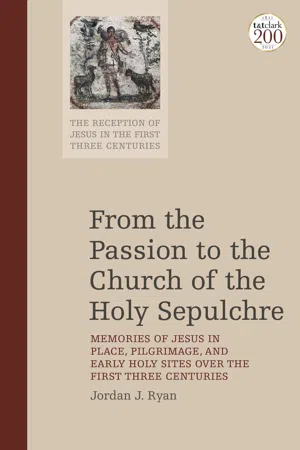
eBook - ePub
From the Passion to the Church of the Holy Sepulchre
Memories of Jesus in Place, Pilgrimage, and Early Holy Sites Over the First Three Centuries
- 272 pages
- English
- ePUB (mobile friendly)
- Available on iOS & Android
eBook - ePub
From the Passion to the Church of the Holy Sepulchre
Memories of Jesus in Place, Pilgrimage, and Early Holy Sites Over the First Three Centuries
About this book
Information
1
Introduction
Place is central to the early Jesus tradition. The gospel narratives about Jesus are localized in the world of first-century Judea, Galilee, and Samaria. According to the traditions in the canonical gospels, Jesus was born in Bethlehem. He taught in Galilee. He died in Jerusalem. Beginning in antiquity, Christian visitors to Eretz Israel-Palestine have imagined themselves to walk in the very footsteps of Jesus of Nazareth. Likewise, today’s pilgrims too can touch the place where Jesus was born, sit where he fed the five thousand, see the place where he had his Last Supper, pray at the spot where his body was laid, and even stand at the place where he ascended. At least that is what they are told by tradition, by their guides, and above all, by the existence of the monumental buildings that mark these spots as the places where the events took place.
In 2014, I spent a summer studying at the École Biblique et Archéologique in Jerusalem. During that summer, I once shared a vehicle on a journey from Jerusalem to Galilee with some travel companions, including a Roman Catholic priest, a seminarian, and another scholar. On that particular journey, we took a route that took us near Mt. Tabor. It was the seminarian’s first visit to the region, and so the priest pointed to the mountain as it appeared in the distance and told him that Mt. Tabor was the place where Jesus was transfigured. The seminarian, like so many of us who have visited this region, asked how we can know that Mt. Tabor was the site of the transfiguration, since the location is not specified in the gospels. The priest’s response was succinct and memorable: “Mt. Tabor is the place where we remember it.”
The question of the “authenticity” of the traditional Christian commemorative sites is a valid one, but it is not the only question that can be asked about them in relation to Jesus and the gospels. To limit our inquiry of the relevance of early Christian commemorative sites related to the life of Jesus to the question of “authenticity” would miss the richness of the data that these sites provide us. Regardless of the historical “authenticity” of the site, the fact that the memories of Jesus and the traditions about him are given physical, geographical, even architectural expression through place in the form of holy sites is significant in itself. Moreover, the places themselves invite interpretation, and traditions can coalesce around them. The way that the sites connected to key events in the life of Jesus are interpreted can significantly impact the manner in which the events that they commemorate are interpreted. Thus, by considering a reception of significant places in the Jesus tradition of the first few centuries ce, we will be able to examine underexplored avenues of the history of the tradition and of the reception of Jesus of Nazareth in early Christianity.
The aim of the present project is to examine the reception of places connected to key events in the life of Jesus from the first century to the fourth century and to study the ways in which Jesus was commemorated at or in connection with those places. What did early Christians have to say about Golgotha? How did they understand the place of Jesus’ birth? Of his burial? How did they interpret the significance of those places? What traditions, theological concepts, or narratives took root at these sites, and what can they tell us about the reception of Jesus over the first few centuries of the Common Era? The age of Constantinian commemorative church building in the fourth century at sites connected to the life of Jesus provides us with a bookend to cap off the study. More importantly, it affords us an opportunity to study the crystallization of memory and tradition in the form of the architecture of the monuments as we know them through the archaeological record. With this in mind, we will limit our study to places connected to key events in the life of Jesus for which churches commemorating those events were certainly or arguably constructed in the age of Constantine or slightly thereafter. This includes the place of Jesus’ crucifixion, the place of his burial, the site of his birth, and the site of the ascension. Naturally, the events that loomed largest in Christian memory and tradition were among the first to receive monumental commemorative architecture. These places connected to central events in the life of Jesus, all of which are located in or near Jerusalem, are joined by a handful of ancillary sites in Galilee at which churches commemorating Jesus’ miracles at Capernaum, the multiplication of the fish and the loaves, and the annunciation to Mary at Nazareth were constructed in the fourth century.
While commemorative churches are important, visible instantiations of the reception of places connected to the events of the life of Jesus, they are not the only object of our study. Nor should we conceive of the places that we will study only in terms of the geographic sites where the gospel narratives under discussion have been traditionally located. It is also essential to consider the reception of these places and its impact on the reception of Jesus himself in text, beginning with the gospel accounts. The early church had much to say about places such as Golgotha and the birthplace of Jesus. In order to fully appreciate and understand the contribution of the memory of these places to the way that Jesus was himself remembered, it will be essential to consider literary representations and interpretations of these sites.
In order to achieve our aim, we will need to examine the data from several perspectives. First, we will track and examine the presentation and discussion of each place in early Christian literature from the first century to the fourth century, beginning with the gospels. In the course of doing so, we will consider the various traditions, particularly extracanonical traditions, that were connected to the sites that we are studying. We will also consider the relationship of the traditions and interpretations of the sites in Christian literature to any parallels within early Jewish literature, if there are any. All of this will allow us to chart and track the reception of these places and the events of Jesus’ life that were connected to them through the first few centuries. Then, with the advent of the construction of commemorative monuments at the traditional location of these places in the age of Constantine, we will turn our attention to the architecture of the commemorative churches in order to examine them as instantiations of reception and memory. Particular attention will be paid to ways in which the architecture itself communicated concepts, traditions, or ideas about Jesus. When the available evidence allows us to do so, we will also consider the ways in which these spaces, which served to anchor and locate the memory of Jesus in specific locations, were experienced by worshippers and pilgrims through liturgy and through pilgrimage itineraries and guides. We will also pay special attention to the roles that these places and the memory of them played in Jewish-Christian relations and in the intersection of Jewish and Christian traditions and concerns.
The data available to us are rich and complex. This makes it difficult to articulate a summary of what our study will uncover about each place that we will examine. However, there are a few themes that will emerge from the study. As we will see, the reception and interpretation of the key events in the life of Jesus that we are examining here were often impacted by the way that the place where the event happened was remembered. We will also see that the commemorative activity that took place at the traditional locations of key life-of-Jesus events, such as the crucifixion, contributed to Christian identity formation. Moreover, sites of Jesus-memory frequently functioned as vehicles and receptacles for the preservation of traditions, both canonical and apocryphal. Furthermore, these places and the memories attached to them were unfortunately sometimes leveraged to serve supersessionist, anti-Jewish purposes.
Place gives memory a tangible referent, grounding it, allowing it to take root. Thus, Gérôme Truc writes, “Our memory is framed by spatial reference points: places, sites, buildings, and streets give us our bearings and enable us to anchor and order our memories.”1 Memories of Jesus were attached to places very early on. Thus, the evangelists tell us that Peter’s confession took place specifically at Caesarea Philippi,2 that Jesus healed a sick man at the Pool of Bethesda,3 that the “Bread of Life” discourse was given in the synagogue in Capernaum,4 and so on. The specific identifications of place in early Christian memory anchored memories of Jesus in the physical space of the Land of Israel in the late Second-Temple period and allowed for the organization of those memories into coherent narratives of the past. Whatever we may think about the reliability of individual traditions, the memories of Jesus set in places such as the lake region of Galilee and Jerusalem are so solidly crystallized in the early Christian collective memory that a reasonable historian cannot but acknowledge that the man was active in these regions.
This, of course, speaks to the geography of the gospel accounts, both historical and sacred, but what about the holy sites of early Christianity? How did they come to be, and moreover, how did the process of commemoration through the building of monuments, the writing of accompanying liturgy that interacted with the places and monuments, and the oral spread of traditions coalescing around these sacred places contribute to the reception, interpretation, evolution, and preservation of the Jesus tradition? How did place continue to play a role in Jesus memory beyond the writing of the gospels? What role did it play for the memorialization of Jesus in the Christianized Palestine of the fourth century? Furthermore, what can the history, traditions, architecture, and archaeology of places like the Church of the Holy Sepulchre, the Church of the Nativity, or the so-called House of Peter tell us about Jesus in memory, history, and reception?
The relevance of the commemorative churches to the church historian or archaeologist of early Christianity in Palestine is clear. However, the matter of their relevance to the things that interest New Testament scholars, such as the study of Jesus, the gospels, Jesus-memory, and gospel traditions has yet to be fully appreciated. The study of early Christian...
Table of contents
- Cover
- Series page
- Dedication
- Title page
- Contents
- Figures
- Translations Commonly Used
- Acknowledgements
- Abbreviations
- 1 Introduction
- 2 Remembering Golgotha: Memory and Interpretation of the Place of Crucifixion from the First to the Fourth Centuries
- 3 The Tomb of Jesus in Christian Memory and Interpretation
- 4 Locating a Memory: The Architecture of the Constantinian Church of the Holy Sepulchre as Jesus-Memory
- 5 Bethlehem and the Mount of Olives
- 6 Galilee: “There They Will See Me”
- 7 Conclusion
- Gallery of Additional Photos
- Bibliography
- Index of Authors
- Index of References
- Copyright Page
Trusted by 375,005 students
Access to over 1.5 million titles for a fair monthly price.
Study more efficiently using our study tools.
Frequently asked questions
Yes, you can cancel anytime from the Subscription tab in your account settings on the Perlego website. Your subscription will stay active until the end of your current billing period. Learn how to cancel your subscription
No, books cannot be downloaded as external files, such as PDFs, for use outside of Perlego. However, you can download books within the Perlego app for offline reading on mobile or tablet. Learn how to download books offline
Perlego offers two plans: Essential and Complete
- Essential is ideal for learners and professionals who enjoy exploring a wide range of subjects. Access the Essential Library with 800,000+ trusted titles and best-sellers across business, personal growth, and the humanities. Includes unlimited reading time and Standard Read Aloud voice.
- Complete: Perfect for advanced learners and researchers needing full, unrestricted access. Unlock 1.5M+ books across hundreds of subjects, including academic and specialized titles. The Complete Plan also includes advanced features like Premium Read Aloud and Research Assistant.
We are an online textbook subscription service, where you can get access to an entire online library for less than the price of a single book per month. With over 1.5 million books across 990+ topics, we’ve got you covered! Learn about our mission
Look out for the read-aloud symbol on your next book to see if you can listen to it. The read-aloud tool reads text aloud for you, highlighting the text as it is being read. You can pause it, speed it up and slow it down. Learn more about Read Aloud
Yes! You can use the Perlego app on both iOS and Android devices to read anytime, anywhere — even offline. Perfect for commutes or when you’re on the go.
Please note we cannot support devices running on iOS 13 and Android 7 or earlier. Learn more about using the app
Please note we cannot support devices running on iOS 13 and Android 7 or earlier. Learn more about using the app
Yes, you can access From the Passion to the Church of the Holy Sepulchre by Jordan J. Ryan in PDF and/or ePUB format, as well as other popular books in Theology & Religion & Biblical Studies. We have over 1.5 million books available in our catalogue for you to explore.