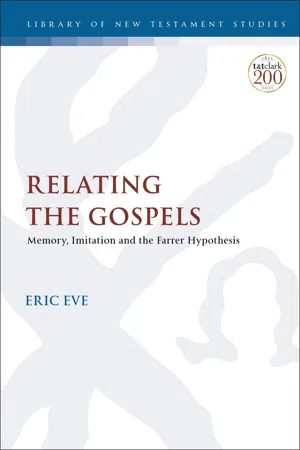
This volume examines the synoptic problem and argues that the similarities between the gospels of Matthew and Luke outweigh the objections commonly raised against the theory that Luke used the text of Matthew in composing his gospel. While agreeing with scholars who suggests that memory played a leading role in ancient source-utilization, Eric Eve argues for a more flexible understanding of memory, which would both explain Luke's access of Matthew's double tradition material out of the sequence in which it appears in Matthew, and suggest that Luke may have been more influenced by Matthew's order than appears on the surface.
Eve also considers the widespread ancient practice of literary imitation as another mode of source utilization the Evangelists, particularly Luke, could have employed, and argues that Luke's Gospel should be seen in part as an emulation of Matthew's. Within this enlarged understanding of how ancient authors could utilize their sources, Luke's proposed use of Matthew alongside Mark becomes entirely plausible, and Eve concludes that the Farrer Hypothesis of Matthew using Mark, and Luke consequently using both gospels, to be the most likely solution to the Synoptic Problem.
- 240 pages
- English
- ePUB (mobile friendly)
- Available on iOS & Android
eBook - ePub
About this book
Information
1
Introduction
How are the Gospels of Matthew, Mark and Luke related to one another? Since the mid-nineteenth century the dominant position had been that Matthew and Luke made independent use of Mark and Q (the hypothetical source that supposedly accounts for the so-called double tradition, the material common to Matthew and Luke not found in Mark). But dissenters from this Two Document Hypothesis (2DH) have long been proposing alternative theories, not least the Two Gospel Hypothesis (2GH) and the Farrer Hypothesis (FH), both of which do away with the need to postulate Q by proposing, in the first case, that Luke used Matthew and Mark then used the other two, and in the second, that Matthew used Mark and Luke then used the other two.1 The debate between competing theories has increasingly come to turn on not just why the later evangelists would have treated their sources in the manner the theories require but how they could have done so given the writing technologies available to them and the source-utilization techniques employed by other ancient authors.2 It is often suggested that such considerations favour the 2DH3; this book, however, will argue that it is the Farrer Hypothesis that makes better sense of the data.4
In doing so we shall need to revisit a number of well-ploughed fields, both for the sake of completeness and to counter arguments that advocates of the 2DH continue to deploy. But we shall also explore some fresher pastures, in relation to memory use, literary imitation and the influence of Matthew’s order on Luke’s.5
As defended here, the FH is not a denial that other sources may have been involved in the composition of Matthew and Luke, particularly if by ‘sources’ we mean not only written documents but also oral tradition and collective memory. But it is a denial that one of those sources was Q, in the sense of the hypothetical document required by the 2DH. It is conceivable that Luke used Matthew and Mark and that Matthew and Luke also had a common source in addition to Mark, but that common source would be something other than the 2DH Q. Moreover, such a Three Document Hypothesis would be difficult to test, since the reconstruction of its hypothetical common source would lack the relatively tight constraints that inform attempts to reconstruct Q.6 The hypothetical third source would be in danger of becoming sufficiently flexible to accommodate any apparent difficulties, thereby rendering any 3DH potentially unfalsifiable. This does not make such a hypothesis untrue, but it may render it unfruitful. In general, while the existence of hypothetical lost written sources cannot be excluded a priori, it seems better to make as little use of them as possible and to first see if we can do without them; other sources may have existed, but the possibility of our reliably reconstructing them seems remote. In any case, the aim here is not to account for every factor that may have gone into the composition of the Synoptic Gospels but to argue where those three gospels fit into the process.
Suggested solutions to the Synoptic Problem cannot hope to reconstruct precisely what actually happened. There are too many unknowns. The texts of any gospels available to Matthew and Luke will not have been identical to those printed in modern critical editions of the New Testament, but we can never know precisely what they were, which means that the significance of detailed differences and similarities in wording is subject to the uncertainties of textual reconstruction. Moreover, while we can discuss the working methods of the gospel authors on the basis of appropriate ancient analogies, we can never know for certain precisely how the evangelists went about their tasks. All we can do is construct the most economic available hypothesis that plausibly explains the surviving data, where economy relates not just to the number of documents involved but to the compositional methods demanded of the evangelists.
Rather than attempting an objective evaluation of every conceivable solution to the Synoptic Problem, the present study will confine itself to comparing the viability of the Farrer Hypothesis with that of its principal competitor, the Two Document Hypothesis. Sometimes the argument may thus turn not so much on whether the FH can provide a totally watertight explanation of every potential difficulty, but whether it can provide one at least as plausible as that offered by the 2DH; a potential difficulty for the FH cannot select in favour of the 2DH if it is an equal or worse difficulty for the 2DH.
In Chapter 2 we shall begin by sketching out a general picture of how the gospel writers may have worked. In Chapter 3 we shall explore the techniques ancient authors typically employed in reworking their sources. The following three chapters will argue that the reasons for supposing that Luke did know Matthew outweigh those for supposing he did not. Chapter 4 will identify a number of similarities between these two gospels that suggest Luke used Matthew. Chapter 5 will counter four of the principal arguments that have been urged against such dependence. Chapter 6 will address the weightiest argument, the alleged difficulty of envisaging how and why Luke would have dispersed and rearranged so much of the material he found in Matthew. Finally, Chapter 7 will sum up the conclusions of this study and review some of the issues that remain.
1 The Griesbach Hypothesis (the earliest version of the 2GH) predated the 2DH; the FH also has pre-twentieth-century precursors.
2 F. Gerald Downing has been something of a pioneer in this area in a series of articles many of which will be discussed in Chapters 3 and 5, although the need to address some of these questions was already adumbrated by William Sanday, ‘The Conditions under Which the Gospels Were Written, in Their Bearing upon Some Difficulties of the Synoptic Problem’ in William Sanday (ed.), Oxford Studies in the Synoptic Problem (Oxford: Clarendon, 1911), 3–26. Other substantial contributions in this area include R.A. Derrenbacker, Ancient Compositional Practices and the Synoptic Problem (BETL, 186; Leuven: Peeters-Leuven, 2005), and Alan Kirk, Q in Matthew: Ancient Media, Memory, and Early Scribal Transmission of the Jesus Tradition (LNTS, 564; London: Bloomsbury T&T Clark, 2016) (henceforth QiM), together with a number of the essays in P. Foster, A. Gregory, J.S. Kloppenborg, J. Verheyden (eds), New Studies in the Synoptic Problem: Oxford Conference, April 2008: Essays in Honour of Christopher M. Tuckett (BETL, 239; Leuven: Peeters, 2011). The present author’s previous book, Writing the Gospels: Composition and Memory (London: SPCK, 2016) (henceforth WTG), also looks at ancient compositional techniques in relation to the composition of the gospels but only sketches the possible implications for the Synoptic Problem.
3 Notably in the work of Gerald Downing, Robert Derrenbacker and Alan Kirk, which will be discussed in Chapter 3.
4 It thus responds to a challenge issued by advocates of the 2DH, for example Derrenbacker, Compositional Practices, 258, ‘As a new generation of FGH advocates work through their theory, the compositional conventions of writers in the Greco-Roman world need to become part of their discussion’; and Kirk, QiM, 307, n. 28, commenting on John C. Poirier and Jeffrey Peterson (eds), Marcan Priority without Q: Explorations in the Farrer Hypothesis (LNTS, 455; London: Bloomsbury T&T Clark, 2015), ‘Anyone hoping to find engagement with ancient media realities in the most recent set of FGH essays … will be disappointed.’
5 The role of memory is not in itself a novel insight, see, e.g., Andrew Gregory, ‘What Is Literary Dependence?’ in Foster, New Studies, 87–114, here 95–103. The discussion of the role of memory in gospel composition has been substantially advanced by Kirk, QiM, which appeared in the same year as Eve, WTG. The potential importance of literary imitation as a mode of gospel composition has been identified, for example, by Dennis MacDonald, Thomas Brodie and Adam Winn (for further bibliography, see Chapter 3), although its application to the Synoptic Problem has so far been slight. Some of the details of the argument concerning Luke’s order in Chapter 6 also appear in M.D. Goulder, Luke: A New Paradigm (JSNTSup, 20; Sheffield: Sheffield Academic Press, 1989), but in the rather different context of a process involving reverse scrolling through Matthew by Luke, which the present study does not envisage.
6 Although such attempts are not without their problems: see Eric Eve, ‘Reconstructing Mark: A Thought Experiment’ in Mark Goodacre and Nicholas Perrin (eds), Questioning Q (London: SPCK, 2004), 89–114, and Nicholas Perrin, ‘The Limits of a Reconstructed Q’ in Goodacre, Questioning Q, 71–88.
2
Models, memory and Markan priority
A solution to the Synoptic Problem is more likely to command respect if it fits ancient compositional methods. In the present chapter we shall therefore look at some different models of ancient literary composition and the working methods they entail.1 We shall leave a more detailed examination of transformational techniques (the kinds of things ancient authors typically did with their source material) to the following chapter. In the present one we shall also briefly discuss Markan priority, both because it makes sense to address this early on and because thinking through the implications of Matthew’s and Luke’s use of Mark will help crystallize the preceding discussion.
Elite, oral and scribal composition
If you ask someone how they envisage the gospel writers working, they might well describe them sitting at a desk, pen in hand, writing on a papyrus scroll open in front of them while referring to other written sources lying in convenient reach on their desktop.2 But this picture is quite inappropriate. We now recognize that writing desks were not in use as early as the first century, that many authors preferred to dictate their works rather than act as their own scribes and that ancient authors did not routinely work in the kind of splendid scholarly isolation favoured by modern ones.3 We should not, however, overcorrect for such anachronisms by overstating the oral component of first-century culture.4
We also need to be wary of assuming that elite authors (which the evangelists were not) provide the best models for understanding the composition of the gospels. They may, however, provide a convenient starting point. Elite authors, at least Roman ones, typically employed slaves (or other assistants) to do much of their donkey work, including reading to them, assisting with their research (e.g. by taking notes from archives), taking down a first draft from dictation and perhaps doing some initial polishing of that draft before presenting it to the author for further correction and then finally making one or more fair copies. Composition might take place in several stages. First, a research phase in which the author gathered his (or occasionally her) material and made or dictated notes. Then the composition of a rough draft, usually (though not exclusively) via dictation. Often this rough draft might be an attempt to get the material in order prior to the application of any literary (or rhetorical) polish. The author might then apply this polish at a subsequent stage when dictating a second draft. At some point he might try out a draft on a circle of friends to glean suggestions and feedback. He might then annotate his draft for his secretary (slave or freedman scribe) to make a final fair copy which would form the archetype for ‘publication’. Although there was a commercial book trade, publication generally meant the formal reading of the work before an invited audience and/or the distribution of a small number of copies to a few friends in the hope that they in turn would make more copies so that the work would eventually circulate through their network. While some works may have been intended primarily for private perusal and some were used that way, more typically an elite literary work would be received through listening to it being read aloud, for example to an invited audience or as a form of highbrow entertainment at an elite dinner party.5
The study of the works of elite historians suggests that although they may well have consulted a number of works in the course of their research, in the course of composition they generally preferred to follow only one source at a time. This did not prevent their switching from one source to another in the course of their own work, but in writing up any particular episode they would choose one source and largely stick to that for the basis of their own composition, perhaps also including the odd detail they happened to remember from their reading of other sources, or from oral tradition, or from their own background knowledge. In doing so, however, elite authors tended to avoid borrowing the wording of their sources, instead seeking to retell the material in their own words.
Following one source at a time did not necessarily mean having eye contact with that source. Some passages in Plutarch, for example, seem to have been prone to memory errors that suggest that Plutarch had first read the account he intended to use and then put it aside whil...
Table of contents
- Cover
- Title Page
- Contents
- Abbreviations
- 1 Introduction
- 2 Models, memory and Markan priority
- 3 Transformational techniques
- 4 Significant similarities
- 5 Difficult differences
- 6 The order objection
- 7 Conclusion
- Bibliography
- Index of References
- Index of Authors
- Imprint
Trusted by 375,005 students
Access to over 1.5 million titles for a fair monthly price.
Study more efficiently using our study tools.
Frequently asked questions
Yes, you can cancel anytime from the Subscription tab in your account settings on the Perlego website. Your subscription will stay active until the end of your current billing period. Learn how to cancel your subscription
No, books cannot be downloaded as external files, such as PDFs, for use outside of Perlego. However, you can download books within the Perlego app for offline reading on mobile or tablet. Learn how to download books offline
Perlego offers two plans: Essential and Complete
- Essential is ideal for learners and professionals who enjoy exploring a wide range of subjects. Access the Essential Library with 800,000+ trusted titles and best-sellers across business, personal growth, and the humanities. Includes unlimited reading time and Standard Read Aloud voice.
- Complete: Perfect for advanced learners and researchers needing full, unrestricted access. Unlock 1.5M+ books across hundreds of subjects, including academic and specialized titles. The Complete Plan also includes advanced features like Premium Read Aloud and Research Assistant.
We are an online textbook subscription service, where you can get access to an entire online library for less than the price of a single book per month. With over 1.5 million books across 990+ topics, we’ve got you covered! Learn about our mission
Look out for the read-aloud symbol on your next book to see if you can listen to it. The read-aloud tool reads text aloud for you, highlighting the text as it is being read. You can pause it, speed it up and slow it down. Learn more about Read Aloud
Yes! You can use the Perlego app on both iOS and Android devices to read anytime, anywhere — even offline. Perfect for commutes or when you’re on the go.
Please note we cannot support devices running on iOS 13 and Android 7 or earlier. Learn more about using the app
Please note we cannot support devices running on iOS 13 and Android 7 or earlier. Learn more about using the app
Yes, you can access Relating the Gospels by Eric Eve in PDF and/or ePUB format, as well as other popular books in Theology & Religion & Biblical Studies. We have over 1.5 million books available in our catalogue for you to explore.