Cato Gulaker employs narrative criticism to explore where the depiction of Satan found in the Book of Revelation is positioned on the axis of two divergent roles. The literary character of Satan is commonly perceived to gradually evolve from the first divine agents in the Hebrew Bible, representing the darker sides of the divine governing of affairs (Job 1–2; Zech 3; 1 Chr 21:1; Num 22:22, 32), to the full-blown enemy of God of the post-biblical era. However, Gulaker posits that texts referring to Satan in between these two poles are not uniform and diverge considerably.
This book argues for a new way of perceiving Satan in Revelation that provides a more probable reading, as it creates less narrative dissonance than the alternative of the ancient combat myth/cosmic conflict between Satan and God. From this reading emerges a subdued Satan more akin to its Hebrew Bible hypotexts and Second Temple Judaism parallels – one that fits seamlessly with the theology, cosmology and the overarching plot of the narrative itself. Gulaker explores the functions of Satan in a text written relatively late compared to the rest of the New Testament, but with strong affinities to the Hebrew Bible, concluding that Satan is characterized more as the leash, rod, and sifting device in the hand of God, than as his enemy.
eBook - ePub
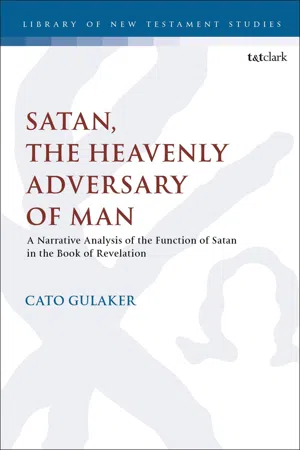
Satan, the Heavenly Adversary of Man
A Narrative Analysis of the Function of Satan in the Book of Revelation
- 304 pages
- English
- ePUB (mobile friendly)
- Available on iOS & Android
eBook - ePub
Satan, the Heavenly Adversary of Man
A Narrative Analysis of the Function of Satan in the Book of Revelation
About this book
Information
1
Introduction
Making sense of the concepts of good and evil is often considered to be the main issue of the book of Revelation.1 The author struggles to cope with the apparent suffering of believers in Asia Minor and the prosperity of the persecuting authorities and local unbelievers.2 How can a just and almighty God retain his position as worthy of trust while his own people are suffering? How can the saints be afflicted, while at the same time their transgressors prosper? In the end, the suffering of the saints raises the question of God’s justice (cf. Rev 6:10–11; 18:6–8; 19:1–2).3 The basic pattern of the answer provided is that everything happens according to God’s eschatological plan of salvation of his creation. The horrors and afflictions the churches of Asia Minor are experiencing represent a combination of the divine sifting of humankind and wrath poured upon the inhabitants of this world referred to as the hour of testing which is about to be unleashed (Rev 3:10). The outcome is either salvation or judgment, depending on how one responds to the trials of affliction presented in the visionary section of the book (Revelation 6–20).
Satan is one among many agents actively taking part in this eschatological ordeal. His violent conduct on earth represents a serious challenge to the congregations to be overcome through faithfulness to Christ unto death (Rev 2:10; 13:10, 15). As the rewards for enduring such afflictions by far outweighs the short-term pain in question (12:11; 20:4–5), the plot of the book turns out to be a cosmic version of the now famous “marshmallow test” conducted by Walter Mischel in the 1960s and 1970s.4 If one abstains from the present momentary bliss of survival and social inclusion (cf. Rev 13:15–17), popular, intriguing, and tempting religious deviations included (Rev 2:6, 14–15, 20), the future rewards will be marvelous and manifold (cf. Revelation 21–22). However, in Revelation, the stakes are raised acutely from mere rewards to the inclusion of dire punishment (cf. Rev 14:9–11; 20:12–15). The function of Satan is central to this eschatological ordeal of sifting the world’s population into two categories, and causes several questions regarding the cosmological framework of Revelation to surface. If Satan is functioning as a sifting device in the hands of the divine, to what extent is his malevolent conduct described as his actions and not those of God? To what degree can we speak of subjectivity or autonomy in his cunning deception of the world? Does Satan function literarily as a necessary opposition against which the faithfulness of believers is to be measured?5 Is he partaking in a carefully composed hour of testing in the vein of the renowned trial of Abraham (Gen 22:1–19), the ordeal of Christ in the desert (Mark 1:12–13; Matt 4:1–11; Luke 4:1–13), or perhaps the general acts of testing of believers referred to by Paul in 1 Cor 10:13? Also, if this can be argued to be the case, how does this affect the image of God in the narrative? It is at these crossroads that we encounter the main problem of interest to the present study.
1.1 Ambiguous Satans and the Issue of Tension
According to Jeffrey Burton Russell, Christianity is a semi-dualistic religion with a history of resisting the simpler solutions of dualism and monism. This “tension between monism and dualism has led to inconsistencies in Christian dualism,”6 which has always been the “weak seam in Christian theology.”7 It is probably from these tensions that the different incompatible concepts of the Devil in the New Testament evolved.8 The patristic era reveals some struggles in coming to terms with these tensions as what one say about Satan in turn affects what is said about God:9 If one accepts the idea of God not being responsible for the suffering of sentient beings in the world, but attributes it to the Devil, then the image of God diminishes to the benefit of two divine entities heading toward dualism.10 On the other hand, if one retorts with the idea of God in the end being somehow the ultimate sovereign divine force, controlling, utilizing, and forcing the hand of the Devil, then he is ultimately responsible for said suffering—a characteristic of cosmological monism. The New Testament Satans/Devils11 moved along the axis between these two poles, never fully embracing either, and left it to the church fathers to solve the issue of theodicy from its loose ends.12 The main task of this reading is to pinpoint where on this axis the Satan of Revelation is to be situated.13 In the following, I will explain the concept of this axis by giving a few examples from the Scriptures of how tension is created within the Christian tradition by its diverse utilization of various cosmological adaptations and perspectives on the character of Satan from the Hebrew Bible14 throughout the New Testament. These literary references will be of great hermeneutical value to my exegesis below, as they constitute a wide array of possible interpretational points of reference—the echo chamber of the text and symbolism of Revelation. I have categorized the texts under the headings “A Monistic Approach to the Character of Satan” and “A Dualistic Approach to the Character of Satan” (see Section 1.1.4 for the use of the terms “dualism” and “monism” in this book) to indicate which pole the texts are most close to, while at the same time being fully aware that only a few of the texts in question actually reflect such a cosmology to its fullest extent. Subsequent to this, I will point out a few indicators of how this tension is reflected in the text of Revelation. Finally, I will comment on how contemporary research has dealt with these matters before I lay out the scope and approach of this study.
1.1.1 A Monistic Approach to the Character of Satan
Much ink has been spilled on the issue of Satan in the Hebrew Bible. As a great many scholars have contributed informative studies on the development of Satan from the Hebrew Bible and Second Temple Judaism, I will here only present an excerpt from this development to prove my point.15
In the Hebrew Bible we have several texts describing both human and celestial agents functioning as divinely sanctioned adversaries in which their adversarial function is either explicit (Num 22:22; 1 Kgs 11:14, 23) or implicit (1 Kgs 22:19–23; Exod 12:23; 2 Sam 24:16). In addition, we have four texts reflecting what could be referred to as the cradle of what in time would become the New Testament Satan by their use of the term שָׂטָ֣ן (adversary) as a specific title/name (1 Chr 21:1) or referring to a particular celestial office of prosecution (Job 1–2; Zechariah 3).16 In these nongeneric references to a Satan in the Hebrew Bible he is characterized as one of the בְּנֵי הָאֱלֹהִים (Sons of God, Job 1:6; 2:1), functioning as a tester and tempter (Job 1–2; 1 Chr 21:1) as well as a judicial accuser (Job 1–2; Zech 3:1–2).17 Nowhere in the Hebrew Bible do we find any reference to Satan as the enemy of God, but from the sixth century bc, he frequently appears as a facilitator of God’s shadier side.18 As many have suggested, one can easily perceive this development in the alteration of 1 Sam 24:1 in 1 Chr 21:1 by making Satan an intermediary agent of the deed of deception.19 Such a development might reflect a distrust or dissatisfaction in the monistic cosmology expressed in texts such as Isa 45:7 and the book of Job.20 After all, a recurring element in the prophetic literature is the description of the suffering of the people as just punishment or chastisement, due to previously unfavorable conduct (cf. Isa 64:5–12; Jer 33:4–5; Ezek 39:23–24; Mic 3:4). However, such a way of dealing with the suffering of the people of God only works if they deserve it.
In the post-exilic period we witness the growth of a body of literature attempting to answer the main problem of Job (cf. Job 9:24; 21:7, 17, compared to 24:12, 18, 19; 22) by means of solving the issue of theodicy through reference to an eschatological future. This development can be seen at play in the third century bc LXX revision of the ending of Job (42:17).21 According to Alan Bernstein, “apocalyptic literature proclaims a future judgment that will separate the good from the wicked so that they will no longer share the same soil in the underworld.”22 In the apocalyptic vision of Daniel, the cosmic perspective is still monistic as the saints are to be given over to these violent afflictions of the fourth beast for a divinely apportioned time (Dan 7:23–25; 9:24–27; 11:27, 29, 36; 12:6–7). Here the violent conduct of Antiochus Epiphanes IV is described not as much as just judgment of the saints (although possibly, in 9:24), but rather as necessary for the divinely predestined history to unfold.23 By describing the foreign perpetrator as acting according to the divine governing of time, unknowingly filling up the divine measure of evil, a solution to the momentary affliction can be explained as a necessary rite of passage on the path toward eternal bliss (12:2–3). Daniel 11:32–35 and 12:10–12 describe three types of response to the tribulations: the wise who prevail even unto death (11:33), the sinners and the ungodly who turns to apostasy (11:32a; 12:10a), and the wise who stumble but are refined, purified, and cleansed (11:35; 12:10). The end of affliction will come when the power of the saints is completely devastated (12:7). Moreover, it is by responding wisely to the contents of what is revealed that one can hope to become one of the happy souls having prevailed over the ordeal (12:12). There is no Satan in the book of Daniel, but as these visions constitute the blueprint of Satan and his minions as they appear in Revelation 12–13, their cosmological implications on theodicy will be important to my exegesis below. Moreover, despite the absence of any Satan, the plot of the visionary part of Daniel is similar to that of Revelation.24
When turning to the noncanonical literature of Second Temple Judaism, one finds in the book of Jubilees (approx. 150 bc25) an implied necessity of adversaries to be the main explanation of the existence of Mastema/Satan (Jub. 10:7–9).26 Their devious nature and violent conduct are presented as early as the beginning of the book (1:11; 7:26–28), whereas their origins are explained later (10:1–14). After having been confronted and defeated by Michael and his angels in battle, the leade...
Table of contents
- Cover
- Series Page
- Title Page
- Contents
- Figures
- Tables
- Abbreviations
- 1 Introduction
- 2 Theoretical and Methodological Considerations
- 3 Satan in the Messages to the Seven Congregations
- 4 Satan in the Story of the Woman, the Dragon, and the Beasts
- 5 The End of Satan
- 6 Conclusion
- Bibliography
- Index
- Copyright Page
Trusted by 375,005 students
Access to over 1.5 million titles for a fair monthly price.
Study more efficiently using our study tools.
Frequently asked questions
Yes, you can cancel anytime from the Subscription tab in your account settings on the Perlego website. Your subscription will stay active until the end of your current billing period. Learn how to cancel your subscription
No, books cannot be downloaded as external files, such as PDFs, for use outside of Perlego. However, you can download books within the Perlego app for offline reading on mobile or tablet. Learn how to download books offline
Perlego offers two plans: Essential and Complete
- Essential is ideal for learners and professionals who enjoy exploring a wide range of subjects. Access the Essential Library with 800,000+ trusted titles and best-sellers across business, personal growth, and the humanities. Includes unlimited reading time and Standard Read Aloud voice.
- Complete: Perfect for advanced learners and researchers needing full, unrestricted access. Unlock 1.5M+ books across hundreds of subjects, including academic and specialized titles. The Complete Plan also includes advanced features like Premium Read Aloud and Research Assistant.
We are an online textbook subscription service, where you can get access to an entire online library for less than the price of a single book per month. With over 1.5 million books across 990+ topics, we’ve got you covered! Learn about our mission
Look out for the read-aloud symbol on your next book to see if you can listen to it. The read-aloud tool reads text aloud for you, highlighting the text as it is being read. You can pause it, speed it up and slow it down. Learn more about Read Aloud
Yes! You can use the Perlego app on both iOS and Android devices to read anytime, anywhere — even offline. Perfect for commutes or when you’re on the go.
Please note we cannot support devices running on iOS 13 and Android 7 or earlier. Learn more about using the app
Please note we cannot support devices running on iOS 13 and Android 7 or earlier. Learn more about using the app
Yes, you can access Satan, the Heavenly Adversary of Man by Cato Gulaker in PDF and/or ePUB format, as well as other popular books in Theologie & Religion & Biblische Studien. We have over 1.5 million books available in our catalogue for you to explore.