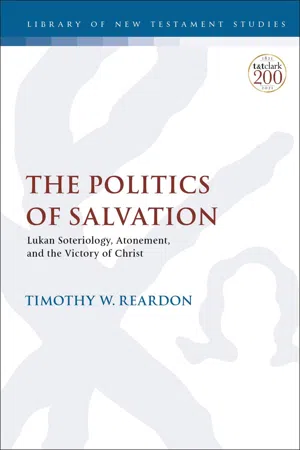
Timothy W. Reardon uncovers thesalvation narrative developed within Luke-Acts and its key themes as they develop within the Lukan presentation of time and space, while being attentive to overcoming a facile compartmentalization of religion and politics. Reardon argues that Luke-Acts offers a complete, holistic, embodied, and theopolitical soteriology, cosmic in scope, that includes both the what and how of salvation.
In contrast to recent arguments for some form of vicarious expiation in Luke-Acts, Reardon instead suggests that Luke-Acts' presentation of salvation - though exhibiting elements of multiple atonement models - noticeably takes a Christus Victor form, using Irenaeus's Christus Victorparadigm in particular as a point of comparison. Throughout this book, Reardon repeatedly demonstrates that Lukan soteriology is political, examining Jesus' role as herald of God's kingdom, the salvific space of heaven and the Church, and the mission of salvation. Reardon concludes that Luke-Acts is a theopolitical salvation unfolding in space, aiming toward the reconciliation of all things.
eBook - ePub
The Politics of Salvation
Lukan Soteriology, Atonement, and the Victory of Christ
- 224 pages
- English
- ePUB (mobile friendly)
- Available on iOS & Android
eBook - ePub
About this book
Information
1
Defining Spaces: Religion, Politics, and Luke-Acts
Salvation has long been understood as a central theme of Luke-Acts, though the precise nature of this salvation remains contested.1 Despite its recognized soteriological focus, Luke-Acts has been assessed as somewhat deficient, offering the what of salvation without fully delineating the how.2 The how that Luke is said to be missing is a detailed means for achieving this salvation, generally understood in terms of atonement.3 Nevertheless, there lie behind this assumption certain theological preconceptions that obscure Luke’s answer for how salvation is achieved. This work will attempt to uncover some of these assumptions and demonstrate that this assessment is incorrect and that, conversely, Luke-Acts does demonstrate a holistic and complete “political” soteriology.4
It is not a new observation that foreign theological categories have been unfairly imposed on Luke-Acts. Werner Georg Kümmel, nearly half a century ago, lamented prevalent theological accusations against Luke, including the unfair imposition of Pauline categories in assessing Luke’s theology.5 Nevertheless, this Pauline imposition continued.6 Still, the issue runs somewhat deeper, encompassing at least the tendency to isolate religion (and salvation and atonement as narrowly religious realities) to a distinct, almost hermetically sealed sphere. With Lukan soteriology, this can be seen in the way salvation is often either spiritualized or eschatologized.7 For some, Lukan salvation is an eschatological reality, presently unrealized. For others, salvation requires future consummation but is available now as “spiritual” or subjective forgiveness.8 Still, for others, Lukan salvation unfolds in tangible and often public manifestations of physical, economic, and social salvation; nevertheless, the bedrock assumption remains the necessity of a “religious” mode of forgiveness to attend this public salvation. Certainly, Luke’s Gospel opens with political prophecies of God’s salvation and deliverance from enemies (1:71, 74) by the hands of a Davidic savior who brings peace in accordance with promises made to Israel’s ancestors (cf. 1:30–3, 46–55, 67–79; 2:10–12). However, for various reasons, when salvation is presented with such politically construed language in Luke-Acts, critics frequently explain this away as marginal, emphasizing, instead, the spiritualization of these motifs and more subjectivized notions of forgiveness, peace, mercy, and so on.
This division of spheres derives, at least partially, from presupposed compartmentalization characteristic of modern, Western space.9 Though such divisions as religion and politics, or even religion and the public sphere, seem natural, these delineations of space are discursive products of power consolidation. The modern imagination in many respects is rent by this categorical fault line, so that the divide between the political and religious defines the present and is assumed of the past. It is a discursive act from which NT interpretation and the study of Lukan soteriology are not immune.
Nevertheless, scholarship has increasingly found this distinction to be dubious, noting that the bifurcation of religious and political spheres does not faithfully represent the fluid interaction, indeed, the indissoluble unity, of political and religious phenomena in the first century. Simon Price, for one, in his work on the imperial cult, blames “Christianizing” tendencies for imposing foreign conceptions of the relationship between religion and politics onto antiquity: “The influence of prejudice and the imposition of arbitrary culture-bound categories, especially ones derived from Christianity, are a perennial problem in the study of the imperial cult … The most pervasive [Christianization] is our assumption that politics and religion are separate areas.”10 It should, however, be debated whether this division of religion and politics is endemic to Christianity, or if this apparent element of modern Christianity is rather influenced by other cultural and paradigm-shaping forces. Nevertheless, echoing Price’s sentiment, we should examine the soteriological assumptions we bring to Luke-Acts.
In this way, the title of this work is both provocative and problematic. It should be clear that I do not intend, by claiming that Lukan soteriology is political, that it should be understood as non-religious or relegated to some reductive political sphere, nor am I attending to religio-political reality as if religion is merely a veil for the political. My concern is to integrate something (politics) that has long been excised from Lukan soteriology. The term “religio-political” in itself has its own problems, reflecting implicitly the somewhat fashionable notion of a mutual embedding of these spheres in antiquity, yet this “embedding” tacitly asserts that these spheres remain distinguishable, even if muddled.11 It is difficult to remove ourselves and our terminology from its own situatedness. Can we reimagine these categories that have become so distinct in our time?
At one level, this project investigates the association of Lukan politics and soteriology. My concern is not primarily whether Luke-Acts is pro-Roman, anti-Roman, or ambivalent vis-à-vis Rome. Though there are certainly ways in which Luke appropriates imperial ideological production and delegitimates political authorities, my contention is rather that salvation, grounded in God’s initiatory covenant fidelity and Israel’s restoration, is a theopolitical reality that takes up space in the world, made present in Jesus and manifest in the political body of the church participating in God’s kingdom.12 My thesis is that Luke-Acts offers a complete, holistic, embodied, and political soteriology, cosmic in scope, that takes up space in the world and includes both the what and how of salvation, taking Christus Victor form. In addition to a holistic what and the inclusion of the aforementioned how of salvation, I assess this soteriology as a complete soteriological scheme understood narratively: what is the beginning, middle, and end of salvation, and how is salvation achieved along this trajectory? This salvation is communal, present, and universal without denying the role of Israel or the particularity of any people. The contours of this will become clearer as we continue.
1.1 Defining Salvation
Soteriology is a considerably large topic that utilizes various other theological loci, such as Christology, ecclesiology, anthropology, and eschatology. Depending on how one understands such coordinate elements, salvation may refer to any number of realities, national deliverance, bodily healing, reconciliation with God, and so on. Here, I wish simply to establish an approach to soteriology.13
For our purposes, it is profitable to understand salvation narratively, with a beginning, middle, and end (cf. Aristotle, Poet. 1450b27).14 This includes the state from which salvation is necessary (the beginning), the resultant state of salvation (the end), and the means by which salvation is achieved (the middle). No one element is coherent or complete on its own; the nature of the beginning is defined by the middle and end, the middle is defined by where it comes from and where it is going, and the end is a product of what led there. Defining one element recasts the whole scheme.
This is seen, for instance, in Christoph Stenschke’s effort to clarify Lukan soteriology through anthropology.15 Stenschke’s formulation (focusing on gentiles) presumptively limits the investigatory scope in narrow moral-religious terms. Stenschke is responding primarily to the work of Jens Taeger, who maintains that Luke regards humanity as needing not salvation but simply correction, denying universal sinfulness.16 For Stenschke, the Lukan person is defined by (1) universal (“spiritual”) ignorance that can only be healed by God, (2) devotion to idols, (3) demonic cosmological oppression, and (4) debt and guilt incurred through sins. Lukan salvation is primarily deliverance from God’s judgment and wrath. Though, certainly aspects of these observations are present, Stenschke’s investigation narrowly circumscribes salvation’s scope, providing a reductively religious anthropology demonstrating little concern for the social, economic, or political situation of human beings within their world.
I hope to move beyond restrictive anthropology. Luke’s narrative is not the narrative of the universal (and de-particularized) human person but of God’s people, Israel, their restoration, and their mission to be light to the nations (Isa. 49:6; Lk. 2:32; Acts 1:8; 13:47; 26:17–18). At Luke’s outset, we find the beginning of our soteriological scheme firmly rooted in Israel’s history, while the middle of God’s unfolding salvation is told through the end of Acts. The end (state) of salvation is not the same as the end of Acts;17 rather, Acts’ non-ending leaves us within the unfolding middle, the unfolding of history. Though there is an eschatological hope of full restoration, the state of salvation is experienced now. Within the particularity of this narrative, concepts like atonement and forgiveness of sins, traditional elements of soteriology, take on flesh.
1.2 Politics and Religion
Of primary importance is defining politics and religion. This task is both negative and positive. Negatively, I am critiquing the imposition of foreign delineations of space, such as those characterizing key soteriological elements as personal or private and thus religious rather than political.18 Salvation’s scope, when associated with religious categories, is a function of the realm in which religion operates. Demarcation of distinct political and religious spheres predetermines soteriological possibilities. Positively, we must develop a working definition for politics. This is not a description of an ancient category, but a redescriptive category through which we understand the text.19 It is important to be transparent in this regard. Luke-Acts includes political elements, but does not itself define politics. I am not so much concerned about how Luke might understand politics, but how Luke-Acts is political.
1.2.1 Politics and Space
Politics at its base is concerned with the regulation of social activity and resources.20 This may include what is colloquially understood as politics, namely, the art of governance, though I am not interested in such a restricted definition. A helpful starting place is Aristotle, whose focus is the organization of public affairs in the polis. Politics, for Aristotle, is a branch of ethics concerned with establishing a just society (cf. Eth. nic. 1181b15), a matter of life pertaining not to institutions primarily but to social interaction, as human being are “by nature” (φύσει) “political animals” (Pol. 1253a3). The f...
Table of contents
- Cover
- Title Page
- Dedication Page
- Contents
- Acknowledgments
- Abbreviations
- 1. Defining Spaces: Religion, Politics, and Luke-Acts
- 2. An Inbreaking Salvation (Luke 1:68–79)
- 3. Jesus, Herald of God’s Kingdom (Luke 4:18–19)
- 4. Heaven Invading: The Holy Spirit, Church, and Salvific Space (Acts 2)
- 5. The Mission of Salvation and Historical Recurrence (Acts 13:16–52)
- 6. Conclusion
- Bibliography
- Index of Ancient Sources
- Index of Modern Authors
- Subject Index
- Imprint
Trusted by 375,005 students
Access to over 1.5 million titles for a fair monthly price.
Study more efficiently using our study tools.
Frequently asked questions
Yes, you can cancel anytime from the Subscription tab in your account settings on the Perlego website. Your subscription will stay active until the end of your current billing period. Learn how to cancel your subscription
No, books cannot be downloaded as external files, such as PDFs, for use outside of Perlego. However, you can download books within the Perlego app for offline reading on mobile or tablet. Learn how to download books offline
Perlego offers two plans: Essential and Complete
- Essential is ideal for learners and professionals who enjoy exploring a wide range of subjects. Access the Essential Library with 800,000+ trusted titles and best-sellers across business, personal growth, and the humanities. Includes unlimited reading time and Standard Read Aloud voice.
- Complete: Perfect for advanced learners and researchers needing full, unrestricted access. Unlock 1.5M+ books across hundreds of subjects, including academic and specialized titles. The Complete Plan also includes advanced features like Premium Read Aloud and Research Assistant.
We are an online textbook subscription service, where you can get access to an entire online library for less than the price of a single book per month. With over 1.5 million books across 990+ topics, we’ve got you covered! Learn about our mission
Look out for the read-aloud symbol on your next book to see if you can listen to it. The read-aloud tool reads text aloud for you, highlighting the text as it is being read. You can pause it, speed it up and slow it down. Learn more about Read Aloud
Yes! You can use the Perlego app on both iOS and Android devices to read anytime, anywhere — even offline. Perfect for commutes or when you’re on the go.
Please note we cannot support devices running on iOS 13 and Android 7 or earlier. Learn more about using the app
Please note we cannot support devices running on iOS 13 and Android 7 or earlier. Learn more about using the app
Yes, you can access The Politics of Salvation by Timothy W. Reardon in PDF and/or ePUB format, as well as other popular books in Theology & Religion & Biblical Studies. We have over 1.5 million books available in our catalogue for you to explore.