This volume examines the reasons that prompted the New Testament writers to create the texts which would become the formation of the Christian religion, exploring the possibility that certain religious experiences were understood as revelatory, and consequently inspired the writing of texts which were seen as special from their inception. Mark Wreford uses Luke-Acts and Galatians as test-cases within the New Testament, reflecting both on the stated importance of religious experiences – whether the author's own or others' – to the development of these texts, and the status the texts claim for themselves.
Wreford suggests that Luke-Acts offers a helpful example of the relationship between religious experience and the creation of Scripture, as an extensive narrative which reflects on early Christian claims to Spirit-inspired witness and which begins with an explicit authorial statement of purpose. Similarly, in Galatians, Paul's autobiographical account of God's revelation of Christ to him is the foundation of a letter that is intended to play an authoritative role in shaping its addressees' own faith and practice. Wreford argues that religious experiences are presented as the driving force behind the creation of the texts, examining how such religious experience links with notions of scripture and canonicity. He then asserts that both Luke and Paul understood themselves to be creating new scriptural writings on the basis of their relationship to new religious experiences, citing the experience and speech at Pentecost, the inclusion of gentiles in the experience, and Paul's own conversion experience as key elements behind the self-understanding of these New Testament authors.
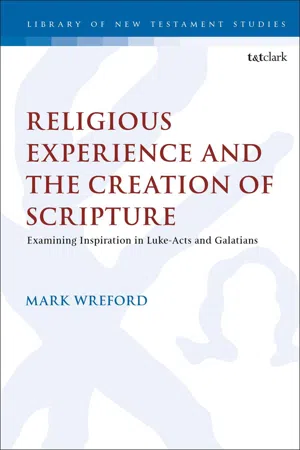
eBook - ePub
Religious Experience and the Creation of Scripture
Examining Inspiration in Luke-Acts and Galatians
- 208 pages
- English
- ePUB (mobile friendly)
- Available on iOS & Android
eBook - ePub
Religious Experience and the Creation of Scripture
Examining Inspiration in Luke-Acts and Galatians
About this book
Information
Section 1
Approaching Religious Experience: Theoretical Foundations
1
Religious Experience and New Testament Research
In this study, I will argue that religious experiences (REs) which were perceived as divine revelatory actions inspired the writing of at least some of the texts which became New Testament Scripture, and that the eventual inclusion of these texts in the NT canon in part reflects their writers’ intention to produce scriptural texts. Analysing this dual claim will require a rigorous engagement with RE, and in this chapter I will situate my work within a history of research on RE. An exhaustive consideration of all relevant material is not necessary in light of several recent publications, including my own.1 Instead, I will outline older approaches to RE (§1.1.1) and its subsequent neglect (§1.1.2), before focusing on its retrieval by James D. G. Dunn, Larry W. Hurtado and Luke Timothy Johnson (§1.1.3). I will suggest three points of confluence in their research and bring these into conversation with four indicative recent approaches (§1.1.4) and religious studies treatments of RE (§1.2). At the end of this chapter (§1.3), I will identify four theoretical questions which must be addressed when considering RE as a historical phenomenon and possible cause in the creation of the writings which came to make up the NT. In Chapter 2, I will then suggest a constructive approach which can address these questions to serve as a theoretical groundwork for my exegetical test cases.
1.1. Religious experience in biblical studies research
Moule notes that ‘almost wherever one starts, the discussion of Christian experience leads without much delay to some question about the Spirit of God’.2 This has two implications for this review: first, it explains why material treating the Spirit will figure prominently in a survey of research into RE; second, it already gestures towards the theological implications of considering the possible historical role played by REs in the processes which led to the creation of the NT texts. REs are inherently bound up with theological claims about reality and divine revelation.3 This makes it potentially problematic to consider such experiences within the scholarly field of biblical studies, which arose as a historical discipline in opposition to theology.4 As Luke Timothy Johnson notes, ‘Scholars’ openness to RE is entangled in their theories about the way reality is structured’,5 and assumptions about the structure of reality inform understandings of the nature of history and the historiographical task.6 Consequently, attitudes to RE in biblical studies often reflect theological presuppositions. However, Hengel argues that ‘we cannot talk theologically of God’s disclosure of himself in Jesus and the apostolic testimony without at the same time grasping the form and content of this communication by means of historical research’.7 Studying the potential REs that motivated the NT authors to write and shaped the writings they produced is one way to try to grasp the ‘form and content’ of their inspiration.
Reflection on experience has been an important resource for Christian theology since at least Augustine,8 but during the Reformation the question of how to treat claimed immediate revelatory experiences of God came to the fore. In 1525, radical reformers such as Andreas Karlstadt and Thomas Müntzer appealed to RE-derived knowledge of God’s will to justify violent political action.9 In response, Martin Luther, who saw the Holy Spirit as ‘the fullest gift to all, including the most “ordinary,” Christians’,10 denounced their attitude as Schwärmerei (‘enthusiasm’). In doing so, Luther was critiquing what he saw as an insufficient recognition of human sinfulness: in ‘baptizing’ their subjective feelings as revelatory, Karlstadt and others had consumed ‘the Holy Spirit, feathers and all’,11 resulting in an inappropriate treatment of human feelings as theological data. However, as Zahl notes, the result was that ‘enthusiasm’ came to function as a polemic label for ‘subjectivistic, chaotic, emotional, and irrational’12 religious phenomena. In this sense, it was used to discredit later movements, such as the Pietist revivalists, who drew on experience as a theological resource in the aftermath of the Reformation.13
Nevertheless, the Pietist emphasis on experience distinctively shaped theological reflection in the eighteenth century. Awakening preacher Jonathan Edwards focused on religious affections,14 and John Wesley’s commitment to ‘experimental theology’ shaped the so-called Wesleyan Quadrilateral, which raised experience to a theological source alongside Scripture, reason, and tradition.15 Pietism also influentially coincided with the Enlightenment elevation of reason, as well as romanticism, in the work of Friedrich Schleiermacher. Accepting that the erosion of scriptural authority by historical criticism meant religion needed to be placed on a new foundation, Schleiermacher argued that it could best be grounded in feeling – a category intended to stand alongside reason (thinking) and morality (action) as naming an irreducible anthropological element. For Schleiermacher, this feeling – famously most truly apprehended as the ‘feeling of absolute dependence’16 – is only ever noticeable in particular REs of an ‘other’. Thus, Nimmo argues that Schleiermacher aims to allow ‘the lived experience of the Christian to form and inform the dogmatic presentation’.17 However, this emphasis on feeling ultimately helped underwrite the development of German liberal theology in the nineteenth century, and thus formed the context in which the religionsgeschichtliche Schule emerged.
1.1.1. Religionsgeschichtliche Schule
At the end of the ‘long nineteenth Century’ the religionsgeschichtliche Schule sought, like Schleiermacher, to focus on the lived experience of religion. Of particular importance was Hermann Gunkel’s seminal monograph, Die Wirkungen des heiligen Geistes nach der populären Anschauung der apostolischen Zeit und der Lehre des Apostels Paulus.18 Gunkel begins by analysing ‘the popular views of the Spirit’, taken from the synoptics and Acts as representative of the views of the earliest Christian community, and concludes with an examination of Paul’s teaching on the Spirit.
As Turner notes, Gunkel’s work ‘is really a historian’s attack on the idealism of liberal theology, which tended to reduce “Spirit” to the rational development of ideas’.19 It was groundbreaking and provocative because Gunkel claimed that the earliest Christian community were not speaking about a doctrine when they spoke about the Holy Spirit, but ‘the supernatural power of God which works miracles in and through the person’.20 Moreover, Gunkel argued that these experiences were accessible to critical study. He asked ‘what type of phenomena the communities and Paul regarded as pneumatic’, with the ultimate aim of ‘liv[ing] the pneumatic’s inner states after him’, in order to ‘define the concept of an activity of the Spirit and thus that of the Spirit himself’.21 For Gunkel then, the term ‘Spirit’ was an explanatory label applied to an experiential phenomenon:
The primitive community was not at all concerned with a doctrine of the Holy Spirit and his activities … Rather, at issue are quite concrete facts, obvious to all, which were the object of daily experience and without further reflection were directly experienced as effected by the Spirit … [Excepting occasionally in Paul] we find in our sources absolutely no doctrinal statements regarding the Spirit, though we find a host of descriptions of the Spirit’s activities.22
Although he does not address it, Gunkel’s claim that ‘Spirit’ was a descriptive label applied to unusual experiences intuitively interpreted acutely raises the issue of the relationship between REs and the language used to express them. As Turner puts it, the question was, ‘Did the primitive church have a theology of the Spirit (or was “Spirit” just an “explanation” offered for dramatic supernatural events or charismata)?’23 Gunkel argued the latter and claimed that understanding these explanations could allow an interpreter to access the subjective experiences of the ‘pneumatics’ writing them. The argument that doctrinal developments were secondary to RE found later echoes in the work of Adolf Deissmann, who described Christianity as primarily a religious movement centred on worship and experience,24 and Albert Schweitzer, who argued that mystical participation in Christ was of primary importance to Paul.25
Another innovative feature of Gunkel’s work was his argument that earliest Christianity needed to be considered in its Jewish context rather than primarily in light of the Hebrew Bible: ‘The assumption of Jewish influence always carries much greater probability than does the assumption of the influence of the Old Testament.’26 This raises the question of how REs relate to their received framework – the historical milie...
Table of contents
- Cover
- Half-Title Page
- Title Page
- Dedication
- Contents
- Acknowledgements
- Abbreviations
- Introduction
- Section 1 Approaching Religious Experience: Theoretical Foundations
- Section 2 Religious Experience and the Creation of Scripture in Luke-Acts and Galatians
- Conclusion
- Bibliography
- Index of References
- Index of Names and Subjects
- Copyright Page
Trusted by 375,005 students
Access to over 1.5 million titles for a fair monthly price.
Study more efficiently using our study tools.
Frequently asked questions
Yes, you can cancel anytime from the Subscription tab in your account settings on the Perlego website. Your subscription will stay active until the end of your current billing period. Learn how to cancel your subscription
No, books cannot be downloaded as external files, such as PDFs, for use outside of Perlego. However, you can download books within the Perlego app for offline reading on mobile or tablet. Learn how to download books offline
Perlego offers two plans: Essential and Complete
- Essential is ideal for learners and professionals who enjoy exploring a wide range of subjects. Access the Essential Library with 800,000+ trusted titles and best-sellers across business, personal growth, and the humanities. Includes unlimited reading time and Standard Read Aloud voice.
- Complete: Perfect for advanced learners and researchers needing full, unrestricted access. Unlock 1.5M+ books across hundreds of subjects, including academic and specialized titles. The Complete Plan also includes advanced features like Premium Read Aloud and Research Assistant.
We are an online textbook subscription service, where you can get access to an entire online library for less than the price of a single book per month. With over 1.5 million books across 990+ topics, we’ve got you covered! Learn about our mission
Look out for the read-aloud symbol on your next book to see if you can listen to it. The read-aloud tool reads text aloud for you, highlighting the text as it is being read. You can pause it, speed it up and slow it down. Learn more about Read Aloud
Yes! You can use the Perlego app on both iOS and Android devices to read anytime, anywhere — even offline. Perfect for commutes or when you’re on the go.
Please note we cannot support devices running on iOS 13 and Android 7 or earlier. Learn more about using the app
Please note we cannot support devices running on iOS 13 and Android 7 or earlier. Learn more about using the app
Yes, you can access Religious Experience and the Creation of Scripture by Mark Wreford in PDF and/or ePUB format, as well as other popular books in Theology & Religion & Biblical Studies. We have over 1.5 million books available in our catalogue for you to explore.