This study addresses the many initiatives to decrease industrial pollution emitting from the Pechenganikel plant in the northwestern corner of Russia during the final years of the Soviet Union, and examines the wider implications for the state of pollution control in the Arctic today.
By examining the efforts of Soviet industry and government agencies, Finnish and Swedish officials, and Norwegian environmental authorities to curb industrial pollution in the region, this book offers an environmental history of the Arctic as well as a transnational, geopolitical history.
- 256 pages
- English
- ePUB (mobile friendly)
- Available on iOS & Android
eBook - ePub
About this book
Information
1
Introduction
But nature has little time to lose. We are still closer to where we started than we are to the goal line. The reconstruction of the nickel works is a gigantic industrial project, the Soviet Union is going through a deep transformation. Responsibilities are unclear. Decision making processes in the east are difficult, but decisions are necessary. Time is of the essence.
Jan Peder Syse, 19901
While the small Norwegian municipality Sør-Varanger, in the county of Finnmark, is unique in many ways, its primary claim to fame lies in its location. The eastern stretches of Sør-Varanger’s territory make up Norway’s national border with Russia. This fact has a multitude of implications for Sør-Varanger’s municipal administrators, local NGOs and roughly 10,000 inhabitants. The main settlement Kirkenes has a palpable Russian presence, and sports clubs, various cultural groups and other associations are engaged in a plethora of collaborative projects with Russian counterparts.
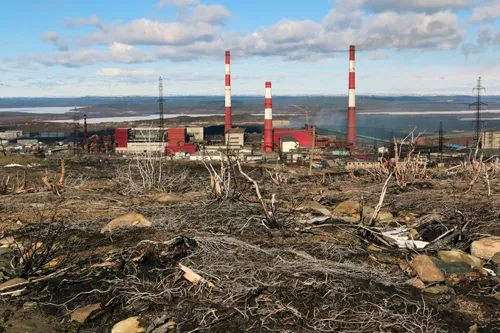
The Pechenganikel plant seen from the southeast and facing the Russian–Norwegian border. Note the extensive damages to vegetation.
Photo: Amund Trellevik
Photo: Amund Trellevik
However, the proximity to Russia does not only produce cooperation, trade and cultural exchange. It can at times, especially during the cold Arctic winter when meteorological factors conspire to put a frosty lid over the area, result in something entirely different. For instance, on 25 February 2019, during an especially frigid period when temperatures plummeted towards minus 40 degrees Celsius, the Sør-Varanger administration felt obliged to warn local citizens to stay indoors. It was not the freezing cold that constituted the danger (people in Finnmark are well equipped to handle low temperatures). Rather, it was a specific Russian export which flowed unchecked across the Russian–Norwegian border that necessitated this public announcement: streams of sulphur dioxide emitted from the industry in the Russian border town Nikel. According to the local newspaper, an air quality measuring station close to the national border reported sulphur dioxide content in the atmosphere that well surpassed the established danger levels of 500 milligram per cubic metre of air.
The same article informed that the Russian owner-oligarch Mikhail Potanin pledged to reduce his company’s total emissions by 75 per cent by 2023.2 Potanin’s statement, promising air quality improvement around his industrial facilities, is but one of many that have been issued by him and previous owners over the years. To the inhabitants of Sør-Varanger, such promises will hardly raise any hopes. They have seen bright prospects fall through on too many occasions to be swept away by optimism.
In this book, we shall look closer at the historical processes that so persistently curb their enthusiasm by examining the many attempts at decreasing industrial pollution stemming from the Pechenganikel plant in Russia’s northwestern corner. These efforts have since the late 1980s involved, inter alia, Soviet and Russian industry and government agencies, Finnish and Swedish industrialists and officials and, not least, Norwegian environmental authorities, foreign services and ecological activists. Thus, the history of pollution control in Northwest Russia is both a transnational history and an environmental history. It is also, inasmuch as the book follows the development from the dying breaths of the Soviet Union to the final Norwegian decision to withdraw from the collaborative efforts in 2010, a contribution to post-Soviet history. Finally, this book is an account of how Russia’s transformation from a socialist superpower to a quasi-democratic and ultra-capitalist state was handled by Western societies, in this case a small neighbouring country.
Before we embark on the main narrative of this book, I will introduce some background information and analytical approaches that will help frame the empirical investigation. One of the more astounding features of the thirty-year history of the Pechenganikel modernization is that the collaborative efforts to curtail polluting emissions have barely made a dent in Pechenganikel’s practices. This suggests that there are deeper constraints than just scarce funding and technological difficulties at play. In the coming section, I argue that one main impediment to success lay in how industrial activity and industrial waste was and is perceived of in the Soviet Union and later Russia. I then round off this introduction by briefly outlining two approaches to understanding ideas, interests, motivations and restraints that surround international relations. These approaches will be revisited in the concluding chapter of this book, and thus inform my analysis of why and how the Pechenganikel modernization never materialized.
Soviet and Russian environmental thinking
In the final years of the Soviet Union and in the aftermath of its collapse, environmental issues were in vogue, for various reasons. The attention directed at Soviet environmental practices, or lack thereof, was immense. Exposed to the outside world, Soviet and later Russian authorities came under pressure to deal with the problems of industrial discharges that had apparently been ignored during seventy years of Soviet rule. In some instances, Soviet pollution was harmful not only to Soviet/Russian territory, but also to neighbouring countries. Pechenganikel was an example of this, and its emissions became a contentious question in Soviet and later Russian relations with the Nordic neighbours. As background to my treatment of the meeting between Soviet and Nordic (predominately Norwegian) ideas and interests that took place in the Pechenganikel question, some aspects of the scholarly debate on Soviet approaches to nature and pollution merit attention here.
Recent research has aimed to nuance the commonly promoted image of Soviet society as one-sidedly preoccupied with the wealth-accruing potential of nature and natural resources. Attention to nature, it is argued, was an accompanying feature of Soviet industrialization, though admittedly one that rarely en joyed priority status. As will be maintained in the following, the insights provided by these studies, however valuable, do not provide the basis for a revision of the basic understanding that the Soviet state (and, by extension, its Russian successor) invariably ranked industrial interests over environmental values.
In his comprehensive historical study of the Soviet conservationist movement, Douglas R. Weiner shows how the existence of this essentially oppositional grouping was accepted by the Soviet leadership. Finding no apparent answer as to why this came to be, he arguably, and perhaps inadvertently, provides the answer, in pointing to the movement’s ‘single-minded focus on the protection of “pristine” nature’. The movement never truly challenged industrial interests, but rather served to uphold a division between industrialized areas (where acceptance of pollution was high) and wilderness areas that were protected as zapovedniki (where pollution or other human influences were kept to a minimum). In Weiner’s interpretation, it seems, the main significance of the Soviet environmental movement did not reside in its ability to fight pollution, but in its role as an accepted vehicle for (minor) dissent. For Soviet conservationists, ‘environmental activism provided the feeling (and sometimes the fact) that they were tangibly and independently defending the good of the community in the face of a repressive, wasteful, and destructive bureaucratic system’.3
A social science study of the Soviet environmental legacy addresses what is seen as a knowledge gap among non-Russian researchers in the aftermath of the Soviet collapse. Pointing to what he calls ‘a number of underlying preconceptions and biases’, Jonathan D. Oldfield criticizes Western scholars’ ignorance of Soviet nature protection agencies and history of environmental management. Drawing inter alia on Weiner’s work, Oldfield traces the roots of the conservationist movement back to the pre-revolutionary era and describes the network of protected zapovedniki. Furthermore, he writes, the Soviet regime ‘left a reasonably extensive environmental monitoring infrastructure in addition to systems of natural resource management and environmental impact assessment’. He concludes that ‘a more sensitive understanding of Russia’s environmental legacies is essential if we are to move away from the notion of Soviet society possessing a limited social and intellectual capital in the general area of environmental protection’.4
Like Weiner and Oldfield, historian Andy Bruno identifies a Soviet reverence for nature. In his book The Nature of Soviet Power, Bruno argues that varying degrees of holistic approaches accompanied the Soviet inclination to view nature as an impediment that should be conquered for the sake of human betterment. While clearly poorly protected, the natural environment was not disregarded. Bruno argues that Soviet industrialism, in its essence, was not uniquely antagonistic to the natural world. Rather, Soviet industry related to resources much the same way as its capitalist counterparts and viewed the riches of the natural world as wealth-accruing substances to be exploited. There existed, however, an undeniable gap between environmental standards in the Soviet Union and large parts of the capitalist world towards the end of the Soviet era. Bruno, acknowledging this, seems to ascribe the prolific environmental degradation that became evident in the Soviet Union from the mid-1980s onwards mostly to a lack of flexibility in the planned economy in the face of global economic shifts in the 1970s and 1980s.5 I will, on the basis of the empirical study in this book, argue that such an exogenous explanation cannot fully account for the remarkably damaging environmental practices of Soviet industry. Rather, I emphasize a factor indigenous to the Soviet, and later Russian, system: that national industry, unlike its Western counterpart, was able to operate unchecked by any form of restrictive and empowered environmental agencies.
Neither Weiner nor Oldfield nor Bruno argue that Soviet industrialization was anything less than disastrous for the natural landscapes that were exposed to it, but their main objective has been to identify traces of Soviet environmental concerns. Consequently, their studies tend to emphasize evidence of such tenets. The purposes of the present study are quite different. Unlike these authors, I see Soviet and Russian environmental policies in the contrasting light cast by neighbours who held different views about industrial pollution and its detrimental effects on the environment. I will argue that the actual impact of environmental concerns on Soviet and later Russian policies can be assessed better in this comparative light. In other words, while Weiner, Oldfield and Bruno have demonstrated that the environment did matter to the Soviet state, the question remains exactly how and to what degree it mattered.
The historical trajectory that culminated in the establishment of modern and influential environmental protection agencies as seen in many Western countries from the early 1970s was not paralleled in the Soviet Union.6 Oldfield does demonstrate that evidence of environmental concerns in government can be traced continuously throughout Soviet history, but he is acutely aware that these concerns never trumped the logics of productivity in the centrally planned economy. Rather than being a policy area in their own right, environmental issues relating to industrial production were dealt with (or ignored) by the various Soviet branch ministries. Only in 1988 did the Soviet Union get its first central (union-level) agency for environmental protection – the State Committee for Nature Protection (Goskompriroda).7
In the Soviet system, there was always a strong inclination to see problems of pollution as a matter for industry itself, and not as an issue for general political debate. During the 1970s, a range of regulations aimed at protecting water, minerals, forests and air quality were enacted in Soviet legislature. Oldfield points to the 1972 Supreme Soviet decree ‘Concerning Measures for the Future Improvement of Nature and the Rational Utilization of Natural Resources [italics added]’ as the forerunner for this legislative process.8 The title of the decree is in itself a pointer towards Soviet, and later Russian, approaches to industrial pollution. It couples the ambition to protect the environment with ‘rational utilization of natural resources’, reflecting the belief that these two goals were seen as symbiotic rather than opposed to each other. The best way to protect the natural environment from industrial waste was not to set limitations for polluting activities, but to strive to optimize industrial processing of raw material.
The emphasis on advances in industrial technology and methods for exploitation of raw materials to reduce pollution is not exclusive to Soviet approaches to environmental problems. Enhancing the environmental standards of production processes is a widespread and obvious ambition in Western countries as well. The Soviet uniqueness resides in the understanding of pollution as a largely acceptable side-effect of the all-important industrial production. Rather than it representing an intolerable damage to the natural environment, and in some cases to human health, pollution was expected to disappear once the industry found better ways of refining its raw materials. Pollution was a purely industrial concern, not a mainstream political matter; and all aspects of industrial activity, including harmful discharges, were to be handled by the industry itself, through unceasing efforts to enhance production methods. The habitual reference to the need to optimize the exploitation of natural resources is evident not only in the abovementioned Supreme Soviet decree from 1972, but in many subsequent Soviet and Russian statements and documents pertaining to industrial pollution.9 Full, or complex, utilization of raw materials was as a crucial tenet in Soviet and later Russian thinking about the problem of industrial waste.
The concept of ‘complex utilization’ was developed in the 1930s by the prominent Soviet geochemist Aleksandr Fersman (1883–1945). Fersman’s programme was intrinsically bound to a deeply utilitarian understanding of nature.10 He argued that the ‘complete use of all mining mass extracted from the earth’ could be made possible through technological advances and comprehensive recycling of the slag resulting from the refining process. He not only was very hopeful of heightened productivity and efficiency, but also enthusiastically foresaw that such a ‘complex utilization’ of mineral ore would mark the end of pollution, as ‘nothing is emitted into the air and washed away by water’ – it would all be used.11
Though arguably utopian, Fersman’s ideas came to influence Soviet governance and industry, forming an important part of the country’s environmental tradition. Pollution problems were simply ascribed to the suboptimal utilization of resources and understood as an expression of the still-underdeveloped production system in the Soviet Union. The concept of ‘complex utilization’ became institutionalized in the Soviet system and was later referred to by civil servants and politicians in post-Soviet Russia. As an idea that shaped Soviet and Russian policy choices, it was very different from the typical Western inclination to see industrial activity and environmental protection as two conflicting aims. I will in this study argue that the contradiction between ...
Table of contents
- Cover
- Half-Title
- Dedication
- Title
- Contents
- List of illustrations
- Acknowledgements
- Abbreviations, acronyms and Russian terms used
- 1 Introduction
- 2 The advent of an environmental disaster
- 3 Business, environmentalism and the Soviet collapse
- 4 Reconstruction time again
- 5 A Russian revival
- 6 Conclusion
- Notes
- References
- Index
- Copyright
Trusted by 375,005 students
Access to over 1.5 million titles for a fair monthly price.
Study more efficiently using our study tools.
Frequently asked questions
Yes, you can cancel anytime from the Subscription tab in your account settings on the Perlego website. Your subscription will stay active until the end of your current billing period. Learn how to cancel your subscription
No, books cannot be downloaded as external files, such as PDFs, for use outside of Perlego. However, you can download books within the Perlego app for offline reading on mobile or tablet. Learn how to download books offline
Perlego offers two plans: Essential and Complete
- Essential is ideal for learners and professionals who enjoy exploring a wide range of subjects. Access the Essential Library with 800,000+ trusted titles and best-sellers across business, personal growth, and the humanities. Includes unlimited reading time and Standard Read Aloud voice.
- Complete: Perfect for advanced learners and researchers needing full, unrestricted access. Unlock 1.5M+ books across hundreds of subjects, including academic and specialized titles. The Complete Plan also includes advanced features like Premium Read Aloud and Research Assistant.
We are an online textbook subscription service, where you can get access to an entire online library for less than the price of a single book per month. With over 1.5 million books across 990+ topics, we’ve got you covered! Learn about our mission
Look out for the read-aloud symbol on your next book to see if you can listen to it. The read-aloud tool reads text aloud for you, highlighting the text as it is being read. You can pause it, speed it up and slow it down. Learn more about Read Aloud
Yes! You can use the Perlego app on both iOS and Android devices to read anytime, anywhere — even offline. Perfect for commutes or when you’re on the go.
Please note we cannot support devices running on iOS 13 and Android 7 or earlier. Learn more about using the app
Please note we cannot support devices running on iOS 13 and Android 7 or earlier. Learn more about using the app
Yes, you can access Pollution and Atmosphere in Post-Soviet Russia by Lars Rowe in PDF and/or ePUB format, as well as other popular books in Politics & International Relations & European History. We have over 1.5 million books available in our catalogue for you to explore.