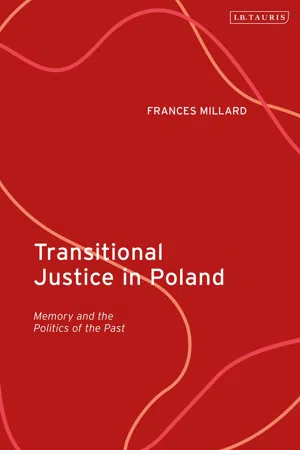
In this study of the mechanisms of transitional justice in Poland, Frances Millard asks: How does society come to terms with its past? How should it punish the perpetrators of oppression and acknowledge its victims? In the former communist countries of Central and Eastern Europe the task of answering these questions came down to the need to eliminate the communist parties' hold over the state, the economy and society in order to move towards democracy. Millard argues that the key step in achieving this was uncovering the truth about the previous regime's past, prosecuting the perpetrators of past crimes and providing compensation and restitution for its victims.
Through the specific case of Poland, Millard provides a comprehensive assessment of the mechanisms and institutions used to achieve this, such as lustration, law enforcement through a Constitutional Tribunal and institutions dedicated to dealing with the past such as the Institute of National Remembrance. Crucially, these processes have assumed new significance in recent years after the Law and Justice Party came to power in 2015, using transitional justice as a tool of political control which has enabled the restructuring of Polish democracy.
- 272 pages
- English
- ePUB (mobile friendly)
- Available on iOS & Android
eBook - ePub
About this book
Information
1
Approaches to the study of transitional justice
Introduction
East Central Europe provides a distinctive arena for the study of transitional justice, and Poland is a particularly interesting case. Like other communist countries Poland was dominated by the Communist Party, with a single ideology of socialism and a planned economy. The collapse of communism in Central Europe was (with the partial exception of Romania) peaceful, spearheaded by the negotiated ‘exit from communism’ in Poland and Hungary in the early months of 1989. Unlike its counterparts, Poland had a strong opposition movement, the Solidarity trade union, penetrating deep into society and providing a strong negotiating partner for the communists. The Catholic Church, which had proved impossible to suppress, provided an alternative moral compass. Although industry was largely in state hands, a land-owning peasantry farmed the land.
This chapter examines the nature of transitional justice and some key theoretical approaches and explanatory frameworks used by scholars to analyse and understand it. It looks at the features distinguishing the countries of Central and Eastern Europe (CEE) in relation to the scope and mechanisms mobilized to remedy the injustices of the previous regime. This provides the basis for the subsequent in-depth analysis of the Polish case. Although it has been suggested that transitional justice is ‘under-theorized’,1 it is hard to see how a single theory could encompass different historical periods, different regions, and the different scope and requisites of modern transitional justice practice. Yet there is no dearth of conceptual clarity and insights to be gained from the various approaches and emphases.
Seeking Historical Justice
New regimes define themselves in terms of the past as well as the future. All new democracies face the question of how to put the formerly repressive, authoritarian regime behind them. How does society come to terms with its past? How should it punish wrongdoers and acknowledge the victims of oppression? After the end of communism in Europe, scholarly focus centred on democratization in a context of ‘multiple transitions’ to democratic capitalism.2 Because the rule of law was the essential underpinning of democracy, institution-building was at the core, with emphasis on the need for new constitutions defining and protecting the rights and liberties of citizens vis-á-vis the state and new state structures securing the separation of powers. The past was the starting point of the future, but the new democratic future could expunge the past. ‘Liberating the future from the past’ would mean a ‘past-free future’ very different from the future which would have emerged out of the ‘old’ past.3
Ridding the systems of the vestiges of communism, ‘de-communization’ was often seen as analogous to the denazification processes following the Second World War.4 But decommunization made CEE distinctive because of the breadth and depth of the project, namely the need to eliminate the communist parties’ pervasive penetration of the state, the economy and society. The new elites sought to generate a multi-faceted transformation of the one-party polity to democracy, the planned economy to capitalism and the society of subjects to an open, pluralist society of active citizens. New structures were necessary but so too were changes of personnel: governments inherited political, economic and social institutions whose senior officials had been appointed with Communist Party approval (the nomenklatura system) and who were – nominally at least – infused with communist ideology.
The ‘transition paradigm’ was dominant, if contentious.5 However, quite quickly CEE was also deemed a relevant arena for approaches based on the concept of ‘transitional justice’, which clearly overlap but do not wholly coincide with the democracy-building project or decommunization. The aim of the new democratic regimes was not only to alter the system for the future; it also needed to right the wrongs of the past, providing justice for the innocent victims of the authoritarian system.
What is transitional justice?
The concept of transitional justice is not straightforward. Firstly, it may refer to a particular concept of justice needed for the interim period of change between one regime and another – a justice that was itself ‘transitional’. As a student of communism this is what I assumed when I first came across the concept. When the Bolsheviks took power in Russia in 1917, they could not use the ‘old’ legal system because they rejected the concept of bourgeois law and the institutional separation of powers; during the period of ‘war communism’ they dissolved the courts and set up people’s courts to be guided by ‘revolutionary legal consciousness’.6 Later the legal system was reconstructed on the new ideological basis of ‘socialist legality’, with judges and legal personnel subject to the dictates of the Communist Party,7 whose ‘leading role’ was eventually given constitutional status. After the imposition of communist power in Eastern Europe, the Soviet model of justice was adopted wholesale.
In the 1990s the problem of transitional justice came to the fore in the context of the collapse of authoritarian regimes. The problem arises because the legal order is a mechanism for maintaining predictability and stability, so law is by nature conservative; it defends and upholds the status quo. At the outset of a putative ‘transition’ to democracy the rule of law is absent or qualified, but the goal of new elites is a state in which the rule of law is the foundation stone for liberal democracy. The new democratic system necessitates radical change in the law as well as mechanisms to ensure the impartiality and independence of judges. Hence, a special kind of ‘justice for the transition’ seemed a legitimate concern; the problem of law was an essential problem of regime change. Transitional justice was ‘a concept of justice, intervening in a period of political change … ; in extraordinary periods of political upheaval, law maintains order even as it enables transformation.’8 Law plays a constitutive role in times of change, though existing law (prior law) shapes the possibilities available.
However, the term transitional justice has also been used to refer simply to ‘justice meted out during the transition’, marked by special concern to address the legacies of human rights abuses. In other words, it can refer to justice ‘during the transition’, rather than a modification of the concept of justice itself. In 1992 the Conference of the Charter 77 Foundation used the term ‘Justice in Times of Transition’ (transitional justice has no easy equivalent in the Slavic languages), a term that then mutated into the more succinct ‘transitional justice’. One result of the conference was the three-volume collection generated by the Rule of Law Initiative of the United States Institute of Peace. Its approach is encapsulated in the subtitle of this major compendium, Transitional Justice: ‘how emerging democracies reckon with former regimes’.9 It focused on the policies adopted for this ‘reckoning’ in twenty countries in six areas: commissions of inquiry, public access to the files of the former secret police, purges and screening practices, trials and (or) amnesty, statutes of limitations, and compensation and rehabilitation.
This approach also embraced some nuanced differences. There could indeed be a distinctive form of justice, often ‘dictated not only by strict principles of justice, but also by the need to balance ethical and legal concerns with the hard realities of politics’,10 especially when the military continued to wield de facto power. However, others questioned the notion of a different concept of justice; the viability and credibility of new democracies depended on dealing with ‘past injustices through means and procedures … consistent with presently valid standards of justice, such as the rule of law and equality before the law’.11 Nor was ‘transitional justice’ necessarily qualitatively different from the problems of change in ‘ordinary’ societies, which also cope periodically with shocks and value shifts.12 This latter view was hotly contested by Wojciech Sadurski, who saw transitional justice as sui generis in post-communist societies.13
The body of scholarship is now very large.14 As it evolved, the concept of transitional justice became more multi-layered and entailed a more complex and broader approach going beyond the strictly legal focus.15 This gave rise to a third approach: increasingly transitional justice came to be seen as a concern with ‘how societies emerge from violent conflict’.16 Louis Bickford observed that the influence of the human rights movement on the development of the field made it ‘self-consciously victim-centric’,17 but it did not only seek ‘recognition for victims (but also the) promotion of possibilities for peace, reconciliation and democracy’.18 Arthur argues that transitional justice was distinctive not in its concern for the victims of injustice under the old regime but in this wider brief, the normative aim of securing democracy.19
The focus on divided societies, riven with bitter conflict and memories of recent atrocities, understandably made reconciliation a key issue of transitional justice in countries like Rwanda or Bosnia, where the integration of ex-combatants and the healing of deep divisions were a key element of social reconstruction. International tribunals and courts were part of this process but so too were international non-governmental organizations for peace-building or conflict resolution. Issues such as poverty and gender equality were fed into the mix.20 Resources provided by the international community proved significant in impoverished countries such as East Timor and Sierra Leone. The Post-Conflict Justice (PCJ) Dataset deals with ‘how post-conflict countries address the wrongdoings committed in association with previous armed conflict’.21 Yet outside parts of the former Yugoslavia post-communism in Europe was different. It did not entail a recent struggle followed by compromise between ‘violently conflicting parties’.22 The international community did not participate directly, as in Rwanda and Bosnia.23
This is why in this study we confine ourselves to the first two approaches noted above, excluding wider issues of the creation of a just society. We are dealing with what Hanson calls an ‘orthodox case’, where ‘a fundamental political transition takes place and the new regime employs transitional justice to deal with rights violations committed under a prior regime’.24 We will argue that there was a distinctive ‘justice of the transition’ but only in a very limited sense. In most instances, the ‘normal’ practices of the rule of law applied.
‘Transitional justice’ remains useful as a shorthand umbrella term to embrace policies dealing with the human rights abuses of the past and with the implications of the past for the new democratic politics. Of course, reckoning with the past also raises questions about how to identify the ‘end’ of ‘transition’. For our purposes the ‘end’ of democratic transition did not signal an end to the process of dealing with the past, so transitional justice (in either conception of the term) has a longer lifespan than democratic transition itself.
Transitional justice in Central and Eastern Europe
Our enquiry is limited to Poland in the context of the so-called Eastern bloc of the USSR. Here transitional justice became a central concern, while in much of the former Soviet Union there was little that could be described as ‘transitional justice’. The democratic project was not entrenched and indeed went into reverse in many post-Soviet states, including Russia itself. We will make some references to the Baltic states, but the context of our discussion is the European communist regimes within the ‘bloc’.
In CEE, the experience of mass repression, purges and murder had largely ended with the death of Stalin in 1953, though individual countries bore the scars of social resistance: protest in East Germany and Czechoslovakia in 1953, the Hungarian revolution of 1956, the Prague Spring of 1968, protest on the Baltic coast in Poland in 1970 and the imposition of martial law in Poland in 1981. But mass murder, large-scale disappearances or the abduction of children did not constitute features of late communism in CEE. In CEE the population largely maintained its passive acquiescence and accommodation with the regime, despite the institutional denial of everyday democratic rights.
Moreover, there was no institutional threat to the new democratic order. The military, which featured so visibly in parts of Latin America, was not accustomed to a political role even in Poland, which had seen General Wojciech Jaruzelski in charge after 1981. This means that a ‘key problem’ of transitional justice, that of finding a balance between the demands of justice and politics,25 seemed peripheral in much of CEE. The velvet nature of the 1989 revolutions meant that they were not protracted; with few exceptions social mobilization against the old regime was limited until the roller coaster began to move in Poland and Hungary, and – with the exception of Yugoslavia, outside the ‘Soviet bloc’ – only in Romania was violence a (short-lived) feature of the ‘revolution’. All elites, old and new, were formally committed to establishing a democratic system. There was no ‘dragon living on the patio’26; no institutions remained ‘on the authoritarian side’.27
It is of course undeniable that serious rights’ violations occurred under communism in CEE. Although rights were nominally guaranteed by the Constitution, these rights could not manifest ‘bourgeois individualism’; they could only be exercised if they were consistent with the ‘interests of working people’. Mechanisms such as censorship defined the limits of free expression, internal registration procedures controlled individual mobility, and when state interests were perceived to be at stake the compliant judiciary ensured that ‘socialist legality’ denied due process and equality before the law. Throughout CEE post-communist governments won power by denouncing the abuses of the old system. The first free elections were ‘founding election...
Table of contents
- Cover
- Halftitle Page
- Title Page
- Dedication Page
- Contents
- List of tables
- Foreword
- 1 Approaches to the study of transitional justice
- 2 The politics of transitional justice in Poland 1989–2015
- 3 Reparations through rehabilitation and compensation
- 4 Dealing with past crimes
- 5 The restitution of property
- 6 Lustration. The first stage 1989–2005
- 7 Lustration after the fall of the SLD: The return of the Right
- 8 History and memory. The Institute of National Remembrance
- 9 The Constitutional Tribunal
- 10 From transitional justice to social engineering
- Conclusion: Some reflections on the justice of transitional justice
- Notes
- Bibliography
- Index
- Imprint
Trusted by 375,005 students
Access to over 1.5 million titles for a fair monthly price.
Study more efficiently using our study tools.
Frequently asked questions
Yes, you can cancel anytime from the Subscription tab in your account settings on the Perlego website. Your subscription will stay active until the end of your current billing period. Learn how to cancel your subscription
No, books cannot be downloaded as external files, such as PDFs, for use outside of Perlego. However, you can download books within the Perlego app for offline reading on mobile or tablet. Learn how to download books offline
Perlego offers two plans: Essential and Complete
- Essential is ideal for learners and professionals who enjoy exploring a wide range of subjects. Access the Essential Library with 800,000+ trusted titles and best-sellers across business, personal growth, and the humanities. Includes unlimited reading time and Standard Read Aloud voice.
- Complete: Perfect for advanced learners and researchers needing full, unrestricted access. Unlock 1.5M+ books across hundreds of subjects, including academic and specialized titles. The Complete Plan also includes advanced features like Premium Read Aloud and Research Assistant.
We are an online textbook subscription service, where you can get access to an entire online library for less than the price of a single book per month. With over 1.5 million books across 990+ topics, we’ve got you covered! Learn about our mission
Look out for the read-aloud symbol on your next book to see if you can listen to it. The read-aloud tool reads text aloud for you, highlighting the text as it is being read. You can pause it, speed it up and slow it down. Learn more about Read Aloud
Yes! You can use the Perlego app on both iOS and Android devices to read anytime, anywhere — even offline. Perfect for commutes or when you’re on the go.
Please note we cannot support devices running on iOS 13 and Android 7 or earlier. Learn more about using the app
Please note we cannot support devices running on iOS 13 and Android 7 or earlier. Learn more about using the app
Yes, you can access Transitional Justice in Poland by Frances Millard in PDF and/or ePUB format, as well as other popular books in History & European History. We have over 1.5 million books available in our catalogue for you to explore.