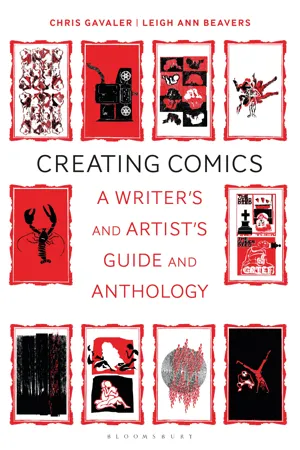
For creative writers and artists, comics provide unique opportunities for expression – but unique challenges, too. Creating Comics brings together in one volume an authoritative guide to the creative process, with practical drawing exercises throughout and an anthology of comics demonstrating the eclectic possibilities of the form. Creating Comic covers: · Using images to conceive and develop characters and stories
· The complete range of possible relationships between two images
· The step-by-step structure of visual narratives
· How to approach each page like a unique canvas
· Combining words and images to create new meanings
Fully integrated with the main guide, the anthology section includes work by creators including: Lynda Barry, Alison Bechdel, Jaime Hernandez, Marjane Satrapi, Adrian Tomine, and many others.
eBook - ePub
Creating Comics
A Writer's and Artist's Guide and Anthology
- 360 pages
- English
- ePUB (mobile friendly)
- Available on iOS & Android
eBook - ePub
About this book
Information
1
Images
CHAPTER OUTLINE
Image First
Scripts Aren’t Images
Media
Reproductions
Line Variation
Draw Reality
Manipulate Reality
Use References
Frames
Revision
Creating Characters
Anthology
“So every once in a while I try to write a story,” explains novelist Peter Cameron,
and since the writer Iris Owens once told me that she didn’t believe in writer’s block because all you needed was one sentence, the first sentence, and there you go, I occasionally try to come up with opening sentences, this being easier than coming up with complete ideas for stories.
2010: 430
Cameron followed this open-ended opening-sentence creative process when writing his award-winning short story “The End of My Life in New York.” It begins:
When I come home from Paula’s dinner party, Philip is still awake, sitting up in bed, contemplating a book.
2010: 266
The sentence is rich in cascading possibilities: Who is Philip? Who is the narrator? Who is Paula? Why didn’t Philip go to Paula’s dinner party too? Does Philip have a problem with Paula? Does she have a problem with him? How does Philip feel about the narrator going without him? Cameron didn’t know the answer to any of these when he first wrote the sentence. Exploring these questions requires an author to develop details about the characters, their relationships, and the larger situation—and there you go, the short story starts writing itself.
But is this an effective process for starting a comic? That first sentence could appear in a caption box in a first panel—but then what image would accompany it? If it’s a drawing of a man sitting in bed with a book, it will have to provide additional details (maybe Philip is a dark-skinned, prematurely balding athletic-looking man in floral pajamas reading a mangled paperback of Pride and Prejudice), but the words and images would still be largely redundant. Scott McCloud terms that word-picture relationship “duo-specific,” and effective comics usually avoids it because the redundancy undermines what’s most interesting about the comics form. Words and image don’t share a path. They work on separate paths that can parallel, crisscross, and diverge.
You might instead delete the caption and let the image stand alone, maybe giving Philip a talk balloon of context-creating dialogue: “How was Paula’s?” No redundancy, so a significant improvement. But while this one-panel image-text would be more interesting than the first, is it the best way to develop a comics story? Even though that originating sentence would not be included in the comic itself, the image is still an illustration of the deleted words. It began as an idea, one visually vague by virtue of being word-based. Cameron’s sentence could produce literally thousands of necessarily specific variations, an infinite number of possible Philips drawn in varying angles and styles.
If Cameron were a comics writer, he might write a whole script this way, aware that each of his verbal descriptions would eventually be interpreted and made visually concrete by some future collaborating artist. His words would be akin to a song score to be later played by a musician whose performance would be the actual comic. But no one thinks of sheet music as music itself, and what composer writes music only through musical notation? Notes on a staff are only a method of representing sounds, ones tested, revised, and retested aloud on actual instruments during the composing process.
Though theoretically a composer could compose exclusively in her head—Mozart supposedly did—words are far less precise than notation. While comics writer Alan Moore is notorious for producing exceptionally detailed scripts for his collaborating artists, Nat Gertler’s script for “Degeneration” nearly exceeds the a-picture-is-worth-a-thousand-words truism. Here is an excerpt describing a portion of the office setting to appear in the opening panel:
There is a desk facing the entrance door. It has a heavy, polished black stone top, and space directly under that for about 4 inches of drawers. The desk is supported by black metal sides; instead they head from the edge of the top downward and inward, curving back at the bottom to provide feet. This has the effect of accentuating the information that the desk does not have file drawers on the side—this is not the desk of someone who is supposed to keep his own files, and heaven forbid that it looks as though he does.
2002: 163
Gertler seems to have a very specific desk in mind, and though artist Steve Lieber translates his descriptions dutifully, it’s not possible for Lieber’s drawn desk and Gertler’s mentally imagined and then verbally described desk to be the same desk. For one, the desk is not described from one specific angle—a requirement of drawing. It is instead described in perspective-free details true from all possible angles. The desk isn’t being looked at it—it simply is. Gertler later describes his preferred “angle” too: “we’re looking toward the desk from the inside … we can be far enough back that we get a sense of the room” (2002: 164). But this isn’t a single angle either, but a slightly reduced range of possible angles.
Not only are Gertler’s words not a desk, they may not produce a specific image of desk in a reader’s head either. Peter Mendelsund observes that “even the most … lushly described locales in naturalistic fiction, are, visually: flat” and “characters, in all types of fiction, [are] merely visual types, examplars of particular categories—sizes; body, shapes; hair colors”; and since we “don’t have pictures in our minds when we read, then it is the interaction of ideas—the intermingling of abstract relationships—that catalyzes feeling in us readers” (2014: 371, 373, 245). That’s why verbal descriptions can’t achieve what drawings can. To visually represent something is to capture it from one specific perspective at one specific moment. Visual representations are inevitably spatiotemporal—which is why comics tend to be like storyboards or sequenced snapshots. Moving from image to image in a comic typically means also moving from moment to moment and perspective to perspective. That is a norm that can and should be overturned at times. No matter how detailed a visual description might be—Gertler could describe not only the desk but how it appears from one precise angle as though working from a photograph in his head—words are not images. The image in Gertler’s head is not an image either. It’s an idea. He then translates his mental ideas into words and Lieber translates those words into an image.
Image First
So why not just begin with the image?
Images are physical. They’re ink on paper or pixels on screen or paint on canvas. Words can be physical too, but only to the degree that they are rendered lines and shapes. Their meanings are less grounded. Prose writers weigh not simply a word’s overt definition, but its connotations too, including its sounds and associations. Cameron could have written that Philip was “reading a book.” Instead he wrote “contemplating a book.” Do the two verbs denote the same meaning? More or less, but the nuance of difference is the power of prose. Philip might instead be studying, flipping through, fingering, squinting at, clutching, or hunching over a book. Each has a slightly different connotation that subtlety shapes a reader’s experience. And while some of these subtleties might be translatable to a drawn image, images acquire other qualities in the process, producing a range of additional connotations that couldn’t be expressed in words. What is the attitude toward Philip implied by the angle of perspective? What is the expressive quality of the lines that compose his body? Do they convey the same low energy of his quiet activity or contradict it? Is he holding the book in one hand or two? Is his posture overall relaxed or stiff? And what do all those external details imply about Philip’s internal state?
Images also are not simply information conduits. They contain ambiguities. A script writer can only state what she hopes the image will convey, not what the image will actually be. Even an artist can’t control for every visual nuance and how those details—the unplanned slope of Philip’s cartoonish shoulders, the slightly frenetic scribble of his hair shading—will shape the viewer’s experience of the scene. A drawing is not simply an execution of an idea. Things happen in the drawing process itself, and so the composition of the comic doesn’t fully begin until the artist commits pencil to paper (or paint to canvas or photograph to Photoshop, etc.). And yet a scripter first conceives and develops an imaginary comic through the medium of words—which is not the medium of the comic. Conceiving and developing a story in a different medium turns the actual comic into an adaptation, a secondary work that is dependent on the primary work. Script-based writing reduces comics art to illustrations. It also shapes the content in ways alien to image-making.
Consider the second sentence of Peter Cameron’s short story:
I know from experience that he is not reading.
2010: 266
How does an artist draw that? She doesn’t. It’s a visually unrepresentable fact. Like Gertler’s desk, it simply is. To translate it, the adapter would have to invent a specific action—a single event in space and time—ideally one that implies a pattern of similar actions. The narrator could say, “I know you’re not reading.” Again, a good translation, but since comics are more than illustrated plays, it’s better if an image does more than prop dialogue. Maybe Philips is holding his copy of Pride and Prejudice upside down. Not bad, but how does the humorous effect alter the intended tone? If the author were simply working with images as images and not as translations of text, there would be no intended tone. There would only be the drawn drafts of the comic itself.
If Peter Cameron were a comics artist-writer, his story’s characters andsituations co...
Table of contents
- Cover
- Half-Title Page
- Series Page
- Title Page
- Contents
- List of Illustrations
- Acknowledgements
- Introduction: An Art-Focused Approach to Creating Comics
- 1 Images
- 2 Hinges
- 3 Sequences
- 4 Pages
- 5 Words
- 6 Processes
- 7 Anthology
- Works Cited
- Index
- Copyright
Trusted by 375,005 students
Access to over 1.5 million titles for a fair monthly price.
Study more efficiently using our study tools.
Frequently asked questions
Yes, you can cancel anytime from the Subscription tab in your account settings on the Perlego website. Your subscription will stay active until the end of your current billing period. Learn how to cancel your subscription
No, books cannot be downloaded as external files, such as PDFs, for use outside of Perlego. However, you can download books within the Perlego app for offline reading on mobile or tablet. Learn how to download books offline
Perlego offers two plans: Essential and Complete
- Essential is ideal for learners and professionals who enjoy exploring a wide range of subjects. Access the Essential Library with 800,000+ trusted titles and best-sellers across business, personal growth, and the humanities. Includes unlimited reading time and Standard Read Aloud voice.
- Complete: Perfect for advanced learners and researchers needing full, unrestricted access. Unlock 1.5M+ books across hundreds of subjects, including academic and specialized titles. The Complete Plan also includes advanced features like Premium Read Aloud and Research Assistant.
We are an online textbook subscription service, where you can get access to an entire online library for less than the price of a single book per month. With over 1.5 million books across 990+ topics, we’ve got you covered! Learn about our mission
Look out for the read-aloud symbol on your next book to see if you can listen to it. The read-aloud tool reads text aloud for you, highlighting the text as it is being read. You can pause it, speed it up and slow it down. Learn more about Read Aloud
Yes! You can use the Perlego app on both iOS and Android devices to read anytime, anywhere — even offline. Perfect for commutes or when you’re on the go.
Please note we cannot support devices running on iOS 13 and Android 7 or earlier. Learn more about using the app
Please note we cannot support devices running on iOS 13 and Android 7 or earlier. Learn more about using the app
Yes, you can access Creating Comics by Chris Gavaler,Leigh Ann Beavers in PDF and/or ePUB format, as well as other popular books in Languages & Linguistics & Creative Writing. We have over 1.5 million books available in our catalogue for you to explore.