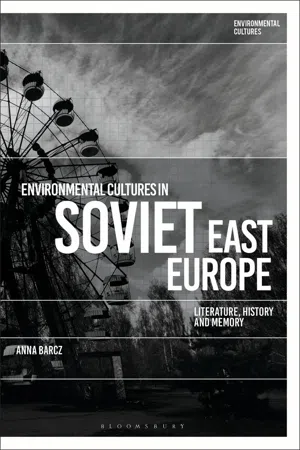
For more than 40 years Eastern European culture came under the sway of Soviet rule. What is the legacy of this period for cultural attitudes to the environment and the contemporary battle to confront climate change?
This is the first in-depth study of the legacy of the Soviet era on attitudes to the environment in countries such as Poland, Hungary and Ukraine. Exploring responses in literature, culture and film to political projects such as the collectivisation of agricultural land, the expansion of the mining industry and disasters such as the Chernobyl explosion, Anna Barcz opens up new understandings of local political traditions and examines how they might be harnessed in the cause of contemporary environmental activism. The book covers works by writers such as Christa Wolf, the Nobel Prize winner Svetlana Alexievich and film-makers such as Béla Tarr, Andrzej Wajda and Wladyslaw Pasikowski.
- 256 pages
- English
- ePUB (mobile friendly)
- Available on iOS & Android
eBook - ePub
About this book
Information
Part One
Unknownland: Retelling the
Environmental History of Soviet
Eastern Europe through Literature
and Cultural Memory
1
Narrating History across Borders
In this book I examine texts, events and phenomena that help explain the environmental cultures of the former Soviet dominion and reconnect memory and environmental history through literature. Eastern Europe here delimits the spatial and historical context in which all the cultural phenomena described take place. Considering the geopolitical timeline, the book mainly focuses on the period of Stalin’s reign and the Soviet domination of Central and Eastern Europe, including the European part of Russia, after the Second World War. In fact, the Soviet era began much earlier, when the October Revolution, also called Red October or the Bolshevik Revolution, established the Russian Soviet Republic as the world’s first constitutionally socialist state on 7 November 1917, with the imposition of communist ideology and the execution of Tsar Nicholas II and his family. However, when it comes to nature as an essential part of the Soviet communist project via the state’s industrialization, collectivization and militarization, the real starting point is exactly in line with Stalin becoming the dictatorial ruler of the Soviet imperium towards the end of 1927, after the expulsion of Trotsky. To put it even more precisely, the most harmful and large-scale anti-environmental programme was Stalin’s so-called Plan for the Transformation of Nature, which was initiated in the 1930s and partially implemented in other subjugated countries after the Second World War (Josephson 2016: 8–36).
The year 1945, following the Yalta Conference, was a breaking point for many distinct countries and regions that were suddenly brought together to form an isolated island – the Soviet bloc – an Unknownland for non-Easterners who were luckily excluded from the Soviet phantasm of community. The rise and fall of this vast body of socialist land – ‘the land-utopia’, as Svetlana Alexievich called it – strained not only countries within it but also the entire non-human world (The Nobel Prize 2015). The Stalinist system, in contrast with that of the Nazis, precluded any environmental protection, although Chernobyl was the first event to open people’s eyes to the negative consequences of intensive Soviet modernization.
However, scholars dealing with Soviet history and its environmental legacy tend to concentrate on Russia (Ziegler 1987; Pryde 1991; Feshbach and Friendly 1992; Feshbach 1995; Josephson et al. 2013) and on the extension of Western European political and economic systems following the collapse of the Soviet Union (Manser 1994; Carter and Turnock 1996; Webster 2016). While they criticize the polluting economies of Eastern European countries, their analyses typically ignore the cultural dimensions of this phenomenon.
In order to avoid the simple but still-dominant schema of contrasting East with West, and the stigmatization of the ‘Eastern’ in Western environmental culture, I reread texts on Soviet Eastern European environmental history in conjunction with the cultural memory and other-than-human voices I find in literary narratives. I ask questions about the criteria that should be used to identify sources for the cultures of nature in this part of the world and seek to reframe the sweeping notion of ‘Easternness’ that was ‘naturalized for the broader Western audience’ after the fall of the Iron Curtain (Trojanowska, Niżynska and Czapliński 2018: xvi). Roskin argues, for example, that ‘East Europeans do not think of themselves as East Europeans’ and suggests that phrases such as the ‘Eastern bloc’ are controversial (Roskin 2002: 2). While Soviet Eastern Europe can be equated with Warsaw Pact signatory states (Maslowski 2011: 13), the countries thus encompassed developed distinct identities, responses to their political situation, and cultural representations of the environment. Even so, it is possible to discern broad patterns amid the variation and identify some tropes and figures of cultural memory that are linked across Eastern Europe.
To enhance memory of the communist period and extend it to environmental representation, I do not treat Eastern Europe and Central Europe as separate entities, no matter how sharply their cultural identities differ (Ash 1989; Maslowski 2011). Hungary, the Czech Republic and the former East Germany geographically belong to Central Europe, but when it comes to reconstructing environmental cultures in the period of Soviet domination, the histories of Central and Eastern Europe merge. Writers and intellectuals like Milan Kundera, Andrzej Stasiuk and Juriji Andruchovych in My Europe (2000) have concentrated on cultural phenomena shared by the whole of (post-communist) Eastern Europe, while historians such as Robert Traba have focused on ‘places of memory’ (2015–17) spread across this vast region. Environmental cultures should also be considered such hybrid phenomena.
Political borders are obstacles for revising historical narratives to include environmental cultures because they do not admit a variety of non-human witnesses to past events, such as mountains, forests and trees, meadows and ravines, rivers and lakes, or animals. However, these beings, as well the soil, weather, particular landscapes, polluted environments and even hazardous radiation emitted by nuclear waste are the real sources of this istóriya1 – not Eastern Europe’s shifting borders. These non-human historical actors prompt me to reflect on the gaps in historical narratives and on the way I reread texts of cultural memory and ask who or what should be included in reconstructing the Soviet past’s troubled human relationship with nature.
To some extent historical discourse reflects the structural and conventional guidelines of its leading branches (e.g. political, social, economic, military and even environmental history), because the borders between humans and the environment are themselves historical and we constantly participate in the process of renegotiating them. Many authoritative historians certainly understand history as mankind’s activities in the past, as conscious action (Collingwood 1946), or as ‘the science of people in time’ (Marc Bloch, see Domańska 2006). The same goes for major German philosophers of history who produced the influential historical narratives, such as the history of human freedom (Georg Friedrich Hegel) or the history of moral constraints (Friedrich Nietzsche, Max Weber). Such classics raise neither the question of non-human histories nor the natural status of humans in the course of history (Chakrabarty 2009: 214). In other words, the historiography of non-human actors and the problem of environmental representation is either excluded from human-centred historical narration, or subordinated to explaining human involvement in past events.
However, some useful ideas about how to challenge anthropocentric historiography have emerged via a sceptical approach to historical research. The French historian Paul Veyne argues (1984 [1971]) that history has neither a clearly defined object nor a particular method. Historians study not only people but everything that is specific and took place in the past (Veyne 1984: 59). The only restriction historians impose upon themselves is that they do not search for laws, which they leave to social scientists. There is not even a consensus about a minimal definition of history as a discipline concerned with ‘humankind in the past’:
Then what is history? And what do historians, from Thucydides to Max Weber or Mark Bloch, really do, once they have gone through their documents and proceeded to the ‘synthesis’? Is their work the scientifically conducted study of the various activities and the various creations of men in other days? the science of men in society? human societies? … The science of what sort of societies? The whole nation, even humanity? A village? At least an entire province? A group of bridge players? … The human presence is not necessary for events to rouse our curiosity.
Veyne 1984: x, 3, 58
I quote from a passionate essay in which Veyne concludes that humanity is too narrow to serve as an historical object, since historical events without ‘human presence’ still intrigue us and, I would add, some histories cannot even be reconstructed without considering other-than-human actors. In a broader perspective, human history must be combined with that of geology and environments because they are not only related but challenge each other. As Dipesh Chakrabarty argues in his critique of anthropocentric historiography, The Climate of History, we face the collapse of the ‘age-old humanist distinction between natural history and human history’ (2009: 201). The global climate does have a history (Carey 2017), as do forests (Grewe 2010; Brain 2011; Brock 2017). Including non-human animals in historical narratives is actually necessary – for example, to describe the lives lost in the First World War (Baratay 2013) or to write the history of the circus, in which animals have obviously long been central performers (Neirick 2012).
Writing histories that include non-humans, or even writing histories of non-humans, may shed some light on historical scholarship’s approaches to writing itself. In this case, an historian is like a writer who enters unknown territory with no definite borders and searches the most convincing language for characters who are under-represented in historical discourse and that, like climate or soil, need not be anthropomorphized to be included. Ecocritically-oriented historians, informed by theory, focus on how to de-hierarchize hi...
Table of contents
- Cover
- Half-Title Page
- Series Page
- Title Page
- Contents
- List of Illustrations
- Acknowledgements
- Introductory Remarks
- Part One Unknownland: Retelling the Environmental History of Soviet Eastern Europe through Literature and Cultural Memory
- 1 Narrating History across Borders
- 2 History and Literature
- 3 Environmental History
- 4 Cultural and Environmental Memory
- Part Two The Tired Village
- 1 Historical Background
- 2 Fatigue: Platonov’s Pit and the Stalinocene
- 3 The Rural World is Gone: Peasants’ Voices
- 4 Satantango: Interconnecting Human and Ecological Worlds
- Part Three The Earth’s Memory
- 1 Mining Narratives and Their Historical Background
- 2 Unearthing the Story of Coal: Drach
- 3 The Uranium Narrative: History of a Disappearance
- Part Four The Persistence of Chernobyl in Cultural Memory
- 1 Eastern European Risk Narrative: Chernobyl Memorial
- 2 Contaminated Language: Wolf’s Accident
- 3 The Bees Knew: Alexievich’s Chronicle
- Part Five Disturbed Landscapes
- 1 Non-sites of Memory and the Violation of Nature
- 2 Greening Sites of Memory
- 3 Białowieża Forest across Eastern Europe’s Borders
- Notes
- Bibliography
- Index
- Copyright
Trusted by 375,005 students
Access to over 1.5 million titles for a fair monthly price.
Study more efficiently using our study tools.
Frequently asked questions
Yes, you can cancel anytime from the Subscription tab in your account settings on the Perlego website. Your subscription will stay active until the end of your current billing period. Learn how to cancel your subscription
No, books cannot be downloaded as external files, such as PDFs, for use outside of Perlego. However, you can download books within the Perlego app for offline reading on mobile or tablet. Learn how to download books offline
Perlego offers two plans: Essential and Complete
- Essential is ideal for learners and professionals who enjoy exploring a wide range of subjects. Access the Essential Library with 800,000+ trusted titles and best-sellers across business, personal growth, and the humanities. Includes unlimited reading time and Standard Read Aloud voice.
- Complete: Perfect for advanced learners and researchers needing full, unrestricted access. Unlock 1.5M+ books across hundreds of subjects, including academic and specialized titles. The Complete Plan also includes advanced features like Premium Read Aloud and Research Assistant.
We are an online textbook subscription service, where you can get access to an entire online library for less than the price of a single book per month. With over 1.5 million books across 990+ topics, we’ve got you covered! Learn about our mission
Look out for the read-aloud symbol on your next book to see if you can listen to it. The read-aloud tool reads text aloud for you, highlighting the text as it is being read. You can pause it, speed it up and slow it down. Learn more about Read Aloud
Yes! You can use the Perlego app on both iOS and Android devices to read anytime, anywhere — even offline. Perfect for commutes or when you’re on the go.
Please note we cannot support devices running on iOS 13 and Android 7 or earlier. Learn more about using the app
Please note we cannot support devices running on iOS 13 and Android 7 or earlier. Learn more about using the app
Yes, you can access Environmental Cultures in Soviet East Europe by Anna Barcz in PDF and/or ePUB format, as well as other popular books in Literature & Eastern European History. We have over 1.5 million books available in our catalogue for you to explore.