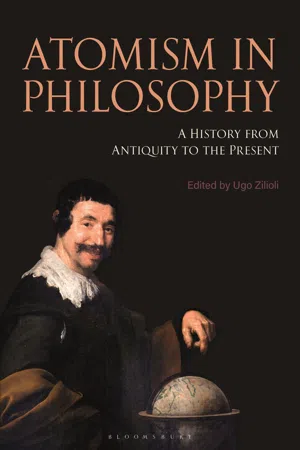
The nature of matter and the idea of indivisible parts has fascinated philosophers, historians, scientists and physicists from antiquity to the present day. This collection covers the richness of its history, starting with how the Ancient Greeks came to assume the existence of atoms and concluding with contemporary metaphysical debates about structure, time and reality.
Focusing on important moments in the history of human thought when the debate about atomism was particularly flourishing and transformative for the scientific and philosophical spirit of the time, this collection covers:
- The discovery of atomism in ancient philosophy
- Ancient non-Western, Arabic and late Medieval thought
- The Renaissance, when along with the re-discovery of ancient thought, atomism became once again an important doctrine to be fully debated
- Logical atomism in early analytic philosophy, with Russell and Wittgenstein
- Atomism in Liberalism and Marxism
- Atomism and the philosophy of time
- Atomism in contemporary metaphysics
- Atomism and the sciences
Featuring 28 chapters by leading and younger scholars, this valuable collection reveals the development of one of philosophy's central doctrines across 2,500 years and within a broad range of philosophical traditions.
- 592 pages
- English
- ePUB (mobile friendly)
- Available on iOS & Android
eBook - ePub
About this book
Information
PART 1
Atomism in ancient philosophy
CHAPTER 1
Early ancient atomism
Similarities and differences
Andrew Gregory
There is a great temptation in dealing with the early atomists, especially in a volume like Atomism in Philosophy: From Antiquity to the Present, to overplay the similarities with later and modern atomism and to underplay the differences.1 Even when differences are recognized, there can be a tendency to treat them as philosophically uninteresting or as a product of their time which can easily be ignored or rectified. It is also important not to treat the earlier atomists solely as precursors to later ones. It is common in the literature for the ancient atomists to be seen as predecessors to the mechanical philosophy of the seventeenth century. If the ancients are seen in this manner, there can be a tendency to treat the questions which exercised later atomists as critical to the ancient atomists and there can be a tendency to impose later answers as well. It is often historically more accurate and more enlightening to treat them as reacting to their predecessors and to place them in their own philosophical situation. This chapter will look at the atomism of Leucippus (fifth century BCE) and Democritus (c. 460–c. 370 BCE), who can reasonably be said to have originated the idea of atomism in the Western tradition. It will argue that while there are important similarities with later atomists, there are some interesting differences as well and we need to be cautious about imposing later ideas on Leucippus and Democritus. Key issues here are the motivation towards atomism, how atomism was argued for, what we would term conservation of energy and background assumptions about the nature of atoms and space.
Parmenides’ problems
Leucippus and Democritus are rightly seen as reacting to the philosopher Parmenides (c. 520–c. 450 BCE). Parmenides’ ontology was brutal in its apparent simplicity. He argued that ‘what is’, is and ‘what is not’, is not and ‘what is not’ cannot be thought of or spoken about.2 Parmenides further argued that there can be only one existent thing, which is spherical and incapable of movement or change.3 Exactly how we should understand Parmenides has been discussed ever since,4 but there is no doubting his influence in antiquity. Leucippus and Democritus are seen as in a sense asserting the existence of ‘what is not’, in the form of to kenon, the void. They also asserted that ‘what is’ exists as multiple, indivisible entities (Greek atomos, hence atoms). These atoms do not change in themselves, but can become entangled with each other to form more complex entities and can become un-entangled again. These changes at a micro level are what we ultimately perceive and understand as change in our perceptual world. The early atomists also appear to be strongly reductive. Democritus Fragment 9 says:
By convention sweet, by convention bitter, by convention hot, by convention cold, by convention cold, but in reality atoms and the void.
Here one might say, so far so good. This all looks reasonably familiar and even if the idea of the ‘entanglement’ of atoms looks crude by modern standards, at least there is some account of how atoms come together and come apart again.
Further issues
In this context of reacting to Parmenides, there were questions which were important for the ancient Greeks, though they may look a little odd to us. If there is no longer just one entity, then how many entities are there? If there are many entities, what are their shapes? If there are many entities, what is their distribution? On the question of the shapes of the atoms, Simplicius (c. 490–c. 560CE), an important ancient commentator, tells us that
Leucippus supposed there to be an infinite number of atoms that are always in motion and have an infinite number of shapes on the grounds that nothing is this rather than such (dia to mêden mallon toiouton ê toiouton einai).5
This is an interesting deployment of an ou mallon, a ‘not rather’ argument. There is no reason to prefer any one shape over another shape (so not rather this shape than that shape) so there are many shapes for the atoms. It is generally held that Leucippus and Democritus thought something similar about the sizes of atoms. There was no reason to prefer any specific size, so there were many sizes.6 On the subject of the distribution of the atoms, Plutarch (c. 46–c. 120 CE), another ancient commentator stated the following:
He said that thing exists no more than (mê mallon) nothing, ‘thing’ being the name of body and ‘nothing’ of void, the latter having a nature and substance of its own.7
There is then no reason why this part of space is occupied and this part is not.8 So if asked about the distribution of atoms in the void, the Leucippus and Democritus reply is ou mallon, there is no preferred distribution, no reason why this part of space is occupied rather than that part, no reason why this atom is here rather than there. Aristotle (384–322 BCE) also has this to say about Leucippus and Democritus in his Physics:
Why should there be void here rather (mallon) than there? If an entity is in one place, should it not be in all places?9
Aristotle’s criticism comes, typically, from a strong sufficient reason perspective. Why, if all parts of the void are similar, should there be a distribution of matter, with some here and none there? Sometimes it is thought that Leucippus and Democritus subscribed to the principle of sufficient reason, but that clearly is not Aristotle’s view of them. If their view is that the shapes of atoms and the distribution of atoms are genuinely ou mallon, then it is hard to see how they could support the principle of sufficient reason. This should be seen in contrast to Parmenides who asked, if something were to grow for nothing, when would it do so (why sooner rather than later) and where it would do so,10 given the homogeneity of what is and the non-existence of what is not.
Atoms and void as unlimited?
It is standard to say that the early atomists had an infinite number of atoms in an infinite void and that there were an infinite number of shapes and sizes for those atoms. This may be an over-modernization of their thought though. The original Greek here actually derives from the word aperas, literally without limit, the a being an alpha privative and peras meaning limit. This can mean infinite, but it could also mean unlimited. Parmenides was much concerned with limits and used the term peras and its cognates.11 The early atomist reply may be to deny limits rather than to assert infinity. So there are an unlimited number of atoms in an unlimited void and these atoms have an unlimited selection of shapes and sizes. Do we read ‘infinite’ into the early atomists, making them more modern, when ‘unlimited’ might be more appropriate? Interpreting to kenon, the void, as space may also over-modernize the early atomists. So rather than atoms moving in Newtonian space (=the void), it is more likely they thought of atoms (=being) and voids (=not being) moving in space, placing atoms and voids on equal footing in space.12 This would make their reply to Parmenides more coherent. Parmenides did not deny that what exists is somewhere but did deny that there could be somewhere without what exists.13
Plato on atomism
Plato’s views are often written out of the history of atomism as his strongly teleological and a priori ideas do not sit well with modern conceptions. Nevertheless, his views are of some interest especially in contrast to the views adopted by Leucippus and Democritus. Plato (428–c. 348 BCE) postulated two types of triangle as his basic, unchangeable entities, the 1, 1, √2 triangle and the 1, √3, 2 triangle.14 These could form up into more complex planar entities, four of the 1, 1, √2 triangles into a square and six of the 1, √3, 2 triangle into an equilateral triangle. These in turn could form up into three-dimensional entities, matching the four elements of common early Greek thinking. So there was a cube of air, a tetrahedron of fire, an octahedron of air or an eikosahedron (twenty sides) of water. The two basic triangles are chosen by the demiurge, Plato’s organizer god, who did not create ex nihilo but organized from a primordial chaos. The demiurge chose these two triangles from the unlimited/infinite number of possible triangles because he considered them to be the two best types of triangles. While it is less clear why these two triangles are good (are they intrinsically good or good because they can generate the symmetrical Platonic solids which are the elements?), it is clear from the proliferation of the term ‘good’ in the relevant passages that Plato did think these triangles were preferable and so were chosen by the demiurge.15 This was typical of Plato’s approach to such questions. He argued for a single we...
Table of contents
- Cover
- Half-Title
- Series
- Title
- Contents
- LIST OF CONTRIBUTORS
- PREFACE AND ACKNOWLEDGEMENTS
- ABBREVIATIONS AND TRANSLITERATIONS
- General introduction
- Part I Atomism in ancient philosophy
- Part II Atomism in non-Western, medieval and modern philosophy
- Part III Atomism in contemporary thought
- Section Two Metaphysics
- Section Three The sciences: Physics and chemistry
- NAME INDEX
- SUBJECT INDEX
- Copyright
Trusted by 375,005 students
Access to over 1.5 million titles for a fair monthly price.
Study more efficiently using our study tools.
Frequently asked questions
Yes, you can cancel anytime from the Subscription tab in your account settings on the Perlego website. Your subscription will stay active until the end of your current billing period. Learn how to cancel your subscription
No, books cannot be downloaded as external files, such as PDFs, for use outside of Perlego. However, you can download books within the Perlego app for offline reading on mobile or tablet. Learn how to download books offline
We are an online textbook subscription service, where you can get access to an entire online library for less than the price of a single book per month. With over 1.5 million books across 990+ topics, we’ve got you covered! Learn about our mission
Look out for the read-aloud symbol on your next book to see if you can listen to it. The read-aloud tool reads text aloud for you, highlighting the text as it is being read. You can pause it, speed it up and slow it down. Learn more about Read Aloud
Yes! You can use the Perlego app on both iOS and Android devices to read anytime, anywhere — even offline. Perfect for commutes or when you’re on the go.
Please note we cannot support devices running on iOS 13 and Android 7 or earlier. Learn more about using the app
Please note we cannot support devices running on iOS 13 and Android 7 or earlier. Learn more about using the app
Yes, you can access Atomism in Philosophy by Ugo Zilioli in PDF and/or ePUB format, as well as other popular books in Philosophy & Philosophical Metaphysics. We have over 1.5 million books available in our catalogue for you to explore.