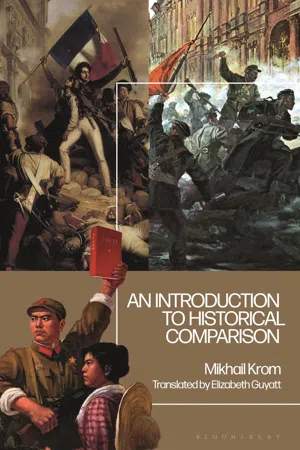
Historical comparison as a method of historical analysis goes back to Herodotus in antiquity, yet it was not until the 1920s through the work of historian Marc Bloch that it was recognised as a solid historical method. Even today, some historians are wary of applying a comparative lens to their work. Why is this, Mikhail Krom asks, when historical comparison can be an incredibly insightful approach to history?
Designed as a helpful resource for historians, An Introduction to Historical Comparison aims to teach scholars how to develop the skills needed to successfully employ a comparative methodology. It begins by tracing the intellectual history of comparative history writing and then examines the practice of historical comparison. The result is a clear and engaging analysis of historical thinking and a useful guide to main methodological techniques, successes, and pitfalls of comparative research.
An Introduction to Historical Comparison is the first comprehensive study of the theory and practice of comparative-historical research. Combining a wide range of case-studies from the best practitioners of historical comparison with an innovative interdisciplinary perspective, this book is thus a meaningful contribution to current debates on historiography. As such, this resource will be of immense value to both students reading historiography and methodology and to historians looking to apply a comparative approach to their own research.
- 168 pages
- English
- ePUB (mobile friendly)
- Available on iOS & Android
eBook - ePub
An Introduction to Historical Comparison
About this book
Information
Part I
Key milestones in the development of historical comparison
1
Comparison in history
From antiquity to the Enlightenment
Comparison has existed in history as long as history itself. This does not mean that historians in ancient times developed a particular ‘comparative historical’ method: before the eighteenth century there were no discernible attempts to develop a theory of comparison that could be applied to society and its history. Rather, comparison is an integral part of any thought, whether on an everyday or a scholarly level. In Herodotus’ time, the boundary between these levels was highly unstable and his work is an example of how an immense collection of historical and geographical information about the entire known world of the time was formed both from ordinary curiosity – through interviews with eyewitnesses to events and inhabitants of the countries he visited – and from his own observations and travel notes. In all this, Herodotus constantly resorts to comparison, particularly when describing the customs of various peoples: the ‘father of history’ could equally be considered the ‘father of ethnography’. It is entirely natural that in these cross-cultural comparisons as we would call them now, the customs of Hellas, with which Herodotus and his readers were very familiar, serve as a kind of standard and an essential element of comparison. Thus, he writes of the Egyptians (Histories, II: 79–80),
The Egyptians keep to their native customs and never adopt any from abroad. Many of these customs are interesting, especially, perhaps, the ‘Linus’ song. This person, under different names, is celebrated in song not only in Egypt but in Phoenicia, Cyprus, and other places, and appears to be the person whom the Greeks celebrate as Linus. . . .
There is another point in which the Egyptians resemble one section of the Greek people – the Lacedaemonians: I mean the custom of young men stepping aside to make room for their seniors when they meet them in the street, and of getting up from their seats when older men come in. But they are unlike any of the Greeks in that they do not greet one another by name in the streets, but make a low bow and drop one hand to the knee.1
Elsewhere in his Histories (VI: 58–9), Herodotus compares the burial customs of the Spartans with those of the Persians.2 At times, he is even ready to believe on the basis of outward similarity that the Greeks had borrowed certain elements of their religious rites from the ‘barbarians’; he makes such an assumption – mistaken as it happens – about a Libyan origin of the clothing and shield on a statue of Pallas Athena (IV: 189).3
Comparison also plays an important compositional role in Herodotus’ work. In the first, ‘ethnographic’ books of his Histories, it helps organize heterogeneous material on the principle of the similarity and differences of the customs described with those of the Hellenes; when he reaches the central theme of the Graeco–Persian Wars and the opposition of a small but freedom-loving people to the vast hordes of barbarians led by King Xerxes, it becomes a leitmotif of the narrative.
It should be noted that the use of comparison in ancient historiography correlates with the chosen scale of research. The setting of Herodotus’ Histories is the entire known world of the time, and it is thus unsurprising that comparison is his preferred method. Meanwhile, Thucydides makes virtually no use of comparison. This can be explained by the limited scale of his work; Thucydides’s Histories, one of the masterpieces of ancient Greek historical thought, is devoted entirely to the events of the Peloponnesian War, in essence being a monographic analysis of the war. But when in the Hellenistic period, a few centuries later, Polybius first undertook an attempt to write a universal history, naturally he could not avoid the need to make comparisons.
Explaining his project, Polybius writes:
Previously the doings of the world had been, so to say, dispersed, as they were held together by no unity of initiative, results, or locality; but ever since this date [140th Olympiad, 220–216 BC – MK] history has been an organic whole, and the affairs of Italy and Libya have been interlinked with those of Greece and Asia, all leading up to one end. And this is my reason for beginning their systematic history from that date.4
Polybius saw the meaning of events that had taken place as lying in the establishment of Rome’s dominion over the world at that time. Justifying the importance of the subject he had chosen to study, he compared the might of the Romans with earlier great powers – the Persians and Macedonians – and naturally the comparison was in favour of the new conquerors.
Not satisfied with this, in the sixth book of his Histories, which constituted a genuine political treatise, Polybius tried to explain the successes of the Romans through particular features of their state’s structure, and to this end compared the Roman Republic with the city states of the Cretans and Spartans and with Carthage, noting the advantages of the Roman army, social customs and religion.5 Interestingly, Polybius does not include Plato’s ideal state in this comparison for the following reason:
Nor again is it fair to introduce Plato’s republic, which also is much belauded by some philosophers. . . . Up to the present it would be just the same thing to discuss it with a view to comparison with the constitutions of Sparta, Rome, and Carthage, as to take a statue and compare it with living and breathing men. For even if the workmanship of the statue were altogether praiseworthy, the comparison of the lifeless thing with a living being would strike spectators as entirely imperfect and incongruous.6
As we see, even in his theoretical analyses, Polybius strongly favoured real experience of the state structures of different eras and peoples over philosophers’ abstract models.
As for Roman histori ography, this did not succeed in overcoming the confines of ethnocentrism: neither Livy, Tacitus nor any other great Roman historian displayed interest in the fate of any people or state other than their own. Comparison is therefore virtually non-existent in their works.
At the end of antiquity, a work appeared that was entirely constructed on historical comparisons and was at the same time utterly unhistorical in its spirit, namely Plutarch’s Parallel Lives. Comparing the biographies of famous Greeks and Romans – twenty-two of these paired biographies are extant – Plutarch discusses which of each pair displayed more skill in his affairs and showed greater virtue. In this, the differences in the periods when each figure had lived and their respective historical contexts were entirely glossed over. This is not surprising: in Plutarch’s time – from the first to the beginning of the second century AD – the view of history as a collection of edifying examples or as ‘life’s teacher’ (magistra vitae) as Cicero put it, was already firmly established.
Thus, the ancient historians – principally the Greeks – used comparison readily and for various purposes: as a descriptive or rhetorical method; as an element of causal analysis (Polybius); or as an exercise in moral philosophy (Plutarch).
Historical comparison did not develop further in the medieval period; the reasons for this are found primarily in provincialism and the narrow outlook of chroniclers whose interests, like those of their readers, did not go beyond the boundaries of distinct cultural domains.7
The genre of universal history is revived only with the beginning of the modern era. In his treatise Method for the Easy Comprehension of History, the French scholar Jean Bodin (1530–96) made active use of comparison, comparing different geographical regions and inferring the characters of the peoples inhabiting them from the features of the climate, and also analysing the forms of government of states that had existed in antiquity and the recent past.
Reflections on the course of world history, including comparative observations, were widely disseminated during the Enlightenment. Many eighteenth-century thinkers were given to attempting to widen the framework of historical knowledge and overcome traditional Eurocentrism. Thus, in an article about history published in Diderot’s Encyclopédie (1765), enumerating the growing demands on ‘the modern historian’ Voltaire remarked:
The history of a foreign country should be formed on a different model to that of our own.
If we compose a history of France, we are under no necessity to describe the course of the Seine and the Loire; but if we publish a history of the conquests of the Portuguese in Asia, a topographical description of the recently explored country is required. It is desirable that we should, as it were, conduct the reader by the hand round Africa, and along the coasts of Persia and India; and it is expected that we should treat with information and judgement, of manners, laws, and customs so new to Europe.8
Another renowned French philosopher, Montesquieu, drew examples for his The Spirit of the Laws (1748) not only from the history of ancient Greece and Rome and the Europe of his day but also from the history of Turkey, Persia, China and Russia.
At the end of the eighteenth century, linking natural history with the history of society’s development in his main work Outline of a Philosophical History of Humanity, Herder compared the structure and physical characteristics of different peoples – from Greenlanders and Eskimos living near the North Pole to African tribes and the native people of America – and came to the conclusion that ‘all mankind are only one and the same species’9 (Herder’s emphasis, MK).
In subsequent parts of his book he gave a brief sketch of the history of the peoples of the Middle East and Far East, of ancient Greece and Rome, and also of medieval Europe. In Herder’s opinion, the history of humanity constitutes a forward movement and a gradual spreading of humanism and culture.10
Commenting on the views of Enlightenment thinkers, Theodor Schieder notes that in the historiography of the Enlightenment, comparing European and non-European cultures and historical processes had the function of revealing the homogeneity of the human race in any historical incarnations. The fact that this forever homogeneous human being was none other than a person of Enlightenment culture constituted a cognitive problem of the first order, which the eighteenth-century historians themselves could not appreciate.11 He goes on to remark accurately that, in fact...
Table of contents
- Cover
- Half-Title
- Title
- Contents
- List of table
- Acknowledgements
- Introduction: The paradoxes of historical comparison
- Part I Key milestones in the development of historical comparison
- Part II Historical comparison in search of a method
- Part III Themes of comparative historical research
- Bibliography
- Index
- Copyright
Trusted by 375,005 students
Access to over 1.5 million titles for a fair monthly price.
Study more efficiently using our study tools.
Frequently asked questions
Yes, you can cancel anytime from the Subscription tab in your account settings on the Perlego website. Your subscription will stay active until the end of your current billing period. Learn how to cancel your subscription
No, books cannot be downloaded as external files, such as PDFs, for use outside of Perlego. However, you can download books within the Perlego app for offline reading on mobile or tablet. Learn how to download books offline
Perlego offers two plans: Essential and Complete
- Essential is ideal for learners and professionals who enjoy exploring a wide range of subjects. Access the Essential Library with 800,000+ trusted titles and best-sellers across business, personal growth, and the humanities. Includes unlimited reading time and Standard Read Aloud voice.
- Complete: Perfect for advanced learners and researchers needing full, unrestricted access. Unlock 1.5M+ books across hundreds of subjects, including academic and specialized titles. The Complete Plan also includes advanced features like Premium Read Aloud and Research Assistant.
We are an online textbook subscription service, where you can get access to an entire online library for less than the price of a single book per month. With over 1.5 million books across 990+ topics, we’ve got you covered! Learn about our mission
Look out for the read-aloud symbol on your next book to see if you can listen to it. The read-aloud tool reads text aloud for you, highlighting the text as it is being read. You can pause it, speed it up and slow it down. Learn more about Read Aloud
Yes! You can use the Perlego app on both iOS and Android devices to read anytime, anywhere — even offline. Perfect for commutes or when you’re on the go.
Please note we cannot support devices running on iOS 13 and Android 7 or earlier. Learn more about using the app
Please note we cannot support devices running on iOS 13 and Android 7 or earlier. Learn more about using the app
Yes, you can access An Introduction to Historical Comparison by Mikhail Krom, Elizabeth Guyatt in PDF and/or ePUB format, as well as other popular books in Historia & Enseñanza de historia. We have over 1.5 million books available in our catalogue for you to explore.