Analysing political discourse in the British press during a time of crisis and austerity, this book examines how the concept of the welfare state has been constructed between 2008 and 2015. At a time when the financial crisis and government policies have put the welfare state under increased pressure, a corpus from four British newspapers from across the political spectrum - the Guardian, Daily Mirror, Daily Mail, and Daily Telegraph - is brought together to investigate the political debate on its evaluation and the ambiguity about its exact definition.
Combining two theoretical approaches, Malgorzata Paprota outlines the figurative models and scenarios relevant to this element of the political system. The discourse-historical approach to discourse analysis is used to establish what the welfare state is, tracing the boundaries of the concept and which elements of political reality are explicitly associated with it. Conceptual metaphor theory is then used to explore the figurative conceptualisations of the welfare state. Together, this book shows the discursive construction, and shifting boundaries and metaphors, of the welfare state by the British press and its use in current political debates.
eBook - ePub
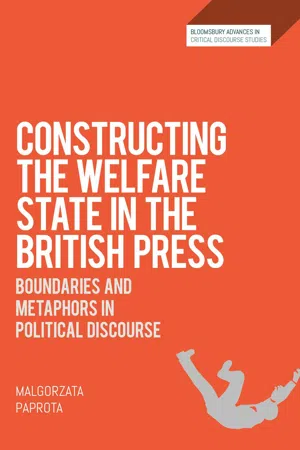
Constructing the Welfare State in the British Press
Boundaries and Metaphors in Political Discourse
- 240 pages
- English
- ePUB (mobile friendly)
- Available on iOS & Android
eBook - ePub
Constructing the Welfare State in the British Press
Boundaries and Metaphors in Political Discourse
About this book
Information
1
The contexts, the corpus and the assumptions in this study
In accordance with the spirit of critical discourse studies, this chapter provides essential contexts for the analysis in the subsequent chapters. It opens with a section on the welfare state, which discusses the welfare state in general before moving on to outline the British welfare state and its discourses at two important stages: its foundation in the 1940s and the developments in the early-twenty-first century. The chapter then discusses the key theoretical concepts, the corpus, procedures and the major assumptions adopted in this study.
1.1 The field of action: The welfare state
1.1.1. The welfare state: The term and some definitions
The term ‘welfare state’ was most likely inspired by the German Wohlfahrtsstaat (Lowe 2005, Cousins 2005). In the 1920s, it was used to denote a state that was willing to include social welfare in its responsibilities, in addition to the traditional remit of policing and upholding the law and order, and alongside another new addition, culture (Cousins 2005, after Hong 1998). By the 1930s, Wohlfahrtsstaat had taken on a negative meaning: in 1932 it was deployed to ridicule the Weimar Republic for taking on social tasks it was unable to handle (Flora and Heidenheimer [1981b]). But its use to describe Britain, attested since the 1930s (Cousins 2005), appears to have been far from derogatory. In a book by Archbishop William Temple,1 it underscored the contrast between the Nazi Germany’s self-explanatory ‘warfare state’ and the ‘welfare state’ of Britain, the latter commendably putting the state apparatus to work in order to uphold the welfare of its citizens (Lowe 2005). The term was subsequently popularized in the UK and from there internationally by the late 1940s and early 1950s (Flora and Heidenheimer [1981b], Hill 2013). Its uptake reflected, as Lowe (2005) points out, the increased acceptance of social responsibilities of the state. The welfare state thus comes into being as an expression of social solidarity, of which the state is an instrument.
Establishing the meaning of the term ‘welfare state’ is notably more difficult than tracing its origin. This difficulty is well established in specialized literature and often commented on explicitly (see e.g. Briggs 1961, Lowe 2005, Timmins 2017, Cousins 2005, Beech 2012, Hill 2013, Garland 2016). It can be accounted for by the discrepancies in the usage of the term as well as the diversity in existing welfare states.
At its most general – though of course individual definitions vary in detail and emphasis – the welfare state has been described as a response of the state to the problems experienced by a society that arise from the operation of the market economy, where the function of the response is to mitigate these problems (see e.g., Flora and Heidenheimer [1981b], Mau 2003, Lowe 2005, Hayward 2012).
This response can be understood in a broad or a narrow manner (see Esping-Andersen 1990, Cousins 2005, Lowe 2005, Øverbye 2010, Kuhlmann 2019). In the broader sense, a welfare state is a state that is involved in the management of the economy, and the concept thus subsumes issues like the fiscal regime up to the overall macroeconomic policy (Esping-Andersen 1990, Garland 2016). In a similar vein, Lowe describes the welfare state as a type of post-1940s society where the government ‘actively accepts responsibility for the welfare (broadly defined) of all its citizens’ (2005:16), in addition to providing or funding certain core universal services, such as health or education. These services are to be provided ‘at a standard well above the barest minimum’ (2005:18), which in turn necessarily impacts the economy. The ‘minimum’ is a reference to the classic definition of the welfare state by Briggs (1961), which specifies that the modification of the impact of market forces should occur not only by ‘guaranteeing families and individuals a minimum income irrespective of the market value of their work or property’ and by protecting them from ‘social contingencies’ (such as illness) but also by ‘ensuring that all citizens without distinction of status or class are offered the best standards available in relation to a certain agreed range of social services’ (Briggs 1961:228). This last point is, according to Briggs, the ‘distinctive direction’ of the welfare state, which thus goes beyond ensuring mere survival of less successful groups and encompasses universal provision of social services at what he calls an ‘optimum’ level. Lowe (2005) accepts this argument, with the commonsensical reservation that ‘optimum’ standards at a universal level are necessarily a compromise on what would be technically achievable in individual cases.
Pierson (2006), who too applies the term ‘welfare state’ to a type of society (and notes that it may also denote a type of state or polity), similarly stresses the objective of state intervention in economic processes, which is to ‘reallocate life chances between individuals and/or classes’ (Pierson 2006:10).
This ‘normative’ (see Cousins 2005) aspect of the welfare state, whereby the state specifically sets out to achieve (or to seek to achieve) specific redistributive or emancipatory objectives, is sometimes considered a necessary condition to qualify a polity as a welfare state. Such a condition leads to questions of degree of ‘welfare statehood’ (i.e. what kind of policies or institutions are sufficient for a state to qualify, see Hill 2013) and historical difficulties (i.e. whether a major change in policy means a state no longer qualifies as a welfare state). Some studies (such as Cousins 2005) therefore adopt a narrower understanding of the concept, restricting it to social policy measures taken by the state, or, as Pierson (2006:10) puts it, ‘state measures for meeting key welfare needs’. These he lists as typically restricted to ‘health, education, housing, income maintenance, and personal social services’. Similarly, Esping-Andersen describes the narrowly defined welfare state as social services and income transfers, regarded as ‘the traditional terrain of social amelioration’ (1990:1).
Less usual but useful is the delineation of the welfare state in the short compendium by Garland (2016). Garland (2016:7–8) outlines what he calls three ‘conceptions’ of the welfare state that should be viewed not as mutually exclusive but as ‘concentric circles of welfare state government’ (8). The inner one, which he labels ‘welfare state for the poor’ (6), is limited to support which is based on need, is means-tested and does not depend on a person’s previous National Insurance or other contributions. The second of these concentric circles is the view of the welfare state typically adopted in social policy studies, which includes ‘social insurance, social rights, and social services’ (7) within the welfare state. In this way, Garland subdivides the welfare state defined above as ‘narrow’ into two layers. The third and outermost layer in his classification is that of the welfare state as ‘a mode of government’ (6), where the government is active in shaping the economy via its ‘regulatory, fiscal, monetary, and labour-market policies’ (8). This corresponds to the broader view of the welfare state as defined above.
In all these definitions, the welfare state denotes primarily institutions and policies with a broadly specified aim. It should, however, be noted that there are also other conceptualizations (or operationalizations) of the welfare state. A relatively straightforward example is one used in Hills (2015:xiv): ‘public spending on and provision for’ public services and social security. Another is the view of the welfare state as a set of rights, which builds on T. H. Marshall’s concept of social rights (positive rights to e.g. healthcare or education) existing alongside civil and political rights (see White 2010). In this framework, social rights enable individuals to fully participate in civil society and are ‘constitutive of modern citizenship’, since in practice the exercise of other rights is contingent on social rights (Daguerre and Etherington 2014:10). These, however, do not typically filter outside of specialist discourse, unlike the institutional/policy-based conceptualization. Usefully, Kuhlmann (2019) points out that the welfare state is perhaps best viewed as a dynamic concept, necessarily informed by the context in which it emerged or is analysed.
1.1.2. Typologies and critiques of the welfare state
Welfare states in the broad sense show a substantial diversity and have been variously classified. An early typology, whose terminology continues to recur in the British political discourse, is by Titmuss (1974). It distinguishes three models of social policy (a term interpretable as the welfare state). The first is the residual model, where state intervention is a temporary emergency measure accorded to an individual when the two primary channels of support – the family and the market ...
Table of contents
- Cover
- Half-Title Page
- Series Page
- Title Page
- Contents
- Tables
- Acknowledgements
- Introduction: What we talk about when we talk about the British welfare state
- Chapter 1 The contexts, the corpus and the assumptions in this study
- Chapter 2 Boundaries of the welfare state
- Chapter 3 What the welfare state is: Figurative models of the welfare state
- Chapter 4 What the welfare state is: Other metaphors of the welfare state
- Conclusions: Constructing the welfare state – a safety net versus public services
- Notes
- References
- Excerpts Quoted in the Main Text
- Index
- Copyright Page
Trusted by 375,005 students
Access to over 1.5 million titles for a fair monthly price.
Study more efficiently using our study tools.
Frequently asked questions
Yes, you can cancel anytime from the Subscription tab in your account settings on the Perlego website. Your subscription will stay active until the end of your current billing period. Learn how to cancel your subscription
No, books cannot be downloaded as external files, such as PDFs, for use outside of Perlego. However, you can download books within the Perlego app for offline reading on mobile or tablet. Learn how to download books offline
Perlego offers two plans: Essential and Complete
- Essential is ideal for learners and professionals who enjoy exploring a wide range of subjects. Access the Essential Library with 800,000+ trusted titles and best-sellers across business, personal growth, and the humanities. Includes unlimited reading time and Standard Read Aloud voice.
- Complete: Perfect for advanced learners and researchers needing full, unrestricted access. Unlock 1.5M+ books across hundreds of subjects, including academic and specialized titles. The Complete Plan also includes advanced features like Premium Read Aloud and Research Assistant.
We are an online textbook subscription service, where you can get access to an entire online library for less than the price of a single book per month. With over 1.5 million books across 990+ topics, we’ve got you covered! Learn about our mission
Look out for the read-aloud symbol on your next book to see if you can listen to it. The read-aloud tool reads text aloud for you, highlighting the text as it is being read. You can pause it, speed it up and slow it down. Learn more about Read Aloud
Yes! You can use the Perlego app on both iOS and Android devices to read anytime, anywhere — even offline. Perfect for commutes or when you’re on the go.
Please note we cannot support devices running on iOS 13 and Android 7 or earlier. Learn more about using the app
Please note we cannot support devices running on iOS 13 and Android 7 or earlier. Learn more about using the app
Yes, you can access Constructing the Welfare State in the British Press by Malgorzata Paprota in PDF and/or ePUB format, as well as other popular books in Languages & Linguistics & Historical & Comparative Linguistics. We have over 1.5 million books available in our catalogue for you to explore.