This revised edition of the play is published alongside commentary and notes by Christopher Collins, Assistant Professor of Drama at the University of Nottingham, UK. It includes information for today's students on the play's context; themes; dramatic devices; production history; critical reception; academic debate; and ideas for further study. It also includes interviews with practitioners involved in major recent productions of the play.
Described by J.M. Synge as "a comedy, an extravaganza, made to use", The Playboy of the Western World is one of the most iconic plays to have come out of Ireland in the 20th century and is today recognised as a staple of the dramatic canon. It is published as a new Student Edition, which offers a 21st century lens on a play over 100 years old.
When it was first performed in 1907 at Dublin's Abbey Theatre, Synge's play provoked uproar and was interrupted more than once by the police. Today, we recognise its importance in making Irish drama the force it became in the early 20th century.
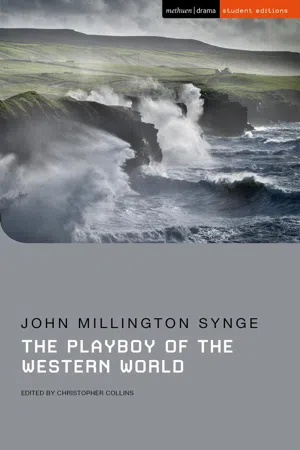
- 112 pages
- English
- ePUB (mobile friendly)
- Available on iOS & Android
eBook - ePub
The Playboy of the Western World
About this book
Information
The Playboy of the Western World
Persons in the play
Christopher Mahon
Old Mahon, his father, a squatter
Michael James Flaherty (called Michael James), a publican
Margaret Flaherty (called Pegeen Mike), his daughter
Widow Quin, a woman of about thirty
Shawn Keogh, her cousin, a young farmer
Philly Cullen and Jimmy Farrell, small farmers
Sara Tansey, Susan Brady and Honor Blake, village girls
A Bellman
Some Peasants
The action takes place near a village, on a wild coast of Mayo. The first Act passes on an evening of autumn, the other two Acts on the following day
Preface
In writing ‘The Playboy of the Western World’, as in my other plays, I have used one or two words only that I have not heard among the country people of Ireland, or spoken in my own nursery before I could read the newspapers. A certain number of the phrases I employ I have heard also from herds and fishermen along the coast from Kerry to Mayo or from beggar-women and ballad-singers nearer Dublin; and I am glad to acknowledge how much I owe to the folk-imagination of these fine people. Anyone who has lived in real intimacy with the Irish peasantry will know that the wildest sayings and ideas in this play are tame indeed, compared with the fancies one may hear in any little hillside cabin in Geesala, or Carraroe, or Dingle Bay. All art is a collaboration; and there is little doubt that in the happy ages of literature, striking and beautiful phrases were as ready to the story-teller’s or the playwright’s hand, as the rich cloaks and dresses of his time. It is probable that when the Elizabethan dramatist took his ink-horn and sat down to his work he used many phrases that he had just heard, as he sat at dinner, from his mother or his children. In Ireland, those of us who know the people have the same privilege. When I was writing The Shadow of the Glen, some years ago, I got more aid than any learning could have given me from a chink in the floor of the old Wicklow house where I was staying, that let me hear what was being said by the servant girls in the kitchen. This matter, I think, is of importance, for in countries where the imagination of the people, and the language they use, is rich and living, it is possible for a writer to be rich and copious in his words, and at the same time to give the reality, which is the root of all poetry, in a comprehensive and natural form. In the modern literature of towns, however, richness is found only in sonnets, or prose poems, or in one or two elaborate books that are far away from the profound and common interests of life. One has, on one side, Mallarmé and Huysmans producing this literature; and on the other, Ibsen and Zola dealing with the reality of life in joyless and pallid works. On the stage one must have reality, and one must have joy; and that is why the intellectual modern drama has failed, and people have grown sick of the false joy of the musical comedy, that has been given them in place of the rich joy found only in what is superb and wild in reality. In a good play every speech should be as fully flavoured as a nut or apple, and such speeches cannot be written by any one who works among people who have shut their lips on poetry. In Ireland, for a few years more, we have a popular imagination that is fiery, and magnificent, and tender; so that those of us who wish to write start with a chance that is not given to writers in places where the springtime of the local life has been forgotten, and the harvest is a memory only, and the straw has been turned into bricks.
J.M.S.
21st January, 1907.
Act One
Country public house or shebeen, very rough and untidy. There is a sort of counter on the right with shelves, holding many bottles and jugs, just seen above it. Empty barrels stand near the counter. At back, a little to left of counter, there is a door into the open air, then, more to the left, there is a settle with shelves above it, with more jugs, and a table beneath a window. At the left there is a large open fireplace, with turf fire, and a small door into inner room. Pegeen, a wild-looking but fine girl, of about twenty, is writing at table. She is dressed in the usual peasant dress.
Pegeen (slowly as she writes) Six yards of stuff for to make a yellow gown. A pair of lace boots with lengthy heels on them and brassy eyes. A hat is suited for a wedding day. A fine-tooth comb. To be sent with three barrels of porter in Jimmy Farrell’s creel cart on the evening of the coming Fair to Mister Michael James Flaherty. With the best compliments of this season. Margaret Flaherty.
Shawn Keogh (a fat and fair young man comes in as she signs, looks around awkwardly, when he sees she is alone) Where’s himself?
Pegeen (without looking at him) He’s coming. (She directs letter.) To Mister Sheamus Mulroy, Wine and Spirit Dealer, Castlebar.
Shawn (uneasily) I didn’t see him on the road.
Pegeen How would you see him (licks stamp and puts it on letter) and it dark night this half-hour gone by?
Shawn (turning towards door again) I stood a while outside wondering would I have a right to pass on or to walk in and see you, Pegeen Mike (comes to fire), and I could hear the cows breathing and sighing in the stillness of the air, and not a step moving any place from this gate to the bridge.
Pegeen (putting letter in envelope) It’s above at the crossroads he is, meeting Philly Cullen and a couple more are going along with him to Kate Cassidy’s wake.
Shawn (looking at her blankly) And he’s going that length in the dark night.
Pegeen (impatiently) He is surely, and leaving me lonesome on the scruff of the hill. (She gets up and puts envelope on dresser, then winds clock.) Isn’t it long the nights are now, Shawn Keogh, to be leaving a poor girl with her own self counting the hours to the dawn of day?
Shawn (with awkward humour) If it is, when we’re wedded in a short while you’ll have no call to complain, for I’ve little will to be walking off to wakes or weddings in the darkness of the night.
Pegeen (with rather scornful good humour) You’re making mighty certain, Shaneen, that I’ll wed you now.
Shawn Aren’t we after making a good bargain, the way we’re only waiting these days on Father Reilly’s dispensation from the bishops, or the Court of Rome.
Pegeen (looking at him teasingly, washing up at dresser) It’s a wonder, Shaneen, the Holy Father’d be taking notice of the likes of you; for if I was him I wouldn’t bother with this place where you’ll meet none but Red Linahan, has a squint in his eye, and Patcheen is lame in his heel, or the mad Mulrannies were driven from California and they...
Table of contents
- Cover
- Half-Title Page
- Title Page
- Contents
- Chronology
- Commentary
- Contexts
- Themes
- Dramatic Devices
- Production History
- Critical Reception
- Academic Debate
- Further Study
- Notes
- The Playboy of the Western World
- Notes on the Text
- Copyright
Trusted by 375,005 students
Access to over 1.5 million titles for a fair monthly price.
Study more efficiently using our study tools.
Frequently asked questions
Yes, you can cancel anytime from the Subscription tab in your account settings on the Perlego website. Your subscription will stay active until the end of your current billing period. Learn how to cancel your subscription
No, books cannot be downloaded as external files, such as PDFs, for use outside of Perlego. However, you can download books within the Perlego app for offline reading on mobile or tablet. Learn how to download books offline
Perlego offers two plans: Essential and Complete
- Essential is ideal for learners and professionals who enjoy exploring a wide range of subjects. Access the Essential Library with 800,000+ trusted titles and best-sellers across business, personal growth, and the humanities. Includes unlimited reading time and Standard Read Aloud voice.
- Complete: Perfect for advanced learners and researchers needing full, unrestricted access. Unlock 1.5M+ books across hundreds of subjects, including academic and specialized titles. The Complete Plan also includes advanced features like Premium Read Aloud and Research Assistant.
We are an online textbook subscription service, where you can get access to an entire online library for less than the price of a single book per month. With over 1.5 million books across 990+ topics, we’ve got you covered! Learn about our mission
Look out for the read-aloud symbol on your next book to see if you can listen to it. The read-aloud tool reads text aloud for you, highlighting the text as it is being read. You can pause it, speed it up and slow it down. Learn more about Read Aloud
Yes! You can use the Perlego app on both iOS and Android devices to read anytime, anywhere — even offline. Perfect for commutes or when you’re on the go.
Please note we cannot support devices running on iOS 13 and Android 7 or earlier. Learn more about using the app
Please note we cannot support devices running on iOS 13 and Android 7 or earlier. Learn more about using the app
Yes, you can access The Playboy of the Western World by John Millington Synge, Christopher Collins in PDF and/or ePUB format, as well as other popular books in Literature & British Drama. We have over 1.5 million books available in our catalogue for you to explore.