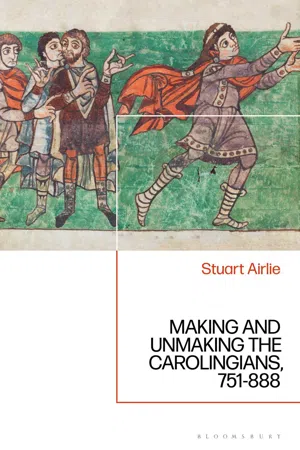
How does power manifest itself in individuals? Why do people obey authority? And how does a family, if they are the source of such dominance, convey their superiority and maintain their command in a pre-modern world lacking speedy communications, standing armies and formalised political jurisdiction? Here, Stuart Airlie expertly uses this idea of authority as a lens through which to explore one of the most famous dynasties in medieval Europe: the Carolingians.
Ruling the Frankish realm from 751 to 888, the family of Charlemagne had to be ruthless in asserting their status and adept at creating a discourse of Carolingian legitimacy in order to sustain their supremacy. Through its nuanced analysis of authority, politics and family, Making and Unmaking the Carolingians, 751-888 outlines the system which placed the Carolingian dynasty at the centre of the Frankish world. In doing so, Airlie sheds important new light on both the rise and fall of the Carolingian empire and the nature of power in medieval Europe more generally.
- 456 pages
- English
- ePUB (mobile friendly)
- Available on iOS & Android
eBook - ePub
About this book
Information
1
A ruling family
Weighing the legacy of the Carolingians
The magnificent aura of the great medieval king and emperor Charlemagne (768–814) and of his family, the Carolingians, has dazzled Europeans for centuries. The very name of the king evokes grandeur: Charles the Great, in Latin Carolus Magnus, hence the now generally adopted (French) Charlemagne. In the Middle Ages, the kings of France proclaimed their attachment to the Carolingian royal line while a king of Germany, Frederick Barbarossa, went one better by having him proclaimed a saint in 1165. The great chandelier that Frederick granted to the church at Aachen for the cult of the now saintly Charlemagne survives as visible testimony to the medieval investment in the remembrance of Charlemagne and his dynasty, just as the tombs of his western descendants in the abbey of St-Denis to the north of Paris were intended to be a visible focus for reverence towards the French crown.1 The church of Charlemagne at Aachen still stands and can provide for those visitors with sufficient imagination ‘a history lesson more vivid than any book can offer’.2
One visitor with more than enough imagination was the French writer Victor Hugo, whose novel Notre Dame of Paris testifies to his lively sense of the Middle Ages. On his visit to Aachen in 1840, Hugo fell into a sort of trance and saw, as in a vision, the gigantic figure of Charlemagne himself lumber to his feet and stand as a vast shadow on the horizon. For Hugo, Charlemagne and the Carolingian empire seemed to offer a blueprint for the union of France and Germany; that has been the role that Charlemagne and his family were called upon to play in the political imagination of western Europe after 1945. In this respect the title of a book by the French scholar Pierre Riché – The Carolingians: A Family That Made Europe – is suggestive, as is the fact that it has been translated into other European languages.3 Nor are such notions of the Carolingians as the progenitors of modern (western) Europe confined to university professors, as shown by the great Charlemagne-centred exhibitions held in Aachen in 1965 and in 1999 in Germany, Spain, Italy and Croatia.4 Furthermore, the city of Aachen now awards an annual prize to individuals who have served the cause of European unity. Unsurprisingly, recipients have tended to be political grandees, including British prime ministers such as Winston Churchill and Tony Blair.5
The fact that is now impossible to imagine a British prime minister being awarded this prize shows that Charlemagne and his line should not be imagined as harmless puppets in the service of blandly harmonious Euro-speak. While Europe after the fall of communism in 1989 looks bigger than the post-1945 western grouping that tended to look back to Charlemagne, it also looks smaller in a world in thrall to globalization. Historians now fret over Charlemagne’s dwindling stature: was he a ‘global player’?6 European identity, however, remains as complex and problematic as that of individual European states. Charlemagne could not always be invoked as a universally acceptable father-figure. Thus, the attempt to place a large equestrian statue of Charlemagne outside Notre-Dame cathedral in Paris in the late nineteenth century provoked strong opposition from secular republicans on the grounds that Charlemagne personified absolute royal power and imperial aggression.7 Charlemagne’s legacy could be drawn on for dark purposes, as in Nazi Germany where it was invoked in attempts to foster a sense of European unity in the struggle against Bolshevism. In our own time, the battle between Charlemagne’s grandfather and Muslim Arab forces in 732 has been evoked by the far right as an example of a ‘clash of cultures’.8
Given this weighty heritage, it can be difficult for us to realize that the Carolingians were not always looked on with awe and respect. In fact, Charlemagne’s ancestors were simply one aristocratic family among others in the struggles for power that engulfed Frankish kingship in the late seventh and early eighth centuries. At this time the kingship was held by the family of the Merovingians who had been kings of the Franks since time out of mind. The attempts by the Carolingians to muscle in on the supreme power cost them dear. One of Charlemagne’s ancestors, Grimoald (I), prepared a coup d’état in 656 but was ambushed by his enemies who imprisoned him before torturing him to death, a bleak testimony to the horror his ambitions had aroused. The name Grimoald seems to have been ill-starred, for Grimoald (II), another of Charlemagne’s ancestors, was assassinated in 714 despite, or probably because of, the political power of his father Pippin. The stabbing of this Grimoald and the rising of his father from his sickbed to unleash vengeance on the assassins show how deeply involved the early Carolingians were in the feuds and resentments of Frankish power politics. They had no privileged status that lifted them out of that mire and pro-Carolingian sources reflect the family’s anger and unease. The name Grimoald did not recur in the family. Some of Charlemagne’s ancestors were too awkward to be remembered.9
Thus we must not project the later glories of Carolingian royalty back on to the family’s pre-royal past. As powerful aristocrats, Charlemagne’s ancestors were respected by contemporaries but were not seen as uniquely awe-inspiring figures. Even after it was elevated to the throne in 751, the new royal Carolingian dynasty did not always get the respect which it believed that it deserved. After Charlemagne’s conquest of much of Italy in the 770s, in one monastery an abbot refused to join in prayers for the king, snarling that if it weren’t for the fact that he wanted to keep his post as abbot he would treat Charlemagne like a dog. This, however, together with other vividly anti-Frankish remarks, was reported back to Charlemagne who took a very dim view of it. North of the Alps, the situation was not always much better. In 785, a conspiracy was hatched against Charlemagne and when the conspirators were seized, one of them boldly told the king to his face that if the plotters had only held together then Charlemagne would never have crossed the Rhine alive. The desperate utterances of Duke Tassilo of Bavaria, who said that he would rather die than continue to buckle under Charlemagne’s escalating demands for his submission, reveal further resistance at the end of the 780s to Charlemagne’s claims to western European hegemony.10 Rather than seeing Charlemagne as ‘the father of Europe’, as his court poets styled him, we should remember Michael Wallace-Hadrill’s characterization of the rulers of this period as ‘Barbarian chieftains who quarrelled fiercely among themselves … and who were commonly despised outside their own territory’.11
If Carolingian rule had to be imposed in the face of such stiff opposition and resentment, this only makes the Carolingians becoming the acclaimed legitimate masters of Europe all the more striking. Towards the end of the ninth century, Europe itself was a term that simply meant the Carolingian realms: ‘Europe, that is the kingdom of Charles [the Fat, 876–887]’.12 This book does not offer a comprehensive survey of the nature of this dynasty’s power, but its sheer scale ought to be recalled. The idea of empire in the west was revived, famously, in Charlemagne’s coronation by the pope as emperor in Rome in 800. At a less rarefied level, Carolingian government sought to become involved at a very practical level in people’s daily lives. Such aspirations are clearly visible in Carolingian legislation, particularly in the reign of Charles the Bald, king of west Francia (840–77). The Edict of Pitres, for example, is a vast document stemming from a royal assembly which Charles held there in 864, and it contains regulations on coinage, weights and measures, markets, and labour-services on building of roads and bridges, together with payment of royal rents.13
While Carolingian rulers did busy themselves with all levels of society, this book is rather more elitist. My concern is the royal family itself. The 888 reference to Europe cited above has for its focus the Carolingian ruler. ‘Europe is the kingdom of Charles’, that is, Charles the Fat. The Carolingian dynasty, in fact the Carolingian family at large, was prominent in the landscape of this world. Conflicts and struggles within this ‘notably quarrelsome’ family were the stuff of politics and were closely watched by contemporary political observers. Struggles for power within the family between 830 and 834 (when the emperor Louis the Pious was locked in conflict with his three oldest sons) were reflected in a letter of Einhard, friend and biographer of Charlemagne, enquiring as to the exact balance of power between the emperor and his sons as well as in more humble documents such as property transactions in Brittany, far from the centres of Carolingian power, but whose inhabitants nevertheless felt sufficiently brushed by the ruling family’s quarrels to date their documents by the years of rival members of that family.14
It was not only in the political arena that kings and their doings had an impact. They also intruded into more private spaces. A remarkable book has survived written up by abbot Hartbert between 864 and 879 while he was in the abbey of Corbie in what is now northern France. Both the ‘shorthand’ script and the contents of this book reveal that it was a personal object. In it, Hartbert records the precise time of death of monks and nuns in a variety of monastic communities, which suggests that he officiated as priest for the last rites. He also noted his dreams, including dreams about his sister. Amidst such spiritual and intimately personal concerns, we also find references to the deeds of Carolingian kings. Hartbert was not writing a chronicle but compiling a mixture of personal memories, liturgical material and historical dates. The historical notes have a terse quality. Charles the Bald’s invasion of the eastern Frankish kingdom is noted thus: ‘Charles came to Aachen on Sunday in the year of Our Lord 876’. Hartbert does not give him his royal title; that was hardly necessary; Charles was a royal name, borne exclusively by members of the ruling family. Many people would have visited Aachen that year, but the royal visit of a Charles was something special, and the name alone would have identified it as such.15 We thus find Carolingian kings in a personal text and can conclude that they loomed large in the consciousness of figures such as Hartbert. Indeed a variety of texts from the period purport to record the dreams of their subjects about the Carolingian rulers; the dreams of monks and humble women were populated by the great kings of the day. Nor was it only the kings that made an impact. The death of a Carolingian princess in 925 was seen by a poet as evoking mourning across all Europe. The holy Carolingian woman Saint Gertrud of Nivelles was called upon by the possessed in their agony.16 The Carolingian family was deeply integrated into imaginations of this world, as well as into its political structures.
The illusion of natural authority
The depth of the dynasty’s integration can perhaps be most fully grasped at the point of its dissolution. In 888, the Carolingian dynasty entered political crisis. Charlemagne’s great-grandson, the ailing Charles the Fat, who had re-united Charlemagne’s empire under the rule of a single figure, was abandoned by his supporters in the winter of 887–8 to die in obscurity. This was the signal for new challengers to emerge. A well-known account of all this is offered by a contemporary, Regino, who wrote up his Chronicle some twenty years after the event. Abbot of the great abbey of Prüm, which was closely linked to the Carolingian family, Regino structured his account of the decade leading up to 887–8 as a story of dynastic crisis: the Carolingians were running out of suitable heirs to inherit royal authority. In fact, as we shall see in the final chapter of this book, the process was more complicated than that, but the pattern that Regino perceived retrospectively is important testimony to contemporary understanding of Carolingian claims to rule. Key here is the following well-known passage:
After [Charles the Fat’s] death the kingdoms which had been subject to his rule, deprived of a legitimate heir, dissolved into separate parts, and each of them, rather than waiting for its natural lord, chose a king from its own guts. This was the cause of great wars; not because the Franks lacked leaders with the nobility, courage and wisdom necessary to rule over kingdoms; rather the equality of ancestry, rank and power magnified the discord, since none of them was so outstanding that the others could accept submission to his control.
Another contemporary shared Regino’s perspective, describing these new rulers as mere ‘kinglets’.17
We will look at what actually happened in 887–8 in my last chapter. For now I focus on a paradox of Regino’s text: while much of the scholarly comment it has provoked has seen it as providing a perceptive explanation for much of the political instability of subsequent decades, it also casts a searching light backwards, into the very nature of Carolingian authority before its disintegration.18 In showing what happened when the Carolingian dynastic system crashed, it shows how that system worked. It is thus a guide through the labyrinth of that system to the very heart of Carolingian authority.
Regino’s account of the challenge to the dynasty’s exclusive right to rule is the climax to his story of Carolingian decline. That account does not seem, at first sight, to be characterized by originality. Regino probably drew on the Consolation of Philosophy by the sixth-century Roman writer Boethius, a text that has much to say on the role of fortune in the vicissitudes of human life. It is certain that, like many medieval writers, he drew on an account of the reign of the Greek ruler Alexander the Great preserved in the text of Justin, who possibly compiled his work in the second or third century AD. Justin’s influence on Regino’s text here was deep but was also truly creative and did not imprison Regino in an antiquarian vision. Rather, it helped him, and us, to understand the shifts in power of his own age. Creative originality need not mean creating something out of nothing.19
Why was the story of Alexander the Great of such importance to Regino? The section of Justin upon which he drew here dealt with the problems of the succession to Alexander, with the famous story of how Alexander’s anxious companions asked him on his deathbed whom he wanted to have as his successor. ‘The best’ was Alexander’s enigmatic reply. It is with this prospect of an empire up for grabs that Justin begins his Book XIII describing the merits of Alexander’s leading warriors as the possible successors. This is the section that Regino found so useful, and no wonder. Justin does not belittle Alexander’s warriors as unworthy to fill the great man’s boots. Instead, he claims that they were of such high quality that one might think each one of them deserving of the title of king, but they were fatally equal. Their great qualities made it impossible for one of them to yield to another and fortune decreed that they should turn against each other. Surely this was the dilemma and self-image of Frankish aristocrats themselves in 888.20
While the parallels with the situation of winter 887–8 are not exact, they gave Regino a way of articulating his own essential points about the emergence of the ‘kinglets’. Like Justin, but more urgently, Regino was dealing with the problems posed by the death of a leader who had been acknowledged as such by all under him. Nor was Regino alone in knowing of Alexander the Great as a powerful but problematic figure of a ruler. Towards the end of the eighth century, Alcuin’s poetic response to the Viking attack on Lindisfarne had taken Alexander as part of its cataloguing of the transience of earthly glory. In the ninth century, Gerward, librarian of Louis the Pious and friend of Einhard, possessed a copy of Justin, as did abbeys in northern Francia as well as St-Gall and other abbeys in the south-east of the empire. The story of Alexander’s death and the subsequent squabbles over the succession was also told in the History of Alexander by Quintus Curtius, a copy of which seems to have been made for a great lay aristocrat, Count Conrad, in the late ninth century.21
For Regino, the Carolingian ruler’s claims to leadership were of a different order from those who came after. He was a ‘natural lord’; ‘each kingdom, instead of waiting for its natural lord chose a king’. By ‘natural lord’ Regino was referring to the senior able-bodied Carolingian male, Arnulf, nephew of Charles the Fat. The implication is that though Charles the Fat left no legitimate heir, a Carolingian was the ‘natural lord’. Without that lord, there was disintegration into separate parts. In anatomizing the break-up of Carolingian hegemony, Regino actually pays...
Table of contents
- Cover
- Halftitle Page
- Title Page
- Dedication Page
- Contents
- Preface
- Acknowledgements
- Abbreviations
- Maps
- Family Trees
- 1 A ruling family
- 2 Building Carolingian royalty 751–68
- 3 A house and its head: The reign of Charlemagne 768–814
- 4 Child labour 751–888
- 5 Louis the Pious and the paranoid style in politics
- 6 Lines of succession and lines of failure 843–79
- 7 Universal Carolingians: Masteries of time and space 751–888
- 8 Women’s work
- 9 The loss of uniqueness: 888 and all that
- Notes
- Bibliography
- Index
- Imprint
Trusted by 375,005 students
Access to over 1.5 million titles for a fair monthly price.
Study more efficiently using our study tools.
Frequently asked questions
Yes, you can cancel anytime from the Subscription tab in your account settings on the Perlego website. Your subscription will stay active until the end of your current billing period. Learn how to cancel your subscription
No, books cannot be downloaded as external files, such as PDFs, for use outside of Perlego. However, you can download books within the Perlego app for offline reading on mobile or tablet. Learn how to download books offline
Perlego offers two plans: Essential and Complete
- Essential is ideal for learners and professionals who enjoy exploring a wide range of subjects. Access the Essential Library with 800,000+ trusted titles and best-sellers across business, personal growth, and the humanities. Includes unlimited reading time and Standard Read Aloud voice.
- Complete: Perfect for advanced learners and researchers needing full, unrestricted access. Unlock 1.5M+ books across hundreds of subjects, including academic and specialized titles. The Complete Plan also includes advanced features like Premium Read Aloud and Research Assistant.
We are an online textbook subscription service, where you can get access to an entire online library for less than the price of a single book per month. With over 1.5 million books across 990+ topics, we’ve got you covered! Learn about our mission
Look out for the read-aloud symbol on your next book to see if you can listen to it. The read-aloud tool reads text aloud for you, highlighting the text as it is being read. You can pause it, speed it up and slow it down. Learn more about Read Aloud
Yes! You can use the Perlego app on both iOS and Android devices to read anytime, anywhere — even offline. Perfect for commutes or when you’re on the go.
Please note we cannot support devices running on iOS 13 and Android 7 or earlier. Learn more about using the app
Please note we cannot support devices running on iOS 13 and Android 7 or earlier. Learn more about using the app
Yes, you can access Making and Unmaking the Carolingians by Stuart Airlie in PDF and/or ePUB format, as well as other popular books in History & European History. We have over 1.5 million books available in our catalogue for you to explore.