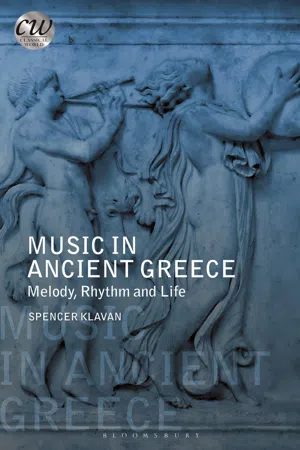
Life in ancient Greece was musical life. Soloists competed onstage for popular accolades, becoming centrepieces for cultural conversation and even leading Plato to recommend that certain forms of music be banned from his ideal society. And the music didn't stop when the audience left the theatre: melody and rhythm were woven into the whole fabric of daily existence for the Greeks. Vocal and instrumental songs were part of religious rituals, dramatic performances, dinner parties, and even military campaigns. Like Detroit in the 1960s or Vienna in the 18th century, Athens in the 400s BC was the hotspot where celebrated artists collaborated and diverse strands of musical tradition converged. The conversations and innovations that unfolded there would lay the groundwork for musical theory and practice in Greece and Rome for centuries to come. In this perfectly pitched introduction, Spencer Klavan explores Greek music's origins, forms, and place in society.
In recent years, state-of-the-art research and digital technology have enabled us to decipher and understand Greek music with unprecedented precision. Yet many readers today cannot access the resources that would enable them to grapple with this richly rewarding subject. Arcane technical details and obscure jargon veil the subject - it is rarely known, for instance, that authentic melodies still survive from antiquity, helping us to imagine the vivid soundscapes of the Classical and Hellenistic eras. Music in Ancient Greece distills the latest discoveries into vivid prose so readers can come to grips with the basics as never before. With the tools in this book, beginners and specialists alike will learn to hear the ancient world afresh and come away with a new, musical perspective on their favourite classical texts.
- 176 pages
- English
- ePUB (mobile friendly)
- Available on iOS & Android
eBook - ePub
About this book
Information
1
Introduction: Origins and Beginnings
What this book is about
Music has always been with us. Even in prehistoric caves in Spain (the Caves of El Cogul) and Italy (the Grotta dell’Addaura), we can see depictions of dancing people painted onto the walls. And to this day there is no known culture in the world that lacks a tradition of singing, chanting, playing instruments, or moving to a beat. The earliest known form of written musical notation is carved into a clay tablet from around 1400 BC in the ancient city of Ugarit (now Syria). But that’s many thousands of years later than the aforementioned cave paintings, a fact from which we learn something important: music itself is much older than music notation. The vast majority of ancient music left behind no trace for historians to study. There are still songs being sung today that will never get written down – think of the rhymes you used to chant as a kid on the playground, or the private melodies that some parents make up and sing to their babies. These unwritten tunes might be passed down within families, or after a short while they might vanish forever. But whether written or not, music is a fundamental component of human life. Wherever there are people, they sing and dance together.
This book is first and foremost about ancient Athens – the voting citizens, the rich matrons, the enterprising prostitutes, the slaves, the immigrants, the children, and everyone else who lived together in a form of legally and culturally organized life called a city-state (or in Greek, a polis). Athens is near the eastern tip of Greece, the first major city one would encounter if travelling into Europe from Turkey or elsewhere in the Middle East. In the ancient world it was often a hub for commerce, travel, and trade among the many cultures that would move between those eastern regions and the communities of what is now Europe. This became especially true during the fifth century BC, in between 479 (when a coalition of Greek city-states managed to fend off colonization by the massive Persian Empire) and 404 (when Athens was forced under siege to surrender to Sparta, its major rival for power in Greece, at the end of the conflict between them called the Peloponnesian War).
The period before the Greek victory over Persia in 479 is usually called the ‘Archaic’ period, whereas the period after is called the ‘Classical’ period. Here we come up against a problem: as will soon become clear, the Classical period was a time of tremendous cultural flourishing, during which many of the developments that interest us took place. But it was also, crucially, not the period during which many of our sources about music were written. Quite a few great poets (such as composers of tragedy like Aeschylus, Sophocles, and Euripides, or of lyric like Pindar and Bacchylides) and historians (Herodotus and Thucydides chief among them) did leave written records of their work that survive to this day. But plenty of others, including many musicians and musical philosophers (Damon of Athens, Timotheus of Miletus, Lasus of Hermione, and the rest whom we will meet in this book) left nothing or only a few fragments.
We can ameliorate the situation somewhat by reading reports from philosophers such as Plato, who was born in the 420s BC and wrote reflections on fifth-century Athenian life throughout his career, though that career itself extended well into the fourth century. Other fourth-century writers, such as the philosopher and music theorist Aristoxenus, paid minute and careful attention to musical forms which probably originated, at least in part, during the fifth century and earlier. But in each of these cases we have to be careful: the echoes of history get fainter as each year passes, and methods of reporting were much less reliable in the ancient world than they are today. Besides which, every author has an agenda: Plato’s opus was devoted, broadly speaking, more to philosophical than to musical accuracy. And Aristoxenus was attempting to craft a standard system for organizing musical practices that were, in real life, much more unruly and varied than he often let on. Similar warnings apply to Plato’s student Aristotle, who wrote even later than his teacher, and to theorists like Dionysius of Halicarnassus – who was later still, and whose expertize in technical matters was somewhat limited.1 So although we are not at a loss for sources, we will always have to think in this book about who’s telling us the story, and be cautious about whose reports we take at face value. But through the late reports, the fractured testimonies, and the eyewitness accounts, we can get something like a glimpse at what happened to music in Athens during the fifth century and in the Greek-speaking world afterwards.
During the Classical period itself, Athens was buzzing with artistic and intellectual activity. Every so often in history, stars align and one city becomes a nexus where people from around the world meet, collaborate, and share new ideas – think of Detroit in the Motown explosion of the 1960s or Vienna in the eighteenth-century heyday of Classical music. That’s what Athens was like in the 400s: electric with new forms of politics, debate, and art. Flushed with the exhilaration of facing down a Persian onslaught, the Athenians came to see themselves as world leaders and to pride themselves on being at the cutting edge of culture. ‘Everything comes from every city into ours,’ said the Athenian general and statesman Pericles in 431 BC. ‘We reap the fruits of other cultures just as naturally as we reap our own.’2
Pericles was overstating the case quite a bit, but it’s true that Athens learned a great deal from the societies surrounding it (more than Pericles himself might have liked to admit). In the 400s, Athenian culture became a kind of crucible in which all sorts of musical traditions merged to form something radically new and exciting. The advancements made in musical theory and practice during that time caught on all around the Mediterranean. In some cases they radiated even further outwards to influence other cultures and subsequent generations – the Romans, especially, adopted many Greek musical practices and spread them throughout the ancient world.
That is why ultimately, though this book tends to focus on Athens, it’s about more than just Athenian music. As we’ll see throughout these pages, Greece was the starting point for a host of hugely important developments in music history, many of which endure to this day and have had major effects even on the music that remains popular in the modern West. From Shostakovich to Skrillex, from Bach to Beyoncé and in between, almost no part of Western music history is untouched by the musical legacy of ancient Greece.
This is not to say that Athens was the be-all and end-all of ancient music. Just the opposite: precisely because it was so abuzz with cultural commerce, Athens was indebted to a huge range of practices and ideas which weren’t at all Athenian or even Greek in origin. There is a wealth of valuable and significant music history to learn from before and beyond Athens, and plenty more that we simply will never know. Again, think how often music disappears without ever being written down or written about – if that’s still true today, it’s even more true for the many highly refined musical cultures which existed before Greece and which, for one reason or another, haven’t left the same kind of historical record that Greece did. We’re lucky that we have so much from ancient Athens, but even so we need to qualify what we do have with an awareness of all that came before and all that has been lost. We begin, then, by surveying some of what we know – and what we wish we knew – about the music that came into Athens from older traditions around the world.
Influences
One region whose music was certainly influential in antiquity was the vast expanse of realms and kingdoms known today as the ‘Near East.’ This wasn’t just one big block of land: it was a complicated patchwork of sprawling empires that jockeyed for power across Mesopotamia from as early as the 3000s BC. There were the Babylonians and the Assyrians, whose monarchs left behind imposing monuments, some of them still standing now, over all the huge territories that they conquered. There were the Israelites, a small but defiant race of monotheists who staked their claim to a territory beside the Dead Sea – their descendants, the Jewish people, are of course still thriving and practising their religion around the world. Then there were the Lydians, who ruled in Asia Minor (now Turkey) from about 1200 until 547 BC, when they would be conquered by the Persians. The wealth and sophistication of Persian culture, for its part, is on display even now in the immense remains of the Persian royal complex known as Persepolis, which people still visit in modern-day Iran. It was the Persians that lost the wars against Athens between 490 and 479, the opening of the Classical period. But even before the Persian wars, contact with the civilizations of the East played a major role in setting the scene for the fifth-century cultural explosion.
It stands to reason that encounters with Persia and the Near East would have galvanized Greek musical culture, because all of the societies mentioned above were alive with song and dance. The lyrics to many of ancient Israel’s greatest hymns were written down and survive in the book of the Bible called ‘Psalms’ – the Hebrew title of this book, Tehillim, simply means ‘worship songs.’ Tradition holds that many of these songs were written by the greatest king of Israel, David, who reigned during the tenth century BC and was known for the ecstatic dancing and singing with which he worshipped God (see the Bible’s Second Book of Samuel, Chapter Six). Later, King Sargon II of Assyria (who reigned between 722 and 705 BC) left behind an inscription claiming that he gathered ‘princes of the four regions of the globe’ for ‘a feast of music’ in his palace.3 Monarchs like Sargon prided themselves in assembling performers and musicians from the many cities within their power, as a display of how widely their empires ranged and how completely their own capital cities excelled the rest. Artists of all kinds, then, gathered from around the world in the great courts of ancient Mesopotamia and the Levant (the region on the east coast of the Mediterranean where Israel, Syria, Lebanon, and Jordan are found today). These massive royal complexes were centres of diverse and innovative musical culture.
From very early on, Eastern communities were doing business and sharing ideas with Greece. The Levant is only a short journey away from Athens by sea, and Asia Minor with its rich Lydian culture was separated from Europe by nothing more than a tiny strip of water called the Hellespont. Especially in the eighth and seventh centuries, Greek musicians seem to have taken cues from their neighbours in the East. There are some snatches of Archaic poetry which may indicate that Lydian harps were popular in that period among the Greek male gentry – although on vase paintings from the Classical period, harps are represented as an instrument for women. In any case, Archaic Greeks certainly did have their own stringed instrument, lower-toned than the Lydian harp: the long seven-stringed barbitos. The Greek court songwriter Pindar thought that Terpander (one of the first and best-known Greek musicians) created the barbitos after ‘hearing the lofty harp strummed at Lydian drinking parties.’4 Whether or not it really was Terpander who invented the barbitos, it’s clear that Greek musical culture before the fifth century grew and flourished in dynamic exchange with the thriving cultures of Lydia and Assyria.
One important place where Greek musicians met their fellow artists from the East was the island of Lesbos. That’s where Terpander himself was from, along with many of the other greats of the Archaic period. The people on Lesbos spoke Greek, but the island was right off the coast of Asia Minor, putting it closer to Lydia than to mainland Greece and making it a perfect meeting place for singers from all around the Mediterranean. The celebrities from that time in Lesbos are among the most famous of all Greek history: Sappho, especially, made such a name for herself that her admirers used to say she was one of the elegant goddesses of song and poetry known as Muses.5 Sappho wrote some of the most enduring love songs of her day – or any day, for that matter. The fragments of her work that still survive have been translated into English by famous poets – like the nineteenth-century English writer Christina Rosetti, for example. Or the twentieth- and twenty-first-century Classicist Anita George, who begins one translation of Sappho with the evocative line, ‘you: an Achilles’ apple / Blushing sweet on a high branch / At the tip of the tallest tree.’6
Students today usually read these words in print, as if they were poems meant to be written down in books. But in fact they’re song lyrics, and the tradition of poetry that they belong to is called ‘lyric’ poetry because originally it would have been sung along with a class of stringed instrument called the ‘lyre’ (more on this in Chapter 2). Sappho’s sensuous odes would have been sung at drinking parties (Greek symposia – see Chapter 3), and other compositions of hers would likely have been learned by choruses of young girls and performed at public festivals (see Chapter 4). The same is true of Sappho’s fellow Lesbian musicians such as Terpander and, a little later, the younger singer Alcaeus. The tight community of artists on Lesbos shared ideas and techniques amongst themselves, but they also learned from their eastern neighbours, making for a two-way international exchange of instruments and songs.
There was cultural crossover going on within Greece, too. Terpander, for one, was famous for having travelled west from Lesbos to the Greek city-state of Sparta. There he was said to have inaugurated the musical competitions held at a festival for Apollo (god of music and medicine) called the Carneia. As often happens in the early history of Greece, it’s hard to tell here where fiction ends and fact begins. There definitely was a contest at the Carneia in which performers would sing to their own accompaniment on the lyre and compete for prizes. Terpander is named as the winner in a list from the first of these contests in the 670s BC.7 He certainly composed for, and played on, the kithara – an elaborate professional-grade lyre for concert performance. There are stories (again, quite possibly fictional) that Terpander actually invented the kithara too, and it’s even possible (although far from certain) that he also wrote and played music for the auloi (singular aulos), a set of double-pipes which, along with the lyre, was the other major concert instrument of Greek tradition. Whether or not Terpander played the auloi, the pipes rivalled (or in some instances even surpassed) the kithara as the instrument of competition performance, festival song, and high art in Greece.
But whether or not Terpander was r...
Table of contents
- Cover
- Half-Title Page
- Dedication
- Series Page
- Title Page
- Contents
- List of Figures
- Timeline
- 1 Introduction: Origins and Beginnings
- 2 How Music Was Made: Instruments and Songs
- 3 Where Music Happened: Venues
- 4 Education
- 5 Politics
- 6 The Cosmos
- 7 Tunes
- 8 Rhythms
- 9 Beyond Greek Music
- Notes
- Glossary
- Index
- Copyright
Trusted by 375,005 students
Access to over 1.5 million titles for a fair monthly price.
Study more efficiently using our study tools.
Frequently asked questions
Yes, you can cancel anytime from the Subscription tab in your account settings on the Perlego website. Your subscription will stay active until the end of your current billing period. Learn how to cancel your subscription
No, books cannot be downloaded as external files, such as PDFs, for use outside of Perlego. However, you can download books within the Perlego app for offline reading on mobile or tablet. Learn how to download books offline
Perlego offers two plans: Essential and Complete
- Essential is ideal for learners and professionals who enjoy exploring a wide range of subjects. Access the Essential Library with 800,000+ trusted titles and best-sellers across business, personal growth, and the humanities. Includes unlimited reading time and Standard Read Aloud voice.
- Complete: Perfect for advanced learners and researchers needing full, unrestricted access. Unlock 1.5M+ books across hundreds of subjects, including academic and specialized titles. The Complete Plan also includes advanced features like Premium Read Aloud and Research Assistant.
We are an online textbook subscription service, where you can get access to an entire online library for less than the price of a single book per month. With over 1.5 million books across 990+ topics, we’ve got you covered! Learn about our mission
Look out for the read-aloud symbol on your next book to see if you can listen to it. The read-aloud tool reads text aloud for you, highlighting the text as it is being read. You can pause it, speed it up and slow it down. Learn more about Read Aloud
Yes! You can use the Perlego app on both iOS and Android devices to read anytime, anywhere — even offline. Perfect for commutes or when you’re on the go.
Please note we cannot support devices running on iOS 13 and Android 7 or earlier. Learn more about using the app
Please note we cannot support devices running on iOS 13 and Android 7 or earlier. Learn more about using the app
Yes, you can access Music in Ancient Greece by Spencer Klavan in PDF and/or ePUB format, as well as other popular books in Geschichte & Geschichte der griechischen Antike. We have over 1.5 million books available in our catalogue for you to explore.