The definitive guide to the birds of Pakistan
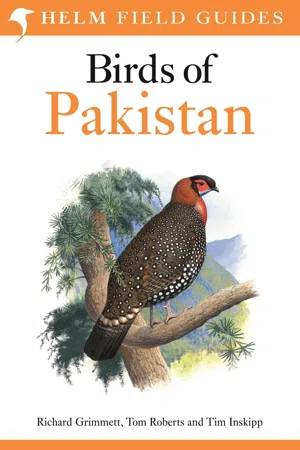
Pakistan has a rich diversity of bird habitats, from the dry alpine and moist temperate forests of the western Himalayas to the deserts of Baluchistan and Sind. This diversity of habitats supports a wide variety of species, and some 669 have been recorded. These include some serious big-hitters – names such as Orange Bullfinch, White-cheeked Bushtit and Long-billed Grasshopper Warbler are guaranteed to stop any birder int their tracks – along with a suite of warblers, laughingthrushes, rosefinches and pheasants, such as the stunning Western Tragopan that graces the cover of this book. And, with Pakistan little visited by birders, there is always the chance of finding something new or extraordinary.
This guide covers every species known to occur in the country. Superb plates are accompanied by a succinct text highlighting identification, voice, habitat, altitudinal range, distribution and status, and there are accurate distribution maps for every species.
Birds of Pakistan remains the key birding field guide to the country. It's an essential addition to the backpack of any birder living in or visiting the region.
- 256 pages
- English
- ePUB (mobile friendly)
- Available on iOS & Android
eBook - ePub
Field Guide to Birds of Pakistan
About this book
Information
PARTRIDGES, QUAILS AND BUTTONQUAILS, PLATE 1
1 SNOW PARTRIDGE Lerwa lerwa
38 cm

ADULT Vermiculated dark brown and white upperparts, chestnut streaking on underparts, and red bill and legs. Often occurs in large parties, and can be very tame. Males advertise with low whistling calls, and noisy cackling when going to roost. High-altitude rocky and grassy slopes with scrub. Resident; 3300–5200 m. Rare in Hazara and uncommon in Gilgit and the Khunjerab.
2 SEE-SEE PARTRIDGE Ammoperdix griseogularis
26 cm

a MALE and b FEMALE Rather uniform, sandy-coloured partridge. Male has white eye-stripe and chestnut and black flank stripes. Female has cream super-cilium and throat, grey flecking on neck, and pinkish-buff and grey vermicula-tions on mantle and breast. Much smaller than Chukar. Males repeat inflected khooit-khooit call from prominent rock. When flushed, wings produce distinctive whirring. Dry rocky foothills, sand dunes and cultivation edges. Widely distributed west of the Indus, throughout Baluchistan from sea coast to northern foothills and across Punjab Salt Range.
3 CHUKAR Alectoris chukar
38 cm

ADULT Black gorget encircling throat, barring on flanks, and red bill and legs. Aggressive males call, a repeated chuk-a-ka-chuk-a-ka from a prominent rock. Easily trapped and popular cagebird. Open rocky or grassy hills; dry terraced cultivation. Resident. Widely distributed in mountainous tracts from central Baluchistan through NWFP, Gilgit, Hunza and Baltistan, up to 5000 m.
4 COMMON QUAIL Coturnix coturnix
20 cm

a MALE and b FEMALE Male has black ‘anchor’ mark on throat (which may be lacking), and buff or rufous breast with pale streaking. Female lacks ‘anchor’ mark and has blackish spotting on buffish breast. Call a liquid repeated kwik-whi-kwik. Often trapped for food. Crops and grassland. Passage migrant from April to May and from August to October, with some birds staying to breed in Chitral, Gilgit and Hunza.
5 RAIN QUAIL Coturnix coromandelica
18 cm

a MALE and b FEMALE Male has strongly patterned head and neck, black on breast, and streaking on flanks. Female smaller than female Common, otherwise almost identical, but has unbarred primaries. Call a double whistle which-which, repeated 3–5 times. Crops, grassland, grass and scrub jungle. Localised monsoon visitor to southeast Sind and northeast Punjab, breeding after good rains.
6 SMALL BUTTONQUAIL Turnix sylvatica
13 cm

MALE Very small size and pointed tail. Buff edges to scapulars form prominent lines, and rufous mantle and coverts are boldly fringed buff, creating scaly appearance. Underparts are similar to many Yellow-legged. Bill grey and legs pinkish. Only females call, as befits their polyandrous breeding: a surprisingly loud throbbing lasting 10 seconds, repeated at intervals. Tall grassland. Erratic summer breeding visitor to extreme southeastern Sind and northern parts of the Punjab Salt Range, westwards to adjacent foothills.
7 YELLOW-LEGGED BUTTONQUAIL Turnix tanki
15–16 cm

a MALE and b FEMALE Yellow legs and bill. Comparatively uniform upper-parts (lacking scaly or striped appearance), and buff coverts with bold black spotting. Polyandrous breeding, with only the female calling; call is reminiscent of the distant chuffing of a two-stroke engine. Scrub and grassland, and crops. Uncommon v...
Table of contents
- Cover
- Title Page
- CONTENTS
- INTRODUCTION
- BIRDWATCHING AREAS
- NATIONAL ORGANISATIONS
- REGIONAL AND INTERNATIONAL ORGANISATIONS
- REFERENCES
- ACKNOWLEDGEMENTS
- GLOSSARY
- SELECTED BIBLIOGRAPHY
- FAMILY SUMMARIES
- COLOUR PLATES AND SPECIES ACCOUNTS
- APPENDIX: VAGRANTS AND EXTIRPATED SPECIES
- TABLES
- eCopyright
Trusted by 375,005 students
Access to over 1.5 million titles for a fair monthly price.
Study more efficiently using our study tools.
Frequently asked questions
Yes, you can cancel anytime from the Subscription tab in your account settings on the Perlego website. Your subscription will stay active until the end of your current billing period. Learn how to cancel your subscription
No, books cannot be downloaded as external files, such as PDFs, for use outside of Perlego. However, you can download books within the Perlego app for offline reading on mobile or tablet. Learn how to download books offline
Perlego offers two plans: Essential and Complete
- Essential is ideal for learners and professionals who enjoy exploring a wide range of subjects. Access the Essential Library with 800,000+ trusted titles and best-sellers across business, personal growth, and the humanities. Includes unlimited reading time and Standard Read Aloud voice.
- Complete: Perfect for advanced learners and researchers needing full, unrestricted access. Unlock 1.5M+ books across hundreds of subjects, including academic and specialized titles. The Complete Plan also includes advanced features like Premium Read Aloud and Research Assistant.
We are an online textbook subscription service, where you can get access to an entire online library for less than the price of a single book per month. With over 1.5 million books across 990+ topics, we’ve got you covered! Learn about our mission
Look out for the read-aloud symbol on your next book to see if you can listen to it. The read-aloud tool reads text aloud for you, highlighting the text as it is being read. You can pause it, speed it up and slow it down. Learn more about Read Aloud
Yes! You can use the Perlego app on both iOS and Android devices to read anytime, anywhere — even offline. Perfect for commutes or when you’re on the go.
Please note we cannot support devices running on iOS 13 and Android 7 or earlier. Learn more about using the app
Please note we cannot support devices running on iOS 13 and Android 7 or earlier. Learn more about using the app
Yes, you can access Field Guide to Birds of Pakistan by Richard Grimmett,Tim Inskipp,Tom Roberts in PDF and/or ePUB format, as well as other popular books in Biological Sciences & Zoology. We have over 1.5 million books available in our catalogue for you to explore.