Filmmakers and cinema industries across the globe invest more time, money and creative energy in projects and ideas that never get produced than in the movies that actually make it to the screens. Thousands of projects are abandoned in pre-production, halted, cut short, or even made and never distributed – a "shadow cinema" that exists only in the archives.
This collection of essays by leading scholars and researchers opens those archives to draw on a wealth of previously unexamined scripts, correspondence and production material, reconstructing many of the hidden histories of the last hundred years of world cinema. Highlighting the fact that the movies we see are actually the exception to the rule, this study uncovers the myriad reasons why 'failures' occur and considers how understanding those failures can transform the disciplines of film and media history. The first survey of this new area of empirical study across transnational borders, Shadow Cinema is a vital and fascinating demonstration of the importance of the unmade, unseen, and unknown history of cinema.
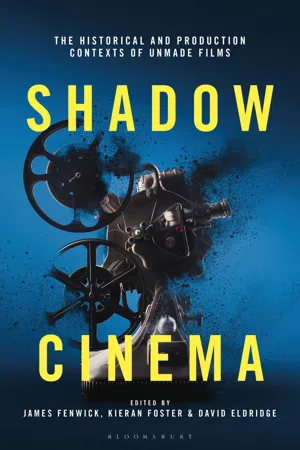
eBook - ePub
Shadow Cinema
The Historical and Production Contexts of Unmade Films
- 280 pages
- English
- ePUB (mobile friendly)
- Available on iOS & Android
eBook - ePub
Shadow Cinema
The Historical and Production Contexts of Unmade Films
About this book
Information
PART ONE
Producers and production companies
1
A production strategy of overdevelopment: Kirk Douglas’s Bryna Productions and the unproduced Viva Gringo!
James Fenwick
In 1969, after nearly twenty-five years in the business and over fifty screen appearances starting with The Strange Love of Martha Ivers (Milestone 1946), Kirk Douglas took the decision to begin donating his personal and business papers to the Wisconsin Center for Film and Theater Research (WCFTR). Over the next decade, Douglas continued to donate his papers, leading to the division of the original collection into seven broad categories: correspondence and personal papers; financial and business records; television; theatre; radio; motion pictures – produced; and motion pictures – unproduced. Taken together, the Kirk Douglas Papers cover one of the most important and transformational eras in American film history, commencing with the twilight years of the studio system in the 1940s, through its break-up in the 1950s and the eventual conglomeration of the Hollywood studios in the 1960s. At the same time, the papers reveal Douglas’s own centrality to these transformations following the incorporation of his own independent production company in 1949, Bryna Productions. Douglas was one of the first actors to form his own company in the post-Second World War era, precipitating an industrial trend that reached its apogee in the mid-1950s.
The Kirk Douglas Papers (KDP), as the collection was eventually named, are quite revealing, with correspondence and other documents that unveil the man behind the screen-persona. What we find is an actor, producer, writer, philanthropist and diplomat who frequently displayed a furious level of perfectionism, determined to ensure his projects – in all their forms – possessed a long-lasting quality and that (increasingly so, from the late 1950s onwards) they contained deeper intellectual and social themes. Douglas had been encouraged to donate these papers at the invite of film historian and academic Tino Balio. At the time, Balio was the director of the WCFTR and was instrumental in growing its archival acquisitions. Balio set about obtaining the United Artists Corporation Records, a vast collection of films, production files, business papers and more. Balio’s success in securing such major archival donations was a result of his pitch, convincing potential donors that ‘UW–Madison was a serious research institution looking to provide students and scholars with resources to study the history of film, television and theater, and that it would take the steps necessary to archive and preserve those materials’ (Price 2007).
The intention of this chapter is to demonstrate how and why such archival material, even the most mundane, incomplete and trivial of records, is a vital and necessary source that can help researchers uncover new perspectives, histories and even dynamics within the American film industry. The chapter will serve as a guide for the reconstruction of lost film texts as well as raise questions as to what even constitutes a ‘text’ in the murky and dusty scholarly domain of shadow cinema. The chapter will examine Douglas’s unmade project Viva Gringo!, situating its development (and eventual abandonment) within the wider industrial and cultural contexts of the late 1950s and early 1960s, as well as in the broader business history of Douglas’s Bryna. It will explore the creative and business decisions that led to both the development and abandoning of the project, and, more importantly, it will show how we can use the scant archival material of a project like Viva Gringo! to reconstruct a wider history of industrial and cultural logic of failure that informed Hollywood production processes in the 1950s and 1960s.
Kirk Douglas and Bryna Productions
Before undertaking the case study of Viva Gringo!, I want to explore the wider history of Douglas’s productions in the 1950s and the archival category of ‘motion pictures – unproduced’ within the KDP. In doing so, the aim is to understand more broadly the management processes of Bryna and of Douglas as a producer. It also serves to show the extent of overdevelopment taking place at the company: the way in which Douglas was committing to more projects than Bryna could ever feasibly produce, given its limited resources as a small, independent production company, and in turn how this led to a surplus of unproduced films.
Table 1.1 surveys the KDP category of ‘motion pictures – unproduced’, with fifty-nine separate unproduced projects from the incorporation of Bryna in 1949 through to the mid-1970s. The table also contains information about the years attributable to the respective archival documentation, but this does not necessarily correlate to the years in which the project was in active development. For example, The Shadow contains documentation from 1944, but this relates to contracts that detail previous literary rights to the property on which the project was based prior to Douglas actively looking to develop the project. Table 1.1 is by no means a complete record of all the unproduced projects with which Bryna or Douglas were associated. Despite forming his own production company, Douglas still regularly starred in the productions of other producers and production companies. At the same time, other archival documents contained in the KDP refer to projects that Douglas/Bryna were developing (Norton 1957) but which are not present within the unproduced section, while newspaper and trade journal articles, such as Variety, detail the names of projects Douglas was – however briefly – associated with.
Table 1.1 Film listed in the ‘Motion pictures – unproduced’ category of the KDP
| Title | Year(s) | Title | Year(s) |
| The Man Without a World | 1950 | Something for Nothing | 1966 |
| The Travelers | 1950 | Lie Down, I Want to Talk to You | 1967 |
| Allison Brothers | 1955 | Shady Baby | 1967 |
| The Syndicate | 1954–6 | Seat of Power | 1967–70 |
| Shadow of a Champ | 1955–9 | The Piano Sport | 1968 |
| A Most Contagious Game | 1955–7 | The Bronc Rider | 1968–9 |
| Mavourneen | 1956–67 | Charlemagne | 1968–9 |
| The Shadow | 1944–72 | Chaka | 1969 |
| Deliver Us from Evil | 1956 | Project II | 1969 |
| Quality of Mercy | 1956 | A Last Valley | 1969 |
| Silent Gun | 1956–66 | Fling! | 1969 |
| Man on a Motorcycle | 1956–7 | Adam’s Garden | 1969 |
| The Golden Triangle | 1956 | Alimony Jail | 1969 |
| I Stole $16,000,000 | 1957–60 | The Photographer | 1969 |
| Montezuma | 1957–60 | The Stranglers | n.d. |
| The Sun at Midnight | 1957–61 | Catch Me a Spy | 1972 |
| The Incredible Yanqui | 1951 | The Black Box | n.d. |
| The Beach Boys | 1958 | The Heroine | n.d. |
| The Disenchanted | 1958 | The Changing Man | n.d. |
| The Mound Builders | 1958–61 | Jamie | n.d. |
| Port of Call | 1958 | Aces ‘n Eights | n.d. |
| Viva Gringo! | 1958 | Brief Madness | n.d. |
| Masters of the Dew | 1958–9 | Fuzz | n.d. |
| The Indian Wars | 1961 | The Glory of Love | n.d. |
| King Kelly | 1955–63 | The Many Loves of Jerome | n.d. |
| Trapeze | 1961 | Marauder | n.d. |
| Walls of Jolo | 1963 | The Milk Run, or the Aerodynamic Love Song of Eddie MacLean | n.d. |
| Automation | 1964 | The Rustler and the Prostitute | n.d. |
| The Confessor | 1964–5 | Yatra: A Beginning, A Pilgrimage | n.d. |
| Bolivar! | 1966 | Miscellaneous stories | |
Following its incorporation in 1949, there were attempts by Bryna to produce several films, including The Shadow, a project that was to be filmed in the UK and co-star Jane Wyman alongside Douglas (Fenwick 2020a: 96). But Bryna did not enter active production until the mid-1950s with the release of The Indian Fighter (1955), following the signing of a six-picture, non-exclusive contract with United Artists (UA). Yet, between the ‘dormant’ years of 1949 and 1955, there were frequent reports of potential properties being developed by the company. Producer Richard Sokolove worked for this earliest iteration of Bryna between 1950 and 1951. Sokolove would read twelve to fifteen stories and scripts per week and provided Douglas with reports so that he could consider what projects Bryna might develop (Sokolove 1951).
But Sokolove appears to have grown increasingly frustrated at the inactivity of Bryna, which he deemed to be a result of Douglas’s own heavy workload; since the incorporation of Bryna in 1949, through to Sokolove expressing his frustration in 1951, Douglas had appeared in eight films, none of which were produced by Bryna. Sokolove was frank in his assessment of the situation at Bryna, telling Douglas, ‘No project should depend upon your acting in it. As willing and interested as you might be, you have neither the time nor the strength. Each project should stand on its own’ (Sokolove 1951 – emphasis in the original). Following his intervention, which largely went unheeded, Sokolove left Bryna’s employment in 1952. By March 1952, Boxoffice was reporting that Douglas finally intended to activate Bryna, with plans for two projects to enter immediate production, followed by an annual slate of three pictures (though Douglas planned on appearing in only one picture per year, perhaps taking on board Sokolove’s suggestion) (‘Kirk Douglas Activating’ 1952: 30).
William Schorr was brought on board as a producer to replace Sokolove and commence development of The Shadow and The Fear Makers (‘Kirk Douglas Activating’ 1952: 30). But once again Bryna stalled and neither project entered production. The latter was an adaptation of Darwin Teilhet’s 1945 novel of the same name, a thriller about a communist plot to infiltrate America. Douglas’s lawyer, Sam Norton, optioned the novel in 1948, with Douglas intermittently seeking ways to adapt it throughout the early 1950s (Williams 1949; Teilhet 1950). By the summer of 1950, Douglas’s assessment of the project was that he was not ‘in a hell of a rush. I have waited too long to do anything with “Fear Makers” to louse it up by rushing into it now’ (Douglas 195...
Table of contents
- Cover Page
- Title Page
- Contents
- Contributors
- Introduction
- Part I Producers and production companies
- Part II Directors and auteurs
- Part III Questioning the unmade
- Part IV Reconstructing the unmade
- Index
- eCopyright
Trusted by 375,005 students
Access to over 1.5 million titles for a fair monthly price.
Study more efficiently using our study tools.
Frequently asked questions
Yes, you can cancel anytime from the Subscription tab in your account settings on the Perlego website. Your subscription will stay active until the end of your current billing period. Learn how to cancel your subscription
No, books cannot be downloaded as external files, such as PDFs, for use outside of Perlego. However, you can download books within the Perlego app for offline reading on mobile or tablet. Learn how to download books offline
Perlego offers two plans: Essential and Complete
- Essential is ideal for learners and professionals who enjoy exploring a wide range of subjects. Access the Essential Library with 800,000+ trusted titles and best-sellers across business, personal growth, and the humanities. Includes unlimited reading time and Standard Read Aloud voice.
- Complete: Perfect for advanced learners and researchers needing full, unrestricted access. Unlock 1.5M+ books across hundreds of subjects, including academic and specialized titles. The Complete Plan also includes advanced features like Premium Read Aloud and Research Assistant.
We are an online textbook subscription service, where you can get access to an entire online library for less than the price of a single book per month. With over 1.5 million books across 990+ topics, we’ve got you covered! Learn about our mission
Look out for the read-aloud symbol on your next book to see if you can listen to it. The read-aloud tool reads text aloud for you, highlighting the text as it is being read. You can pause it, speed it up and slow it down. Learn more about Read Aloud
Yes! You can use the Perlego app on both iOS and Android devices to read anytime, anywhere — even offline. Perfect for commutes or when you’re on the go.
Please note we cannot support devices running on iOS 13 and Android 7 or earlier. Learn more about using the app
Please note we cannot support devices running on iOS 13 and Android 7 or earlier. Learn more about using the app
Yes, you can access Shadow Cinema by James Fenwick, Kieran Foster, David Eldridge, James Fenwick,Kieran Foster,David Eldridge in PDF and/or ePUB format, as well as other popular books in Media & Performing Arts & Film & Video. We have over 1.5 million books available in our catalogue for you to explore.