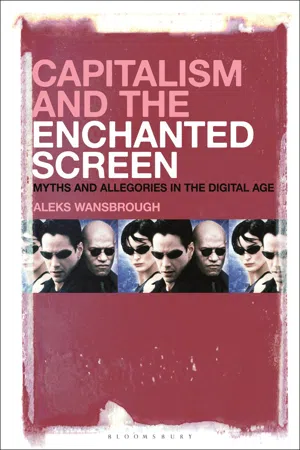
eBook - ePub
Capitalism and the Enchanted Screen
Myths and Allegories in the Digital Age
- 232 pages
- English
- ePUB (mobile friendly)
- Available on iOS & Android
eBook - ePub
Capitalism and the Enchanted Screen
Myths and Allegories in the Digital Age
About this book
Myths such as Narcissus' reflection, Pandora's box, and Plato's cave have been used to frame modern technological dangers; often to describe people absorbed in their own digital reflections. Such speculation either purports that technology has a magical power or else that technology merely represents human nature unchanged from the myth's inception. But those accounts ignore the paradoxical understandings of the power relationships allegorized, where people are manipulated by higher forces beyond their comprehension. Working from the assumption that capitalism rather than God is the highest power, this book examines mythic anticipations of the screen and digital technology from European literature, poetry, folklore and philosophy. Digital technology and social media are approached not as reflections of human nature but capitalist ideology's power to enchant. To this end, Capitalism and the Enchanted Screen also surveys a diverse variety of films, digital media and contemporary artworks to understand and critique how myths are reimagined today.
Information
1
Introduction to Magical Technology and Disenchanting Screens
“The myths which fell victim to the Enlightenment were themselves its products. […] Myth sought to report, to name, to tell of origins—but therefore also to narrate, record explain. This tendency was reinforced by recording and collecting myths.”
—Theodor Adorno and Max Horkheimer1
Myths and fables are sometimes said to anticipate issues surrounding digital media. Today, there are apps and software that claim to allow you to see what you will look like older, functioning as enchanted mirrors for users.2 Apparently, these near-magical abilities include the power of social media to alter society and individual habits. Social media is blamed for increases in anxiety and the spread of false information. In old, often ancient stories, objects can become enchanted by higher powers to deceive mortals and shape their behavior—such as Pandora’s box, Plato’s cave of shadows, and Narcissus’s pool. The narrative of inanimate objects exerting power over human beings portends social media’s ability to entrance people as they gaze, absorbed in their phones. But what if these objects exert such power because they are designed to do so by a contemporary force, akin to god? As the highest power that we know of in this earthly realm is capitalism, we might ask how mythic analogues for digital media could be used to critique our digital condition. Such an approach would help remove the hype and alarmism around digital media and the many screen devices, emphasizing that social media’s power to enthrall often comes from something other than the devices or interactive screens.
Although mythic analogues appear in headlines, articles, and blogs about social media, it is seldom asked what powerful force manipulates the digital screen. We may well be aware that corporations manipulate social media or that governments do, as with concerns about Russian interference in the 2016 US presidential election. But the reigning power of capital—and all the competition and consumerism it entails—also finds new forms of expression online. With the rise of “the selfie” as a commodified, “filtered,” and perfected version of self—saleable in the sense of its ability to accrue “likes”—the collecting and selling of user data by social media platforms, social media users are participating in the promotion of neoliberal values. After all, in August 2019, Facebook surreptitiously changed its promise on its sign-up page—“It’s free and always will be”—to a slogan easier for the company to adhere to: “It’s quick and easy.”3
Framing the power of social media as conferred by the power of neoliberal capitalism, this inquiry presents a political framing of mythic or fantastical allegories or concepts, in part so that we can appreciate the power of capitalist ideology’s often intangible hold over our daily lives. Myth is important because it affirms the power of the invisible (ideology) to shape the visible symptoms (screen-related compulsions); it reveals how technology becomes a form of reverence for capital. Myth also can underscore the significance of manipulation, deception, and cruel enchantment—themes which so often recur not only in myths but online.
As such, this intervention asks what truth may be exhumed from myth and allegories that would aid us in understanding contemporary problems endemic in our digital lives. But it also asks what is obscured by these fables. When one reads headlines comparing social media to Pandora’s box or Plato’s cave, or selfies to Narcissus’s bewitching reflection, the political possibilities of such tales are invariably limited or obscured. Such headlines relay exhausted ideas that narcissism has always been with us, or that we have always grappled to discern truth from fiction. This book instead will critique how myths are used and retold to conclude either that social problems are timeless or that technology has some “magical” ability to shape us in unforeseen ways. Such a critique subverts these assumed fables by finding political accents to these allegories. Rather than just analyzing the use of old myths in new contexts, this book will also draw on television and cinema to allegorize the power relations present in the digital world and extend a political analysis.
From Understanding Myth to Myth as Understanding
Part of the reason for the de-politicizing of fables may be that all too often myth or allegories, when invoked, intimate timeless or poetic truth. The very word “myth” is difficult to define, descending from the Greek muthos, which can be translated as “story” but also “speech” or “word.”4 Myths relate to sacred tales and are often embedded in historical specificity, acquiring or losing complexity when adapted. Often myths entail hieratic, multilayered interpretation and invite various understandings, reworkings, and appropriations. Myths do not function exclusively as advisory parables, but also as allegorical weavings of subtle, sometimes subversive meanings as when myths, legends, and fairy tales serve as masked critiques of political problems. Marcel Danesi fittingly argues that myths are “narrative theories” of the world that contrast the world-as-it-seems with the otherworldly and stage or dramatize a confrontation between realms.5 Such an interpretation is compatible with Marxist theories of Myth, such as those offered by Horkheimer and Adorno but also other Marxists theorists such as Raymond Williams. Even Marx’s own use of myth (to be explored later in this chapter) chimes with the idea that myth shapes but also theorizes reality.
Although this framing of myth is markedly political, the very term “mythic truth” is commonly shorn of any political connotation and implies an elevated truth, or the revelation of a primal encounter with the mysterious and magical. Much of the current conceptualization of myth was bestowed prominence by different strands of Romanticism in the eighteenth and nineteenth centuries. The German Romantic philosopher FWJ Schelling, for example, argued that all epistemic endeavors (as well as all art) begin with myth, as the mythic need was one to discern and impart greater meaning to the world.6 Earlier the English Romantic William Blake had postulated that myth had descended from the earliest poets who sensuously described their surroundings.7 In contrast to some more recent conceptions, both of these two very different thinkers understood there to be a sort of political relationship to myth; Blake arguing that myth had been corrupted as a political tool that “enslaved the vulgar”;8 and Schelling championing the idea that myth differentiated different forms of community.9 What remains of romantic theorizations of myth in contemporary media is a vague understanding that myths are sometimes naïve, sometimes timeless forms of knowing that speak to the emotions; but this is not the position taken here.
The understanding that I propose to adopt is strikingly contrastive to contemporary residues of the Romantic venerations of myth and, as such, may prove to be more useful to understanding the specifics of the current digital era. This book covers issues such as selfie-compulsions, Incels, and the Alt-Right, as well as a sense of cultural recycling and digital deathlessness, online culture wars, and unrealizable ideals of digital perfection. A political interpretation of myth will be largely adapted and modified from Adorno and Horkheimer’s work Dialectic of Enlightenment (1944; revised 1947). Dialectic of Enlightenment not only sought to understand how myth was revitalized through modern technologies in order to manipulate the masses, but also how myth already framed the world instrumentally. This notion that myth reveals instrumental rationality has often been overlooked and instead we find myths that obscure the rationality behind the production of digital screen technology. By using Marxist understandings of myth such as Adorno’s and Horkheimer’s, prevailing views that social media screens function as Narcissus’s pool as well as other cliché understandings will be examined, critiqued, and subverted. In ancient times, myths were recorded and collected for their explanatory power, argue Adorno and Horkheimer. It is for this reason that the book collects some of the myths used as contemporary analogues for understanding digital media.
Mainstream uses of mythic tales seek to claim either that technology merely reveals issues that have always been with humanity or that technology has powers akin to magic, with the ability to change human behavior. Both perspectives return us to enchantment, to treating technology as mysterious and powerful. In contrast, Adorno and Horkheimer have argued, counter-intuitively, that myths actually engender disenchantment. Far from myths enchanting objects, giving life, meaning, and mystery to them, mythic tales reveal that what appears to be an object acting on its own is a trick, or manipulation or created with that intention. Although there is magic in myth, where objects have special powers such as invisibility rings and helmets, the magic is often not immanent to the object itself. Far from the world being a glorious enchanted place, myths tell us to beware what we might otherwise take for granted. The stories of myth concern objects being manipulated by the Gods or sorcerers, not some authentic or romantic truth, not some inherent, wonderous condition—things are not the way that they always were; they have been contrived and molded to ensnare. It is true enough that myth can be associated with wonder, and enchantment; and certainly myths are used to this end. As Adorno cautions elsewhere, “irrationality is not necessarily a force operating outside the range of rationality,” meaning that notions of magic or the supernatural can perform utilitarian ends while also obscuring those ends.10 Adorno and Horkheimer understand that disenchantment develops into re-enchantment, but still for the purposes of deriving reverence. The wonderous object given by the Gods can turn out to be cursed all along. Myths teach us to be cautious of forces that control a situation. Although Horkheimer and Adorno detect a sinister tendency in mythic disenchantment, where myths glorify an instrumental understanding of the world, such a position could be rendered more dialectical. Pushing the interpretive dialectic further, myth instead of encouraging instrumental rationality could be reworked to expose instrumental tendencies and ideological beguilement with regard to modern technology. (Indeed, as will become clear, Marx himself uses mythic imagery for this very purpose.)
When myths feature in mainstream media stories they tend to be retold in a manner that conceals questions of power—myths such as Pandora’s box appear in news articles, opinion columns, and blogs to convey that technology is enchanted, but such writings seldom stipulate by whom or what. Narcissus’s pond is invoked to suggest an immortal narcissism inscribed in the human condition that technology merely reveals (see the next chapter). But Pandora was tricked into opening the box (or rather, vase) by the gods, and Narcissus was trapped, again by the divine. Technology is enchanted by capitalism, capitalism almost assuming the role of our invisible creator, shaping and conditioning our values.
The disenchanted truth is that which empties magic from the world. The useful truth myths impart to us about enchanted objects for our contemporary period is not that objects have magical powers or that humans have always been self-absorbed or at risk from being deceived by shadows. Rather myths reveal that objects become enchanted by more powerful forces: often, the gods. The most powerful force that we know of is capitalism; yet it hides from view. Capitalism presents itself as hardly a system at all, with apologists claiming that humans have always been this way, and that capitalism merely caters to human nature. As Paul Mason encapsulates, “when you realize that capitalism, once, did not exist—either as an economy or a value system—a more shocking thought arises: it might not last forever.”11 In so doing, he highlights the necessity of the belief that capitalism is an emanation of nature. Without such a conviction, capitalism is threatened as its existence is far from guaranteed. As with all oppressive systems, capitalism grounds itself in a mix of wonder, gratification, terror, and a belief that as a political system, it is natural. Just as English decriers of democracy in the 1500s claimed it would be “monstrous” and “unnatural” to have a state, or “body,” with more than one “head,” capitalism often seems just as insurmountable.12 In the words of Ursula K. Le Guin, “We live in capitalism,...
Table of contents
- Cover
- Halftitle Page
- Title Page
- Contents
- Acknowledgments
- Preface
- 1 Introduction to Magical Technology and Disenchanting Screens
- 2 Lost in Reflection: Selfies and the Echo of Narcissus
- 3 Interactive Entrapment beyond Plato, Popcorn, and The Matrix
- 4 Digital Haunting, Vampires, and Time Loops
- 5 Pygmalion and Virtual Selves
- 6 Babel and the Internet Tower
- 7 The Invisible Cloaks, Rings, and Trappings of the Capitalist Systems
- 8 Digital Media as Pandora’s Box Ajar
- Toward a Conclusion: Clearing the Digital Haze
- Bibliography
- Index
- Imprint
Trusted by 375,005 students
Access to over 1.5 million titles for a fair monthly price.
Study more efficiently using our study tools.
Frequently asked questions
Yes, you can cancel anytime from the Subscription tab in your account settings on the Perlego website. Your subscription will stay active until the end of your current billing period. Learn how to cancel your subscription
No, books cannot be downloaded as external files, such as PDFs, for use outside of Perlego. However, you can download books within the Perlego app for offline reading on mobile or tablet. Learn how to download books offline
Perlego offers two plans: Essential and Complete
- Essential is ideal for learners and professionals who enjoy exploring a wide range of subjects. Access the Essential Library with 800,000+ trusted titles and best-sellers across business, personal growth, and the humanities. Includes unlimited reading time and Standard Read Aloud voice.
- Complete: Perfect for advanced learners and researchers needing full, unrestricted access. Unlock 1.5M+ books across hundreds of subjects, including academic and specialized titles. The Complete Plan also includes advanced features like Premium Read Aloud and Research Assistant.
We are an online textbook subscription service, where you can get access to an entire online library for less than the price of a single book per month. With over 1.5 million books across 990+ topics, we’ve got you covered! Learn about our mission
Look out for the read-aloud symbol on your next book to see if you can listen to it. The read-aloud tool reads text aloud for you, highlighting the text as it is being read. You can pause it, speed it up and slow it down. Learn more about Read Aloud
Yes! You can use the Perlego app on both iOS and Android devices to read anytime, anywhere — even offline. Perfect for commutes or when you’re on the go.
Please note we cannot support devices running on iOS 13 and Android 7 or earlier. Learn more about using the app
Please note we cannot support devices running on iOS 13 and Android 7 or earlier. Learn more about using the app
Yes, you can access Capitalism and the Enchanted Screen by Aleksandr Andreas Wansbrough in PDF and/or ePUB format, as well as other popular books in Social Sciences & Cultural & Social Anthropology. We have over 1.5 million books available in our catalogue for you to explore.