As Canadian universities work to increase access to graduate education, many are adopting blended modes of delivery for courses and programs. Within this changing landscape of higher education, The Finest Blend answers the call for rigorous research into these methods to ensure quality learning and teaching experience and presents case studies of French and English universities across Canada that are experimenting with blended learning models in graduate programs. Drawing on various research methods, the contributors to the volume investigate the sustainability of blended learning, shifts in pedagogical practices, and the role of instructional designers. They share key practices for both graduate students and instructors and emphasize the importance of institutional and departmental support for both students and faculty transitioning to blended delivery modes. Touching on theory, design, delivery, facilitation, administration, and evaluation, this book provides a comprehensive overview of current practices and opportunities for blended learning success.
With contributions by Alicia Adlington, Shaily Bhola, Denise Carew, Jane Costello, Daph Crane, Jane Hanson, Michael Fairbrother, Wendy Kraglund-Gauthier, Shehzad Ghani, Michele Jacobsen, Carol Johnson, Sawsen Lakhal, Yang (Flora) Liu, Dorothea Nelson, Pam Phillips, Marlon Simmons, Kathy Snow, Maurice Taylor, and Jay Wilson.
1 A Critique of Course-Delivery Strategies Implemented by Canadian Universities
Michael Power
Traditional campus-delivered graduate-level education has a long history during which voice was prioritized as a medium of communication through the seminar method (Jaques, 2000), whereas distance education, evolving through several generations, mainly targeted undergraduate studies and was largely text-based (Rowntree, 1994). As the 21st century advances, questions arise as to the role of text (e.g., asynchronous discussion forums) and voice (e.g., synchronous audio discussion) in graduate online learning (OL) and blended learning (BL): Are both text and voice necessary in OL/BL courses? How do faculty and students currently use both? How have Canadian universities been reaching out to off-campus graduate students, and what technologies have they been implementing in course delivery? These are just a few of the questions guiding the writing of this chapter. As Zawacki-Richter and Anderson (2014) state, there is a “strong imbalance” in the distance education and online learning literature: “The micro-perspective (teaching and learning in distance education) is highly over-represented,” whereas “other important areas (e.g., costs and benefits, innovation and change management, or intercultural aspects of distance learning) are dreadfully neglected” (p. 5).
The goal of this chapter is thus to lift the veil on the mechanics of OL/BL specifically with regard to the complementary roles of text and voice as implemented by universities in graduate programs across Canada (Bates, 2016). This represents a major challenge, as data on such is often hidden within internal reports, white papers, and memos, even in online course guides designed by administrators and support staff for internal use, aimed at their faculty transitioning online. As a result, information is generally not widely available, especially to outsiders. Some learning management system sites also contain instructions and guidelines, but much remains unshared and thus unknown. Yet the stakes could not be higher as OL and BL are quickly becoming the main means of course delivery for university programs, especially those aimed at professional development. Indeed, according to Kelly (2019), “nearly nine in 10 faculty members (87 percent) at colleges and universities across the country [the United States] said they are using either fully online or a mix of online and face-to-face instruction in their courses” (para. 1). In Canada, the numbers are virtually the same according to Donovan, Seaman, and Bates (2019, p. 6): “85% of responding institutions offering at least some online learning for credit in 2016.” Bad choices or those unenlightened by research can result in universities investing large amounts of funding in implementing an OL/BL strategy that does not leverage institutional strengths while ignoring weaknesses. A huge burden can be imposed on administrators and especially on faculty should an inappropriate strategy be implemented. For instance, courses designed to be front-end heavy may not be the best choice since they usually require institutions to incur high-level design, development, and delivery costs (Reiser & Dempsey, 2018). Such courses generally do not leverage existing institutional strengths, such as a great wealth of knowledge expertise among faculty, but rather require a cadre of design staff, which is a known institutional weakness in dual-mode universities (DMUs) (Power, 2008). In addition, given that, at the graduate level, content volatility in academic fields (i.e. content that is subject to sudden change, review, and/or revision) is quite high, institutions must think carefully before devoting resources in attempt to set the contents of these fields in stone (Dijkstra, 2000).
With regard to BL, requiring students to come on campus, even for part of their course, may not be a pedagogically valid and strategically viable choice (Boelens, De Wever, & Voet, 2017). Some questions that should be raised are as follows: To what extent does BL obviate the need and subsequent cost of OL? What is the impact of BL on access to higher education? Such considerations may be especially important for decision makers in higher education at a time when Canadian universities are struggling financially amid government cutbacks and claw backs (Usher, 2018). Therefore, it is no exaggeration to say that a lot is riding on how universities design, develop, and deliver OL/BL in general and, within the scope of this book, specifically with regard to graduate studies.
A Paucity of Research
I begin this discussion with a global overview of how universities have, over time, implemented courses and programs through the application of educational technology in order to increase access to their graduate programs while attempting to maintain quality and cost-effectiveness. This particular aspect of higher education is, sadly, sorely lacking in documented studies specifically on DMUs, yet this is not the case for distance education offered at single-mode universities (Daniel, Kanwar, & Uvalić-Trumbić, 2009; Rumble, 2014). Indeed, such initiatives at DMUs have often been the result of individual university administrations, acting singly rather than as a province-wide system, and often falling below the radar of scientific inquiry.
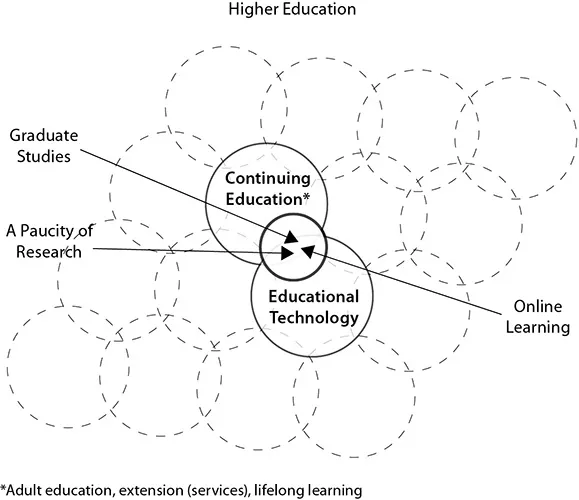
I position this chapter at the nexus of two fields and two respective subfields of inquiry in higher education (HE). There are a large number and a variety of subfields of research in HE, and many of them overlap. In Figure 1.1, the identified subfields of inquiry continuing education (and related terms) and educational technology are seen as being independent yet overlapping and intersecting when it comes to graduate studies and online learning, which also overlap and intersect. It is the nexus of these subfields that is of particular interest and concern to me (e.g., research dealing with OL from an educational technology perspective and graduate studies from a continuing education perspective). I have yet to find one publication that deals squarely with this nexus of inquiry within the context of Canadian DMUs—that is, universities that deliver courses both on campus and online.
Figure 1.1 A paucity of research at the nexus of sub-fields in higher education.
Outreach
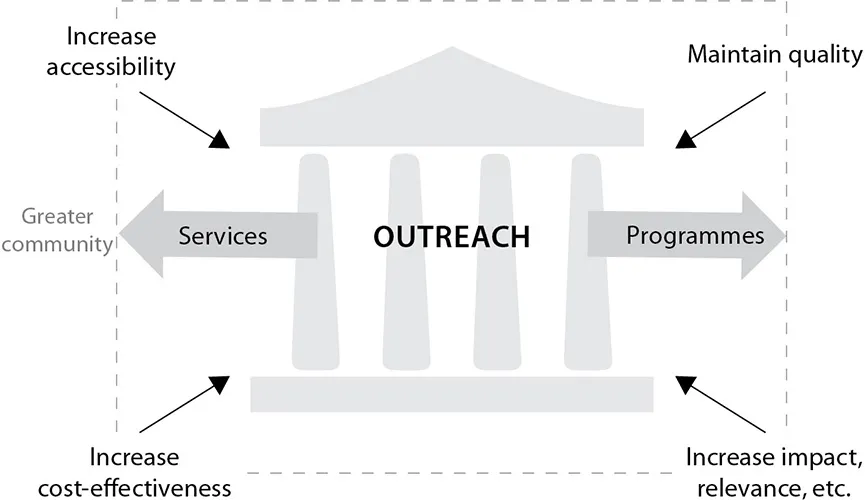
Universities offering traditional, on-campus HE have a long history of technologically enhanced, decentralization strategies—or outreach strategies, as I term them—especially at the undergraduate level, whereas graduate-level courses pose particular challenges, which I will explore later. In Figure 1.2, I present a view of the term outreach within the context of HE and its attendant pressures.
Figure 1.2 A definition of university outreach.
Outreach occurs in the form of programs and services offered by universities to their respective communities and, increasingly, to an international academic community via OL. Given projections for growth in HE worldwide (Sarrico, McQueen, & Samuelson, 2017), institutions are under pressure to not only increase access to their programs and services but also to maintain quality, improve cost-effectiveness, and even demonstrate impact and relevance. This, of course, places them in a bind, captives of the “iron triangle” (Daniel, Kanwar, & Uvalić-Trumbić, 2009).
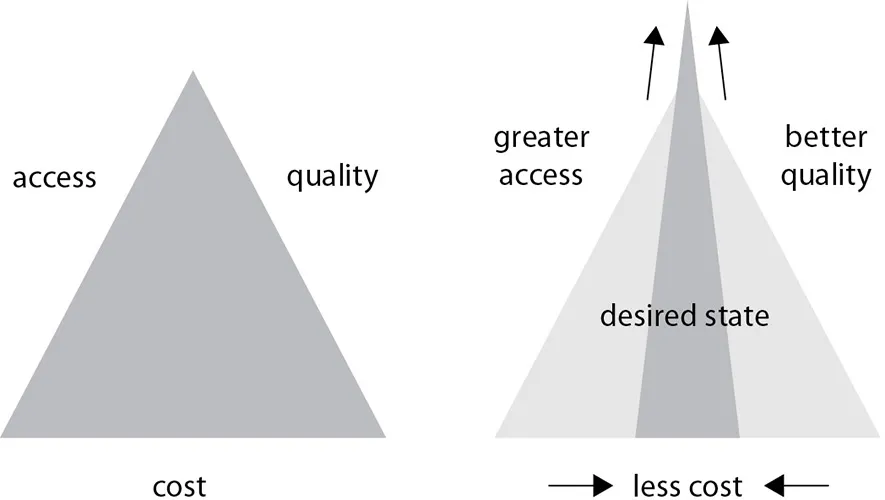
Sir John Daniel has held many important positions in distance education, from vice-chancellor of the British Open University (BOU) to UNESCO’s assistant director-general, and he has been a vocal proponent for lifelong learning by increasing access to HE worldwide, especially among underprivileged and underserved populations. Daniel et al. (2009) have very precisely analyzed the crisis of access that has befallen institutions of HE, especially in developed nations. In short, they focus on three variables that are in dynamic interplay: access, quality, and cost. To break out of what he termed an iron triangle, Daniel et al. (2009) state that they see no other way than for governments and national departments of HE to change profoundly the way institutions are currently functioning, from the ground up, ushering in reforms that would make distance education the modus operandi of all institutions (see Figure 1.3).
Figure 1.3 Daniel’s Iron Triangle, demonstrating the current state of higher education and the desired state. Source: Power & Morven-Gould (2011).
In Daniel’s analysis, attempts to break out of this iron triangle unavoidably result in one or more of the variables, all necessary, being reduced, diminished, neglected, or, in the case of cost, increased.
Guri-Rosenblit (2014) has characterized the current period as one that involves a large variety of OL providers all seeking “the golden triangle between wide access to higher education, high-quality learning, and economies of scale” (p. 123). In an earlier article (Power & Morven-Gould, 2011), my co-author and I proposed linking these variables to specific stakeholders and their priorities in an attempt to better understand this crisis and find an alternative solution to Daniel’s dilemma. I will now examine how universities have attempted to break out of the iron triangle via various outreach strategies, some being more successful than others, yet all falling short of what is required to achieve a complete breakout, especially in terms of scale.
Breakout Attempts
Correspondence Courses (First-Generation DE)
The first alternative to campus-based teaching had rather humble beginnings at the University of London, starting in 1858. This first attempt was undergraduate correspondence education, a limited, text-based option for off-campus students who were usually enrolled in what has been termed independent studies (Scott, 1999). In the late 1800s, this form of outreach spread across the Atlantic to take root in the United States at universities such as the University of Chicago (Moore & Kearsley, 2011). However, actual enrolment numbers were low, and, as a result, few courses were ever offered, due in part to resistance from faculty and administration in mainstream universities. In short, the impact of correspondence courses on HE as a whole was fringe at best in terms of numbers, yet such courses can be seen as the seed that would, a century later, sprout and grow into the first open universities, but not before universities tried out other pioneering uses of mass media.
Distance Education via Educational Radio and Television (Second-Generation DE)
As these non-print mass medias first became available in the 1920s and 1930s, universities, namely in North America, tried adopting them for outreach purposes, squarely aimed at adult education (see Keast, 2005). A departure from correspondence courses, these courses brought voice back into the classroom—albeit one-way, not two-way, voice—first in the form of broadcasts and, decades later, in the form of recordings, leveraging a major faculty strength: oral exposition (Buck, 2006).
According to Rosenberg (2001), such unidirectional voice-based courses lacked a key ingredient, which has remained missing right up until computer-based training: interaction with and among students. Without it, courses operated more as vehicles of information than vessels of knowledge development. Moreover, because such initiatives were often seen by university administrators as peripheral to their core target population—and thus to their core activities—funding was always an issue.
As a result, these courses became associated with university extension services that worked—and, in many cases, still work—on a cost recovery basis. Similar to correspondence education, courses offered “over the air” remained few in number and immune from input by traditional academia (Keegan, 1996, 2008). Yet, once again, the lessons learned from such endeavours were not lost on the politicians behind the creation of the BOU.
It is important to mention the role of film and the film projector in training during this period; the prodigious inventor Thomas Edison was quoted as saying that “books will soon be obsolete in the schools. Scholars will soon be instructed through the eye. It is possible to teach every branch of human knowledge with the motion picture” (as cited in Saettler, 1990, p. 141). This, of course, has not happened. Moreover, I cannot include film among the main technologies used in HE; its use has been more prevalent in the military, government, and corporate America (see Williams, 1944). University outreach attempts, modest at best, were always made with the undergraduate student in mind. This is understandable as graduate education was still in its infancy (Jones, 2014) and generally restricted to society’s elite, although the effects of Lyndon Johnson’s “Great Society” would, in the 1960s, begin to reverberate across all of North America.
The British Open University (Third-Generation DE)
The BOU, opened in 1969, was, to put it frankly, a game changer, at least in the United Kingdom, where systemic barriers to HE were legendary. The BOU was, from its beginning, a political animal, what many saw as a made-to-measure, left-wing ideological dagger aimed at the heart of right-wing elitist HE (Anderson, 1995; Perry, 1976; see ...
Table of contents
Cover
Title Page
Copyright Page
Dedication
Contents
Foreword
Introduction: A Pan-Canadian Perspective on Blended and Online Learning
1. A Critique of Course-Delivery Strategies Implemented by Canadian Universities
2. The Role of the Department Chair in Supporting Online Graduate Programs in Education: An Auto-Ethnographical Study of Mentorship and Evaluation
3. Graduate Student Online Orientation Programs: A Design-Based Research Study
4. The Effective Use of Text, Visuals, and Audio in Online Graduate Learning
5. Using Participatory Action Research to Support Pedagogical Processes in Postsecondary Online and Blended Spaces
6. Blended Synchronous Learning in One University’s Graduate Programs in Education
7. Supporting Authentic Higher Education Through Sustainable Open Learning Design
8. What Really Works in a Blended Learning Graduate Program? A Case Study of a Faculty of Education
9. Embodiment and Engagement in an Online Doctoral Research Methodology Course: A Virtual Ethnographic Study
Conclusion: Leading, Not Following, the Reform in Canadian Higher Education
List of Contributors
Trusted by 375,005 students
Access to over 1.5 million titles for a fair monthly price.
Study more efficiently using our study tools.
Frequently asked questions
Yes, you can cancel anytime from the Subscription tab in your account settings on the Perlego website. Your subscription will stay active until the end of your current billing period. Learn how to cancel your subscription
No, books cannot be downloaded as external files, such as PDFs, for use outside of Perlego. However, you can download books within the Perlego app for offline reading on mobile or tablet. Learn how to download books offline
Perlego offers two plans: Essential and Complete
Essential is ideal for learners and professionals who enjoy exploring a wide range of subjects. Access the Essential Library with 800,000+ trusted titles and best-sellers across business, personal growth, and the humanities. Includes unlimited reading time and Standard Read Aloud voice.
Complete: Perfect for advanced learners and researchers needing full, unrestricted access. Unlock 1.5M+ books across hundreds of subjects, including academic and specialized titles. The Complete Plan also includes advanced features like Premium Read Aloud and Research Assistant.
Both plans are available with monthly, semester, or annual billing cycles.
We are an online textbook subscription service, where you can get access to an entire online library for less than the price of a single book per month. With over 1.5 million books across 990+ topics, we’ve got you covered! Learn about our mission
Look out for the read-aloud symbol on your next book to see if you can listen to it. The read-aloud tool reads text aloud for you, highlighting the text as it is being read. You can pause it, speed it up and slow it down. Learn more about Read Aloud
Yes! You can use the Perlego app on both iOS and Android devices to read anytime, anywhere — even offline. Perfect for commutes or when you’re on the go. Please note we cannot support devices running on iOS 13 and Android 7 or earlier. Learn more about using the app
Yes, you can access The Finest Blend by Gale Parchoma,Michael Power,Jennifer Lock, Gale Parchoma, Michael Power, Jennifer Lock in PDF and/or ePUB format, as well as other popular books in Education & Higher Education. We have over 1.5 million books available in our catalogue for you to explore.