As one of North America’s most unique ecologies, the Great Plains have fostered symbiotic relationships between humans and animals for millennia. Among these, Indigenous bonds to beavers, bison, and horses have been the subject of numerous anthropological and scientific surveys.
Beaver, Bison, Horse is an interdisciplinary account that centers on Indigenous knowledge and tradition. R. Grace Morgan’s research, considered essential reading in the field, shows an ecological understanding that sustained Indigenous Peoples for thousands of years prior to colonial contact, with critical information on how the beaver manages water systems and protects communities from drought on the Plains.
Morgan’s work is a game-changer. For the first time in print, her important research now appears with a foreword by James Daschuk, bestselling and award-winning author of Clearing the Plains, and an afterword by Cristina Eisenberg, author of The Carnivore Way and The Wolf’s Tooth.
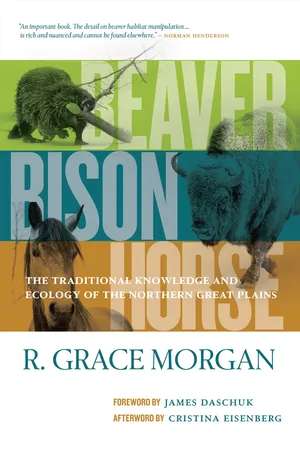
eBook - ePub
Beaver, Bison, Horse
The Traditional Knowledge and Ecology of the Northern Great Plains
- 338 pages
- English
- ePUB (mobile friendly)
- Available on iOS & Android
eBook - ePub
Beaver, Bison, Horse
The Traditional Knowledge and Ecology of the Northern Great Plains
About this book
Trusted by 375,005 students
Access to over 1.5 million titles for a fair monthly price.
Study more efficiently using our study tools.
Information
Publisher
University of Regina PressYear
2020Print ISBN
9780889777880
9780889777941
eBook ISBN
9780889777927

University of Regina Press designates one title each year that best exemplifies the guiding editorial and manuscript production principles of long-time senior editor Donna Grant.
BEAVER, BISON, HORSE
The Traditional Knowledge and Ecology of the Northern Great Plains
R. Grace Morgan

© 2020 University of Regina Press
All rights reserved. No part of this work covered by the copyrights hereon may be reproduced or used in any form or by any means—graphic, electronic, or mechanical—without the prior written permission of the publisher. Any request for photocopying, recording, taping or placement in information storage and retrieval systems of any sort shall be directed in writing to Access Copyright.
Cover art: “Beaver” by Szymon Bartosz; “Bison Walking Out of the Mist” by Effect of Darkness; and “White horse, black and white portrait” by Laure F. / all Adobe Stock.
Cover and text design: Duncan Campbell, University of Regina Press
Copy editor: Alison Jacques
Proofreader: Kendra Ward
Indexer: Patricia Furdek
Library and Archives Canada Cataloguing in Publication
Title: Beaver bison horse : the traditional knowledge and ecology of the Northern Great Plains / R. Grace Morgan.
Names: Morgan, R. Grace, 1934-2016, author.
Description: Includes bibliographical references and index.
Identifiers: Canadiana (print) 20200301438 | Canadiana (ebook) 20200301500 | ISBN 9780889777880 (softcover) | ISBN 9780889777941 (hardcover) | ISBN 9780889777903 (PDF) | ISBN 9780889777927 (EPUB)
Subjects: LCSH: Grassland ecology—Great Plains. | LCSH: Traditional ecological knowledge—Great Plains.
Classification: LCC QH104.5.G73 M67 2020 | DDC 508.315/30978—dc23
University of Regina Press, University of Regina Regina, Saskatchewan, Canada, s4s 0a2 tel: (306) 585-4758 fax: (306) 585-4699 web: www.uofrpress.ca
We acknowledge the support of the Canada Council for the Arts for our publishing program. We acknowledge the financial support of the Government of Canada. / Nous reconnaissons l’appui financier du gouvernement du Canada. This publication was made possible with support from Creative Saskatchewan’s Book Publishing Production Grant Program.

Contents
Publisher’s Note on Terminology
Foreword by James Daschuk
Introduction
Chapter 1 The Regional Setting
Chapter 2 Human-Animal Relationships
Chapter 3 The Ecological Evidence
Chapter 4 The Historical Evidence
Chapter 5 The Archaeological Evidence
Chapter 6 Changing Lifeways on the Northern Plains
Conclusion
Afterword by Cristina Eisenberg
Appendix “Dynamics of Fire and Grazing by Bison on Grasslands in Central Alberta” by R. Grace Morgan and R.J. Hudson
References
Publisher’s Note on Terminology
In 2018, the publishing industry saw the release of Greg Younging’s influential text The Elements of Indigenous Style: A Guide for Writing by and about Indigenous Peoples. In this 2020 publication of R. Grace Morgan’s important research into the ecological impacts of beaver, bison, and horse on the Indigenous populations of the Northern Great Plains, the publisher has endeavoured to reflect the current preferred terminology in Younging’s guide where it was deemed possible, while at the same time trying to maintain the integrity of the author’s original text and her voice as it was at the time of writing.
Foreword
Grace Morgan has written an ecological lament for a lost way of life in an environment that no longer exists: the prairies of western Canada prior to contact. The relationships that she illuminates among humans, beaver, bison, and later horses are key to understanding the ancient ecology of the Northern Great Plains. They also shed light on our current and precarious occupation of the prairies in this age of climate uncertainty. Today our political leaders debate the true impacts of climate change as we continue headlong with industrial farming using genetic modification and other scientific methods to buffer the impacts of drought and other climatic anomalies in the 21st century. This book points to both what was and what might have been, to sustainable land management practices that kept Indigenous communities protected for thousands of years from climatic variability. This is the story of traditional environmental knowledge at its most elegant.
As with so much Indigenous knowledge and so many ancient practices, the balance among species was forever lost as the modern world economic system took the North American Plains into its grasp. In a real sense, this is the story of an extinct ecology that can never be remade. The disappearance of the bison, the defining species of western North America, is widely recognized as the greatest environmental catastrophe to befall the continent. Almost a century earlier, at the turn of the 19th century, the extirpation of the beaver from the grasslands not only signalled the loss of a commercially valued species but also marked the end of a truly Indigenous way of life that used the species as the centre of an ancient system of water management in an arid and potentially dangerous environment.
By the 20th century, not only had the plains environment been irrevocably changed but also Indigenous institutions of governance, religion, and education had endured decades of state-sponsored attacks against what Canadian authorities called “tribalism.” The forcible relocation of Treaty Indians to and their confinement on reserves through the pass system, along with the establishment of Indian residential schools, in many cases broke the connections among Indigenous people, the land, and the animals that had endured since time immemorial. So complete was the assault on Indigenous ways of knowing that, for some, their traditional practices and even their histories were suppressed.
For much of the 20th century, scholars were even uncertain about the historical occupation of the prairie region. Were the Plains Cree the ancient inhabitants of the region, or did they come west as agents of the nascent global economic system? In the 1930s, American anthropologist David Mandelbaum was a...
Table of contents
- Cover
- Title Page
- Copyright Page
- Contents
- Publisher’s Note on Terminology
- Foreword
- Acknowledgements
- Introduction
- Chapter 1 The Regional Setting
- Chapter 2 Human-Animal Relationships
- Chapter 3 The Ecological Evidence
- Chapter 4 The Historical Evidence
- Chapter 5 The Archaeological Evidence
- Chapter 6 Changing Lifeways on the Northern Plains
- Conclusion
- Afterword
- Figures
- Appendix “Dynamics of Fire and Grazing by Bison on Grasslands in Central Alberta”
- Notes
- References
- Back cover
Frequently asked questions
Yes, you can cancel anytime from the Subscription tab in your account settings on the Perlego website. Your subscription will stay active until the end of your current billing period. Learn how to cancel your subscription
No, books cannot be downloaded as external files, such as PDFs, for use outside of Perlego. However, you can download books within the Perlego app for offline reading on mobile or tablet. Learn how to download books offline
Perlego offers two plans: Essential and Complete
- Essential is ideal for learners and professionals who enjoy exploring a wide range of subjects. Access the Essential Library with 800,000+ trusted titles and best-sellers across business, personal growth, and the humanities. Includes unlimited reading time and Standard Read Aloud voice.
- Complete: Perfect for advanced learners and researchers needing full, unrestricted access. Unlock 1.5M+ books across hundreds of subjects, including academic and specialized titles. The Complete Plan also includes advanced features like Premium Read Aloud and Research Assistant.
We are an online textbook subscription service, where you can get access to an entire online library for less than the price of a single book per month. With over 1.5 million books across 990+ topics, we’ve got you covered! Learn about our mission
Look out for the read-aloud symbol on your next book to see if you can listen to it. The read-aloud tool reads text aloud for you, highlighting the text as it is being read. You can pause it, speed it up and slow it down. Learn more about Read Aloud
Yes! You can use the Perlego app on both iOS and Android devices to read anytime, anywhere — even offline. Perfect for commutes or when you’re on the go.
Please note we cannot support devices running on iOS 13 and Android 7 or earlier. Learn more about using the app
Please note we cannot support devices running on iOS 13 and Android 7 or earlier. Learn more about using the app
Yes, you can access Beaver, Bison, Horse by R. Grace Morgan in PDF and/or ePUB format, as well as other popular books in Biological Sciences & Ecology. We have over 1.5 million books available in our catalogue for you to explore.