WINNER: Independent Press Awards 2021 - Leadership
Bestselling and award-winning author duo Chris Lewis and Pippa Malmgren are calling it out. In The Infinite Leader, they argue that the spectacular leadership failures that we have witnessed in recent history, stretching across business, community life and politics, can be explained by a lack of balance.
Having spent centuries perfecting processes and systems to maximize productivity and being indicted to the shrine of numbers, KPI's and financial forecasting, we have to admit, there are very few examples of sustainable and inspirational leadership figures out there. By over-relying on the hard stuff, we have disregarded whole dimensions of values that are desperately needed when trying to engage communities of people towards a common goal.
The Infinite Leader is a roadmap to introducing balance back into organizations. You can adapt your stance to the infinite possibilities facing you as a leader, and balance the main quadrants of the rational, emotional, spiritual and physical leader, to deliver sustainable leadership with integrity. Business is still about people - people operate across paradoxes and opposing forces, in a world that confounds these influences. Leaders need to continuously juggle and neutralize these to succeed. Be what your people need you to be and learn what they don't teach you in business schools; remain analytical and numbers-focused when needed, but also bring your heart, person and integrity to leadership.
eBook - ePub
The Infinite Leader
Balancing the Demands of Modern Business Leadership
- English
- ePUB (mobile friendly)
- Available on iOS & Android
eBook - ePub
About this book
Information
CHAPTER ONE
The end
How bad is the current leadership situation? To what extent has leadership failed and in what areas? Why did it happen? What were its causes? What was the financial cost of this failure? How did it change our culture? Is it just that we hear a lot more about leadership failure because it’s more visible?
We live in an age of catastrophic leadership failure. In 2020 coronavirus struck millions of people around the world, creating a global recession and massive disruption. For those lucky enough to escape it, the impact was still felt in fear, isolation and anxiety. There have been multiple failures of international cooperation, in the sharing of resources and the preparation for the event. If the first duty of leadership is to protect the community, then at best it has mitigated the outcome. At worst, it has failed to protect the weakest and most vulnerable in our community.
Some will say it could have been worse. This will fall upon deaf ears with many groups. With those who lost loved ones before their time. With those who lost their careers, homes and opportunities. With those who were left in great anxiety who will never feel confident again.
What can be learned from this? Our primary conclusion is that our priorities have become inverted. The resulting lack of balance has been costly. The biggest mistake would be for us to emerge from this and to continue, unchanged. Now is the time for a wholesale review of our leadership to see how it could be improved.
But the failure is not just represented in the management and leadership during a pandemic. The problem was there before that. In 2018, more CEOs were forced out of office for ethical lapse than for any other reason.1 The research showed that turnover in the role of CEO increased to an all-time high of 17.5 per cent churn or an average stay of just over five years. The research suggested that now, more than ever, today’s leaders seem to have lost their moral compass. Ethical lapse points to a lack of judgement. So what? Why does it matter? Because it destroys people’s faith, their values, their wealth and even hope itself.
What is an ethical leader?
There are lots of ways of defining what it means to be an ethical leader, but it boils down to the following:
- respecting people;
- building a community;
- demonstrating justice;
- serving others;
- being honest.
You wouldn’t think this was difficult, would you? You’d think that this would fall into the category of leadership basics. So, we need to ask what might warp these principles.
The most obvious factor is the focus on short-term financials. This is particularly exacerbated in companies that are quoted in the US for instance, where the reporting is quarterly. This sometimes leads to chasing performance numbers rather than focusing on customer service.
Another factor might be too rigid a leadership style, which permits only certain outcomes. If the leader is in a hurry to move on to the next thing, then they are likely to bring in their own team, which can sometimes result in a lack of understanding of commitments made.
New leadership sometimes believes that getting to know a community is a waste of time. But, without listening, the leader can run into resistance. Sometimes, cultures are really looking forward to change and they can be fully cooperative with new leaders.
Ethical leadership shouldn’t mean you are less dynamic, or even less dedicated and focused on objectives. It does matter, though, how you do these things.
The upward trend in unethical behaviour suggests that some leaders simply don’t care how something is done, as long as it gets done. Some may even be engaging directly in unethical behaviour themselves. Even if the leader isn’t misbehaving, they can still be promoting it unwittingly. The phrase to follow is: ‘The tone begins at the top.’
This tone is set by the way the leader rewards, condones or ignores employees’ behaviour. This sets a clear benchmark for what behaviour will be valued. The leader doesn’t even need to do anything. For evil to persist, good people need do nothing. It comes down to what the leader ‘is’ rather than what they ‘do’.
This is what we said in The Leadership Lab (reproduced with kind permission of Kogan Page):
Since the turn of the century, we’ve learned that our leaders have illegally avoided taxes,2 lied about emissions in the car industry,3 rigged interest rates,4 laundered Mexican drug money,5 presided over an offshore banking system that was larger than anyone thought possible,6 forced good companies into closure7 and destroyed pension funds as they themselves grew wealthier.8 Collectively, they oversaw unprecedented destruction of wealth and the collapse of the financial system9 and watched as life savings placed into investment funds set up by leaders of unimpeachable integrity turned out to be Ponzi schemes.10 Our spiritual leaders have covered up sex abuse in the Church.11 Our charity leaders have sexually abused the vulnerable.12 Our entertainment leaders are facing multiple allegations of sexual harassment and abuse.13 Our leading broadcasters have falsely accused political figures of being child abusers,14 while allowing actual abusers to commit crimes on their premises.15 Meanwhile, sporting leaders have been caught cheating and doping.16 Our medical leaders have chronically mistreated patients.17 Even the US President’s political advisors are being jailed18 and there are calls to impeach the leader of the free world.
From the Mossack Fonseca and Paradise Papers revelations, it’s estimated19 that $8.7 trillion, or 11 per cent, of global wealth resides in tax havens.20 Governments may have created the conditions for tax havens, but it is only now that we have begun to understand the consequences of these policies. Shielding that money deprived world governments of approximately $170 billion in tax revenue in 2016 alone, with the United States Treasury taking a hit of $32 billion that it might otherwise have had. Most felt the problems were mitigated because this offshore financial system was a fraction of the individual onshore economies. It turned out to be a multiple of them.
These events sound fantastic, incredible, unbelievable, even impossible, but they happened and continue to happen. They didn’t just call into question discrete leadership cultures, but the whole system. The collapse of trust on this scale, even 10 years later, is still being felt.
The conclusion must be that our problems with leadership are not professional but behavioural. When a five-year-old misbehaves at a party, the criterion applied for removal by a watchful parent must be the point at which harm to their peers becomes likely. Of course, we can’t expect an errant child to comply with the intervention. It’s more likely to be the opposite. More than 10 years after the great recession, which began in 2007, there has been no tantrum because there has still been no punishment. Worse still, the response to the problem of making money too freely available is to increase its availability still further, with predictable consequences.
The power of capital versus the power of people
Some might argue that the greedy short-termism that we’ve seen create so much destruction is just the way of the capitalist world. They would argue that minority groups are having little impact on mainstream leadership culture. But is that true? Some of the biggest changes have been brought about by minority groups such as the Tea Party, Extinction Rebellion, the MeToo movement, Black Lives Matter and minority shareholders. In fact, you could argue that all modern progressive development has always been delivered by minority groups.
The point here is that the power of capital and of minority groups could be made even greater by recognizing that their causes are one and the same. Leadership failure has a massive cost, and not just financial. One of the biggest costs could be in the loss of faith that we have in the capital and political process itself. No one is seriously contemplating scrapping democracies, but many would point out that the communist system appears to be much more successful economically (at least in the short term). How often do we now hear that authoritarian economies perform better, faster and more fairly than capitalist systems?
The relevant point about leadership is that it should actively be seeking out minority views, because they may provide a vital early warning system. This was illustrated several times by the great financial crash of 2007–2009. There were voices that were concerned about confidence, liquidity and the validity of the US mortgage market, but no one listened because they were dismissed as maverick. Raghuram Rajan, an economist from India, presented a paper at the annual meeting of central bankers in Jackson Hole, Wyoming, in 2005 where he warned of an imminent financial crisis. He was right. But his views were dismissed at the time.21 He went on to become the Governor of the central bank in India in September 2013. The very definition of maverick might be ‘not the majority’, but this could also describe leadership itself.
Leadership needs to listen to these maverick voices, not because they’re always right, but because they’re always different. The leader’s job is not to predict one outcome and prepare for it. It’s to prepare for all outcomes. What matters is having the imagination to see the potential outcomes and include them in the planning process.
This, incidentally, is not also just for the black swan moment of catastrophe but also for routine innovation. After all, if someone has a view that’s out there, could it be that they’re just ‘early’ in the innovation process? If that’s the case then it becomes not a matter of if, but simply when.
What did these failures cost?
These failures have a cost. We have yet to understand the true cost of the COVID-19-led economic crisis, though some are already arguing that it will eventually be even bigger than the financial crisis.22 While politicians focus on growth and development of the economy, the cost of the financial crisis alone was estimated at $22 trillion.23 That’s $70,000 for every single American. Of course, you can point to the fact that the stock markets hit new highs in 2019, but that tells you the value of shares now. It doesn’t tell you what they could have been (see Figure 1.1).24
Figure 1.1 Real GDP
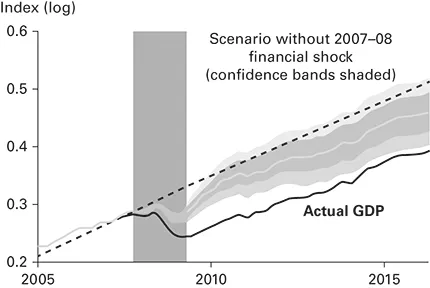
Source: FRBSF Economic Letter 2018
Figure 1.1 details
...Table of contents
- List of figures and tables
- About the authors
- Foreword by Inez Robinson-Odom
- Acknowledgements
- Introduction
- 1 The end
- 2 Circles and zeros
- 3 Existing leadership models
- 4 Introducing ‘zero’ models
- 5 Zero-state thinking
- 6 Zeronomics
- 7 Zero ego, zero gender
- 8 Zero education
- 9 Where this thinking takes us
- Conclusions
- Notes
- Index
Trusted by 375,005 students
Access to over 1.5 million titles for a fair monthly price.
Study more efficiently using our study tools.
Frequently asked questions
Yes, you can cancel anytime from the Subscription tab in your account settings on the Perlego website. Your subscription will stay active until the end of your current billing period. Learn how to cancel your subscription
No, books cannot be downloaded as external files, such as PDFs, for use outside of Perlego. However, you can download books within the Perlego app for offline reading on mobile or tablet. Learn how to download books offline
Perlego offers two plans: Essential and Complete
- Essential is ideal for learners and professionals who enjoy exploring a wide range of subjects. Access the Essential Library with 800,000+ trusted titles and best-sellers across business, personal growth, and the humanities. Includes unlimited reading time and Standard Read Aloud voice.
- Complete: Perfect for advanced learners and researchers needing full, unrestricted access. Unlock 1.5M+ books across hundreds of subjects, including academic and specialized titles. The Complete Plan also includes advanced features like Premium Read Aloud and Research Assistant.
We are an online textbook subscription service, where you can get access to an entire online library for less than the price of a single book per month. With over 1.5 million books across 990+ topics, we’ve got you covered! Learn about our mission
Look out for the read-aloud symbol on your next book to see if you can listen to it. The read-aloud tool reads text aloud for you, highlighting the text as it is being read. You can pause it, speed it up and slow it down. Learn more about Read Aloud
Yes! You can use the Perlego app on both iOS and Android devices to read anytime, anywhere — even offline. Perfect for commutes or when you’re on the go.
Please note we cannot support devices running on iOS 13 and Android 7 or earlier. Learn more about using the app
Please note we cannot support devices running on iOS 13 and Android 7 or earlier. Learn more about using the app
Yes, you can access The Infinite Leader by Chris Lewis,Pippa Malmgren in PDF and/or ePUB format, as well as other popular books in Business & Management. We have over 1.5 million books available in our catalogue for you to explore.