Financing the End-to-End Supply Chain provides readers with a comprehensive understanding of the financial synergies across the supply chain.
It demonstrates the importance of the strategic relationship between the physical supply of goods and services and the associated financial flows. The book provides a clear introduction, demonstrating the importance of the strategic relationship between supply chain and financial communities within an organization. This book links together treasury, banking, supply chain, systems, IT, and key stakeholders.
Financing the End-to-End Supply Chain will help senior supply chain practitioners to build collaboration, improve relationships and enhance trust between supply chain partners. With its combination of theory and practice it tackles vital issues including physical, information and financial flows, and tailoring supply chain finance to individual organisations' circumstances. Recognizing that supply chain finance means different things in different countries, the authors also consider various initiatives to harmonize and develop cross-border financing as well as including an agenda for national and international policy makers. The new edition features interviews from SCF platform providers on how ecosystems are involved in supply chain finance, additional learning activities for students and new examples on working capital management.
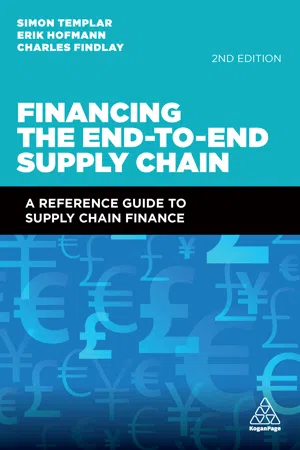
eBook - ePub
Financing the End-to-End Supply Chain
A Reference Guide to Supply Chain Finance
- English
- ePUB (mobile friendly)
- Available on iOS & Android
eBook - ePub
Financing the End-to-End Supply Chain
A Reference Guide to Supply Chain Finance
About this book
Part One
The background
01
The nucleus
Supply chains and financial performance
OUTCOMES
The intended outcomes of this chapter are to:
- identify the impact that supply chain management (SCM) decisions have on the reported financial statements of the organization;
- explain the relationship between SCM decisions on other measures of financial performance (FP);
- introduce a set of financial frameworks that are used to illustrate the impact that SCM decisions have on the FP of a business.
By the end of this chapter you should be able to:
- describe the impact SCM decisions have on FP;
- identify how SCM decisions impact on creating earnings (profits), cash and economic value for a business;
- identify the financial impact of a SCM decision on the profitability, liquidity and asset utilization of a business.
Activities
We recommend the following:
- Calculate and compare the return on total asset-current liabilities (ROTA-CL) ratio for your business against one of your competitors, customers and suppliers using the data contained in their financial statements.
- Describe how your SCM decisions can impact on the financial ratios used to measure an organization’s FP.
- Compare one of your recent SCM initiatives using Christopher’s five drivers of shareholder value (SV). Did the initiative:
- increase profitability?
- reduce operating expenses?
- generate tax reductions?
- increase non-current asset (NCA) efficiencies?
- reduce working capital (WC)?
-
Introduction
This chapter supports the premise that there is a fundamental relationship between an organization’s management of its SCM activities (external and internal) and the FP of the business.
The connection between SCM and FP is not new. Borsodi (1929: Preface) recognizes the importance of understanding distribution and production costs and their impact on FP:
In the fifty years between 1870 and 1920, the cost of distributing the necessities and luxuries which we consume has nearly trebled, while the cost of producing them has been reduced by more than one-fifth.
Borsodi also argues the need for decision makers to take a holistic perspective and that in business there are important trade-offs to be considered:
It is evident that what we are saving through lower costs of modern methods of production, we are losing through the higher costs of modern methods of distribution.
Christopher (1998: 100) emphasizes the importance of understanding the special relationship that logistics has on the financial success of an organization:
It is likely that in the future, decisions on logistics strategies will be made based upon a thorough understanding of the impact they have upon the financial performance of the business.
Notably, Christopher stresses that the decisions taken by logisticians will have an important impact on an organization’s income statement (IS) and balance sheet (BS), but also on the SV and economic value added (EVA) calculations.
The relationship between finance and supply chain (SC) leadership is an important one and will have a significant impact on an organization’s business performance. The Gartner Supply Chain Top 25 for 2019 (Griswold et al, 2019) looks at business performance and opinion:
‘The Supply Chain Top 25 ranking comprises two main components: business performance and opinion. Business performance in the form of public financial and CSR data provides a view into how companies have performed in the past, while the opinion component offers an eye to future potential and reflects leadership in the supply chain community. These two components are combined into a total composite score.’
The composite score:
‘similar to last year, we used a 50/50 overall weighting for this year’s ranking: 50% for the business performance component and 50% for the opinion component.The following three business data financial metrics and the CSR metric are used in the ranking:
- ROA – Net income/total assets;
- Inventory turns – Cost of goods sold/quarterly average inventory;
- Revenue growth – Change in revenue from prior year;
- CSR – Index of third-party CSR measures.’
SOURCE Gartner, ‘The Gartner Supply Chain Top 25 for 2019’ Mike Griswold et al, 15 May 2019
The Gartner Supply Chain Top 25 for 2019 companies are illustrated in Table 1.1 overleaf.
Table 1.1 The Gartner Supply Chain Top 25 for 2019
Skip table
| Rank | Company |
|---|---|
| 1 | Colgate-Palmolive |
| 2 | Inditex |
| 3 | Nestlé |
| 4 | PepsiCo |
| 5 | Cisco Systems |
| 6 | Intel |
| 7 | HP Inc. |
| 8 | Johnson & Johnson |
| 9 | Starbucks |
| 10 | Nike |
| 11 | Schneider Electric |
| 12 | Diageo |
| 13 | Alibaba |
| 14 | Walmart |
| 15 | L’Oréal |
| 16 | H&M |
| 17 | 3M |
| 18 | Novo Nordisk |
| 19 | Home Depot |
| 20 | Coca-Cola |
| 21 | Samsung Electronics |
| 22 | BASF |
| 23 | Adidas |
| 24 | AkzoNobel |
| 25 | BMW |
However, Gartner then introduced a new category:
‘In 2015, we introduced a new category to highlight the accomplishments and capabilities of longterm leaders. We refer to these companies as Supply Chain “Masters” and define them as having attained top-five composite scores for at least seven out of the last 10 years. To be clear, this category is separate from the overall Supply Chain Top 25 list, but it is not a retirement from being evaluated as part of our annual research. To the contrary, if a “Master” company were to fall out of having a top-five composite score for long enough, it would lose this designation and be considered as part of the Supply Chain Top 25 ranking in the same way as any other company in our study.’
The Gartner Supply Chain Master...
Table of contents
- Foreword by Michael Henke
- Foreword by Michiel Steeman
- Acknowledgements
- List of abbreviations
- Introduction
- Part One The background
- 01 The nucleus – Supply chains and financial performance
- 02 The big issue – Working capital management
- 03 The flows – Towards an integrated view of supply chain processes
- Part Two The current practice
- 04 The concept – A case for supply chain finance
- 05 The ecosystem – Who is involved in supply chain finance?
- 06 The value proposition – Solutions for supply chain finance
- 07 The implementation – Bringing supply chain finance programmes to life
- Part Three The future
- 08 The global setting – Supply chain finance in the context of cultural and geographical dispersion
- 09 The look beyond – Factors impacting the future of supply chain finance
- Index
Trusted by 375,005 students
Access to over 1.5 million titles for a fair monthly price.
Study more efficiently using our study tools.
Frequently asked questions
Yes, you can cancel anytime from the Subscription tab in your account settings on the Perlego website. Your subscription will stay active until the end of your current billing period. Learn how to cancel your subscription
No, books cannot be downloaded as external files, such as PDFs, for use outside of Perlego. However, you can download books within the Perlego app for offline reading on mobile or tablet. Learn how to download books offline
Perlego offers two plans: Essential and Complete
- Essential is ideal for learners and professionals who enjoy exploring a wide range of subjects. Access the Essential Library with 800,000+ trusted titles and best-sellers across business, personal growth, and the humanities. Includes unlimited reading time and Standard Read Aloud voice.
- Complete: Perfect for advanced learners and researchers needing full, unrestricted access. Unlock 1.5M+ books across hundreds of subjects, including academic and specialized titles. The Complete Plan also includes advanced features like Premium Read Aloud and Research Assistant.
We are an online textbook subscription service, where you can get access to an entire online library for less than the price of a single book per month. With over 1.5 million books across 990+ topics, we’ve got you covered! Learn about our mission
Look out for the read-aloud symbol on your next book to see if you can listen to it. The read-aloud tool reads text aloud for you, highlighting the text as it is being read. You can pause it, speed it up and slow it down. Learn more about Read Aloud
Yes! You can use the Perlego app on both iOS and Android devices to read anytime, anywhere — even offline. Perfect for commutes or when you’re on the go.
Please note we cannot support devices running on iOS 13 and Android 7 or earlier. Learn more about using the app
Please note we cannot support devices running on iOS 13 and Android 7 or earlier. Learn more about using the app
Yes, you can access Financing the End-to-End Supply Chain by Simon Templar,Erik Hofmann,Charles Findlay in PDF and/or ePUB format, as well as other popular books in Business & Finance. We have over 1.5 million books available in our catalogue for you to explore.