DISTINGUISHED FAVORITE: Independent Press Awards 2021 - Career
SHORTLISTED: Business Book Awards 2021 - Business Self-Development
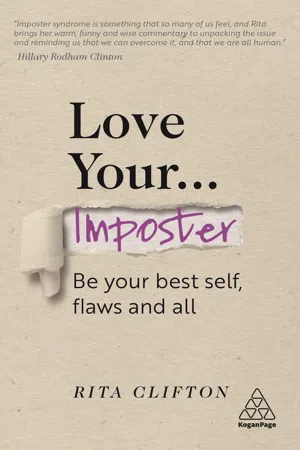
Studies show that a massive 70% of people feel like an imposter at some point in their professional life. Brand guru and former Chair of Interbrand, Rita Clifton, shares how she learnt to work with her imposter self rather than hide from it in order to succeed in her career.
Imposter syndrome can cause a constant fear of being found out that you aren't 'good enough' or called out for being a 'fraud'. It impacts people in different ways and can be debilitating and negatively affect relationships, personal life and careers. So what can you do about it?
Love Your Imposter shows you how to take on your imposter self and use it as a driver to come out stronger. Using practical down-to-earth advice based on her experiences, Rita Clifton, tackles the myth that you need to 'fake it until you make it', highlights why authenticity can be your biggest weapon and skilfully makes the case for business being more humane.
- English
- ePUB (mobile friendly)
- Available on iOS & Android
eBook - ePub
About this book
Information
CHAPTER ONE
Clueless
On my own imposter backstory
If I’m to share real-life thoughts and experiences in a way that’s authentic and gives some context for the rest of the book, that also means sharing a bit about my earlier life. It is not particularly out of the ordinary, but I hope that, if nothing else, it reinforces the old English colloquial phrase, ‘there’s nowt so queer as folk’, meaning that there’s nothing as strange as the variety of people.
Clearly, many people have terrible, heart-breaking backgrounds and life experiences, and for no fault of their own, are crushed by them. They deserve all the support people can give to overcome them. I take my hat off to those who come through and make a positive difference to others.
Then there are those who have slightly odd back stories (most of us, seemingly), and who might value a few thoughts to use that slight oddness to help achieve as much as they can.
A bit of my backstory…
I was born the last child of a man who’d injured his back whilst delivering a huge pallet of bread. My Mum was seven months pregnant, with two small children already, and an ambulance turned up with my Dad groaning on a stretcher and dumped him at home. They were living in a caravan at the time because they’d been kicked out of their flat after my Dad’s latest business attempt – a dry-cleaning company – folded.
When he got worse, they called the ambulance again and discovered that his back was broken. He was basically an invalid all the time I knew him.
Giving it all away
My father was, however, pretty smart. He came from a mining village just outside Newcastle-upon-Tyne in the north-east of England and most of his male relatives worked down the coal mines while his mother eventually ran the local post office. Dad was the product of an affair in the Great War of 1914–18. His mum became pregnant by an Army ambulance driver posted nearby; they quickly married and Arthur Senior (his dad) went off to war, where he died before even meeting his son. Just one of many similar sad tales, I know.
My father then did really well at school and he especially enjoyed telling me later that he often got 99 per cent and 100 per cent for exams, particularly when I only got 97 per cent. He even allegedly sat for a scholarship for the London School of Economics, but sadly for him was never able to take up a place because he, in turn, became a father when he was 18. That relationship didn’t last long and he then married an actress and had two more children. That also broke down in the face of my Dad’s seeming inability to be a reliable husband. (Did I mention he was a compulsive gambler?) In the following years, he moved to Surrey, having dispensed with his regional Geordie accent after merciless teasing in the Royal Air Force. Soon after the Second World War he eventually found himself at a dance where he broke into a waltz with my mother. He offered her nylon stockings and she was smitten.
Mum was one of 12 children, 10 girls and two boys (later in life, it was like being amongst a litter of cats with all my aunties). She had to leave school aged 14 to earn money and was, of course, seriously impressed by my charming and clever Dad-to-be. Her parents were minor musical theatre entertainers; her father was actually an aircraft engineer by trade by day, but his first love was the stage. Grandma ran away from boarding school around the turn of the last century and became an artist’s model, featuring in Tatler and Harper’s Bazaar magazine. Again, nowt so queer as folk.
Dad eventually confessed he had been married twice before, but he and Mum made it marriage number three, and after two more children together, I was his third (or sixth, depending on how you look at it) and definitely last child.
I won’t go into Dad’s various jobs, businesses and schemes, but suffice to say, he was not an easy employee or businessman because work got in the way of his gambling. Fortunately, my previously flighty and flirty Mum turned out to be a grafter, and it was she who managed to sew, run the dry-cleaning shop, and clean houses to keep the show on the road.
It’s funny how you can take things for granted, but I am sure that in some way the fact that my poor Mum was working the clock round both in and out of the home made me feel that it was normal to do so. I also later discovered that with all the strain of my ill father, three young children, constant money troubles and undiagnosed anaemia, she had a nervous breakdown when I was very young. She was away for months in a mental health hospital whilst we stayed with my grandmother. I don’t remember anything specific, but do have the vague memory of an undefined, aching longing as a toddler. Anyway, I’m still breathing. My daughters now laugh at me whenever I smother them with love.
You’ll have your own experiences to bring to bear. The important thing is to recognize them, their impact and try to use them in a positive way.
We’re all products of our time to some extent, but whether post-war, liberation, big shoulders, or #MeToo era, the eternal truth is that every generation of women does what they can and what they need to do.
Here I am
You may well recognize which characteristics you’ve got from which parent, and I seem to have inherited a blend from mine. I got a decent academic brain from Dad, a responsible streak from Mum (as well as a love of dancing), and a lifelong aversion to risk and gambling. Which is even more fortunate, because when Dad surreptitiously took me to the horse races when he was supposed to be childminding, I was blissfully oblivious to the fact that he NEEDED to be there, whereas I thought we were just looking at the lovely horses. I did, though, manage to study racehorse form like an academic subject; to be honest, there wasn’t much else to read in our house except Timeform horse racing books. However, to my everlasting gratitude, there was a set of 10 green encyclopaedias. I don’t know what possessed my father to buy these, except that he did enjoy me being clever and I found out lots of stuff about astronomy, the dinosaurs and myths.
The only other book I remember in my parents’ house was How to Be a Barrister. This appeared random, except when I discovered that Dad had bought it to sue his bread delivery employers for damages to his back. I don’t know the full ins and outs, aside from the fact that he managed to get enough compensation for a leasehold on a small shop in a village called Bourne End, near Marlow, in Buckinghamshire. It was a vinyl record and toy shop and, hey, I was the daughter of a shopkeeper!
I used to hang around in the shop every Saturday and school holidays, although I didn’t realize that this was, in fact, my parents’ necessary version of babysitting. I was quite good at maths and used to add up the weekly takings on the till roll. However, what appeared on the till roll bore little resemblance to what we actually earned because a rather large (fatherly) hand used to delve into the till every week to spend on the horses. Bills often went unpaid, but because we often ‘borrowed’ toys from the shop and had food, my siblings and I were under the impression that life was pretty OK.
Real life becomes a nightmare
I would possibly have remained in blissful ignorance. I passed the 11-plus exam to go to the local grammar school, and I had dancing lessons and horse riding so that Dad could pretend we were more affluent.
But then, he got sick, then sicker, then went into hospital for a check-up. Suddenly, Mum was called to the hospital in the middle of the night. I had a strange dream and woke suddenly with a heart wrench.
He was dead. He was only 51, my sister and brother were 19 and 14 respectively and I was 12. Mum was 45 and totally pole-axed.
It was truly awful. Every year I have been alive since my younger daughter was 12 (she’s now in her 20s) has felt like a bonus. If this sounds a bit morbid, I remember talking to a business colleague many years later at a rather deep and meaningful offsite session, and she confessed that she had lost her father in a plane crash when she was a toddler.
She had always come across as a bit pessimistic and cynical in her outlook and now I knew why – she readily admitted that it was difficult to throw herself with overt enthusiasm into anything. When you’ve lost someone so precious so young, and seen its impact on others, you can keep yourself and your emotions buttoned up for ever more. But this conversation led to a whole new way of us working together, when she could openly acknowledge that, maybe it was just her, but these were the things that she felt were wrong with our business. Her caution was valuable in the right context, and a real advantage to me and the company.
I am sure you know lots of people with similar revelations. Sharing a little bit of a personal story can be quite liberating if it’s relevant and doesn’t take up too much of someone’s day.
There were also a few other things that my father’s early death made me realize – even years later.
PRINCESSES AND DUCKLINGS
A women’s executive network organization in the UK once conducted an interesting qualitative study into the backgrounds and key characteristics of a wide range of successful women in business. It was almost 25 years ago, but one part really stuck in my mind. Amongst many other more nuanced findings, they also found that their interviewees roughly identified into two camps. The study termed these ‘Daddy’s Princesses’ and ‘Ugly Ducklings’.
Daddy’s Princesses – these were described as women who had felt loved, cherished and supported (particularly by their fathers) from an early age, and tended to grow up believing that they were indeed ‘worth it’, scoring life and academic goals with relative ease and who grew up almost wondering what the problem was.
Ugly Ducklings – these were the other interviewees who, for whatever reason, did not feel as loved or valued by one or both of their parents, but responded to the negativity by trying to prove their worth and success; they may have found it more difficult to achieve personal happiness but the rise to the top of organizations showed their determined mettle.
The terms feel rather clumsy for today, but it’s interesting how the fundamental importance of the relationship between parent and daughters – both good and bad – maps on to other academic studies about successful women.1
Know thyself
In real life, many people can be driven by a mix of these positive and negative effects and emotions, and the difference is how each individual responds. I have known people who had such idealized expectations of a life partner that they were totally shocked when they found they had shacked up with a serial cheater. Equally, so-called ‘ugly ducklings’ become determined that they would do the opposite of how they were brought up.
I do believe that people can make use of life experiences if they have proper support. I also know it’s tempting to look at people with a ‘bootstraps up’ mindset, and judge others, particularly if you had a bit of a hard time yourself. However, it’s worth remembering that not everyone can ‘pull themselves together’ without help and belief. It should be part of all our agendas to help others – and remember our own impact if and when we have children ourselves.
From a personal point of view, I guess I had a blend of both ‘princess’ and ‘duckling’ in my upbringing. I did feel adored by my father, but that was rudely cut off by his de...
Table of contents
- About the author
- Prologue: In my imposter dreams…
- Introduction
- 1 Clueless: On my own imposter backstory
- 2 Groundwork: On early lessons in working life, including a bit of personal branding
- 3 Hairy moments and happier outcomes: On the strangely positive power of mortification
- 4 Magic numbers and difficult statistics: On why no numbers = no boardroom
- 5 Money talks: On learning the language called Finance
- 6 Why you don’t have to fake it to make it: On how to be your (best) self… most of the time
- 7 Voices off: On how anyone can learn to be a good communicator. Honestly
- 8 Extending skills and expanding life: On how to add some good strings to your professional life – and an honest take on personal stuff
- 9 Women rule OK: On how to ‘do leading’ in a way that suits you… and helps others
- 10 Nice guys don’t finish last: On why the business and wider world really needs niceness to work
- 11 You and the future of business: On why the business world really needs… YOU. All of you, flaws and all
- Epilogue: Back to real life…
- Acknowledgements
- Notes
- Index
Trusted by 375,005 students
Access to over 1.5 million titles for a fair monthly price.
Study more efficiently using our study tools.
Frequently asked questions
Yes, you can cancel anytime from the Subscription tab in your account settings on the Perlego website. Your subscription will stay active until the end of your current billing period. Learn how to cancel your subscription
No, books cannot be downloaded as external files, such as PDFs, for use outside of Perlego. However, you can download books within the Perlego app for offline reading on mobile or tablet. Learn how to download books offline
Perlego offers two plans: Essential and Complete
- Essential is ideal for learners and professionals who enjoy exploring a wide range of subjects. Access the Essential Library with 800,000+ trusted titles and best-sellers across business, personal growth, and the humanities. Includes unlimited reading time and Standard Read Aloud voice.
- Complete: Perfect for advanced learners and researchers needing full, unrestricted access. Unlock 1.5M+ books across hundreds of subjects, including academic and specialized titles. The Complete Plan also includes advanced features like Premium Read Aloud and Research Assistant.
We are an online textbook subscription service, where you can get access to an entire online library for less than the price of a single book per month. With over 1.5 million books across 990+ topics, we’ve got you covered! Learn about our mission
Look out for the read-aloud symbol on your next book to see if you can listen to it. The read-aloud tool reads text aloud for you, highlighting the text as it is being read. You can pause it, speed it up and slow it down. Learn more about Read Aloud
Yes! You can use the Perlego app on both iOS and Android devices to read anytime, anywhere — even offline. Perfect for commutes or when you’re on the go.
Please note we cannot support devices running on iOS 13 and Android 7 or earlier. Learn more about using the app
Please note we cannot support devices running on iOS 13 and Android 7 or earlier. Learn more about using the app
Yes, you can access Love Your Imposter by Rita Clifton in PDF and/or ePUB format, as well as other popular books in Business & Business Biographies. We have over 1.5 million books available in our catalogue for you to explore.