SHORTLISTED: CMI Management Book of the Year 2017 - Commuter's Read Category (previous edition)
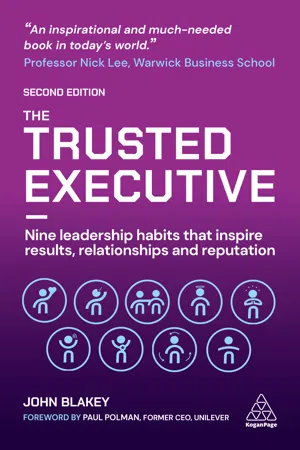
The Trusted Executive helps leaders deliver outstanding results, create inspiring relationships and provide a positive contribution through the power of trustworthy leadership.
In the shifting world of business, affected by trends involving robotics, AI, data privacy, the #metoo movement, climate crisis, employment rights and income inequality, trust and truthfulness have become the agenda. But how can business leaders and executives build trust in an untrusting world?
The Trusted Executive, gives leaders the tools to build trust by focusing on ability, integrity and benevolence. Providing a range of tools, exercises, examples and case studies, the fully updated edition will help readers:
- Understand the primary role of trust as a leadership skill
- Build trust around themselves as a leader, and develop role modelling behaviours
- Lead transformation change within their own organization
- Develop strategies to deal with unwanted violations of trust within their business
eBook - ePub
The Trusted Executive
Nine Leadership Habits that Inspire Results, Relationships and Reputation
- English
- ePUB (mobile friendly)
- Available on iOS & Android
eBook - ePub
The Trusted Executive
Nine Leadership Habits that Inspire Results, Relationships and Reputation
About this book
Information
03
Pillar 1: Habits of ability
Choosing to deliver
First things first. I am going to focus later upon a range of soft skills in the habits of trustworthiness, but I want to start with a hard skill – delivering superlative results. It’s appropriate to begin with delivering results because without this fundamental habit it is unlikely that you will get a pass to the next stage of the executive leadership game. We are in the performance business and performance is measured by achieving challenging goals; these may be triple bottom line goals, but they are still results-focused goals. Consistently, the CEOs I interviewed highlighted this habit:
‘Not being late, not going over budget, not moving commercials around on the hop.’‘Don’t let your customer down.’‘There is always a distrust of government because they make promises that they can’t deliver and many businesses are the same.’‘McKinsey don’t just go the extra mile; they go the extra 1,000 miles.’‘The ultimate arbiter is the customer because they have choice. If they expect x and you deliver y then you have failed. If you deliver x+ you have succeeded.’
We know all of this and yet so often we don’t do it. We over-promise and we under-deliver. We walk out of meetings where there has been no commitment to take action. We pass the buck, we slope our shoulders and we hope that no one will notice. When I started my career at British Gas, I was mentored by a front-line supervisor who was responsible for following up customer enquiries. At the end of the first week of shadowing him, he let me into a secret. He opened his bottom desk drawer and pulled out a massive wad of outstanding customer enquiry sheets. Quietly, he dealt the sheets into two neat piles. The first pile he placed gently into the bin and the second pile he put back in the drawer. Then he turned to me and said, ‘That’s how I prioritize my work.’ Each week he threw away 50 per cent of the enquiries without the blink of an eye! As a young graduate trainee, I was astounded and yet it was only the first of many episodes in my career when I encountered alarming acts of promise-breaking, excuse-making, casual neglect of customer expectations and general delivery malaise.
According to Loehr et al, ‘accountability is protection from our infinite capacity for self-deception’.1 And a lack of accountability destroys trustworthiness like a bout of the plague. In Patrick Lencioni’s impactful work on the five dysfunctions of a team, five traps typically undermine the performance of management teams.2 The fourth trap he terms ‘avoidance of accountability’. At a recent conference event, I sat in a room of 250 CEOs who completed a self-assessment exercise to identify which of Lencioni’s five dysfunctions were most prevalent in their management teams. When the speaker came to request a show of hands for those CEOs who felt ‘avoidance of accountability’ was their most pressing issue, it was like being back in the classroom when the teacher asks the pupils, ‘Who wants a sweet?’ So many hands shot up that the speaker stopped counting and resigned himself to saying, ‘I’ve done this exercise with countless teams all round the world these past four years and it is always avoidance of accountability that is a team’s most common Achilles heel.’ Every time you don’t do what you say you are going to do, you undermine your trustworthiness and you invite others to do the same.
So how do we build accountability into ourselves and those around us? How do we get a reputation for delivering results and exceeding expectations? The habit of ‘choosing to deliver’ involves three crucial steps:
- Be careful when making promises.
- Have a system that manages the execution and delegation of tasks.
- Exceed expectations to generate a ‘wow’ factor.
1. Be careful when making promises
It starts with being extremely careful when we make promises. And we make a promise every time we say we are going to do something. An honest ‘No, I’m too busy right now’ is preferable to a half-hearted ‘Yes, I’ll have a look at that’. For example, at the end of each of my executive coaching sessions I draw up a list of the actions that the executive leader has agreed to take and I ask the question, ‘On a scale of 0 to 10, how committed are you to taking this action?’ My experience tells me that unless the leader replies with a minimum of an ‘8’ then the action is unlikely to be completed and it is best scrubbed off the list. Similarly, at the end of our Trusted Executive Fellowship Board meetings each member is asked to write down on the flipchart the one action that they are willing to be held accountable for by the rest of the group; you know that those actions are most likely to be completed because the member has made a public promise in front of respected peers.
On a bigger scale, when we agree to a performance target we are making a promise. When we sign a new contract with a customer or supplier we are making a promise. When we make a forecast of future earnings to the City we are making a promise. The consequences of breaking these promises are significant, not just in terms of commercial outcomes, but also in terms of trustworthiness. One company chairman described it thus:
The finance director never kept his promises. He would promise to pay something and it wouldn’t happen. Initially, there was a loss of confidence in the individual but it translated eventually into a loss of confidence in the organization as a whole and it infected everyone who was in it. In many respects, that one individual destroyed that business.
2. Have a system that manages the execution and delegation of tasks
Once we have made a careful promise then we need a system for both execution and delegation. This is an issue of discipline. I do not intend to delve into the detail of all the task management systems that are available and their relative merits. I simply want to ask if you have a technology-enabled system for the management of your promises (aka a ‘to do list’) and your delegated promises. Some of my clients use an array of Excel spreadsheets, some use the latest smartphone apps like Trello, some appear to be doing some advanced programming in Outlook and others swear by Evernote as the rock that holds their life together. The point is that they have a system that works for them and they use technology to make that system robust and efficient. For those who need to delve deeper into this aspect of choosing to deliver, I recommend David Allen’s classic text Getting Things Done: The art of stress-free productivity.3
3. Exceed expectations to generate a ‘wow’ factor
Finally, in choosing to deliver we are aiming to exceed rather than meet the expectations of our stakeholders. In the beginning, we made a careful promise and now we look to conclude the cycle by delivering the ‘wow’ factor. One of my colleagues, the outstanding motivational speaker Marcus Child, captures the need to strive for the ‘wow’ factor by using the following ‘three circles of delivery’ model – see Figure 3.1.
Figure 3.1 The three circles of delivery

Figure 3.1 details
The circles include the “Wow” factor – the luxury chocolate on the bed; the Unspoken Expectations – the en-suite bathroom; and the Basic Promise – the room with the bed.
In this model, the inner circle represents the basic promise. If I am booking a hotel room then a basic promise is a room with a bed. The next circle represents the unspoken expectations. If I book a hotel room then I expect that there will be an en-suite bathroom though I may not specifically request it. The final circle represents the point where my expectations are exceeded and I experience the ‘wow’ factor. I walk into my hotel room, tired from a long day, and there on the bed is a small box of luxury chocolates. Now, clearly, if I walked into the room and there was no bed and no en-suite bathroom, just a small box of chocolates on the floor, then that is not going to deliver the ‘wow’ factor. Our basic promises and unspoken expectations must be consistently met before we can generate a ‘wow’ factor. Translating this model to the world of your personal trustworthiness, how can you ‘wow’ not just your customers but your management team, your suppliers and your local community? And a word of warning: remember that today’s ‘wow’ factors are always tomorrow’s ‘unspoken expectations’. Choosing to deliver the ‘wow’ factor is a journey that will never end.
Choosing to coach
When we have mastered the habit of choosing to deliver we can help others to also deliver through coaching. We achieve this partly by role-modelling the delivery skills ourselves, because those around us will learn from our example. This counts for a lot, but there are other aspects of choosing to coach that go beyond leading by example. I recall many years ago witnessing a vivid example of the case for coaching when leadership guru Graham Alexander asked for a volunteer from a room full of executives at the beginning of a course on coaching skills. Graham asked the volunteer to lie flat on the ground and invited another volunteer from the audience to ‘tell’ the first person how to get up. The audience collapsed into laughter as the person ‘telling’ repeat...
Table of contents
- Praise for the first edition
- The Trusted Executive
- Contents
- List of Figures
- List of Tables
- Foreword
- Introduction
- Trust lost and trust regained
- 01 A broken model
- 02 The three pillars that inspire trust
- The nine habits that inspire results, relationships and reputation
- 03 Pillar 1: Habits of ability
- 04 Pillar 2: Habits of integrity
- 05 Pillar 3: Habits of benevolence
- 06 Cracks in the pillars
- Building a high-trust culture
- 07 Working with the Nine Habits of Trust
- Conclusion
- rd Afterword
- About the author
- Acknowledgements
- Index
- Copyright Page
Trusted by 375,005 students
Access to over 1.5 million titles for a fair monthly price.
Study more efficiently using our study tools.
Frequently asked questions
Yes, you can cancel anytime from the Subscription tab in your account settings on the Perlego website. Your subscription will stay active until the end of your current billing period. Learn how to cancel your subscription
No, books cannot be downloaded as external files, such as PDFs, for use outside of Perlego. However, you can download books within the Perlego app for offline reading on mobile or tablet. Learn how to download books offline
Perlego offers two plans: Essential and Complete
- Essential is ideal for learners and professionals who enjoy exploring a wide range of subjects. Access the Essential Library with 800,000+ trusted titles and best-sellers across business, personal growth, and the humanities. Includes unlimited reading time and Standard Read Aloud voice.
- Complete: Perfect for advanced learners and researchers needing full, unrestricted access. Unlock 1.5M+ books across hundreds of subjects, including academic and specialized titles. The Complete Plan also includes advanced features like Premium Read Aloud and Research Assistant.
We are an online textbook subscription service, where you can get access to an entire online library for less than the price of a single book per month. With over 1.5 million books across 990+ topics, we’ve got you covered! Learn about our mission
Look out for the read-aloud symbol on your next book to see if you can listen to it. The read-aloud tool reads text aloud for you, highlighting the text as it is being read. You can pause it, speed it up and slow it down. Learn more about Read Aloud
Yes! You can use the Perlego app on both iOS and Android devices to read anytime, anywhere — even offline. Perfect for commutes or when you’re on the go.
Please note we cannot support devices running on iOS 13 and Android 7 or earlier. Learn more about using the app
Please note we cannot support devices running on iOS 13 and Android 7 or earlier. Learn more about using the app
Yes, you can access The Trusted Executive by John Blakey in PDF and/or ePUB format, as well as other popular books in Business & Management. We have over 1.5 million books available in our catalogue for you to explore.