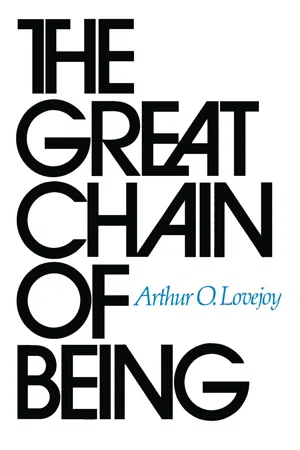
From later antiquity down to the close of the eighteenth century, most philosophers and men of science and, indeed, most educated men, accepted without question a traditional view of the plan and structure of the world.In this volume, which embodies the William James lectures for 1933, Arthur O. Lovejoy points out the three principles—plenitude, continuity, and graduation—which were combined in this conception; analyzes their origins in the philosophies of Plato, Aristotle, and the Neoplatonists; traces the most important of their diverse samifications in subsequent religious thought, in metaphysics, in ethics and aesthetics, and in astronomical and biological theories; and copiously illustrates the influence of the conception as a whole, and of the ideas out of which it was compounded, upon the imagination and feelings as expressed in literature.
1. Cf. the writer’s papers on “The Chinese Origin of a Romanticism,” Journal of English and Germanic Philology (1933), 1–20, and “The First Gothic Revival and the Return to Nature,” Modern Language Notes (1932), 419–446.
2. Science and the Modern World (1926), 106.
3. Ueber das Studium der griechischen Poesie (Minor, Fr. Schlegel, 1792–1804, I, 95).
4. Preface to The English Works of George Herbert (1905), xii.
NOTES TO LECTURE II
1. Kerngedanken der platonischen Philosophie (1931), 8: “Already in the Cratylus and Meno there is to be found much positive content which, as no one doubts, goes beyond the conclusions of Socrates; and this is in increasing measure true of the Phaedo and the Republic and also of the Phaedrus.” Cf. the same writer’s Platon, II (1923), 293 (on the Phaedo): “That the philosophical considerations of the dialogue are foreign to the historical Socrates, that they are therefore essentially Platonic — on this there exists hardly any difference of opinion.”
2. Burnet, Platonism (1928), 115.
3. Taylor, Commentary on the Timaeus of Plato, 11.
4. Ibid., 11.
5. Ibid., 10. This contention is, however, in other passages considerably qualified by Taylor; we may, after all, “expect to find a broad general agreement between [Timaeus’s] doctrine and things which are taught in the dialogues, or even things which we know Plato to have maintained from statements of Aristotle about his teaching” (ibid., 133).
7. It is impossible here, and it is perhaps no longer necessary, to present at length the reasons for accepting the authenticity of this Epistle. The case has been well presented by Souilhé, Platon, Oeuvres complètes, t. XIII, 1re partie (1926), xl–lviii, and by Harward, The Platonic Epistles (1932), 59–78, 188–192, 213. Cf. also Taylor: Plato, the Man and his Work, 2d ed. (1927), 15–16, and Philosophical Studies (1934), 192–223; P. Friedländer, Plato (1928), passim. One of the oddest things in recent Plato-interpretation is the tendency of scholars who do not reject the Seventh Epistle to present accounts of the Platonic doctrines which are utterly irreconcilable with it.
8. Ep. VII, 341c–344d. Against the thesis that the Theory of Ideas is abandoned or minimized even in the latest dialogues, the principal objection is well put by Shorey: “The challenge to find the ideas in dialogues later than the Parmenides is easily met. Nothing can be more explicit than the Timaeus. The alternative is explicitly put: are the objects of sense the only realities, and is the supposition of ideas mere talk? (51c) And it is affirmed that their reality is as certain as the distinction between opinion and science. . . . They are characterized in terms applicable only to pure Being, and the familiar terminology is freely employed (52a, 27d, 29b, 30, 37b)” (The Unity of Plato’s Thought, 1904, p. 37). And of the assertion that “souls take the place of ideas in Plato’s later period,” Shorey observes (equally justly, I think) that “this is a complete misconception of Plato’s thought and style. It is quite true that he did not confine the predicates of true and absolute Being to the ideas; God is, of course, true Being, and in religious and metaphysical passages need not always be distinguished from the ideas taken collectively.” But “that the ideas still take precedence of souls appears distinctly” in several of the later dialogues, e. g., the Statesman, Timaeus, and Philebus (ibid., 39). Cf. Ritter, Kerngedanken, 174: “While the original Theory of Ideas passes gradually quite into the background, we may nevertheless affirm that not a single proposition is ever formally retracted or even tacitly abandoned.” That the exegesis of Plato is far from an exact science is further illustrated by the fact that Sir J. G. Frazer — in an early work recently republished — defends the view that Plato in his early writings did hold the Theory of Ideas, admitting, however, ideal subsisting counterparts only of “good” things; but that later in life he abandoned the theory probably because “he saw that logic compelled him to make an Idea of every common notion, and hence of bad things as well as good.” (Growth of Plato’s Ideal Theory, 51.)
9. The Platonic Tradition in English Religious Thought (1926), 9.
10. Kerngedanken der platonischen Philosophie, 77.
11. Ibid., 91: “die Lehre vom dem jenseitigen Ideenreich” is not held by Plato, at least as a “festes Dogma.”
12. Ibid., 82.
13. Ibid., 89.
14. Ibid., 83.
15. Phaedo, 76e, 92a–e.
16. From Shorey’s review of Ritter’s Neue Untersuchungen über Platon, in Classical Philology, 1910, 391.
17. Unity of Plato’s Thought, 28.
18. Die Kerngedanken der platonischen Philosophie, 56–57.
19. Republic, 507b.
20. Ibid., 518c.
21. Ibid., 509b.
22. Ibid., 517d.
23. Ibid., 516d.
24. E. g., in Philebus, 22, it is at one point intimated that “the divine mind is identical with the Good.” Yet even in this dialogue “the most divine of all lives” is beyond “either joy or sorrow” (ibid., 33).
25. Philebus, 60c.
26. Ibid., 67a. This is qualified by the above-mentioned intimation that the “divine mind” is the good. It manifestly follows that that mind possesses the attribute of self-sufficiency in an absolute sense.
27. Eth. Eudem., VII, 1244b–1245b. That there are other passages in Aristotle which conflict with this is true, e. g., Magna Moralia, II, 1213a. The authenticity of the Eudemian Ethics must now be regarded as established by the studies of Mühlls (1909), Kapp (1912), and especially of W. Jaeger (1923). Cf. also the Pseudo-Aristotelian De Mundo, 399b ff.
28. On the End in Creation, I, 1.
29. Philosophical Aspects of Modern Science (1932), 331–332.
30. Republic, 509b.
31. On the reputation and influence of the Timaeus, cf. Christ, Griechische Literaturgeschichte (1912), I, 701. It was translated into Latin by Cicero, but was known to the Middle Ages chiefly through the fourth-century Latin version of Chalcidius. Over forty ancient or medieval commentaries on it are known. It is the Timaeus that Plato holds in his hand in Raphael’s “School of Athens.” In the eighteenth century the ideas it contained exercised influence, not only through the text of Plato, but also through the vogue of the supposed treatise De anima mundi, believed to be an older writing of the Pythagorean Timaeus himself which was utilized and “embellished” by Plato. It is in fact a poor abridgment or précis of part of the dialogue, of much later date. There were at least three seventeenth-century editions of it; and editions with French translations by d’Argens (1763) and by Batteux (1768) show the interest still taken in this dull rehash of Plato’s argument.
32. Prolegomena to Ethics, § 82.
33. Timaeus, 29, 30.
34. Timaeus, 33d.
35. Ibid., 30c, 6:
The former interpretation was, as Taylor has noted, “definitely held by some Neoplatonists (Amelius, Theodorus of Asine).” That it offers some difficulties cannot be denied; and the...
Table of contents
Cover
Title
Copyright
Contents
I. Introduction: the Study of the History of Ideas
II. The Genesis of the Idea in Greek Philosophy: the Three Principles
III. The Chain of Being and Some Internal Conflicts in Medieval Thought
IV. The Principle of Plenitude and the New Cosmography
V. Plenitude and Sufficient Reason in Leibniz and Spinoza
VI. The Chain of Being in Eighteenth-Century Thought, and Man’s Place and Rôle in Nature
VII. The Principle of Plenitude and Eighteenth-Century Optimism
VIII. The Chain of Being and Some Aspects of Eighteenth- Century Biology
IX. The Temporalizing of the Chain of Being
X. Romanticism and the Principle of Plenitude
XI. The Outcome of the History and Its Moral
Notes
Index of Names and Subjects
Trusted by 375,005 students
Access to over 1.5 million titles for a fair monthly price.
Study more efficiently using our study tools.
Frequently asked questions
Yes, you can cancel anytime from the Subscription tab in your account settings on the Perlego website. Your subscription will stay active until the end of your current billing period. Learn how to cancel your subscription
No, books cannot be downloaded as external files, such as PDFs, for use outside of Perlego. However, you can download books within the Perlego app for offline reading on mobile or tablet. Learn how to download books offline
Perlego offers two plans: Essential and Complete
Essential is ideal for learners and professionals who enjoy exploring a wide range of subjects. Access the Essential Library with 800,000+ trusted titles and best-sellers across business, personal growth, and the humanities. Includes unlimited reading time and Standard Read Aloud voice.
Complete: Perfect for advanced learners and researchers needing full, unrestricted access. Unlock 1.5M+ books across hundreds of subjects, including academic and specialized titles. The Complete Plan also includes advanced features like Premium Read Aloud and Research Assistant.
Both plans are available with monthly, semester, or annual billing cycles.
We are an online textbook subscription service, where you can get access to an entire online library for less than the price of a single book per month. With over 1.5 million books across 990+ topics, we’ve got you covered! Learn about our mission
Look out for the read-aloud symbol on your next book to see if you can listen to it. The read-aloud tool reads text aloud for you, highlighting the text as it is being read. You can pause it, speed it up and slow it down. Learn more about Read Aloud
Yes! You can use the Perlego app on both iOS and Android devices to read anytime, anywhere — even offline. Perfect for commutes or when you’re on the go. Please note we cannot support devices running on iOS 13 and Android 7 or earlier. Learn more about using the app
Yes, you can access The Great Chain of Being by Arthur O. Lovejoy in PDF and/or ePUB format, as well as other popular books in Philosophy & Philosophy History & Theory. We have over 1.5 million books available in our catalogue for you to explore.