An anthropologist's groundbreaking account of how Islamic religious authority is assembled through the unceasing labor of community building on the island of Java
This compelling book draws on Ismail Fajrie Alatas's unique insights as an anthropologist to provide a new understanding of Islamic religious authority, showing how religious leaders unite diverse aspects of life and contest differing Muslim perspectives to create distinctly Muslim communities.
Taking readers from the eighteenth century to today, Alatas traces the movements of Muslim saints and scholars from Yemen to Indonesia and looks at how they traversed complex cultural settings while opening new channels for the transmission of Islamic teachings. He describes the rise to prominence of Indonesia's leading Sufi master, Habib Luthfi, and his rivalries with competing religious leaders, revealing why some Muslim voices become authoritative while others don't. Alatas examines how Habib Luthfi has used the infrastructures of the Sufi order and the Indonesian state to build a durable religious community, while deploying genealogy and hagiography to present himself as a successor of the Prophet Mu?ammad.
Challenging prevailing conceptions of what it means to be Muslim, What Is Religious Authority? demonstrates how the concrete and sustained labors of translation, mobilization, collaboration, and competition are the very dynamics that give Islam its power and diversity.
eBook - ePub
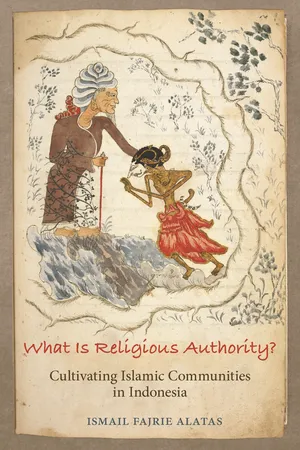
What Is Religious Authority?
Cultivating Islamic Communities in Indonesia
- 256 pages
- English
- ePUB (mobile friendly)
- Available on iOS & Android
eBook - ePub
About this book
Information
Publisher
Princeton University PressYear
2021Print ISBN
9780691204314
9780691204307
eBook ISBN
9780691204291
Table of contents
- Cover Page
- Series Page
- Title Page
- Copyright Page
- Dedication
- Epigraph
- Contents
- Acknowledgments
- Note on Names, Dates, Translation, and Transliteration
- Introduction: Cultivating Islam
- Part I: Authority in Motion
- Part II: Assembling Authority
- Epilogue: Authority and Universality
- Notes
- Bibliography
- Index
Trusted by 375,005 students
Access to over 1.5 million titles for a fair monthly price.
Study more efficiently using our study tools.
Frequently asked questions
Yes, you can cancel anytime from the Subscription tab in your account settings on the Perlego website. Your subscription will stay active until the end of your current billing period. Learn how to cancel your subscription
No, books cannot be downloaded as external files, such as PDFs, for use outside of Perlego. However, you can download books within the Perlego app for offline reading on mobile or tablet. Learn how to download books offline
Perlego offers two plans: Essential and Complete
- Essential is ideal for learners and professionals who enjoy exploring a wide range of subjects. Access the Essential Library with 800,000+ trusted titles and best-sellers across business, personal growth, and the humanities. Includes unlimited reading time and Standard Read Aloud voice.
- Complete: Perfect for advanced learners and researchers needing full, unrestricted access. Unlock 1.5M+ books across hundreds of subjects, including academic and specialized titles. The Complete Plan also includes advanced features like Premium Read Aloud and Research Assistant.
We are an online textbook subscription service, where you can get access to an entire online library for less than the price of a single book per month. With over 1.5 million books across 990+ topics, we’ve got you covered! Learn about our mission
Look out for the read-aloud symbol on your next book to see if you can listen to it. The read-aloud tool reads text aloud for you, highlighting the text as it is being read. You can pause it, speed it up and slow it down. Learn more about Read Aloud
Yes! You can use the Perlego app on both iOS and Android devices to read anytime, anywhere — even offline. Perfect for commutes or when you’re on the go.
Please note we cannot support devices running on iOS 13 and Android 7 or earlier. Learn more about using the app
Please note we cannot support devices running on iOS 13 and Android 7 or earlier. Learn more about using the app
Yes, you can access What Is Religious Authority? by Ismail Fajrie Alatas in PDF and/or ePUB format, as well as other popular books in Social Sciences & Islamic Theology. We have over 1.5 million books available in our catalogue for you to explore.