eBook - ePub
Available until 23 Dec |Learn more
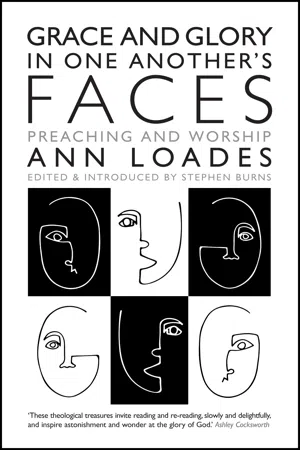
Grace and Glory in One Another's Faces
Preaching and Worship
This book is available to read until 23rd December, 2025
- 160 pages
- English
- ePUB (mobile friendly)
- Available on iOS & Android
eBook - ePub
Available until 23 Dec |Learn more
About this book
Ann Loades is one of the most significant figures in contemporary theology, becoming the first female President of the Society for the Study of Theology and one of only two people ever to be awarded a CBE for services to theology. Grace and Glory in One Another's Faces is a collection of her best sermons given in cathedrals, college chapels, parish churches and ecumenical contexts around the UK and abroad.Many engage the lectionary readings for Sundays in the Christian year, exploring the seasons as well as the texts set before the church. Others make accessible the legacy of figures from different eras: Francis of Assisi, Ignatius of Loyola, Martin Luther and John Wycliffe through to influential twentieth-century Christians. There is a leaning to influential women in Christian history, thus introducing readers not only to engagements with scripture but reformers of Christian worship, of social practice, and of patterns and possibilities for Christian discipleship.Also included are two essays that illumine Ann's sacramental understanding of worship and preaching.
Frequently asked questions
Yes, you can cancel anytime from the Subscription tab in your account settings on the Perlego website. Your subscription will stay active until the end of your current billing period. Learn how to cancel your subscription.
No, books cannot be downloaded as external files, such as PDFs, for use outside of Perlego. However, you can download books within the Perlego app for offline reading on mobile or tablet. Learn more here.
Perlego offers two plans: Essential and Complete
- Essential is ideal for learners and professionals who enjoy exploring a wide range of subjects. Access the Essential Library with 800,000+ trusted titles and best-sellers across business, personal growth, and the humanities. Includes unlimited reading time and Standard Read Aloud voice.
- Complete: Perfect for advanced learners and researchers needing full, unrestricted access. Unlock 1.4M+ books across hundreds of subjects, including academic and specialized titles. The Complete Plan also includes advanced features like Premium Read Aloud and Research Assistant.
We are an online textbook subscription service, where you can get access to an entire online library for less than the price of a single book per month. With over 1 million books across 1000+ topics, we’ve got you covered! Learn more here.
Look out for the read-aloud symbol on your next book to see if you can listen to it. The read-aloud tool reads text aloud for you, highlighting the text as it is being read. You can pause it, speed it up and slow it down. Learn more here.
Yes! You can use the Perlego app on both iOS or Android devices to read anytime, anywhere — even offline. Perfect for commutes or when you’re on the go.
Please note we cannot support devices running on iOS 13 and Android 7 or earlier. Learn more about using the app.
Please note we cannot support devices running on iOS 13 and Android 7 or earlier. Learn more about using the app.
Yes, you can access Grace and Glory in One Another's Faces by Ann Loades, Stephen Burns, Burns in PDF and/or ePUB format, as well as other popular books in Teología y religión & Religión. We have over one million books available in our catalogue for you to explore.
Information
Part 1: Mainly on the Lectionary
Preached between the early 1980s and late 2010s, and in a variety of contexts, the sermons here suggest the ways in which the term ‘lectionary’ is one that covers some flux: the Book of Common Prayer, for which there is clear affection in what follows; the Alternative Service Book which was operative in the Church of England from 1980 to 1997; and from 1997, Common Worship, a variant of the ecumenical Revised Common Lectionary (RCL), itself close to the Roman Catholic lectionary for mass. Common Worship, for example, has sequences for principal, second and third services each Sunday. There is also a so-called ‘pillar’ lectionary, used in cathedrals, in which well-known and ‘purple passages’ of the Bible appear more frequently, geared to settings welcoming occasional worshippers likely to be unfamiliar with the range of more expansive reading schemes. A range of lectionaries were used across the occasions where these sermons were preached, though the note accompanying each one here relates Scripture portions to the RCL.
1. Beginnings (Advent)
This is the time of the year when those who share in the worship of the Christian tradition begin to equip themselves for Advent – so, back to beginnings and the theme of creation for this morning’s liturgy.1 There’s nothing simple about any of the texts chosen to illustrate the theme, but since beginnings is the theme, let us have another look at the first one in particular. What could be more familiar, and often used to foster exactly what we do not need nowadays, than hostility between human beings on the basis of their sexual-social identity. It may be with the greatest difficulty that we can clear our heads and imaginations of some of the interpretations this text has been made to bear throughout the centuries. As we all know, translation and interpretation easily run into one another, so the interests of the translator and interpreter and the hearers or readers have to be borne in mind. In our own time, we need to think very hard about the part ‘religion’ may play in fostering mistrust and hostility between one another and in the habitats we share with so many other creatures.
So, to Genesis, to ‘beginnings’. If you know anything about the first couple of chapters you’ll know that there are two stories about ‘beginnings’, with chapter 2 possibly older than chapter 1. Both celebrate life and delight in one another for the time in which we live. The story makes it clear that it is God’s world as God shapes it, including rain, plants and herbs, and no one to till them – no ‘Adam’ yet, an earth creature, to serve God’s earth. So God works like a potter, shaping the earth creature from the dust, making it alive by breathing God’s own breath into it. God then makes a garden in which to put this earth creature: a garden, ‘Eden’, a place of delight. The only thing we know about this earth creature so far is that it has nostrils, for God breathed into them. Given nostrils, the earth creature can enjoy the garden. Out of the very same earth from which the earth creature was made come trees and plants, so sight and taste are available as well! The garden bubbles with water, and so the earth creature can till it and keep it fertile with more or less responsible care. The word often translated as ‘till’ also means ‘serve’: we serve what we respect. So to keep the garden is not to possess it but to care for it and protect it. Responsible action is here service and caring protection, responsible to God, the potter, life-breather, garden planter; and now lawgiver. Eat this but not that. The earth creature can smell, breathe, taste, see, and hear these words – shaping up nicely, we might say, learning to live within limits. Eat the tree of the knowledge of good and evil, however, and it’s not just big trouble, but death. Step out of the limits God sets for such a simple act as eating, and the results will not be life but the end of it.
God now goes in for a spot of job evaluation. It is not good for the earth creature to be alone, so more of the project develops, with a companion (someone to eat with). The word ‘companion’ is more usually translated as ‘helper’, but this is misleading in our society as it can so easily suggest an assistant, an inferior one at that. But in Hebrew it is used as a word for God, so if we take it with more of the phrase in which it is found, we find a ‘partner’, a ‘companion’ corresponding to the earth creature, built out of flesh, with God as matchmaker.
There is a major sorting out task to perform. For just as God made the earth creatures, they are to be found among God’s animals and birds too (there are no fish in this story, even in those bubbling rivers!). They are identified as domestic animals, birds of the air, wild animals in this shared project with God who delegates the task to God’s speaking creatures. For one and all, life is God-given, and the human sexual carnival is to be celebrated in another scripture, ‘The Song of Songs’!
This is primarily a story about God, but is also an invitation to celebrate our world, to serve it, protect it, with all our senses at full stretch, with all the intelligence, imagination, sensitivity we can muster. We do indeed belong here, but we do not ‘possess’ it, as it is not ‘ours’. For Christians, it is excellent preparation for the celebration of ‘bone of my bone, flesh of my flesh’ – the birth of Jesus of Nazareth from the body of his mother, which is another story about creation and beginnings and, mercifully for us, new beginnings, new possibilities: the gift of an infinitely ingenious God, fortunately for us.
Note
1 Among the readings was Genesis 1.1—2.4a, a text found in the RCL not in Advent but for the Vigil of Easter, Years A, B and C.
2. Cana (Epiphany)
This is the season in which the Church reflects on various manifestations of Jesus of Nazareth as divine.1 Suppose that around the turn of the first and second centuries of the Christian era there exists someone of exceptional insight sitting at a desk with an ample supply of writing materials to hand, thinking about how she or he too can make a contribution to understanding Jesus as a manifestation of the divine by writing a Gospel – a new literary form in response to an extraordinary series of events. Our author will certainly know about the suffering and death of Jesus, and of some strange encounters with Jesus after his death, and will know some of the traditions on which other Gospel writers drew – there were a number of other people, probably not known to one another, trying to get these traditions and memories into some sort of shape. How is our author going to make his own very distinctive version of what he knows?
In its finished form, he gave his book a unique kind of preface by way of introduction, using the simplest but most profound language, getting his hearers or readers familiar in just a few verses with some of the key terms he will explore further in his text: God, light, life, witness, world, flesh, grace, truth and glory. It is that last word, glory, we focus on in this morning’s reading. But, and it is a big ‘but’, when we hear the word ‘glory’ we need to forget magnificence in all its forms, such as that which may be on display in a great state occasion, for example. Glory may indeed be manifest in the beauty and splendour of God’s creation, but it also has connotations of the weight of authority, authorization, clout, responsibility. So in Psalm 102.16 we find that ‘the Lord will build up Zion, he will appear in his glory’, but as we learn from this morning’s Gospel, that appearance can be subtle, obscure except to a few, and eventually lead the one who manifests it to his death.
So let us stay with this morning’s Gospel and what our author makes of divine glory in the person of Jesus of Nazareth. Unsurprisingly, he begins with John the Baptist, but instead of describing Jesus’ baptism directly, we find John provoked into declaring Jesus as Spirit-bearer, and as the Lamb of God, the never-to-be-forgotten death of Jesus throughout the Gospel. Two of John’s disciples attach themselves to Jesus, and Andrew ropes in Simon Peter; the pair of them find Philip, and they find Nathanael whose very name (most appropriately here!) means ‘God gives’ or ‘God has given’. This is apt indeed for a man recognized by Jesus as being without guile, and who in turn acknowledges Jesus as being Son of God – the name in the Psalms used for the King of Israel and, as we know, dangerous to anyone for whom the claim is made. What then?
Here our author contributes something quite new to the Gospel tradition. He tells us that Nathanael comes from Cana, and indeed in his fidelity he turns up right at the end of the Gospel, at the breakfast party Jesus cooks for the disciples by the shore of the sea of Tiberias. From the point where Nathanael joins the group, we move straight to a wedding feast in Cana. Who knows, it might have been a member of Nathanael’s family – what would be more natural than for him to take his new companions along? A marriage feast was one of the major occasions for festivity even in occupied territory, and we know from non-biblical sources that it would have involved a procession with the bridegroom’s friends escorting the bride to her new home for festivities lasting about a week. Quite possibly not all the guests would arrive and stay at the same time – they might well bring their own tents and provisions and stay around the locality, as well as bringing contributions to the feast itself. Hospitality to them would include a good supply of clean water: to wash and soothe much-travelled feet, to clean and refresh head and face, to give a good final wash of arms and hands to make one presentable. The water would be found in the stone water jars at the host’s home, as we find in the narrative of the marriage feast at Cana. They are just about empty when some of the guests arrive, and the servants have yet to refill them from the nearby well. And depending on how the calculations are done, those stone jars might between them hold between 120–150 gallons of water – more than enough to be going on with!
We know nothing about the family apart from the fact that they may have been related to Nathanael, but we do know about some of the guests. First of all, the mother of Jesus was present – one of only two occasions in this Gospel where she appears (the second being near the crucified one when he and a much-loved disciple are helped to commit themselves to one another to begin a new kind of family). Jesus’ mother is not named as ‘Mary’ but is simply, as in the case of most other women in this Gospel, addressed as ‘woman’ – and we don’t know how to take this, to be honest. Is it a formal and most courteous form of address? Even if it is, it’s a bit odd in the words of a son to his mother. Or is it an indication of a certain distance between them – a hint of irritation even, pushing a little further away what is left of parental authority? Anyway, Jesus’ mother is clearly a person of some standing in the gathering, as we see from the way she is to behave.
Jesus and his disciples are also invited to the marriage, and it is as though they have no sooner presented themselves than Jesus’ mother informs him of what he would soon have discovered: much to the embarrassment of his host, ‘they have no wine’. Something has gone wrong here. Of course, Jesus and his little group may have turned up without much to contribute to the celebration, but in any event he seems to have taken this information as a request for help. What is it that she knows about him that makes that credible? We are not told, but we may recall the scriptural blessings of the gifts of wine and oil, not least in association with the figure of divine wisdom. Does she think of him as in some sense the embodiment of that wisdom? We have no way of knowing. In response to ‘they have no wine’, however, Jesus’ mother receives what seems like a brush-off. ‘What have you to do with me?’, but there’s more to it than that. We know of other occasions in Scripture when the phrase is used, and it is usually on the lips of someone ill at ease, or stressed out, we might say (such as the widow whose son has died and who fears the effect of having the prophet Elijah on her premises, though in her case the prophet restores her son). We find the phrase elsewhere in the Gospels where demons challenge Jesus, who is going to destroy them and restore someone to sanity. But in this case it is Jesus who is using the phrase. It is he who is ill at ease, unsure of whether to act – ‘my hour has not yet come’ – but for what, if not for this? His mother’s persistence pays off – there are other examples in the Gospels of persistence being effective at times too! – and she tells the servants to do whatever he tells them. What is at stake here for him? He simply tells the servants to fill up the stone water jars, but also to draw out the liquid and take it to the master of the feast. Was he just going to receive freshly drawn water? The servants, fortunately for them, know better, and so do his disciples. And our Gospel writer makes the point: this was the first of Jesus’ ‘signs’ – what the other Gospels would call ‘mighty works’, but in this Gospel also including many other actions of Jesus. But the sign is not just ‘first’ in the sequence of what Jesus does, but first in the sense of ‘primary’ – it is for them the first trustworthy manifestation of his glory, his authority, his grace in response to a human need, his contribution to festivity, for all the privacy and obscurity of his words and actions here. And if our author has it right, it seems that the experience may have brought something into focus for Jesus himself. We find that our author goes on to write something equally extraordinary, but in a context anything but obscure. For when mother, brothers and disciples journey with Jesus to Capernaum, he leaves them and heads for Jerusalem, and it is here rather than much later in his Gospel that our author records the cleansing of the Temple, and the headlong controversy with Jesus about the status of the Temple that will be one of the things that will bring him to his death. Changing water into wine and the manifestation of divine authority in the obscurity of a wedding feast at Cana was one thing, but it seems to have precipitated Jesus into quite other and far more dangerous circumstances – as well he may of course have feared. But once he had agreed that his hour had indeed come, it would be Jerusalem and not Cana where divine glory would be manifested, with grim consequences for him as Lamb of God, as John the Baptist had foreseen.
Note
1 Among the readings was John 2.1–11, appointed in the RCL for the Second Sunday of Epiphany, Year B.
3. Unclean
There’s no time like the present.1 Mark packs a lot into his first chapter – Jesus responding to the preaching of John the Baptist, finding himself in an opened heaven, Spirit-descending, hearing a divine voice, and as a direct consequence, we might say, Spirit-driven into the wilderness and beginning his conflict with Satan, God’s adversary. John is quickly identified as a likely troublemaker, and imprisoned. Jesus will soon be identified as another, as Mark’s Gospel tells us a couple of chapters later (Mark 3.6), and it also becomes clear that even his friends think he’s problematic – ‘beside himself’, indeed, irresponsible (Mark 3.21). He spells trouble, and attention to him will mean attention to those who associate with him, which is the last thing they need. Galilee is a province governed by a son of Herod the Great, with Roman occupiers not too far away. It is a prosperous agricultural region, and no one wants agriculture, trade and travel disrupted by someone stirring up religious sensitivities. John is no sooner in pris...
Table of contents
- Copyright information
- Contents
- Kindness and Clout
- Part 1: Mainly on the Lectionary
- 1. Beginnings (Advent)
- 2. Cana (Epiphany)
- 3. Unclean
- 4. Exodus (on the Transfiguration)
- 5. Saying No (Lent)
- 6. Justice and Only Justice
- 7. Mercy
- 8. A Pinch of Salt
- 9. Avarice
- 10. Spring (Easter)
- 11. Pentecost
- 12. Trinity
- 13. Holy Man of Galilee
- 14. Taking a Stand
- 15. God’s Reign in our Affairs
- 16. Suffer the Children
- 17. Wiping Away Tears
- 18. The Face of Christ
- Interlude
- 19. Why Worship?
- 20. Word and Sacrament
- Part 2: Around the Sanctorale
- 21. John Wycliffe (31 December)
- 22. Thomas Aquinas (28 January)
- 23. Scholastica (10 February)
- 24. Catherine of Siena (29 April)
- 25. Josephine Butler (30 May)
- 26. Mary of Magdala (22 July)
- 27. Ignatius of Loyola (31 July)
- 28. Michael and All Angels (29 September)
- 29. Francis of Assisi (4 October)
- 30. Elizabeth Fry (12 October)
- 31. Teresa of Avila (15 October)
- 32. Martin Luther (31 October)
- 33. Margaret of Scotland (16 November)
- To Conclude
- 34. Elizabeth Cady Stanton, d. 1902
- Acknowledgements