eBook - ePub
Available until 23 Dec |Learn more
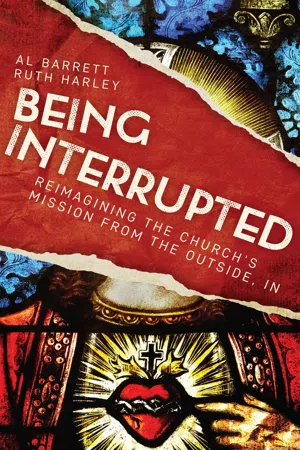
Being Interrupted
Reimagining the Church’s Mission from the Outside, In
This book is available to read until 23rd December, 2025
- 256 pages
- English
- ePUB (mobile friendly)
- Available on iOS & Android
eBook - ePub
Available until 23 Dec |Learn more
About this book
Beginning with a 'Street Nativity Play' that didn't end as planned, and finishing with an open-ended conversation in the midst of the COVID-19 pandemic, "Being Interrupted" locates an institutionally-anxious Church of England within the wider contexts of divisions of race and class in 'the ruins of empire', alongside ongoing gender inequalities, the marginalization of children, and catastrophic ecological breakdown.In the midst of this bleak picture, Al Barrett and Ruth Harley open a door to a creative disruption of the status quo, 'from the outside, in': the in-breaking of the wild reality of the 'Kin-dom' of God. Through careful and unsettling readings in Mark's gospel, alongside stories from a multicultural outer estate in east Birmingham, they paint a vivid picture of an 'alternative economy' for the Church's life and mission, which begins with transformative encounters with neighbours and strangers at the edges of our churches, our neighbourhoods and our imaginations, and offers new possibilities for repentance and resurrection.
Frequently asked questions
Yes, you can cancel anytime from the Subscription tab in your account settings on the Perlego website. Your subscription will stay active until the end of your current billing period. Learn how to cancel your subscription.
No, books cannot be downloaded as external files, such as PDFs, for use outside of Perlego. However, you can download books within the Perlego app for offline reading on mobile or tablet. Learn more here.
Perlego offers two plans: Essential and Complete
- Essential is ideal for learners and professionals who enjoy exploring a wide range of subjects. Access the Essential Library with 800,000+ trusted titles and best-sellers across business, personal growth, and the humanities. Includes unlimited reading time and Standard Read Aloud voice.
- Complete: Perfect for advanced learners and researchers needing full, unrestricted access. Unlock 1.4M+ books across hundreds of subjects, including academic and specialized titles. The Complete Plan also includes advanced features like Premium Read Aloud and Research Assistant.
We are an online textbook subscription service, where you can get access to an entire online library for less than the price of a single book per month. With over 1 million books across 1000+ topics, we’ve got you covered! Learn more here.
Look out for the read-aloud symbol on your next book to see if you can listen to it. The read-aloud tool reads text aloud for you, highlighting the text as it is being read. You can pause it, speed it up and slow it down. Learn more here.
Yes! You can use the Perlego app on both iOS or Android devices to read anytime, anywhere — even offline. Perfect for commutes or when you’re on the go.
Please note we cannot support devices running on iOS 13 and Android 7 or earlier. Learn more about using the app.
Please note we cannot support devices running on iOS 13 and Android 7 or earlier. Learn more about using the app.
Yes, you can access Being Interrupted by Al Barrett,Ruth Harley in PDF and/or ePUB format, as well as other popular books in Theology & Religion & Christian Ministry. We have over one million books available in our catalogue for you to explore.
Information
Part 1: Where Are We?
Act 1: An Interrupted Nativity
It was the annual Street Nativity play: one of those rare occasions where there are more adults wearing tea towels on their heads than children. The story had begun at the Hub, our shop-front youth and community centre, with the surprise news to teenage Mary that she was going to have a baby. From there we walked – through the wind and rain, this year – with our real, live donkey (on loan for the evening from a nearby stables), along the puddle-strewn streets of our estate, a small crowd of the excited, curious and slightly-too-cold-for-comfort adding themselves to the performers, the latter mostly clutching their soggy scripts with one hand, and making sure their makeshift head-coverings didn’t blow away with the other.
Out of the darkness of Comet Park appeared the angel Gabriel, complete with 4-foot wings, light-up halo and a megaphone to ensure her voice was heard by not just the shepherds, and the crowd, but most of the residents of the adjacent tower block too. Turning up Chipperfield Road, we were joined by the magi (approaching from the east end of Bromford Drive), and a young star-bearer led us up the hill known locally as Mount Chipper.
So, it was something of a relief for all of those in the procession when we stopped, for the next scene, in the relative shelter outside Sonny’s chip shop, Atlantis Fish Bar. Sonny, not known for flamboyant performances, had had his arm twisted to play King Herod. Having heard from the magi, he delivered his line responding to them, telling them to go and find the new king and report back to him when they had done so. He then removed his crown and robe (with visible relief) and, in a much more confident voice, invited everyone into the chippy for free fish and chips.
It was at this point that the vicar (Al, also in robe-and-tea-towel attire) reached nervously into his pocket for his mobile phone, to ring those waiting up at the church building, to let them know that the mulled wine and mince pies they were busy warming up wouldn’t be needed for at least another half an hour; that our crowd of people, when we arrived, might well be cold, but not half as hungry as we’d thought; and that those arriving at church expecting the Carol Service to start promptly at 6.30 p.m. should be plied with refreshments in the hope that this might encourage them as they waited for our arrival.
Introduction
The (true) story you’ve just read is a parable: of the kin-dom of God,1 in the hands of our neighbours, interrupting the plans, expectations and flow of the Church’s life and mission, with an undreamt-of abundance that grabs our attention, expands our horizons and reorients our sense of direction and purpose.
When we say ‘us’, we mean, primarily, we who are used to calling ourselves ‘the Church’. We also mean, as a sub-group of the above, we whom the structures of society, and the Church – at least as both of those entities are right now – have given an undue proportion of power, prominence and privilege. In this book we will try to be alert to such unjust structures, and to bring them into greater visibility. We will focus most sharply on the ways human beings have been divided down lines of race,2 class and gender, and the ways in which each of those divisions has assumed a relationship of superiority and inferiority: privileging, in particular, those who find themselves identified as white, middle-class (and ‘higher’) and male. We will also explore the ways in which children have been pushed to the edges of an adult-centred world, and the other-than-human world3 has been exploited, abused and destroyed by many – but not all – of those who call ourselves ‘human’.
While it was far from an easy decision to make, we have chosen not to reflect in detail here on some of the other dividing lines and hierarchies that distort our relationships, especially those that privilege non-disabled people (however temporarily they might be so) over disabled people; heterosexual people over gay, lesbian and bisexual people, and people who are in relationships with someone of the opposite sex over those who are either in same-sex relationships or single; and cis people (those whose gender identity aligns with that given them at birth) over trans and non-binary people. The book would simply have become even more complex, and even longer, than it is already – and we needed to set ourselves a relatively finite, coherent and achievable task! Nevertheless, we have written this book in solidarity with all those who suffer the pain of those divisions that we have not attended to here, and we have done our best both to point to reflection that has been done in those areas already, and also to be ‘creatively disruptive’ in ways that might just inspire or encourage others to do some of the work that still needs doing.
We will assume in these pages not only that these divisions, coupled with an unequal distribution of power, are sinful, signs of humanity’s falling short of what we are created to be; but we will also explore some of the ways in which the Church (particularly when it is dominated by Christians who benefit from the status quo, whether unwittingly or not) all too often colludes with and reinforces those divisions, rather than seeking to break them down. And we will suggest, through sharing stories from our own experience, the analysis of others, and rereadings of Gospel texts, that another way is possible: a way that begins with being interrupted – which means also disrupted, challenged and changed – by our neighbours who, in all kinds of different ways, are ‘other’ than us, but always come bearing gifts – wonderful, strange and sometimes even difficult gifts – that we are invited, with curiosity, wild patience, delight and humility, to receive.
We will also argue in this book that although these divisions have long histories which can be traced back centuries, there is also something critical about this moment, particularly in the national context of the United Kingdom within which both of us are living and writing, that makes an attention to divisions of race, class, gender and age – and our ‘other-than-human’ relationships – of critical importance. We have written this book in the tumultuous four years between the UK’s referendum on membership of the European Union in 2016, and the COVID-19 global pandemic which reached the UK in 2020. But both ‘Brexit’ and COVID-19 have exposed divisions in our society that go much deeper than an abstract question of international politics and economics (EU membership), and which have had – and continue to have – as profound an impact as the coronavirus that has killed hundreds of thousands of people worldwide.4 These deeper divisions have come to public visibility through other crises in our national and global life. All four of them ‘broke’ in the year 2017 – the ‘Windrush scandal’ (race), the Grenfell Tower tragedy (class), the #MeToo movement (gender), and 15-year-old Greta Thunberg’s solo school strike (climate change) – and all four of them, at the time of writing, are anything but resolved.
Windrush
In November 2017, Guardian journalist Amelia Gentleman reported the story of 61-year-old Paulette Wilson, who had been living and working in Britain for 50 years when she received a letter informing her that she was an illegal immigrant and was going to be removed to Jamaica, a country she left when she was ten.5 Wilson’s story, Gentleman revealed, was just one among tens of thousands, stories from the sharp end of the British government’s attempt to detain and deport people from Commonwealth territories who had arrived in the UK before 1973 and did not have documentary evidence of their right to remain in the country.
Dubbed the ‘Windrush scandal’ for its apparent focus on post-war arrivals from the Caribbean (on the Empire Windrush and subsequent ships), estimates suggested up to 57,000 citizens from all over the Commonwealth might be affected, and links were quickly made to the stated aim, in 2012, of home secretary Theresa May, creating a ‘hostile environment’ for ‘illegal immigrants’, with a ‘deport now, appeal later’ policy. Part of ‘an arsenal of measures aimed at curtailing immigration, facilitating deportation, and maintaining hierarchies of status for those who are resident’, the ‘hostile environment’ was shown to be both explicitly legitimizing sanctions against those deemed ‘foreign criminals’ and suspects in the ‘War against Terror’, while also quietly rendering huge numbers of ‘black and brown British citizens in a perpetual state of precarity’.6
In April 2018, 64-year-old Renford McIntyre was homeless and sleeping on a sofa in an industrial unit in Dudley. He has lived in the UK for almost 50 years since arriving from Jamaica in 1968 at 14, to join his mother who had moved here to work as a nurse. He has worked and paid taxes here for 48 years, as an NHS driver and a delivery man, but in 2014 a request for updated paperwork from his employers revealed he did not have documents showing he had a right to be in the UK. He was sacked; the local council told him he was not eligible for housing support or any benefits, so he became homeless. He gathered together paperwork showing 35 years of national insurance contributions but the Home Office returned the application requesting further information. ‘I can’t tell you how angry and bitter it makes me feel. I’ve worked hard all my life, I’ve paid into the system. I’ve sent them details of my NHS pension, and HMRC records going back 40 years. They’ve got all my documents. What more do they want?’ he said. ‘How do they expect me to live? How am I expected to eat or dress myself?’7
Grenfell Tower
In the early hours of 14 June 2017, a 24-storey tower block in west London caught fire. The fire spread with terrifying speed and ferocity, and despite a massive fire-fighting operation, 71 people lost their lives: people from many different nationalities...
Table of contents
- Copyright information
- Contents
- Epigraph
- Foreword
- Foreword
- Foreword
- Part 1: Where Are We?
- Act 1: An Interrupted Nativity
- Introduction
- 1. Who are ‘We’?
- 2. Finding Our Place in Brexit Britain
- 3. What are We Not Seeing?
- 4. The Church’s Privilege Problem
- 5. A Tale of Two Economies
- 6. Getting on the Wrong Side of Jesus
- Part 2: Being Interrupted
- Interruptions in Mark’s Gospel: Finding Our Way In
- 7. On the Road
- 8. At the Edges
- 9. At the Table
- 10. With Little Children
- Act 2: Children Writing the Script
- 11. Amid the Trees
- Part 3: Reimagining
- Act 3: From a Homeless Church to a Community Passion Play
- 12. A Third Economy
- Act 4: A Street Party
- 13. Life at the Edges
- Act 5: The Community Talent Show
- 14. From the Outside, in
- Act 6: Unheard Voices
- 15. At the Cross
- Act 7: An Easter Eve Encounter
- 16. Resurrection
- Act 8: An Easter Day Walk
- Act 9: A Walk in the Woods
- Epilogue: In Conversation – COVID-19, the ‘Great Interruption’
- Further Reading
- Suggested Reading Plan For Groups
- Acknowledgements