In Paradise Betrrayed John Martinkus details what is being done to West Papua by its Indonesian overlords. He illustrates how those who seek independence are killed and tortured for their cause. There is now no one like the Papuan leader Theys Eluay, murdered in 2001 by the Indonesian military, and a campaign of death and terror has been launched on those who raise the Morning Star flag. Martinkus shows how the wealth of the Freeport mine underpins a regimen of repression and he reports on the rise of Laskar Jihad, the imported Islamic extremists who spread fear in the name of Indonesian domination. In a powerful, groundbreaking piece of reportage, Martinkus shows how West Papua is another East Timor waiting to happen and how this is made possible by the indifference of everyone from the United Nations to the Australian government."John Martinkus' narrative is as engrossing as it is appalling. It is full of menace and madness and the smell of death." —Peter Craven, Introduction"The violence in West Papua today … is being orchestrated by the same figures in the Indonesian military who were behind the events in East Timor … the whole repressive network of the Indonesian military that laid [it] waste." —John Martinkus, Paradise Betrayed
eBook - ePub
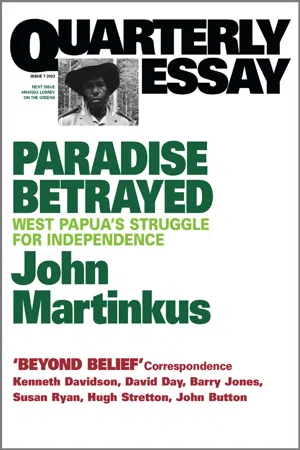
Quarterly Essay 7 Paradise Betrayed
West Papua's Struggle for Independence
- 132 pages
- English
- ePUB (mobile friendly)
- Available on iOS & Android
eBook - ePub
About this book
Information
PARADISE
BETRAYED
West Papua’s Struggle
for Independence
BETRAYED
West Papua’s Struggle
for Independence
John Martinkus
The arrival of Australian troops in East Timor in September 1999 sent such a clear signal to the Indonesian settlers in West Papua that 60,000 of them left for other parts of Indonesia. It seemed at the time that independence for West Papua, the other province of Indonesia that had been forcibly integrated into the unitary republic back in 1962, was just a matter of time.
The parallels between West Papua and East Timor were obvious. Both had been taken over by Indonesia on very shaky legal grounds. Both had identified strongly with their former European colonial masters, the Papuans with the Dutch and the East Timorese with the Portuguese. And in each case their integration into neighbouring Indonesia was approved by the United States and Australia as part of the Cold War strategy to keep Indonesia out of the communist camp.
Both territories had suffered the full force of the Indonesian military’s attempt to crush any resistance. In West Papua this left at least 100,000 people dead and inspired a legacy of hatred for the Indonesians that fuelled the independence movement.
In 1969, the Act of Free Choice, a sham plebiscite that allowed only 1,026 representatives chosen by the Indonesians from an indigenous population of 814,000 to vote on whether to remain a part of Indonesia, had apparently consigned West Papua to permanent occupation. But in 1999, as the Indonesian occupation of East Timor drew to a bloody close (and the Australian and American governments were finally compelled to condemn the actions of the Indonesian military), it seemed that the other great historical wrong to Australia’s north might finally be redressed.
A wave of support for independence went through West Papua. The Morning Star flag, the emblem of Papuan independence, was flown for the first time without bloodshed, and massive rallies for self-government took place in the capital Jayapura, culminating in the 2nd Congress of West Papua in June 2000. For the time being the Indonesian military did not respond. Theys Eluay, leader of the Papuan Presidium Council, could credibly claim to speak for all Papuans when he demanded a UN-sponsored referendum for the people of West Papua to decide whether to remain a part of Indonesia.
But the Indonesian military was not idle for long. Militia groups were set up and Laskar Jihad, a group of militant Islamic fundamentalists allied to the Indonesian army, was now moving into the province. Leaders were tailed and monitored and death lists drawn up. Then, on the night of 11 November 2001, on his way back from a dinner in the capital with members of Indonesia’s special forces,West Papua’s most prominent pro-independence leader, Theys Eluay, was murdered.
It was a deliberate assassination designed to divide the independence movement and provoke the Papuans to violence. When riots broke out in Sentani, Theys’ home town, it looked for a moment as if the strategy might work. But the West Papuan leaders called for calm and the people, for the moment, kept their heads.
I went to West Papua in April 2002 to explore the aftermath of the Eluay assassination and to have a look at the independence movement on the ground. West Papua is remote and expensive to travel to. These reasons alone are enough to deter most visitors, but the Indonesian military has until recently made it doubly difficult for journalists to spend any amount of time there. It is commonplace for journalists requesting visas to travel to Papua to have their request denied with little or no reason given. To travel there “undercover” as a tourist is to risk arrest, and this has, in fact, become increasingly common. On arrival the journalist is heavily monitored, he is kept track of and the atmosphere of intimidation and subtle threat from the Indonesian authorities makes West Papua a very unpleasant place to work. But the threats to foreigners are negligible compared to the risks incurred by those people – leaders, activists, human rights workers – who persist in trying to maintain a flow of reliable information from the province regarding the activities of the Indonesian authorities who are engaged in the business of repressing them. Because of this climate of fear inside West Papua and the effect it has on what people will say, I knew I also needed to speak to the guerrilla leaders of the OPM (the Free Papua Movement), which has long been the umbrella group for the resistance to Indonesian occupation.
In July 2002 I travelled to Vanimo in Papua New Guinea, just across the border from West Papua, to interview Mathias Wenda, the commander of the arms-bearing division of the OPM known as the OPM–TPN or the Liberation Army of West Papua.
The guerrillas Wenda commands are the inheritors of an armed struggle that began almost as soon as the Indonesians arrived. In 1963, a broad-based resistance led to uprisings in several regions of West Papua before the Act of Free Choice. Then, in 1977, revolt in Wamena in the highlands spread to almost all the regions of the province.
Many of those now in the camps on both sides of the border, training as soldiers and pledging allegiance to the OPM, are highlanders. Some like Wenda fled in the late seventies and early eighties as the operations against them intensified. Others took flight more recently. For these guerrillas, the death of Theys was a call to arms. The non-violent dialogue he had espoused had only led to his death.
The repressive strategy being played out now in West Papua by the Indonesian authorities is an intimately familiar one. Only the most blinkered and partisan supporter of Jakarta could refuse to admit to the culpability of the Indonesian military in the destruction of East Timor in 1999, an event that forced the Australian government in the end to act decisively to stop the violence under massive Australian public pressure. Now, as the same Indonesian commanders and the same instrumentalities of its military elite are moving towards a comparable goal in a province that also lies directly to the north of Australia, the line has been drawn and it seems we have no outrage left.
GUNS IN THE FOREST
I wasn’t prepared for Vanimo to be so much like northern Australia. Aluminium houses on stilts with cyclone fences, Steve Liebmann and Today on the only television channel every morning, football commentaries blaring out of every house and a Westpac Bank that reminded me of one in Tennant Creek. Vanimo had the same functional architecture of warehouses and workshops with walls of pressed green tin and air-conditioned offices made from converted shipping containers. The food at the takeaway shop – meat pies, chips and fried chicken – was the same as at any lunch shop back in Australia, complete with a greasy bain-marie. The State of Origin rugby final between Queensland and New South Wales had been on the night before and the soldiers from the local Papua New Guinea Defence Force (PNGDF) detachment were nursing hangovers, and so I imagine was the PNG foreign affairs representative who had begun drinking yesterday morning in preparation for the big match. He had joined me for lunch on that day, accompanied by the man he introduced as the head of military intelligence for the PNG–Indonesia border.
Although part of Papua New Guinea,Vanimo is only thirty kilometres from Indonesia and forty kilometres from the capital of West Papua, Jayapura. As the only sizeable town on the northern tip of the PNG mainland, it has always been the first port of call for those fleeing the Indonesian military on the other side of the border. The first major wave of refugees arrived in 1969 after the UN-sponsored Act of Free Choice. In the lead-up to the Act, two West Papuan leaders stopped over in Vanimo en-route to New York to complain about the way the vote was being conducted. The Australian authorities detained them and flew them instead to Manus Island (where Howard put the people from the Tampa), from where their complaints to New York were never heard.
Little has changed since then. For the PNG government, everything to do with the border is an annoyance, something to be ignored or played down. Its stance is in line with the longstanding Australian policy of pretending nothing untoward happens inside Indonesia’s easternmost province; as most PNG citizens will tell you, the money (A$323.7 million in 2000–2001) Australia gives its former colony each year ensures they effectively have no foreign policy independent of Australia. Now there are only 150 PNGDF troops stationed in Vanimo. It was early in the day when their commanders joined me in one of the two bars in town to find out what I was doing there. As we talked, four soldiers – the commanders’ entourage – sat at a separate table watching us.
“What we have here are criminal elements. Wave-riders and hangers-on. They are easily led,” said the head of military intelligence, referring to the latest batch of border crossers now living outside of Vanimo. “We want to do patrols but we can’t get the money. We could stop it very easily and send them back across. The recommendations for funds go down to Moresby but nothing ever happens. The bureaucracy there is too politicised.” It was clear that the presence of the refugees from West Papua was a bad thing, a problem that should have been solved a long time ago. They were, in his eyes, stupid, murderous people who brought nothing but trouble. The border was peaceful. The Indonesian military had not carried out an incursion into PNG for seven years. There were no problems here. The 318 refugees outside the town stayed, in his opinion, only because of the free food they got from the church.
I told them I was headed for Jayapura, and the civilian head of foreign affairs told me he would take me to the border himself. He was already drunk at midday and had a pronounced nervous tick under one eye. He told me he had fought in Bougainville and the only thing he hated more than the Australian army was Australian journalists. “What are you doing here? You want to meet the OPM. I’ll show you the OPM. They are criminals. They kidnap people.” He told me that he and another of my lunch companions had helped resolve a recent OPM kidnapping: “We were both involved in the negotiations to release them. One time we had to go up there and stay in the bush. We shot a pig, drank beer, it was good fun – like a barbecue.” He laughed and drank more beer and yelled at the waitress to bring him his food. He started talking about the women in Jayapura. About how expensive the beer was and asked where I was going to stay. I told him which hotel. “Ha! So you know Jayapura. When were you there? Show me your fucking passport. I knew you were a fucking journalist,” he screamed. He seemed happy with himself, showing off in front of the others. The military intelligence chief didn’t seem to care. He told me that relations were good with the Indonesians. A memorandum of understanding had formalised arrangements. As far as the OPM were concerned, he wished they had the means to arrest them all and that would be it, no more problem.
They told me to go get the Indonesian visa and they would take me to the border. I said I’d see them around and they laughed. “Of course you will, this is the only place we drink and don’t worry, we know where you are.”
Ten years before, in April 1992, a Swedish documentary film-maker, Per-Ove Carlsson, was found dead in a room in Kiunga, a village south of Vanimo and close to the border. Carlsson had travelled to the region to make a film about the OPM. Although the official version proclaimed that he had cut his throat with his own knife, the death was widely believed, according to the international Committee to Protect Journalists, to be a case of Indonesian-financed assassination.
Max Watts, a veteran European journalist based in Sydney, was given the job of following up the death for the Swedish newspaper Aftonbladet.Watts established that a ragged, tired and broke Carlsson had returned from a two-week trip to see the OPM near Kiunga. Asking a local French-speaking Catholic priest about where to stay, he was directed to the house of a local schoolteacher. He went to bed early in the only upstairs room and in the morning, according to the schoolteacher, blood dripping through the ceiling alerted him and his family to the fact that something was wrong. The schoolteacher said the room was locked from the inside and Carlsson was dead with a fourteen-centimetre cut to his throat that had been administered with the saw blade of his Swiss army knife.Watts recalls asking a doctor if it was possible to commit suicide in such a way. He was told that it was in theory, but it was probably the most painful drawn-out way to cut one’s throat. Why, for instance, didn’t he use the standard blade?
When Watts tried to follow up on the story by phone from Australia, he met dead ends: “The schoolteacher left town unexpectedly very shortly after and the whole matter was closed. From what I could work out, if it wasn’t suicide then whoever had killed Carlsson had told the local people not to talk and had the power to enforce it.” The PNG authorities said the matter was closed and were backed up by the Australian high commissioner in Port Moresby. On the day of his death, Carlsson had called a colleague in Sweden, Mats Brolin, who said, “He was very afraid that [his phone] was being tapped by the local police, and that he was being followed.” Brolin also said that Carlsson was being monitored by Indonesian agents. Watts believes that the PNG police or Indonesian agents colluding with the police killed Carlsson. Nine hours of footage he had taken of the OPM and the refugee camps was the only thing missing from his possessions.
The Australian journalist Andrew Kilvert has written of the close relations between the Papua New Guinean and Indonesian military forces based on the border. In early 2000, he detailed the rewards given to local PNGDF commanders, intelligence officers and two federal MPs in mid-1999 after a joint military operation to secure the release of five Indonesian hostages held by the OPM. According to Kilvert, the Indonesian military provided the group with a two-day stay in Jayapura along with thirty-five prostitutes and a large sum of US dollars. Later, the PNGDF commander-in-chief, Major-General Singirok, was also reportedly rewarded for his forces’ involvement in the operation with a paid holiday to Biak Island for himself and his family. From what my companions had said at lunch, it was clear that they had been among the recipients of this Indonesian largesse.
In Vanimo that night I was reminded of the Carlsson story enough to put the spare bed in the hotel room against the door. But I needn’t have bothered. The whole town, it seemed, was watching the State of Origin game.
“If you’re not back by five tomorrow, I’m not waiting,” the driver said. He realised now that I wasn’t just getting a ride to the border and that the West Papuans with me in the car were there for a reason. There are not a lot of reasons to be in Vanimo unless you want to cross the border to Jayapura or visit the OPM camps just inside PNG. I’d told the fellow from military intelligence and the foreign affairs man that I would make my own way and they had lost interest long enough for me to get away.
On the way up to the border the driver had talked freely about how one day they could pull it down and just let the people cross. “We are the same people,” he had said. It was a view held by many Papua New Guineans.
There was no difference between the people of West Papua and those of PNG; only history and colonialism and now the poverty of those in the West made them different. “Look, what can I do? They are human beings as well,” he had said, making room in the back for two more of the West Papuans who wanted to accompany me to the camp. The fact that Australia had made the border and imposed its policies on the PNG government also grated on him, and he started talking about how PNG was still not really independent from its former colonial boss. But he didn’t want to hang around once he knew who I was going to meet.
Away from the road it was immediately thick jungle. The trees rose straight up two to three hundred feet above and the bush and ferns came up over head height. The path was a combination of mud and logs thrown over thick thorn bushes and gullies, and the five men walked with me in silence across the slimy logs balancing supplies of rice, kerosene and a typewriter on their heads. By the time we got to a small clearing, I was glad to stop and the leader, Peter, told us to wait for the guards. No sooner had he spoken than a man with a thick black beard dressed in ragged shorts and a singlet and carrying a machete came out of the scrub, walked up to Peter, drew himself rigidly to attention and boomed “Siap” – Indonesian for “Ready”. Everybody dropped what they were carrying and stood to attention.
To make the camp they had felled two or three of the enormous trees we had been walking among. Five long huts on stilts served as the headquarters. They had only been in the camp a few weeks and it had not yet been discovered by either the Indonesians or the PNGDF.A parade ground with a flagpole was situated in the middle and five men armed with an M-16, an AK-47 and some shotguns and a bolt-action rifle presented arms as we came in sweating from the bush. Others stopped work on constructing the camp to watch the spectacle. The leader, Mathias Wenda, Supreme Commander of the Liberation Army of West Papua, was in the hut behind and we walked in and sat cross-legged on the rough plank floor.
After the barest of introductions he wanted to start, and when I put my tape recorder in front of him he began speaking in a loud voice. He was addressing everyone in the low-roofed, rough wooden hut. There would have been about thirty who crowded in after us. His small, tightly muscled body coiling up with the effort of talking, he proclaimed his story to the whole camp. “I have been fighting since 1969. I have been here for twenty-two years continuing the struggle on the border. Since 1969 we have been fighting. Every day, every month, every year we have been fighting for independence.” He raised his voice even louder, yelling in Indonesian at the top of his voice, “With the reporter coming from Australia the people of Papua want our desire for independence broadcast in radio, press and TV. We reject autonomy. We want full independence … People have helped East Timor and Aceh whereas the people of West Papua have not got any help … East Timor did not have few victims but in Papua...
Table of contents
- COVER PAGE
- COPYRIGHT PAGE
- CONTENTS
- INTRODUCTION
- MAP OF WEST PAPUA
- GLOSSARY
- PARADISE BETRAYED: WEST PAPUA’S STRUGGLE FOR INDEPENDENCE
- BEYOND BELIEF CORRESPONDENCE
- CONTRIBUTORS
Trusted by 375,005 students
Access to over 1.5 million titles for a fair monthly price.
Study more efficiently using our study tools.
Frequently asked questions
Yes, you can cancel anytime from the Subscription tab in your account settings on the Perlego website. Your subscription will stay active until the end of your current billing period. Learn how to cancel your subscription
No, books cannot be downloaded as external files, such as PDFs, for use outside of Perlego. However, you can download books within the Perlego app for offline reading on mobile or tablet. Learn how to download books offline
Perlego offers two plans: Essential and Complete
- Essential is ideal for learners and professionals who enjoy exploring a wide range of subjects. Access the Essential Library with 800,000+ trusted titles and best-sellers across business, personal growth, and the humanities. Includes unlimited reading time and Standard Read Aloud voice.
- Complete: Perfect for advanced learners and researchers needing full, unrestricted access. Unlock 1.5M+ books across hundreds of subjects, including academic and specialized titles. The Complete Plan also includes advanced features like Premium Read Aloud and Research Assistant.
We are an online textbook subscription service, where you can get access to an entire online library for less than the price of a single book per month. With over 1.5 million books across 990+ topics, we’ve got you covered! Learn about our mission
Look out for the read-aloud symbol on your next book to see if you can listen to it. The read-aloud tool reads text aloud for you, highlighting the text as it is being read. You can pause it, speed it up and slow it down. Learn more about Read Aloud
Yes! You can use the Perlego app on both iOS and Android devices to read anytime, anywhere — even offline. Perfect for commutes or when you’re on the go.
Please note we cannot support devices running on iOS 13 and Android 7 or earlier. Learn more about using the app
Please note we cannot support devices running on iOS 13 and Android 7 or earlier. Learn more about using the app
Yes, you can access Quarterly Essay 7 Paradise Betrayed by John Martinkus in PDF and/or ePUB format, as well as other popular books in Politique et relations internationales & Colonialisme et post-colonialisme. We have over 1.5 million books available in our catalogue for you to explore.