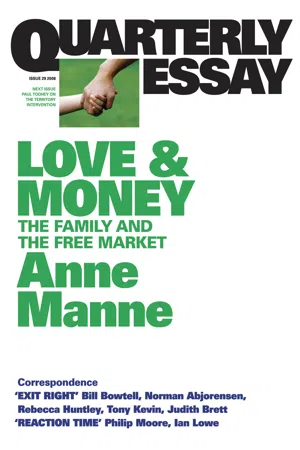
In Love and Money, Anne Manne looks at the religion of work – its high priests and sacrificial lambs. As family life and motherhood feel the pressure of the market, she asks whether the chief beneficiaries are self-interested employers and child-care corporations.This is an essay that ranges widely and entertainingly across contemporary culture: it casts an inquisitive eye over the modern marriage of Kevin Rudd and Therese Rein, and considers the time-bind and the shadow economy of care. Most fundamentally, it is an essay about pressure: the pressure to balance care for others and the world of work.Manne argues that devaluing motherhood - still central to so many women's lives - has done feminism few favours. For women on the frontline of the work-centred society, it has made for hard choices. Eloquently and persuasively, Manne tells what happened when feminism adapted itself to the free market and argues that any true definition of equality has to take into account dependency and care for others.'It is falling fertility … above all else, which gives women a political bargaining chip of a new and powerful kind. Policy makers, formerly deaf to mothers' needs, will have no choice but to listen.' —Anne Manne, Love and Money 'Anne Manne shows a depth and range of analysis that is rare in social-science writing today. Her arguments go behind the child-care debate, behind the work and family tension that is now in the foreground of most Australians' daily lives, to ask the really big questions.' —Steve Biddulph'In Love and Money Anne Manne calls on us to imagine a radically different model of social and political life, one that centres around care rather than on gendered notions of the autonomous, unencumbered individual.' —Julie StephensAnne Manne is an Australian journalist and social philosopher who was has written widely on feminism, motherhood, childcare, family policy, fertility and related issues. She is a regular contributor to the Age and the Monthly. Her books include Quarterly Essay 29 Love and Money: The Family and the Free Market, The Life of I: the New Culture of Narcissism, and, Motherhood: How Should We Care for Our Children? – which was shortlisted for the 2006 Walkley non-fiction prize.
- 144 pages
- English
- ePUB (mobile friendly)
- Available on iOS & Android
eBook - ePub
About this book
Information
LOVE &
MONEY
The Family and
the Free Market
Anne Manne
MONEY
The Family and
the Free Market
Anne Manne
“A princely marriage,” observed the nineteenth-century essayist Walter Bagehot, “is a brilliant edition of a universal fact, and as such it rivets mankind.” In the modern era, a political marriage is likely to interest us more than a princely one. While the royal family continues richly to reward us with the diverting antics of unemployed youths, retired grandmothers and wannabe princesses, it more resembles an exotic and morally chaotic soap opera – sex, infidelity and death – than offers a model for ordinary life. Unsurprisingly, then, we are more than ever likely to turn to our prominent political families as one guide – the “brilliant edition” – to contemporary relationships between men and women.
After Kevin Rudd won the leadership of the Australian Labor Party, it was not long before the nation’s attention turned to his marriage with Therese Rein. As with John and Janette Howard, it was clear that this was a very strong partnership. However, if the Howards represented the old family model of breadwinner husband and homemaker wife, Kevin and Therese seemed to represent the new version: the dual-career power couple. Rein is an immensely successful businesswoman, whose enterprise, in helping the long-term unemployed, had developed from a two-person operation to a multi-million-dollar global business. The transition from the old to the new inhabitants of the Lodge quickly came to stand for more than a mere change of personnel. It was symbolic of the modernisation of the Australian family.
A politician must interest us to be successful. The mild-mannered, bespectacled man who self-deprecatingly called himself an unemployed diplomat held our attention. Kevin Rudd first interested me when I saw him tripping the light fantastic – doing the rumba – with Kerri-Anne Kennerley on her morning show. I immediately thought: he might win the next election. I was struck by his ease with women: he seemed to like women, and they liked him. If Rudd was good with women, it was because he gave the impression of being that most prized of creatures of female culture past and present: the good family man. From Pride and Prejudice to Bridget Jones’ Diary, women who want children must sort the cads from the dads.
More is required of a good family man in the modern era than was required in John Howard’s youth. Then it was enough that he be a good provider. Now our standards are higher: he must have a view of women capacious enough to include not only partnership in child-rearing as an involved and loving father, but respect for his spouse’s independent endeavours in the public realm. He is part of a new social imagination about what love might mean between men and women.
Scarcely a week went by in the lead-up to the election without something turning up to interest us in the domestic life of the Rudds. In what was their political baptism of fire, a scandal erupted over the fact that Rein’s company had inadvertently underpaid workers. They had been placed on precisely the kind of workplace contract that Rudd had been condemning. The scandal did not dent Rudd’s popularity in the slightest. Deftly, he turned liability to advantage by speaking in the language of what family scholars call the new gender contract. He spoke with such respect for and pride in his wife’s achievements that it solidified the impression of him as a loyal husband, and of the partnership as the updated version of companionate marriage. In the Rudd–Rein marriage, a space seemed to have been made for a woman to have her own career: “I’ve never asked Therese any time in the twenty-five years that I’ve been married to her that she should not be active in pursuing her dreams.” They “had always supported each other.” Rudd was “immensely proud of her achievements.”
On closer inspection, however, the Therese and Kevin partnership tells us more about the contemporary patterns of Australian relationships than the commentariat, embracing them as the modern power couple, might have given us to understand. The complexity of their life history tells us why Rudd is able to dance so deftly, and simultaneously appeal as both an old- and new-fashioned family man.
This was made clear during the furore over his wife’s business. Rudd made a bad gaffe. In defending Rein, he said that she was “an independent businesswoman rather than an appendage of middle-aged men.” That instantly offended a great many Australians for a highly interesting reason. The old gender contract, of life-long separate spheres for male breadwinner and homemaker wife, is no longer universal. Yet if motherhood as a monolith, a hegemonic idea, as one life path, is breaking up, in the new scenario women are replacing the old patterns of the past with not just one, but several patterns. (This helps to explain the continual outbreaks of the “mother wars” over which pattern of child-rearing is right.) A minority of families have two full-time workers along the dual-career model. Another minority have a breadwinner husband and homemaker wife. Far more families have a primary and secondary earner. In what the British sociologist of women’s work, Catherine Hakim, has called the “adaptive pattern,” one parent, usually but not always the mother, shapes their working life around the needs of children. In this pattern, women overwhelmingly work part time in preference to full time. Many spend at least some time as a stay-at-home mum while their children are small.
Any politician straddles not only the old world and the new, but also this fraught, complex and conflict-ridden world of choice. It is easy to make a mis-step and offend someone, because we are all doing it differently. Rudd and Rein are not, in fact, the pure embodiment of work-centred careerists whose dilemmas of baby versus briefcase so preoccupy our commentariat, most of whom are themselves leading that life. The occasional columnist for the Age, Natasha Cica, for example, claimed that as a millionaire businesswoman,
Rein is pretty stock standard – most able-bodied Australian mothers work, or they want to. As is her husband – most able-minded Australian men don’t want a dependent appendage and are prepared to stand up and say so. So why the fevered commentary pitch?
In fact, Therese stayed home when her first two children were small, supporting Kevin in his diplomatic career, following him to Sweden and then China. That makes her a member of Hakim’s “adaptive” group, rather than straightforwardly work-centred. Nor did the Rudds share Cica’s contempt for stay-at-home mothers. Defending Rudd against accusations that he had insulted such women, Rein said:
There was a period of time where I was a stay-at-home mum and he fully supported me. There are a whole range of choices that people make in life and a whole range of things that people have to juggle. I have been a mum with two young kids and juggling all of that, I have enormous respect for the people in that position.
Rudd, the Labor populist who had spent a lot of time in the shopping centres of his Queensland electorate getting in touch with ordinary voters, quickly corrected himself. This time he spoke in the “chart your own course” language of postmodern individualism and choice, where, as Anthony Giddens has observed, there is no fixed model for the good life.
What I was saying yesterday was that women must have the right to choose, the right to choose to be a stay-at-home mum, the right to choose to nurture a home, or the right to choose to go to work or to build their own professional career … We have been through that entire spectrum of life experiences ourselves, where with little kids Therese has been at home, building up a home. Then starting off on her own career some time after that.
Yet, further confounding the stereotypes, before a conservative might sigh with relief and define Rein as “serious” about her family but blessedly “unserious” about a little job on the side, it quickly became clear that for her, work is a deeply felt vocation.
What I do at work is my life support … It’s a mission for me to help people who are highly disadvantaged back into jobs that are lasting and decent. It’s a lifeline for me [just as] for Kevin politics is not a career, but this is not a battle for dominance, or power or money, it’s about purpose.
The key to the passion she felt about such work lay in the past. Her father, to whom she was very close, was an aeronautical engineer. He had been crippled when a plane he was testing during the Second World War crashed. Wheelchair-bound, he was nonetheless determined to work and succeeded in doing so, except for brief periods when he took the disability pension. Crucial to the story was the role taken by Therese Rein’s mother, supporting and encouraging:
I know that when you have someone alongside you saying, “I think you can” – which is what my mum did for my dad, she was the urger, she was the encourager – when that’s happening, people can do the extra-ordinary … He wanted to work. I suppose that’s where I learnt about the importance of work in people’s lives.
By the affair’s end, the potential First Couple had done something quite unusual in Australian politics. They had spoken about family and working life in a way that seemed to pay tribute to both, and not diminish either.
The rigid divisions of the work and family debate, the cruel “either you are for me or against me” gusto with which one was flung into one or other camp, were overturned. It seemed suddenly possible that the work/ life collision might give way to a welcome reconciliation of family and working life. Just for a moment, the intolerant atmosphere of the interminable mother wars seemed laid to rest, and a vision put forward which was generous enough to include everyone.
Unhappily, however, it was a rare moment.
GET TO WORK
In the United States in late 2005, the retired trial lawyer, legal academic and feminist Linda Hirshman made a striking intervention in the mother wars. Writing in the magazine The American Prospect, Hirshman attacked educated women for their part in the so-called “opt-out revolution.” This term referred to a 13 per cent rise in the number of new mothers staying home with babies. The controversy was over the question of choice. Did such women freely choose home and children? Or was workplace inflexibility and the absence of affordable child-care creating a situation more “lock-out” than “opt-out”?
Hirshman decided to investigate. She interviewed thirty women who had announced their engagements in the up-market magazine New York Times Style. While her sample was not, admittedly, the most exhaustive survey of American womanhood, Hirshman announced that the trend was indeed true. One interviewee would not come to the phone to answer questions because she was baking apple pie. Another “had a wedding to plan.” It was time to intervene.
In the no-nonsense tone of my old hockey mistress, who clapped her hands on a freezing morning and shouted at the panting team, “Girls, girls, pull your socks up and run another lap!”, Hirshman outlined “The Rules.” A bemused Guardian reporter summed them up like this: “put work first, marry beneath you, and never have more than one child.” Women must not marry for love. They must drive a hard bargain on housework, getting the upper hand by training up and marrying down (to lower-status men who have flexible work lives and can therefore take the mummy track themselves). Women must pursue self-interest at every point:
The best way to treat work seriously is to find the money. Money is the marker of success in a market economy; it usually accompanies power, and it enables the bearer to wield power, including within the family.
Hirshman questioned the sacrosanct notion of the age: the individual’s freedom to choose. The sad legacy of liberal feminism, she argued, had been to bequeath to us this destructive ideal:
Here’s the feminist moral analysis that [the] choice [to stay at home] avoided: The family – with its repetitious, socially invisible, physical tasks – is a necessary part of life, but it allows fewer opportunities for full human flourishing than public spheres like the market or the government … To paraphrase, as Mark Twain said, “A man who chooses not to read is just as ignorant as a man who cannot read.”
Such choices, she went on,
are bad for women individually. A good life for humans includes the classical standard of using one’s capacities for speech and reason in a prudent way, the liberal requirement of having enough autonomy to direct one’s own life, and the utilitarian test of doing more good than harm in the world. Measured against these time-tested standards, the expensively educated upper-class moms will be leading lesser lives … these daughters of the upper classes will be bearing most of the burden of the work always associated with the lowest caste: sweeping and cleaning bodily waste … They have voluntarily become untouchables.
Whether Hirshman was quite measuring up to her “classical standard of using one’s capacities for speech and reason in a prudent way” or the “utilitarian test of doing more good than harm in the world,” one thing at least was certain. She gave a whole new meaning to the old joke: “Before the feminist revolution, housewives were second-class citizens. Afterwards, they were subhuman!”
As the controversy over her views gathered strength, Hirshman threw a wider net. If fury from humiliated at-home mommy bloggers and conservative opinion columnists was not surprising, she soon clashed with those with progressive politics who worked from home or had taken a temporary break to care for children. They, too, by not fulfilling ideal worker norms, experienced the lash of her tongue. She read their blogs about their lives and pronounced them uninteresting. Taken together, the women she attacked constituted most American mothers.
Soon she had a blog, a book contract and the kind of notoriety that brings with it appearances on Sixty Minutes and Good Morning America. The reporter from the Guardian discovered:
She loves work. She believes in work. “To build a life out of the things that aren’t work is like eating cream puffs for every meal,” she proclaims. She is convinced that a truly flourishing life is impossible without paid employment. Her moments of fulfilment came in 1978, when she racked up 2,700 billable hours as a labour lawyer, and in 1984, when she was part of a team of lawyers arguing a case before the supreme court.
If Hirshman’s valuation of work reflected her own life practice, so too did her feelings about caring for babies. Getting her metaphors a little muddled, after likening child-rearing to a diet of cream puffs, she then likened it to being a Nazi torture victim:
[Hirshman] is sceptical about the premise of maternity leave – never having really seen the need for it personally – and worries that women who take a career pause immediately after giving birth expose all women to charges of unreliability. The notion of maternal baby bonding does not appear to enter into her thinking. “You know what maternity leave is really good for?” she asks. “You are constantly getting awakened in the night and so you feel like the victim of a Nazi...
Table of contents
- COVER PAGE
- COPYRIGHT PAGE
- CONTENTS
- LOVE & MONEY: THE FAMILY AND THE FREE MARKET
- CORRESPONDENCE
Trusted by 375,005 students
Access to over 1.5 million titles for a fair monthly price.
Study more efficiently using our study tools.
Frequently asked questions
Yes, you can cancel anytime from the Subscription tab in your account settings on the Perlego website. Your subscription will stay active until the end of your current billing period. Learn how to cancel your subscription
No, books cannot be downloaded as external files, such as PDFs, for use outside of Perlego. However, you can download books within the Perlego app for offline reading on mobile or tablet. Learn how to download books offline
Perlego offers two plans: Essential and Complete
- Essential is ideal for learners and professionals who enjoy exploring a wide range of subjects. Access the Essential Library with 800,000+ trusted titles and best-sellers across business, personal growth, and the humanities. Includes unlimited reading time and Standard Read Aloud voice.
- Complete: Perfect for advanced learners and researchers needing full, unrestricted access. Unlock 1.5M+ books across hundreds of subjects, including academic and specialized titles. The Complete Plan also includes advanced features like Premium Read Aloud and Research Assistant.
We are an online textbook subscription service, where you can get access to an entire online library for less than the price of a single book per month. With over 1.5 million books across 990+ topics, we’ve got you covered! Learn about our mission
Look out for the read-aloud symbol on your next book to see if you can listen to it. The read-aloud tool reads text aloud for you, highlighting the text as it is being read. You can pause it, speed it up and slow it down. Learn more about Read Aloud
Yes! You can use the Perlego app on both iOS and Android devices to read anytime, anywhere — even offline. Perfect for commutes or when you’re on the go.
Please note we cannot support devices running on iOS 13 and Android 7 or earlier. Learn more about using the app
Please note we cannot support devices running on iOS 13 and Android 7 or earlier. Learn more about using the app
Yes, you can access Quarterly Essay 29 Love and Money by Anne Manne in PDF and/or ePUB format, as well as other popular books in Social Sciences & Women in Business. We have over 1.5 million books available in our catalogue for you to explore.