In Power Shift, Hugh White considers Australia's future between Beijing and Washington. As the power balance shifts, and China's infl uence grows, what might this mean for our nation? Throughout our history, we have counted fi rst on British then on American primacy in Asia. Now the rise of China as an economic powerhouse challenges US dominance and raises questions for Australia that go well beyond diplomacy and trade – questions about our place in the world, our loyalties and our long-term security.Will China replace the US as regional leader? If so, we will be dealing with an undemocratic and vastly more powerful nation. Will China wield its power differently from the US? If so, should we continue to support America and so divide Asia between our biggest ally and our biggest trading partner? How to defi ne the national interest in the Asian century?This visionary essay considers the shape of the world to come and the implications for Australia as it seeks to carve out a place in the new world order."This year China overtook Japan to become the world's second-biggest economy. It is already bigger, relative to the US, than the Soviet Union ever was during the Cold War. A Chinese challenge to American power in Asia is no longer a future possibility but a current reality. Few issues are more important to Australia's future than how this plays out. You would not know it to listen to our leaders." —Hugh White, Power Shift
eBook - ePub
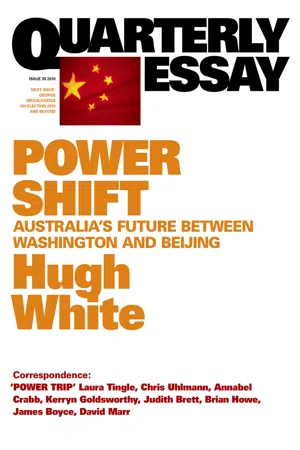
Quarterly Essay 39 Power Shift
Australia's Future Between Washington and Beijing
- 103 pages
- English
- ePUB (mobile friendly)
- Available on iOS & Android
eBook - ePub
About this book
Information
POWER SHIFT
Australia’s Future between
Washington and Beijing
Washington and Beijing
Hugh White
There is a problem with Australia’s vision of its future. On the one hand, we assume that China will just keep growing indefinitely, buying more and more from our miners at higher and higher prices. On the other hand, we expect America to remain the strongest power in Asia, the region’s natural leader and Australia’s ultimate protector. We will have a very nice future if both these things happen. The problem is that they cannot both happen at once. If China grows fast enough to keep our economy buoyant, it will overtake America to become the richest country in the world sometime around 2030. That will make it too strong to live under American leadership in Asia. It will look to lead in its own right, and challenge America’s position.
Asia will be transformed by what follows, and so will Australia. For forty years America’s dominant place in Asia has been essentially uncontested by China and the region’s other strong states. That has kept Asia remarkably peaceful and made Australia very secure. China’s growing wealth and power, by contesting America’s leadership, upsets all this. A new order will appear in Asia, which may not be as peaceful and stable as the one that has served us so well for over a generation. Australia will find itself in a different and perhaps more dangerous region, facing higher risks of conflict and fewer economic opportunities. We could easily end up both poorer and less secure than we are today.
The foundations of Asia’s political and strategic order are already shifting. This year China overtook Japan to become the world’s second-biggest economy. It is already bigger, relative to the US, than the Soviet Union ever was during the Cold War. A Chinese challenge to American power in Asia is no longer a future possibility but a current reality. Few issues are more important to Australia’s future than how this plays out. You would not know it to listen to our leaders. Even Kevin Rudd, who understands Asia’s dynamics as well as anyone, avoided the issue as prime minister, worried that it might make voters uneasy. Tony Abbott dismissed the whole question when he wrote in his book Battlelines that by 2020, “The United States will still have the world’s strongest economy by far” and China’s rise “may not mean much change for Australia’s international relationships or foreign policy priorities.” Julia Gillard seems never to have thought about it at all.
Our leaders, and by extension the rest of us, are assuming that Asia will be transformed economically over the next few decades, but remain unchanged strategically and politically. It is an appealing assumption because the past forty years have been among the best times in Australia’s history, and it has been easy to believe that American power would continue indefinitely to keep Asia peaceful and Australia safe. That has been a cardinal mistake. To see why, we need to know what made the last few decades so good.

For one hundred years – roughly from 1870 to 1970 – Asia was convulsed by the power politics of strong states. Russia, Britain, France, Germany, Japan and America all jostled for markets and political influence. This made them strategic competitors and led to many big wars, culminating in the Pacific War that ended at Hiroshima and Nagasaki. After 1945 the power politics continued, as Asia became a theatre of the Cold War. Then, in the early 1970s, the power politics virtually stopped. Since then, relations among Asia’s strongest states have been remarkably harmonious. Armed force has played little or no role; fear of one another has not driven their defence planning. They have not tried to attract client states and build spheres of influence against one another, nor have they set out to subvert one another’s internal politics or nobble one another’s economies. Above all, they have kept the peace. Aside from a few minor skirmishes, no major Asian power has been involved in substantial military operations in East Asia since China “taught Vietnam a lesson” in 1979. It is probably the longest period of peace in Asia’s long history, and certainly a big change from the previous century.
Why did this happen? One argument is that closer economic integration has fundamentally transformed the way countries relate to one another. In a globalised world, trade, investment and other forms of interaction are so important that governments cannot afford to disrupt them, so old-style power politics has disappeared because it doesn’t pay. This may be part of the explanation, but it cannot be the whole story, and it is probably not the most important part. Asia’s stable order has been as much a cause as a result of economic integration and growth, because the great powers had to stop competing strategically before Asia’s economic integration could get going. So what started the virtuous cycle of stability and growth in the first place?
No one expected that things would work out so well when Asia’s era of peace began almost forty years ago. The late 1960s and early 1970s was a time of great uncertainty. China was seen as a rising power, Japan chafed at the constraints of its post-war settlement, the Soviets were looking elsewhere, India loomed unpredictably, and America seemed weakened and demoralised by failure in Vietnam. It seemed that Asia was headed for an even more dangerous era than the preceding few decades, with a new, more equal, more fluid and more unstable balance of power among all these strong states.
But that did not happen. Instead, America emerged from failure in Vietnam stronger in Asia than ever, because for the first time its position became uncontested by Asia’s two next-strongest countries, Japan and China. This was not just an accident of history, but the result of a remarkable piece of strategic diplomacy by two of the most ambiguous characters in recent history: Richard Nixon and Henry Kissinger. Nixon, advised by Kissinger, went to Beijing in 1972 and cut a deal with Mao. America would stop pretending that the nationalist regime in Taiwan was the government of China and recognise instead the communist government in Beijing. In return, China would stop contesting America’s position in Asia and stop supporting communist insurgencies around the region.
Today the deal sounds merely sensible, but at the time it required real vision and courage from each side. Both had to give up a lot, but both had a lot to gain. For America, recognising the communists in Beijing was a huge concession, which only a hard-right Republican like Nixon could have sold politically. But Nixon knew the only way to get out of Vietnam was to end the strategic competition with China, which had dragged America into the war in the first place; furthermore, winning the support of China against the Soviets would help turn the tide in the Cold War. Beijing had to relinquish its ambitions to build an empire of communist satellites in Asia and tone down two decades of anti-US rhetoric. In return, China got protection against the Soviet Union, insurance against the risk of a resurgent Japan, breathing space to deal with chaos at home, and the opportunity to open China economically to the West.
And so the deal was done. Then Japan was brought in; Tokyo had to be persuaded to remain America’s strategic client and accept America’s new relationship with China. In return, it got continued protection against the Soviets, and against China as well. The deal carried real strategic and political costs for Japan, but also delivered huge benefits, as Japan’s economy enjoyed another twenty years of remarkable growth. Asia’s middle and smaller powers benefited too. When the major powers stopped competing with one another, they stopped interfering in the affairs of smaller countries. Left to themselves, the Southeast Asians flourished economically and developed politically, and they built a strong regional connection in the Association of Southeast Asian Nations (ASEAN), eventually bringing the war-ravaged countries of Indochina into the fold.
For almost forty years, then, Asia’s strategic stability, political evolution, regional integration and economic growth have all been underwritten by the deals struck by China and Japan to accept American leadership. No country has done better out of this than Australia. Politically we have been able to enmesh ourselves in Asia while staying close to America, because America has been welcomed throughout Asia. The stability has underpinned Australia’s growth by allowing Asia’s manufacturing giants, and therefore our exports, to boom. Uncontested American primacy has kept the risk of major conflict in Asia very low. Australia has faced no calls to support America against major military threats in Asia, and we have faced none of our own. That has kept our defence needs modest and our defence budget low. No wonder we would like things to stay the same.
FACING FACTS
If sustained, China’s rise marks the end of the post-Vietnam War era. Yet it may mean even more than that: it may mark the passing of the epoch of Western dominance in Asia that began five centuries ago, in 1498, when Vasco da Gama brought Portuguese naval power to India. America’s role today is simply the latest episode of what scholars call the Vasco da Gama epoch. It could also be the last. If China successfully contests American primacy over the next few decades, Western power will no longer hold strategic sway and Asia will be master of its own affairs once more.
The prospect is momentous for everyone in Asia, but especially for Australia, because our country owes its very existence to the Vasco da Gama epoch in its later, Anglo-Saxon, phases. Ever since Australia was founded in 1788, the domination of Asia’s oceans by Britain, and later by America, has seemed both necessary and sufficient for our security. Nurturing alliances with these powers and supporting their primacy in Asia have been the permanent central pillars of Australian foreign policy since we first started to think about our place in the world. If China’s power displaces America’s primacy, we will have to start thinking about our place in the world all over again from the ground up, and make choices we have never before faced.
We have seen this coming for a while. As long ago as the early 1990s, the end of the Cold War and the Soviet collapse, as well as China’s economic trajectory, suggested that Asia was in for big changes. Both Bob Hawke and Paul Keating began to explore what this might mean for Australia and how we should respond. Both men knew how important American leadership was to Asia, and saw a risk that, suffering economically, it might disengage as the Soviet threat disappeared. They promoted Asia-Pacific Economic Cooperation (APEC) as a forum to counteract that trend and to help hold America in Asia. Both also saw the immense economic promise of China and worked hard to capitalise on it. And they saw that however much we maintained the alliance with America, a new level of engagement in Asia’s affairs was going to be essential for Australia. They both spoke of Australia needing to look for security “in Asia, not from Asia.”
By the time John Howard became prime minister in 1996, the picture had changed. Many people – not just Americans – believed that America had become economically, militarily and ideologically unchallengeable. Fears that the US might disengage from Asia disappeared, replaced by visions of a new era of American unipolarity in which it would exercise uncontested predominance for as far ahead as could be seen, not just in Asia but around the world. Yet at the same time, the scale and momentum of China’s rise started to sink in. As the trauma of the Tiananmen Square crisis faded, and Japan’s problems deepened, it became clear to everyone that China was the big story of Asia. Howard was not expecting this when he took office. “How long has this been going on?” he asked, gazing at Shanghai’s ever-rising skyline from his hotel window on his first visit there as prime minister in April 1997. Yet he quickly grasped what it could mean for Australia and was determined to do whatever it took to increase trade between the two countries.
Just as quickly he realised that the new era would complicate Australia’s foreign policy. A few weeks after winning office in early 1996, Howard had instinctively backed Washington all the way against China in a crisis over Taiwan. Beijing hit back, putting the relationship with Canberra in the deep freeze for months. Howard learned the lesson: building trade with China required greater respect for China’s wishes, which in turn required adjustments to other parts of Australia’s international posture – even when it came to the US alliance itself. From then on, he went quite a long way to meet Beijing’s expectations.
Just how far became clear in October 2003, when a coincidence of scheduling found George W. Bush and Hu Jintao visiting Canberra on consecutive days. Like previous US presidents, Bush was invited to address the parliament, but Howard also extended the same invitation to Hu. This produced the rather surreal spectacle of Canberra’s political classes filing into the chamber to hear Bush on one day, and Hu the next. It also conveyed an impression of parity in Australia’s two most important relationships, especially as Hu was the first foreign leader other than a US president ever to be invited to address the Australian parliament.
That impression became clearer still when Howard rose to welcome President Hu. He acknowledged how fast the relationship with China was changing when he said that ten years before, an occasion such as this would have been “highly improbable.” And then, speaking of the importance of the US–China relationship to Australia, he said:
Our aim is to see calm and constructive dialogue between the United States and China on those issues which might potentially cause tension between them. It will be Australia’s aim, as a nation which has different but nonetheless close relationships with both of those nations, to promote that constructive and calm dialogue.
It was a remarkable statement coming from a man of Howard’s political disposition: he was describing Australia as equidistant from the US and China, and neutral between them – a kind of go-between. The impression was amplified the following year in Beijing when Howard’s foreign minister, Alexander Downer, proclaimed that Australia now had not just an economic relationship with Beijing, but also a strategic and political partnership. Challenged by the journalist Hamish McDonald to explain how that strategic partnership would fare if America and China went to war over Taiwan, Downer replied that there would be no problem: the ANZUS Treaty would not require Australia to support the US in such a war because it fell outside the treaty’s geographical scope. This came as news to Washington; diplomats squawked and Downer backtracked a few days later. Nonetheless, the message had been sent: America could no longer rely on Australia’s automatic support in disputes with China, even on issues as fundamental as Taiwan. China was becoming too important to us.
The shift towards China was obscured by Howard’s strong support for Bush after 9/11, especially on Iraq. Yet Howard accepted China’s growing leadership role in Asia, declined to criticise its military build-up, sought eagerly to join the East Asia Summit (EAS) without US involvement and, until his last year in office, steered clear of American and Japanese efforts to draw Australia into a coalition of democracies designed to resist the Chinese challenge to American primacy.
At the same time, Howard’s Defence White Paper, released in 2000, clearly acknowledged that China’s rise constituted a major change in Australia’s circumstances, and that Australia needed to take a wider view of its national interests and expand its military capabilities. The possibility of war with China now influenced major force-planning decisions for the first time since the Vietnam War.
Howard never really explained all of this to the Australian public. While steadily sliding China’s way, he assured Australians that they did not have to choose between the US and China, saying that escalating rivalry between them was not “inevitable” – which was true but evasive. As so often with Howard, it is unclear to what extent these evasions were conscious and deliberate.
There was much less ambiguity about Kevin Rudd. He came to the Lodge with a deep understanding of China’s trajectory and its implications for Australia, and at times he spoke about the matter quite frankly. In launching his ill-fated Asia-Pacific Community concept in 2008, Rudd noted that the rise of China would fundamentally change Asia and spoke of the need to design a new order. In September 2008, in a speech setting the scene for the release of the 2009 Defence White Paper, Rudd predicted that China could overtake the US to become the largest economy in the world as early as 2020, and suggested that China’s growing power could threaten Australia.
The 2009 White Paper picked up these themes, but it also said that America would remain the strongest power in Asia for as far ahead as we could see. It foreshadowed major expansions of Australia’s naval forces in the 2040s and beyond, but implied that for the next few decades Australia could assume that nothing would change. Rudd’s messages were therefore very mixed: yes, China’s rise changes Asia’s strategic order fundamentally; but no, America will remain in charge and Australia faces no increased risk for many years, if ever. In the end, while Rudd understood China’s rise better than Howard, he was just as unwilling to explain to Australians what it meant. There is no reason to expect that the present generation of political leaders will do any better.
Like climate change, the issue seems too hard for our political system to handle. Despite the clear trends, it is simply too difficult for us to conceive that Australia might no longer be able to rely for protection on the world’s richest and strongest country. And it is easy to hope that, like climate change, the issue will just go away.
CHINA CATCHES UP
Why should China’s rise disrupt the Asian order when stability is so obviously in everyone’s interests? The answer goes back to the original deal that settled regional relationships in 1972. The deal was built on the relative power of the three key countries at the time: the US, China and Japan. Since then, many things have changed. The Soviet Union has disappeared, Japan has grown and then stagnated, India has emerged as a major Asian power, and China has taken off. Inevitably, the further these developments shift the power balance from the way it was in 1972, the shakier the foundations of the deal become. Of these shi...
Table of contents
- COVER PAGE
- TITLE PAGE
- COPYRIGHT PAGE
- CONTENTS
- POWER SHIFT: AUSTRALIA’S FUTURE BETWEEN WASHINGTON AND BEIJING
- CORRESPONDENCE
- CONTRIBUTORS
Trusted by 375,005 students
Access to over 1.5 million titles for a fair monthly price.
Study more efficiently using our study tools.
Frequently asked questions
Yes, you can cancel anytime from the Subscription tab in your account settings on the Perlego website. Your subscription will stay active until the end of your current billing period. Learn how to cancel your subscription
No, books cannot be downloaded as external files, such as PDFs, for use outside of Perlego. However, you can download books within the Perlego app for offline reading on mobile or tablet. Learn how to download books offline
Perlego offers two plans: Essential and Complete
- Essential is ideal for learners and professionals who enjoy exploring a wide range of subjects. Access the Essential Library with 800,000+ trusted titles and best-sellers across business, personal growth, and the humanities. Includes unlimited reading time and Standard Read Aloud voice.
- Complete: Perfect for advanced learners and researchers needing full, unrestricted access. Unlock 1.5M+ books across hundreds of subjects, including academic and specialized titles. The Complete Plan also includes advanced features like Premium Read Aloud and Research Assistant.
We are an online textbook subscription service, where you can get access to an entire online library for less than the price of a single book per month. With over 1.5 million books across 990+ topics, we’ve got you covered! Learn about our mission
Look out for the read-aloud symbol on your next book to see if you can listen to it. The read-aloud tool reads text aloud for you, highlighting the text as it is being read. You can pause it, speed it up and slow it down. Learn more about Read Aloud
Yes! You can use the Perlego app on both iOS and Android devices to read anytime, anywhere — even offline. Perfect for commutes or when you’re on the go.
Please note we cannot support devices running on iOS 13 and Android 7 or earlier. Learn more about using the app
Please note we cannot support devices running on iOS 13 and Android 7 or earlier. Learn more about using the app
Yes, you can access Quarterly Essay 39 Power Shift by Hugh White in PDF and/or ePUB format, as well as other popular books in Politics & International Relations & Geopolitics. We have over 1.5 million books available in our catalogue for you to explore.