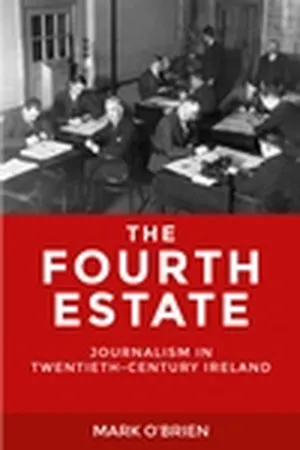
This book examines the history of journalists and journalism in twentieth-century Ireland. While many media institutions have been subjected to historical scrutiny, the professional and organisational development of journalists, the changing practices of journalism, and the contribution of journalists and journalism to the evolution of modern Ireland have not. This book rectifies the deficit by mapping the development of journalism in Ireland from the late 1880s to today.
Placing the experiences of journalists and the practice of journalism at the heart of its analysis, it examines, for the first time, the work of journalists within the ever-changing context of Irish society. Based on strong primary research - including the previously un-consulted journals and records produced by the many journalistic representative organisations that came and went over the decades - and written in an accessible and engaging style, The Fourth Estate will appeal to anyone interested in journalism, history, the media and the development of Ireland as a modern nation.
- 246 pages
- English
- ePUB (mobile friendly)
- Available on iOS & Android
eBook - ePub
About this book
Information
Publisher
Manchester University PressYear
2017Print ISBN
9781526134783
9780719096136
eBook ISBN
9781526108432
1
A new age
Since daily newspapers have doubled their sheets and multiplied their numbers – since men took to travelling by steam and corresponding by telegraph – since the world has begun to live so fast, that it takes its news like its meals, regularly four times a day, with a latest edition, by way of nightcap after supper – the functions of the monthly magazine have undergone a remarkable alteration.1
— The Daily Express on changes in media production, 1851
The second half of the nineteenth century brought profound change to journalism in Ireland. The gradual abolition of the knowledge taxes – the long-standing stamp duty on newspapers and taxes on newsprint and advertising – gave a new lease of life to the printed word by lowering prices, encouraging competition, and making newspapers a more viable business enterprise.2 The expansion of the railway – from 428 miles in 1849 to 1,909 miles in 1866 – encouraged urbanisation and provided secure routes for telegraph wires. In turn, urbanisation encouraged the development of the provincial press by creating core readerships for such titles. Technological innovations, such as the completion of submarine cables from Howth to Holyhead in 1852, and from Valentia Island to Newfoundland in 1866, allowed for the transmission of news almost instantaneously. Other technological advances, such as the typewriter and the rotary press in the 1860s, the telephone in the 1870s, and the Linotype machine in the 1880s, allowed for a more efficient production process. Rising literacy levels meant more people were capable of reading newspapers: between 1841 and 1881, the percentage of the population over five years of age that was literate rose from 47 to 75 per cent.3 Electoral reform increased the number of voters and changed how they voted. While the 1884 Reform Act trebled the number of voters by extending the franchise to cottiers and labours, the Ballot Act 1872 introduced the secret ballot, lessening the hold landlords had over their tenants’ votes. These technological, social, and political developments prompted huge growth in the demand for news. As L. M. Cullen has recorded, sales of Irish daily newspapers through the country’s main distributor, Eason’s, jumped from 99,558 in 1878 to 119,442 in 1894 while sales of weekly newspapers increased from 26,859 in 1878 to 42,864 in 1883.4
Political events also transformed journalism. The ‘new departure’ of the late 1870s, whereby constitutional and militant nationalists and agrarian agitators united in a campaign for land reform and Home Rule, politicised journalism as never before. The Land League, led by Michael Davitt and Charles Stewart Parnell, sought to address the grievances of tenant farmers, and, since land was at the heart of the new political struggle, it also became the centre of journalistic life. As Christopher Morash and Felix Larkin have pointed out, one of the first pieces of what would later be called investigative journalism was published at this time. In 1878, the Freeman’s Journal published William O’Brien’s series ‘Christmas on the Galtees’ that exposed the plight of the rack-rent tenants of the Buckley estate in County Tipperary.5 As the 1880s unfolded, Land League meetings, land sales, evictions, boycotts, crop raids, demonstrations, and attacks on landlords and their agents dominated the work of journalists. Reporting on these events was a hazardous task for journalists as they ran the risk of being mistaken for government officials or being accused of being unsympathetic to the aims of the League – or, in extreme cases, being injured in the disturbances that occasionally erupted. Interestingly, journalists were originally hired by Dublin Castle to report on such meetings and give evidence in court, but when this practice was condemned by the Freeman’s Journal, the Castle resorted to using policemen who had been trained in the use of shorthand. The most noted of these policemen was one Jeremiah Stringer and so famous did he become that ‘his name was often applied derisively to other Constabulary note-takers’.6 Stringer is mentioned consistently in the newspaper reports of the prosecutions of Land League leaders during the 1880s and is also mentioned in House of Commons debates on Ireland. When, in 1881, Parnell challenged William Gladstone’s account of a speech he (Parnell) had made at an eviction, Gladstone retorted that he had ‘authentic evidence’ – to which T. M. Healy cried, amid much laugher, ‘Jeremiah Stringer’.7 On his death, the Weekly Irish Times noted that ‘in the days of the Land League there were few names more prominently mentioned in connection with the preservation of law and order than his, the knowledge of shorthand he possessed being of invaluable service to the Government’.8 In time, the term ‘stringer’ came to be used to describe local correspondents who reported on events for national media.
New journalism
But the biggest change in journalism in the latter half of the nineteenth century was undoubtedly the advent of ‘new journalism’. As Joel Wiener has pointed out, the new journalism emerged in America in the 1830s and significantly influenced the development of journalism in Britain and Ireland. It did so by introducing significant changes in typography and makeup, in content, and by encouraging greater commercialisation.9 The shape of newspapers changed with the introduction of headlines and summary leads, and there was a greater emphasis on display adverts, illustrations, and, later, photographs. There occurred a changed definition of what constituted news – ‘a rejection of the older view that the press existed primarily to record and disseminate high politics’ and the adoption of ‘a modern tabloid sensibility’. Out went the emphasis on verbatim parliamentary reportage and page-length leading articles, and in came an emphasis on ‘gossip, display advertising, sports news, human interest features, articles aimed at women and children and, above all, fast-breaking stories transmitted by wire agencies’.10 As viewed by prominent proponent of the new journalism T. P. O’Connor, its distinguishing feature was ‘the more personal tone of the more modern methods’. While previously ‘any illusion to the personal appearance, the habits, the clothes, or the home and social life of any person would have been resented as an impertinence and almost as an indecency’, new journalism advocated that ‘the desire for personal details with regard to public men is healthy, rational, and should be yielded to’. The public, O’Connor declared, ‘suffer a great deal more from the cowardice than from the audacity of journalism, from the suppression than from the publication of awkward facts’.11 In terms of his own newspaper, The Star, O’Connor promised to ‘do away with the hackneyed style of obsolete journalism’: there would be no place ‘for the verbose and prolix articles to which most of our contemporaries still adhere’.12 Thus, personalised reporting, interviews, serialisations, crime news, and investigative pieces were staples of the new journalism. In Britain, the new journalism was inextricably linked with W. T. Stead, Editor of the Pall Mall Gazette, whose pioneering investigation into London childhood prostitution in 1885 has achieved iconic status.13 But while this series is often highlighted as the first sex scandal that typified the scandalmongering approach of new journalism, Margot Gayle Backus has pointed out that William O’Brien’s exposé, in United Ireland, of the Dublin Castle sex scandal, which involved sexual impropriety among government officials, predates Stead’s series. She also noted that the failed libel suits that arose from the series would have been closely monitored by editors and journalists in London. Their timing, argues Backus, ‘strongly implies a connection between … O’Brien’s right to publish and the new mode of investigative scandal that Stead launched the following year’. Prior to O’Brien’s series, Stead’s actions, Backus concludes, ‘would have been unthinkable’.14
Within the new journalism, crime and divorce stories loomed large: the blanket coverage devoted to the so-called ‘Jack the Ripper’ murders in London’s Whitechapel area in 1888 and the tales of adultery and cruelty that emanated from the divorce courts typified the new journalism. By 1896, with the establishment of the halfpenny Daily Mail by Alfred Harmsworth (later Lord Northcliffe), the new journalism had been appropriated as a mean of selling mass-circulation daily newspapers – a process decried by Stead as ‘purposeless sensationalism, sham heroics, and opportunism’.15 Indeed, many scholars draw a distinction between the initial and later stages of the new journalism: while Stead’s new journalism represented ‘a moral thrust, social conviction, directness of language and political ambition’, Harmsworth’s incorporation of new journalism represented monetisation and commercial gain.16
In Ireland, this use of crime and scandal to sell newspapers manifested itself in the British Sunday titles that arrived every week. The idea of newspapers reporting gossip, scandal, crime, and conducting investigations was one far removed from Irish journalism at the turn of the century. These topics were taboo, and the publication of such stories in imported British titles was viewed by the Catholic Church as c...
Table of contents
- Cover
- Half Title
- Title Page
- Copyright Page
- Contents
- Acknowledgements
- Abbreviations
- Glossary
- Introduction
- 1 A new age
- 2 High dignity and low salaries
- 3 Free State – free press?
- 4 Power in a union
- 5 A red republic
- 6 Official Ireland
- 7 The impact of television
- 8 The Troubles and censorship
- 9 Modernity comes knocking
- 10 Lifting the lid
- 11 Spirit of the nation
- 12 An appalling vista
- Conclusion
- Sources and select bibliography
- Index
Trusted by 375,005 students
Access to over 1.5 million titles for a fair monthly price.
Study more efficiently using our study tools.
Frequently asked questions
Yes, you can cancel anytime from the Subscription tab in your account settings on the Perlego website. Your subscription will stay active until the end of your current billing period. Learn how to cancel your subscription
No, books cannot be downloaded as external files, such as PDFs, for use outside of Perlego. However, you can download books within the Perlego app for offline reading on mobile or tablet. Learn how to download books offline
Perlego offers two plans: Essential and Complete
- Essential is ideal for learners and professionals who enjoy exploring a wide range of subjects. Access the Essential Library with 800,000+ trusted titles and best-sellers across business, personal growth, and the humanities. Includes unlimited reading time and Standard Read Aloud voice.
- Complete: Perfect for advanced learners and researchers needing full, unrestricted access. Unlock 1.5M+ books across hundreds of subjects, including academic and specialized titles. The Complete Plan also includes advanced features like Premium Read Aloud and Research Assistant.
We are an online textbook subscription service, where you can get access to an entire online library for less than the price of a single book per month. With over 1.5 million books across 990+ topics, we’ve got you covered! Learn about our mission
Look out for the read-aloud symbol on your next book to see if you can listen to it. The read-aloud tool reads text aloud for you, highlighting the text as it is being read. You can pause it, speed it up and slow it down. Learn more about Read Aloud
Yes! You can use the Perlego app on both iOS and Android devices to read anytime, anywhere — even offline. Perfect for commutes or when you’re on the go.
Please note we cannot support devices running on iOS 13 and Android 7 or earlier. Learn more about using the app
Please note we cannot support devices running on iOS 13 and Android 7 or earlier. Learn more about using the app
Yes, you can access The Fourth Estate by Mark O'Brien in PDF and/or ePUB format, as well as other popular books in History & Irish History. We have over 1.5 million books available in our catalogue for you to explore.