How do secular Jewish Israeli millennials feel about the Israeli-Palestinian conflict, having come of age in the shadow of the Oslo peace process, when political leaders have used ethno-religious rhetoric as a dividing force? This is the first book to analyse blowback to Palestinian and Jewish-Israeli religious nationalism among this group in their own words, based on fieldwork, interviews and surveys conducted after the 2014 Gaza War.
Offering a close reading of the lived experience and generational memory of participants, Gutkowski offers a new explanation for why attitudes to Occupation have grown increasingly conservative over the past two decades. Examining the intimate emotional ecology of Occupation, this book offers a new argument about neo-Romantic conceptions of citizenship. Beyond the case study, it also provides a new theoretical framework and methods for researchers and students studying emotion, religion, nationalism, secularism and political violence.
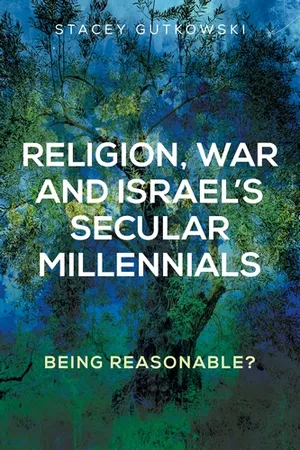
- 284 pages
- English
- ePUB (mobile friendly)
- Available on iOS & Android
eBook - ePub
About this book
Information
1
Who is a secular Jew?
We see that this natural divine law does not require ceremonies …. For the natural light requires nothing which that light itself does not reach, but only that which can indicate to us very clearly the good … finally, we see that the highest reward of the divine law is the law itself, namely, to know God and to love him from true freedom and with a whole and constant heart.
Spinoza, Ethics, 20, III, 30
The first two chapters address the question: how generationally unique (or not) are hiloni millennials? To answer this question, we must start with terminology and the conceptual debates. What does the term ‘hiloni’ mean? How do scholars use it? How do people who identify with the term use it? Scholars agree that the terminology of Western secularism does not translate for the Jewish-Israeli case. This is because Jewish tradition, a cornerstone of Jewish identity, is a powerful reference point even for those who think they are not halakhically observant.
Before delving into the academic debates about who is hiloni (and who is masorti, a traditional Jew), here is a flavour of how self-identified hilonim, millennials and transitional Generation XY, talk about growing up as hiloni Jews in Israel and their earliest experiences of Jewish tradition in their own words. The themes raised here are not generationally specific. Quotations presented here represent mainstream hiloni narratives about ‘becoming hiloni’, in so far as one can speak about there being a mainstream hiloniness in Israel.
To questions about childhood, interlocutors gave answers about food and family – answers which captured Jewish traditional practice and identity.
We are a very independent family. You believe whatever you want, eat bread on Pesach, eat on Yom Kippur. Most of my friends were like this. (Ariela, mid-twenties, female)1
We did Passover and Purim, not in the religious sense, just family gatherings, and Friday prayers in the kibbutz dining room … (Levi, late twenties, male)
We would eat pork and call it the low cow. (Reuben, mid-twenties, male)
I am an entirely secular person (hiloni gamur). I’m not as anti-religious as my parents, but I guess I’d call myself an atheist. I don’t really feel an affiliation to Judaism even though I’m Jewish, or to any other religion for that matter. I may have an Israeli identity or Israeli-Russian but not a Jewish identity … I played with religious kids in my neighbourhood. They were nice neighbours. (Sasha, late twenties, female)
| Q: | Does everyone in your family do and think the same thing? |
| A: | Not at all. I’m descended from a rabbinical family, from Spain and Morocco. Most of my family are traditional secular with a hint of observant … my dad keeps a few habits for sentimental reasons rather than belief …. I’m avidly secular. (Oren, late twenties, male) |
| Q: | What did you think about religion growing up? |
| A: | When my brother and my dad would go [to synagogue] I would not. It wasn’t an issue like ‘you should come’. They would just ask me, and I would say no. It’s really boring …. We used to do Pesach, you know, like every Israeli family, Rosh Hashanah, the main holidays. But I never understood [why]. Why should I separate dairy and meat? I think it was my mom, she didn’t really care about it. There was no one who [gave me] a good answer to these questions …. I had a bar mitzvah like any Jewish boy …. I don’t like big events [laughs] there was an issue about it, I wanted a small one, so we met in the middle, in a restaurant. I didn’t go to the synagogue again until a friend’s brother’s bar mitzvah. I didn’t know how to put on the tefillin … some guy had to do it … it was like putting on, what is the word? The thing to stop the blood? (A tourniquet?) Yes, a tourniquet, that’s how it felt. (Shaul, mid-twenties, male) |
| Q: | What did you learn about religion in school? |
| A: | As a kid I didn’t get it. You learn about God as a figure in a story. That he does this thing and he gets upset with you, not you individually, but with the Hebrew people, and he does all these miracles. It’s like a story. (Ruth, mid-twenties, female) |
| Q: | What did you think about religion growing up? |
| A: | There was something about the religious people, you know, the people that wear black, that was very alienating to me. I was very alienated from it even though the city I grew up in was mostly a religious city. But it was completely separate neighbourhoods. I had one friend at the age of 13 from a religious background. We never talked about religion. The army was the first place where I met religious people. I became close to a religious woman, and then during my BA started to make religious friends. I’m not anti-religious. I have friends who are religious, and I do like the rituals. I think with a different partner I might have done the candles or kiddush. I don’t mind. I wouldn’t consider myself an atheist. I don’t believe in God. I don’t believe in the Jewish God. I’m not sure what my belief is. I practise meditation. I have more Buddhist inclinations. So, if I have any inclinations it would be towards some sort of afterlife or continuation and some kind of fate. (Sara, late thirties, female, Generation XY)2 |
I’m [now] interested in Eastern cultures, yoga. For me it’s more about the development of your social imagination and less about identity. I don’t know if that’s contradictory. (Eyal, mid-thirties, male)
| Q: | When you were growing up did you believe in God? |
| A: | No, not so much. |
| Q: | And now? |
| A: | It’s still the same. Yesterday we had a visit from my friend, and we started talking about it. No, well, it’s not something that guides me. You could always say, yeah, maybe there is something that we don’t understand. We are open-minded people and stuff like that. Never say never. But it’s certainly not something that I would say, that I accept that there’s a superior being that has all the answers to the things we don’t know. So, no: no God. (Uri, early forties, male, Generation XY) |
While there are debates and disagreements, researchers broadly agree with the following:
•hiloniness remains a socially elite identity among Jewish-Israelis; it has had a historically disproportionate impact on Jewish-Israeli national identity and practices relative to other ‘religious sectors’ in Israel;3
•while hilonim do not strictly observe the halakha as it is interpreted by the Orthodox Rabbinate in Israel, Jewish tradition, through Israeli popular culture, plays a substantial role in everyday hiloni practices and self-identity;4
•hiloni identity and practice overlaps with masorti (traditional) Jewish identity and practice;
•hilonim participate in a politics of boundary-marking with Jews from other ‘religious sectors’ in Israel; that this boundary-marking is shaped in important ways by ethnic boundary-marking between Ashkenazi and Mizrahi Jews – even though a third of hilonim are Mizrahim;5
•strong anti-religious sentiments among hilonim is rare;
•belief in a non-interventionist force (koach elyon) or agnosticism are common beliefs among hilonim, with atheists a small (but, I would add, often overlooked) minority;
•compared to other religious sectors in Israel, hilonim have been disproportionately shaped by non-Jewish ideas and practices. The strongest influences have been state atheism and Orthodox Christianity in the former Soviet Union, Eastern religions and New Age spirituality;
•Western conceptions of secularism do not apply to the Jewish-Israeli case.
It is to this last point that we now turn.
Israel and ‘secularism’
In recent years, scholars have quite rightly sought to problematize the idea that the category ‘secular’ can be applied to life in Israel.6 I very much agree with this project. For example, Ram quotes Asad’s point that the ‘religious’ cannot be separated from ‘the secular’, and that which appears ‘secular’ reconstitutes the ‘religious’ within it.7 Ram argues ...
Table of contents
- Cover
- Half Title
- Title Page
- Copyright Page
- Dedication
- Contents
- Tables
- Acknowledgements
- Glossary
- Timeline of Jewish-Israeli millennial generational memory: Key Israeli–Palestinian events
- Introduction
- 1 Who is a secular Jew?
- 2 Generational memory
- 3 My Other, myself
- 4 Imagining jihad
- 5 No atheists in foxholes?
- 6 Imagining home(land)
- Conclusion: Being reasonable?
- Postscript: Religion, violence and the secular
- Appendix: Research method
- Bibliography
- Index
Trusted by 375,005 students
Access to over 1.5 million titles for a fair monthly price.
Study more efficiently using our study tools.
Frequently asked questions
Yes, you can cancel anytime from the Subscription tab in your account settings on the Perlego website. Your subscription will stay active until the end of your current billing period. Learn how to cancel your subscription
No, books cannot be downloaded as external files, such as PDFs, for use outside of Perlego. However, you can download books within the Perlego app for offline reading on mobile or tablet. Learn how to download books offline
We are an online textbook subscription service, where you can get access to an entire online library for less than the price of a single book per month. With over 1.5 million books across 990+ topics, we’ve got you covered! Learn about our mission
Look out for the read-aloud symbol on your next book to see if you can listen to it. The read-aloud tool reads text aloud for you, highlighting the text as it is being read. You can pause it, speed it up and slow it down. Learn more about Read Aloud
Yes! You can use the Perlego app on both iOS and Android devices to read anytime, anywhere — even offline. Perfect for commutes or when you’re on the go.
Please note we cannot support devices running on iOS 13 and Android 7 or earlier. Learn more about using the app
Please note we cannot support devices running on iOS 13 and Android 7 or earlier. Learn more about using the app
Yes, you can access Religion, war and Israel’s secular millennials by Stacey Gutkowski in PDF and/or ePUB format, as well as other popular books in Social Sciences & Politics. We have over 1.5 million books available in our catalogue for you to explore.