eBook - ePub
Civilised by beasts
Animals and urban change in nineteenth-century Dublin
- 234 pages
- English
- ePUB (mobile friendly)
- Available on iOS & Android
eBook - ePub
About this book
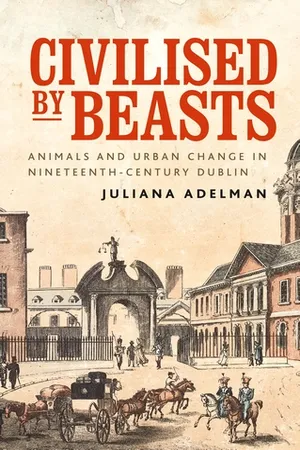
Civilised by beasts tells the story of nineteenth-century Dublin through human-animal relationships. It offers a unique perspective on ordinary life in the Irish metropolis during a century of significant change and reform. At its heart is the argument that the exploitation of animals formed a key component of urban change, from municipal reform to class formation to the expansion of public health and policing. It uses a social history approach but draws on a range of new and underused sources, including archives of the humane society and the zoological society, popular songs, visual ephemera and diaries. The book moves chronologically from 1830 to 1900, with each chapter focusing on specific animals and their relationship to urban changes. It will appeal to anyone fascinated by the history of cities, the history of Dublin or the history of Ireland.
Information
Publisher
Manchester University PressYear
2020Print ISBN
9781526160706
9781526146052
eBook ISBN
9781526146045
Topic
HistoireSubtopic
Histoire du 19ème siècle1
Political zoology: class, religion and animal exploitation, 1830–45
The elephant, which has been for some time expected at these grounds, arrived in town, and will be immediately placed in the gardens for the gratification of the curious in natural history.1
Mr Calder stated that on Friday afternoon, passing through College-Green, he perceived a horse after falling down in the street beneath a load on a dray. A crowd was collected about the animal; several persons were beating him cruelly in order to force him to rise, but he could not do so from his exhausted state.2
An elephant in the Dublin Zoological Gardens and a dying cart horse in College Green could both attract a crowd of onlookers in early nineteenth-century Dublin. Groups intent on reforming Dublin tried to turn the horse and the elephant into different types of lessons. The elephant helped the Zoological Society to teach natural history, boost Dublin’s scientific reputation, improve class relations and soothe political tensions. The horse and its injuries became examples of a form of ignorance that the DSPCA wished to eradicate through policing and punishment. Between 1830 and 1845, horses and elephants became part of very different approaches to the reform and improvement of Dublin, especially its working classes. By comparing the DSPCA and the Zoological Society this chapter shows how ideas about human–animal relationships were entwined with ideas about class, religion, politics and urban improvement.
Mr Calder’s views on the treatment of horses differed significantly from those of both the owner of the dray and the other workers who helped the owner beat the horse ‘in order to force him to rise’. Likewise, visitors to the elephant in the Zoological Gardens ranged from the Lord Lieutenant to ‘ragged boys’, from those interested in amusement and socialising to those ‘curious in natural history’.3 The peculiarities of class, religion and politics in Dublin helped to make the Zoological Gardens a popular success while the DSPCA languished. The caged animals in the Dublin Zoological Gardens presented a clear view of human ascendancy over nature and did not often provoke tensions between Catholic and Protestant, nationalist and unionist, rich and poor. Almost no one cried foul at the manner in which animals lived and died to amuse the visiting public. By contrast, the DSPCA’s detection of animal cruelty amongst poor workers in Dublin’s streets prevented the Society from gaining a public following. ‘Poor’ was too easily interchanged with ‘Catholic’ or ‘Irish’, thereby suggesting that policing cruelty to animals might represent a form of Protestant English oppression.
This chapter is divided into three parts. The first part uses a horse-powered trip to the Zoological Gardens to tease out some of the ways class affected human–animal relationships in early nineteenth-century Dublin. The second part then looks closely at the development of the Zoological Gardens and how animals were useful to a reforming project intended to unite all classes and creeds. The third section examines the DSPCA and its divisive impact, including detractors who considered it a threat to the idea of human ascendancy with political consequences for Ireland.
Between 1830 and 1845 the city consumed animals in the thousands. Attitudes towards these animals, from exotic big cats to ordinary cab horses, reveal ideas about class and identity that made nineteenth-century Dublin unique: a city of Catholics ruled mostly by Protestants, a metropolis of Ireland but a second city of the United Kingdom, a city of middle-class professionals that recalled aristocratic times. We can read the Zoological Society and the DSPCA for signs of the city’s prejudices and pretensions just as Dubliners might have read the high-stepping gait of a horse or an open sore on its back for signs of the owner’s character.
Social class, political reform and human–animal relationships
One Monday in May 1837 a young woman ‘out driving’ arrived at the Dublin Zoological Gardens. Being wealthy, she travelled in her family’s carriage, the same one that her father used to visit his patients.4 Families such as hers kept the streets crowded with carriages and the coachmakers ‘in such full employment that no contract could be obtained for building coaches on the Dublin and Kingstown railroad’.5 The horses drawing the carriage may not have matched the ‘near to perfect’ bay mares owned by the president of the Zoological Society but they were probably glossy, healthy animals around six years old. Horses drawing private carriages stood out from the city’s 7000 working horses, most of which had not been selected for their beauty.6 The young lady’s carriage may have been similar to that constructed for a doctor in 1822 by John Hutton and Sons. At a cost of £205 the carriage included a leather roof, mahogany panelling, leather seats, curtains, lamps and harness for a pair of horses.7 Arriving in dry comfort, she would have paid 1s at the gatehouse to enter the Zoological Gardens on foot while the driver minded the horses. Once inside, she ‘staid [sic] some time & did not hear even one tune from the band’. She recorded nothing of the animals within the gates, although she mentioned meeting a friend. Elite Dubliners used the gardens to socialise, paying extra on fete days for a glimpse of the Lord Lieutenant and other ‘bipeds to be seen’.8 She returned a week later for one such fete where she stayed until midnight but, due to rain, did not even leave the shelter of the marquee to stroll the grounds. The exotic animals did not merit description, unlike Toby the Sapient Pig, whom she visited twice in a shopping arcade to see him tell the hour and spell his name.9
Perhaps other classes of visitors found the zoological spectacle in the gardens more compelling. Over 20,000 made their way to the gardens on a single day in 1838 when the Zoological Society opened them for free to mark Queen Victoria’s coronation.10 Dubliners lacking a carriage could have queued at a jaunting car stand, perhaps on Sackville Street, and paid to be jolted along to the gardens by the combination of ‘vociferous’ driver and malnourished nag.11 While the wealthy young lady passed through the muddy streets in sheltered comfort, the passenger on the open jaunting car felt the rain, smelled the perfume of wastes that passed under the car’s wheels and heard the driver lash the horse. Occasionally an exhausted horse collapsed in the road and would not rise, no matter what sort of beating the driver delivered. Most cab horses were old (about ten to twelve years) and approaching inevitable consignment to the knacker’s yard. Yet from the 1830s, a cab driver who cruelly beat his horse was committing a crime and may have attracted the attention of a police officer or a member of the Society for the Prevention of Cruelty to Animals. A trip to the magistrate would have resulted in a fine he could ill afford to pay from wages that may have been as low as 1s 6d per week, or barely more than the standard entry fee at the gardens.12 But by 1838 even the cab driver could afford to visit the Zoological Gardens. In that year the Zoological Society began to offer one-penny admission on Sundays to attract ‘the lower orders’. The cab driver, like most other Sunday visitors, probably arrived on foot.13
The carriage horse might toss his head and prance but his days of glory were numbered: he would soon find himself under a cab driver’s whip. Perhaps he (as they were nearly all geldings) had recently been ‘young, fresh and engaged perfectly sound’ at a house auction or brought from England ‘just out of breeders hands’ at one of the city’s many horse repositories.14 City work wore him down: as his physical body declined, he moved through jobs of diminishing prestige.15 Most horses were at their peak at the age of five or six; a twelve-year-old horse was close to the end of its usefulness. As the Irish Sportsman described, a rural-bred hunter was ‘only going through his probationary course to fit him’ for being a roadster, a cart horse or entering ‘into the services of “Larry Doolin,”… [who] whirls us across the city for sixpence a “set-down”’.16 A horse at its peak might be used as an elite family’s carriage horse but, once it declined, be sold off for use as a cab or cart horse.
The young lady in her carriage had the privilege to think little of the horse that pulled her: the family’s groom and driver took care of that. When he was worn out he would be replaced. The cab driver, by contrast, thought of his horse all the time, from how fast it was moving to how much food it would need and when it would need re-shoeing. Class determined whether you used your animals to display economic fortune or depended upon them to prevent economic misfortune.
Social class shaped human–animal relationships in city streets as well as in special places such as zoological gardens. Historians ha...
Table of contents
- Cover
- Half Title
- Title Page
- Copyright
- Dedication
- Contents
- List of figures and tables
- Preface
- Acknowledgements
- Introduction
- 1 Political zoology: class, religion and animal exploitation, 1830–45
- 2 How to live on your pig: improvement and the poor during the Great Famine, 1845–50
- 3 The market metropolis: cattle and urban development, 1850–65
- 4 Enforcing values and controlling animals: dogs, pigs and police, 1865–80
- 5 Progress or decline? Associating animals with urban success and failure, 1880–1900
- Epilogue
- Bibliography
- Index
Trusted by 375,005 students
Access to over 1.5 million titles for a fair monthly price.
Study more efficiently using our study tools.
Frequently asked questions
Yes, you can cancel anytime from the Subscription tab in your account settings on the Perlego website. Your subscription will stay active until the end of your current billing period. Learn how to cancel your subscription
No, books cannot be downloaded as external files, such as PDFs, for use outside of Perlego. However, you can download books within the Perlego app for offline reading on mobile or tablet. Learn how to download books offline
Perlego offers two plans: Essential and Complete
- Essential is ideal for learners and professionals who enjoy exploring a wide range of subjects. Access the Essential Library with 800,000+ trusted titles and best-sellers across business, personal growth, and the humanities. Includes unlimited reading time and Standard Read Aloud voice.
- Complete: Perfect for advanced learners and researchers needing full, unrestricted access. Unlock 1.5M+ books across hundreds of subjects, including academic and specialized titles. The Complete Plan also includes advanced features like Premium Read Aloud and Research Assistant.
We are an online textbook subscription service, where you can get access to an entire online library for less than the price of a single book per month. With over 1.5 million books across 990+ topics, we’ve got you covered! Learn about our mission
Look out for the read-aloud symbol on your next book to see if you can listen to it. The read-aloud tool reads text aloud for you, highlighting the text as it is being read. You can pause it, speed it up and slow it down. Learn more about Read Aloud
Yes! You can use the Perlego app on both iOS and Android devices to read anytime, anywhere — even offline. Perfect for commutes or when you’re on the go.
Please note we cannot support devices running on iOS 13 and Android 7 or earlier. Learn more about using the app
Please note we cannot support devices running on iOS 13 and Android 7 or earlier. Learn more about using the app
Yes, you can access Civilised by beasts by Juliana Adelman in PDF and/or ePUB format, as well as other popular books in Histoire & Histoire du 19ème siècle. We have over 1.5 million books available in our catalogue for you to explore.