eBook - ePub
Revisiting <i> Divisions of Labour </i>
The impacts and legacies of a modern sociological classic
- 251 pages
- English
- ePUB (mobile friendly)
- Available on iOS & Android
eBook - ePub
Revisiting <i> Divisions of Labour </i>
The impacts and legacies of a modern sociological classic
About this book
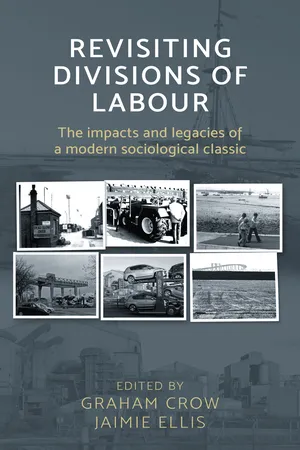
Revisiting divisions of labour is a reflection on the making of a modern sociological classic text and its enduring influence on the discipline and beyond. Ray Pahl's 1984 book is distinctive in the sustained impact it has had on how sociologists think about, research and report on the changing nature of work and domestic life. In this timely revisiting of a landmark project, excerpts from the original are interspersed with contributions from leading researchers reflecting on the book and its effects in the ensuing three decades. The book will be of interest to researchers, students and lecturers in sociology and related disciplines.
Information
Publisher
Manchester University PressYear
2017Print ISBN
9781526107442
9781526107435
eBook ISBN
9781526116246
3 From the Isle of Sheppey to the wider world
Claire Wallace
I became involved in Ray Pahl’s ‘Sheppey project’ (as it became known) in 1978. When I had completed my finals at the University of Kent, but did not yet know the results, I was encouraged to apply for a Social Science Research Council (now Economic and Social Research Council) studentship to do a PhD. At that stage I had not thought of doing a further degree and was at a loss as to how to proceed. I was told to ‘go and talk to Ray Pahl – he is doing something interesting’ and a long collaboration started from this encounter.
Ray Pahl was just at the start of his fieldwork in Sheppey and had asked school students to write essays about how they saw their future. This novel research approach had in fact first been used by Marie Jahoda and colleagues in their study of Marienthal – a small town stricken by mass unemployment in the 1930s (Jahoda et al. 2002). The school students saw their lives in fairly conventional ways – growing up, getting married, having children – where problems of unemployment were bypassed in their projections of a more rosy future. Since unemployment had been historically low in the decades leading up to the 1970s, the 1930s was the only obvious point of comparison. Ray Pahl saw Sheppey as his ‘post-industrial laboratory’ where these trends were being relived and hoped to find pointers to the consequences in more recent times. The prospect of growing up without work faced young people on Sheppey. The prospect of trying to understand this faced me as I embarked on my PhD thesis, which later became a book with the title echoing Ray Pahl’s original article For Richer, For Poorer: Growing Up In and Out of Work (Wallace 1987). Ray Pahl’s instincts as to future trends were correct and mass unemployment consequent on deindustrialisation soon confronted large parts of the UK, especially the traditional industrial areas, as well as other areas of Europe and the USA. It was a watershed in British ways of work, which had hitherto focused on the industrial work of men. This is why understanding changing patterns of work was so important at that time.
The ‘Sheppey project’ expanded into a more ambitious and systematic study when Ray Pahl won a Social Science Research Council grant on which I was employed as research fellow. Influenced by the ideas of Jay Gershuny (explained in more detail elsewhere in this book), the project involved a large-scale survey with in-depth interviews of sub-groups from the survey and was made public through a series of articles culminating in the book: Divisions of Labour. All of these sources were later deposited at the University of Essex archives for both qualitative and quantitative data, providing a rich source of material for future researchers. I have been slightly disturbed (but also honoured) to find out that my early forays into social research have been documented by others as an aspect of social history.
The research team at this point were housed in a property in Delamark Road purchased by Ray Pahl and offering a base from which to operate. The team consisted of PhD students Frances Evans and Bill Gourlay in addition to myself, all looking at different aspects of changing work patterns. Although this was practical in terms of accommodation (my previous lodgings on Sheppey had brought me into the edge of the criminal underworld), it did not turn out to be the happy intellectual community that had been hoped. Ray Pahl’s role as landlord as well as project leader caused some controversy; Bill Gourlay dropped out and Frances Evans completed her PhD and went on to do other things. The overlapping and complicated divisions of labour implied by this ersatz household provoked and perhaps illustrated some of the difficulties of this approach.
One of the key concepts developed in Divisions of Labour is that of the ‘household work strategy’ and one of the key ways in which it was demonstrated in the book was through the evolution of women’s work. Hitherto the focus had been on the male head of household as determining the labour market and social position of the family. Both social policies and sociologists subscribed to this fallacy even at a time when the rise in married women’s labour force participation was striking and unprecedented in the post-war era, as Pahl noted (1984: 79). The refocus on household work strategies was a challenge to this conventional view and helped set the scene for a wider vision of male and female economic activity deriving from a more historical viewpoint. Hence, Pahl saw that we could better understand the future by first understanding the past.
The concept of the ‘household work strategy’ was based on the idea of a household negotiating the division of labour and securing sources of income as a collective unit. The concept of household was an improvement on that of family, recognising the complex ways in which households could be composed at any point in time (which might include lodgers, servants, various family members, dependent children and independent children, grandchildren, couples which may or may not be married, heterosexual and non-heterosexual relationships – not to speak of the domestic lives of researchers). In practice, Ray Pahl focused entirely on heterosexual couples and the more standard family (which was also the most common form of household at the time), but the concept nevertheless opened up new possibilities for understanding intimate relationships and their economic dimensions. The rise of single parent and a variety of other kinds of household arrangements was not acknowledged to the extent that it might have been and has been highlighted by subsequent scholarship. Work was also a broadened concept encompassing not just conventional waged employment but also domestic and childrearing work, work in the informal economy, work for friends and neighbours on a reciprocal or friendly basis, work for NGOs and charities, and so on. Pahl was a pioneer in putting all these kinds of work together into a complex whole drawn together by the idea of a household work strategy. The more emotional aspects of contemporary household relationships later developed by other authors was eschewed in favour of an economic anthropology perspective (Giddens 1991; Beck and Beck-Gernsheim 1995; Jamieson 1998). Ray Pahl’s links to anthropology were developed through the linking of the departments of Social Anthropology and Sociology at the University of Kent.
Nevertheless, this was a breakthrough. Feminists had fought to have domestic or ‘reproductive’ work recognised as an aspect of contemporary life because it had generally been ignored by sociologists and the mass public. Ray’s partner Jan Pahl was an important conduit for this feminist flow of ideas as she brought her own lens to bear on household relationships in a separate project through the domestic division of money (Pahl, J. 1989), having previously published on domestic violence as well as the earlier jointly authored Managers and their Wives (Pahl and Pahl 1971).
Ray Pahl took this on board and transformed it into a more complex analysis of domestic relationships encompassing all forms of work from washing up to reconstructing a house. The whole dimension of hidden labour in the activities of daily life, which were previously seen as trivial, were brought out for sociological scrutiny (Glucksman 1995). Finally, the idea of ‘strategy’ encompassed the way in which different household members fitted together their various contributions and portfolio of working activities to ‘get by’. It assumed a rational renegotiation of income, relationships and activities. It was a clever idea, building on the thinking of others such as Sandra Wallman, which would have influence well beyond the Isle of Sheppey at the time he was writing (Crow 1989; Wallace 2002). Whether these kinds of activities added up to a rational negotiation between partners is controversial and is perhaps challenged as well as illustrated by the case study of Linda and Jim described later in this book.
Ray Pahl’s aim in developing this idea was to challenge the fixation on conventional waged employment – or the lack of it – which had been a preoccupation of the 1970s for social scientists and policy-makers alike. In chapter 3 he reviews a wealth of literature going back a couple of centuries to show that cobbling together a complex portfolio of economic activities had always been the way in which households managed their fluctuating fortunes in the face of personal and historical change. The historical approach drew on a wealth of work, such as that of Tamara Hareven looking at the intersections of Family Time and Industrial Time across the western world, which was emerging at that time as a new way of appreciating historical change. Hareven’s book was set in the USA (Hareven 1982). Reliance on waged employment, Pahl argued, had become the norm in the West over only a few decades in the twentieth century and people had adapted reluctantly. So modern Sheppey families were reflecting what had happened over a longer time scale (the case study of Linda and Jim illustrates this) but were also pointing the way towards the new era of ‘getting by’ with a variety of sources and activities, only some of which might be full-time waged employment. In principle, this could mean that if men lost their jobs, women could take over as breadwinners and men could move into the home through what had been called a ‘revolving door’ (Young and Willmott 1973). But how flexible were households really?
Chapter 10 of Pahl’s book, which focuses quantitatively on on the domestic division of labour within households in the present, illustrates that the gendered interchange of work which rational choices would predict, does not in fact happen. Women were still mainly responsible for domestic work, especially when children were small, and the impact of men’s contribution was negligible. ‘It should be emphasized that, while employment status affects who does the task more than any other single variable, nevertheless, women being employed full-time or men being unemployed do not, as single variables, produce any significant shift away from the likelihood that the woman would do the task’ (Pahl 1984: 270). In fact, hardly any of the usual variables made any difference. Neither class, nor politics nor other aspects of the work of households made much impact. The domestic division of labour remained stubbornly female-centred whatever the external conditions.
Although this was hotly debated, this remains the case in subsequent, much larger and even in international studies (see for example the work of Jackie O’Reilly using large cross-national data sets; O’Reilly et al. 2008). The only variable that had any significant impact on the gendered division of labour was whether women were employed full-time, part-time or not at all. The more they were employed in the labour market, the more likely it was that tasks were shared or devolved. ‘The domestic division of labour is related directly to the economic activity of the female partner, the ages of the partners and their stage in the domestic cycle and to not much else’ (Pahl 1984: 274). Even the ages of the partners reflected not so much a generational shift in values as the fact that the number and nature of tasks changed as people got older. One problem is that it is not clear how the direction of causality flowed in this analysis. Does bringing in an income allow women to assert themselves more in the domestic relations or does the presence of a more equal partnership allow women the opportunity to seek out and take up paid work? The results were at first rather a disappointment to the proponent of the household strategy approach: why did households not change? However, it did lead to new insights and theories.
Women were moving increasingly into paid employment as a normal extension of their roles. How can we account for the apparent lack of change in the traditional household division of labour? Some have called it the ‘stalled revolution’ (Hochschild 1989) and perhaps it illustrates the limitations of the view that the division of labour could be a rational calculation as economists (such as Gary Becker) often assumed (Becker 1965). Jay Gershuny, working with larger, comparative longitudinal data sets, argues that this could also be seen as ‘lagged adaptation’ as women enter the workforce in greater numbers and for longer hours but value change takes place over a longer period – for men (Gershuny et al. 2005). Although men might be responsible for various household chores such as fixing the car or mowing the lawn...
Table of contents
- Cover
- Half Title
- Title Page
- Copyright
- Contents
- List of images
- List of contributors
- Acknowledgements
- Introduction – Graham Crow and Jaimie Ellis
- Excerpts from Divisions of Labour, chapters 6 and 7
- Excerpts from Divisions of Labour, chapters 8 and 9
- Excerpts from Divisions of Labour, Part I
- Excerpts from Divisions of Labour, chapter 11
- Excerpts from Divisions of Labour, chapter 12
- Afterword – Mike Savage
- References
- Index
Trusted by 375,005 students
Access to over 1.5 million titles for a fair monthly price.
Study more efficiently using our study tools.
Frequently asked questions
Yes, you can cancel anytime from the Subscription tab in your account settings on the Perlego website. Your subscription will stay active until the end of your current billing period. Learn how to cancel your subscription
No, books cannot be downloaded as external files, such as PDFs, for use outside of Perlego. However, you can download books within the Perlego app for offline reading on mobile or tablet. Learn how to download books offline
Perlego offers two plans: Essential and Complete
- Essential is ideal for learners and professionals who enjoy exploring a wide range of subjects. Access the Essential Library with 800,000+ trusted titles and best-sellers across business, personal growth, and the humanities. Includes unlimited reading time and Standard Read Aloud voice.
- Complete: Perfect for advanced learners and researchers needing full, unrestricted access. Unlock 1.5M+ books across hundreds of subjects, including academic and specialized titles. The Complete Plan also includes advanced features like Premium Read Aloud and Research Assistant.
We are an online textbook subscription service, where you can get access to an entire online library for less than the price of a single book per month. With over 1.5 million books across 990+ topics, we’ve got you covered! Learn about our mission
Look out for the read-aloud symbol on your next book to see if you can listen to it. The read-aloud tool reads text aloud for you, highlighting the text as it is being read. You can pause it, speed it up and slow it down. Learn more about Read Aloud
Yes! You can use the Perlego app on both iOS and Android devices to read anytime, anywhere — even offline. Perfect for commutes or when you’re on the go.
Please note we cannot support devices running on iOS 13 and Android 7 or earlier. Learn more about using the app
Please note we cannot support devices running on iOS 13 and Android 7 or earlier. Learn more about using the app
Yes, you can access Revisiting <i> Divisions of Labour </i> by Graham Crow,Jaimie Ellis, Graham Crow, Jaimie Ellis in PDF and/or ePUB format, as well as other popular books in Social Sciences & 20th Century History. We have over 1.5 million books available in our catalogue for you to explore.