Providing the first evidenced-based global estimates of the many scientific, economic, policy, and capacity development impacts of livestock research in and for developing countries. This volume is an indispensable guide and reference for veterinarians, animal and forage scientists, and anyone working for the equitable and sustainable development of the world's poorer agricultural economies.Livestock is one the fastest growing agricultural sectors, with most growth occurring in developing countries. For more than four and a half decades one global centre has been mandated to conduct research on leveraging the benefits and mitigating the costs of livestock production in poor countries. This book focuses on the achievements and impacts of the International Livestock Research Institute (ILRI) and its predecessors, the International Livestock Centre for Africa (ILCA) and the International Laboratory for Research on Animal Diseases (ILRAD). The scientific and economic impacts of tropical livestock research detailed in this work reveal valuable lessons for reducing world hunger, poverty and environmental degradation. Describing the impacts of smallholder livestock systems on the global environment, the book also covers animal genetics, production, health and disease control, and livestock-related land management, public policy, and economics, all with useful pointers for future livestock-for-development research.
eBook - ePub
The Impact of the International Livestock Research Institute
- 688 pages
- English
- ePUB (mobile friendly)
- Available on iOS & Android
eBook - ePub
The Impact of the International Livestock Research Institute
About this book
Information
Topic
MedicineSubtopic
Veterinary MedicinePreface to Part I: Research Spending and Publications on Animal Genetics, Production and Health

This preface first reviews the estimated spending in the principal fields corresponding to the ten chapters in the domains of animal genetics, production, and health. It then sketches ‘scientific impact’ as a function of publications and citations of the International Livestock Centre for Africa (ILCA), International Laboratory for Research on Animal Diseases (ILRAD) and International Livestock Research Institute (ILRI) extracted from the Scopus and Google Scholar databases using search keywords relevant to the four fields (Aria and Cuccurullo, 2017).
Research Spending
Data from the financial and annual reports of ILCA, ILRAD and ILRI were used to compile a spending database for 1975–2018. Current spending for each year and institution was assigned to scientific domains using spending detail by project, by scientists’ fields of expertise and, sporadically, from cost accounting by the institutions. Current annual spending in US$ was converted to constant annual spending in 2015 US$ using the global manufacturers’ unit value (MUV) index.
ILRI and its predecessors, ILCA and ILRAD, made major investments in animal health and genetics (Fig. PI.1)1. ILCA and ILRAD scientists working on animal genetics, production and health of all types – notably trypanosomiasis, trypanotolerance, theileriosis, most commonly known as East Coast fever (ECF), intestinal parasites and, recently, transboundary diseases – committed real spending on animal genetics, production and health of some US$334 million (in 2015 US$) in the 20 years before ILRI, or 50% of the total of the two predecessors to ILRI. Lifetime spending (1975–2018) on animal health and genetics was some US$676 million, or roughly 39% of the total of US$1.75 billion. The mean of real annual spending over the lifetime of ILCA/ILRAD/ILRI was roughly US$15 million. The shares of spending on animal genetics, production and health fell after the mid-1990s; during the period 2011–2018, this share was 42% of the 2011–2018 total of US$529 million as ILRI diversified into other research domains.
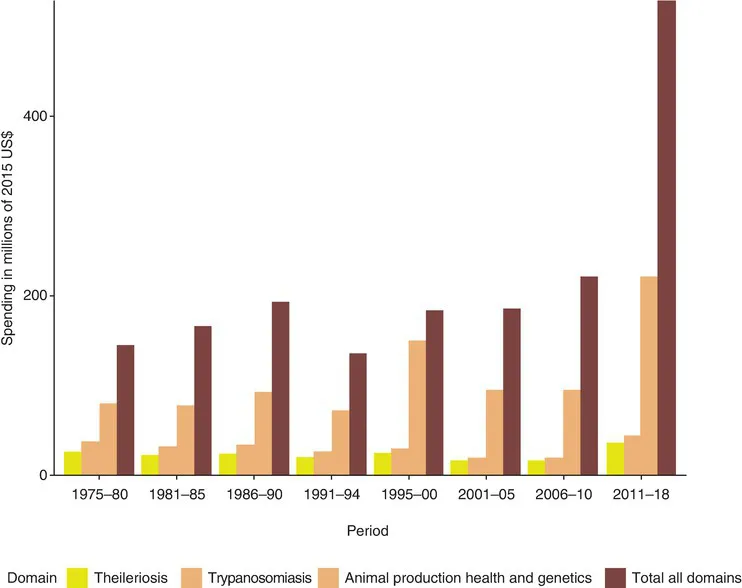
Fig. PI.1. The decreasing importance of ILRI spending on theileriosis and trypanosomiasis, 1975–2018. Data from ILRI Annual Reports and Financial Reports, various years. Total, all domains spending (1975–2018) of US$1753.3 million, in 2015 US$ millions.
Trypanosomiasis
The closest estimate we can make of trypanosomiasis spending is US$234 million (US$5.3 million annually), which is approximately 13% of the total from 1975 to 2018. A paper in the trypanosomiasis field cost about US$334,000 and generated about 77 citations per US$ million. The mean number of citations per trypanosomiasis paper was 26, the median was 15, and the top ten individual papers generated 19% of all citations of ILRI papers in that field (Fig. PI.2a, b). Most ILRI papers (1975–2018) had few citations; for example, 85% had fewer than 41 citations, a share similar to that of global papers on the subject (87%). Trypanosomiasis papers were 16% of all ILRI papers and 17% of all citations. A coarse estimate of ILRI’s lifetime contributions to research on animal trypanosomiasis, including work on the tsetse fly vector, is roughly 7% of global papers and 8% of global citations. It is notable that ILRAD and the International Trypanotolerance Centre (ITC) created the modern field of trypanotolerance research, which had been neglected before the creation of ILRAD (Fig. PI.2c); ILRI and its two predecessors contributed 68% of global papers and 91% of global citations in this field (see Chapters 2–5, this volume).
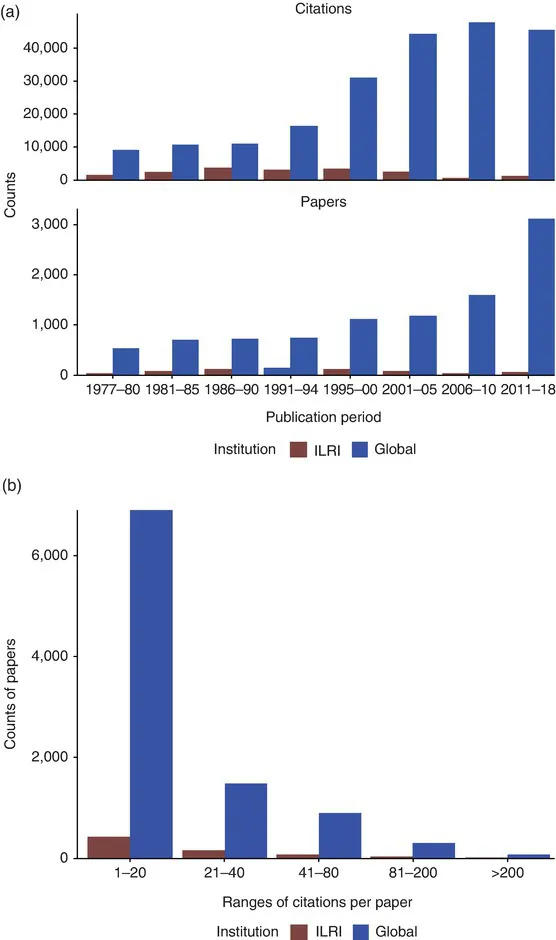
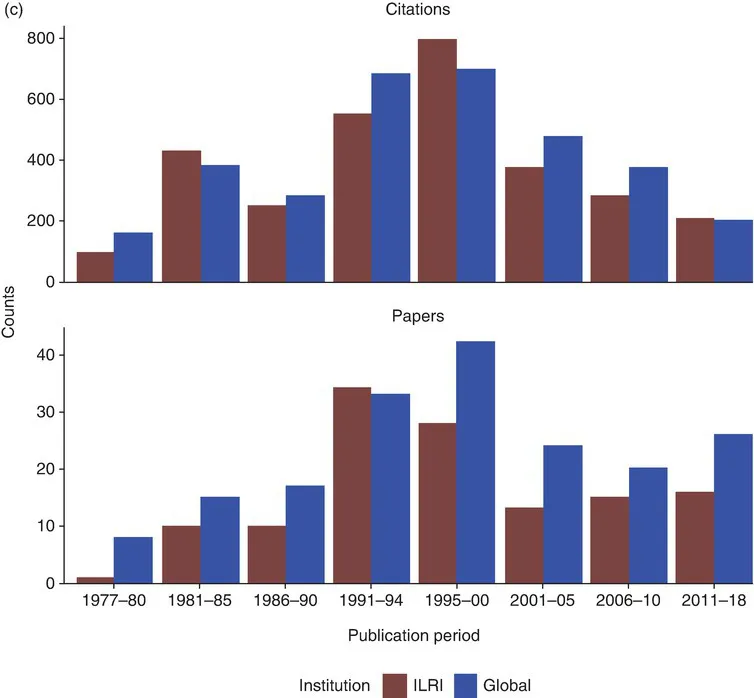
Fig. PI.2. (a) The decreasing ILRI share of global publications on trypanosomiasis, 1977–2018. ILRI sample = 691 papers; global sample = 9,681 papers. (b) Frequency of citations of ILRI and global publications on trypanosomiasis, 1977–2018. Merged ILRI and global sample size = 10,372 papers. (c) Domination of the field of trypanotolerance by ILRI papers, 1977–2018. ILRI sample = 127 papers; global sample = 185 papers. (Data from www.scopus.com/.)
The major papers on trypanosomiasis are older and tend to report advances in methods and in understanding of the basic mechanisms of trypanosomiasis. Highlights include the work of Hirumi and Hirumi (1989) on cultivation in vitro of Trypanosoma brucei, of Murray et al. (1977) and Paris et al. (1982) on diagnostic techniques, of Murray et al. (1982) on host susceptibility and trypanotolerance, and of Baldwin et al. (1986) and Clevers et al. (1990) on bovine immunology. Subsequent work focused on estimating the economic burden of trypanosomiasis, on control methods, on understanding and managing trypanotolerance, on projecting the future of the disease. Swallow’s (2000) review of trypanosomiasis and African agriculture illustrated the difficulties of estimating the impacts of this disease by summarizing the variability in such basic parameters as morbidity, mortality and calving rates associated with trypanosomiasis. The model of Reid et al. (2000) projected that the tsetse fly vector would continue to cover wide areas of sub-Saharan Africa at least until 2040 despite dramatically higher rural population density and cropping intensity. The field work reported in Chapters 2 and 3 showed the difficulty of managing trypanosomiasis by controlling vectors with insecticides and by treating infected animals with drugs in the absence of a vaccine.
Theileriosis
The closest estimate we can make of theileriosis spending in the total is US$181 million (US$4.1 million annually), which is approximately 10% of the 1975–2018 total. A paper in the ECF field cost about US$384,000 and generated about 64 citations per US$ million. The mean number of citations per ECF paper was 25, and the median was 14 (Fig. PI.3a, b). ECF papers were 11% of all ILRI papers and 11% of all citations of ILRI papers. The top ten papers generated 16% of all ILRI papers in the field of ECF. A coarse estimate of ILRI’s lifetime contributions to theileriosis research, including work on the tick vector, is roughly 13% of global theileriosis papers and 19% of global theileriosis citations.
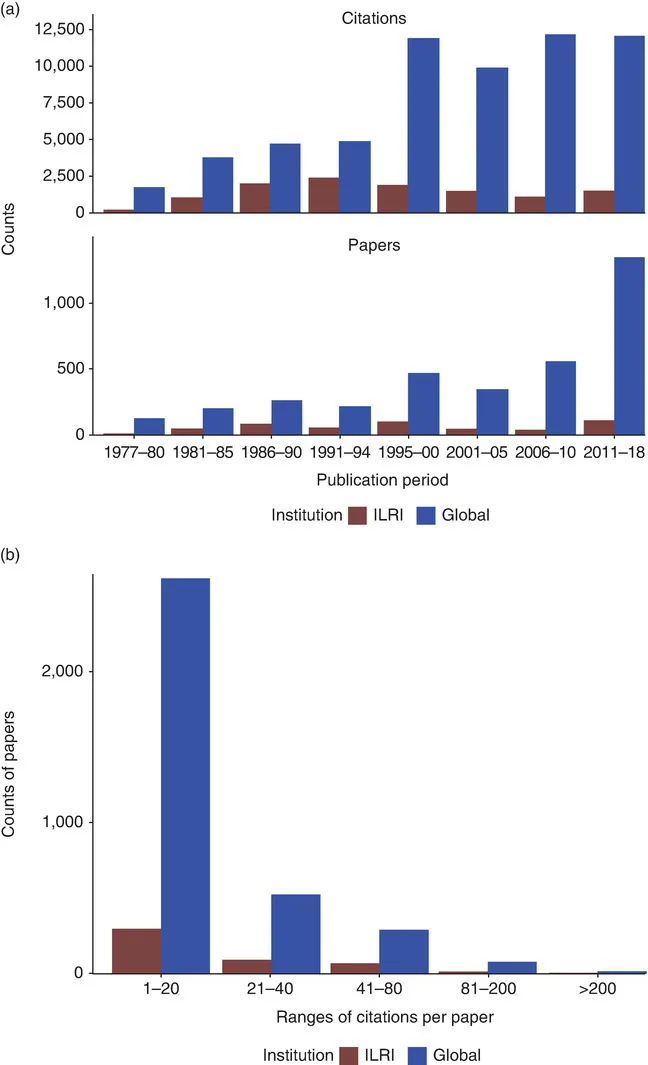
Fig. PI.3. (a) ILRI and other publications on theileriosis and related problems, 1977–2018. ILRI sample = 471 papers; global sample = 3510 papers. (b) Frequency of citations of ILRI and other publications on theileriosis and related problems, 1977–2018. Merged ILRI and global sample size = 3,981 papers. (Data from www.scopus.com/.)
Most of the major epidemiology (e.g. Norval et al., 1992, and the work cited in Chapters 5 and 6, this volume) involved the study of Theileria parva. Notable advances were made in elucidating the genetics of Theileria spp., leading eventually to the sequencing of T. parva (Gardner et al., 2005) and of T. annulata (Pain et al., 2005). A particular innovation in ILRAD/ILRI epidemiology on theileriosis was the initial development of bioeconomic models of ECF (Mukhebi et al., 1992), integrating field data collection into geographic information systems (GIS) data derived from remote sensing and other sources.
Immunology
Spending on immunology cannot be clearly distinguished from other fields given that it was always integrated into trypanosomiasis and ECF investigations and given that ILRAD/ILRI scientists worked across disciplines. ILRI produced 894 papers on some aspect of immunology, with a mean number of citations per paper of 23 and a median of 14 (Fig. PI.4a, b). Immunology papers were 20% of lifetime ILRI papers and 20% of citations. The top ten ILRI immunology papers produced 10% of ILRI lifetime citations in immunology. A rough estimate of ILRI’s lifetime contributions to research on immunology involving human and animal trypanosomiasis and theileriosis is roughly 20% of global papers and 24% of global citations.
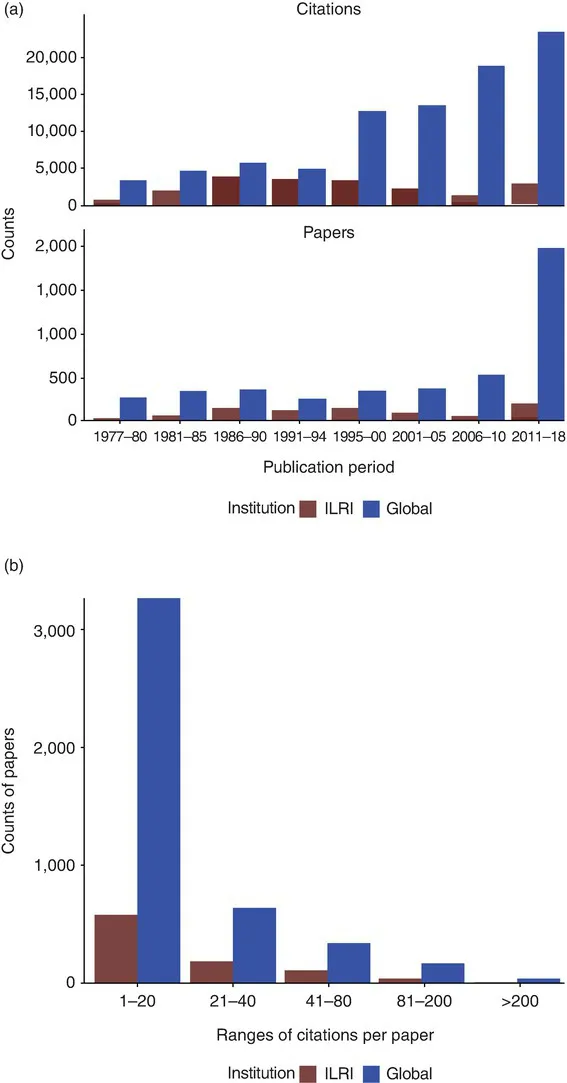
Fig. PI.4. (a) The domination of ILRI papers in global livestock immunology until recently, 1977–2018. ILRI sample = 894 papers; global sample = 4,428 papers. (b) Frequency of citations of ILRI and other publications in immunology, 1977–2018. Merged ILRI and global sample size = 5,322 papers. (Data from www.scopus.com/.)
The failure to develop an effective vaccine against trypanosomiasis should not prevent recognition of the wide scientific impact of the immunology and immunoparasitology work of ILRAD in its 20 years of life (see Chapter 4, this volume). Although the contribution of published ILRI work to the global effort on animal immunology has weakened noticeably after the mid-1990s, as immunology became a lower priority in the views of ILRI management, those earlier contributions remain important to this day.
Genetics, food safety, transboundary diseases and zoonoses
Spending on the wide domain including animal genetics, food safety, transboundary diseases and zoonoses cannot be quantified accurately. The closest estimate we can make of spending on animal genetics, production and health other than projects clearly labelled as ‘trypanosomiasis’ or ‘theileriosis’ is US$261 million (US$6 million annually), which is approximately 15% of the 1975–2018 total. We created an ‘other problems’ category with keywords for ‘zoonoses’, ‘food safety’, ‘Rift Valley fever’, ‘African swine fever’, ‘peste des petits ruminants’ and for several mycoplasmas. The mean of citations per ‘other problems’ paper was 25 and the median was ten. ‘Other problems’ papers were 29% of all ILRI papers and 26% of all ILRI citations (Fig. PI.5, b).
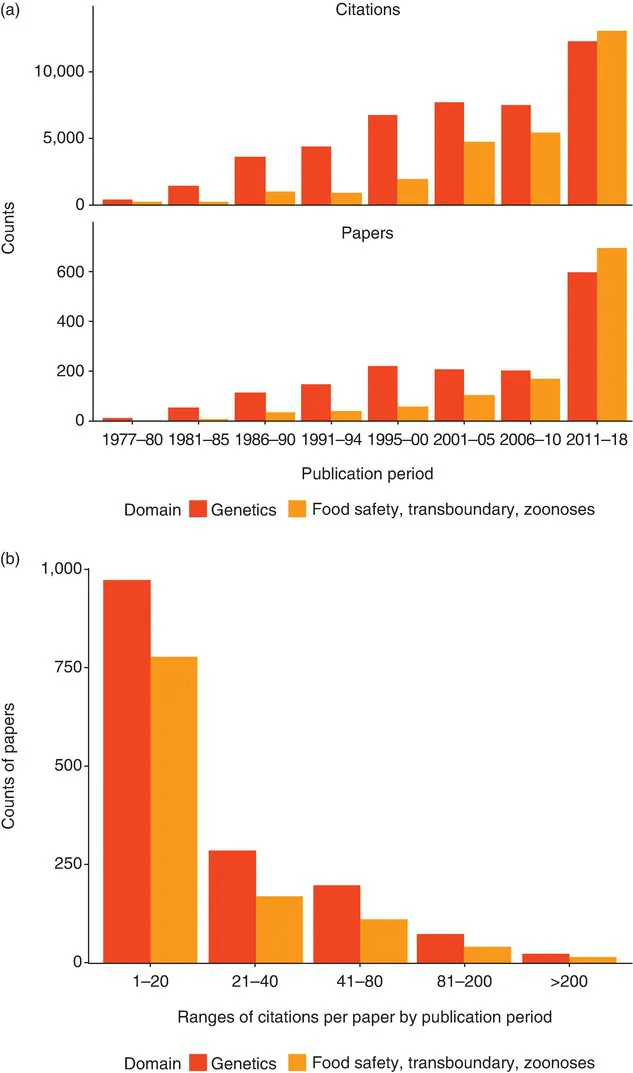
Fig. PI.5. (a) The rapid increase in ILRI papers on animal genetics, food safety, transboundary diseases, zoonoses after the ILCA/ILRAD merger, 1977–2018. Genetics sample = 1,544 papers; food safety, transboundary, zoonoses = 1,108 papers. (b) Frequency of citations of ILRI publication on animal genetics, food safety, transboundary diseases and zoonoses, 1977–2018. Merged sample size = 2,652 papers. (Data from www.scopus.com/.)
The keywords for the genetics field were limited to recent terminology because of the obvious possibility of including practically all papers based on laboratory work. For example, the keyword ‘sequencing’ in the context of DNA/RNA analysis appears in fewer than 20 papers before the year 2000 but appears frequently after that year. Given the explosive growth in modern genetics, we decided not to estimate a share of ILRI papers in global publications, but it would evidently be quite small given the modest research investment made by ILRI over its lifetime in the genetics subfield. Despite contributing a small share of global publications in animal genetics, ILRI has several landmark papers in that domain, as shown in Chapter 1 (this volume), notably on the history and structure of the bovine genome and on the genetics of trypanotolerance. Swine and poultry genetics have only become more important at ILRI over the past decade, following with a long lag the addition of pigs and poultry to ILRI’s mandate in 1995.
The remarkable expansion of ILRI’s work on food safety, zoonoses and transboundary diseases in this century, as shown by the spending and bibliometrics data, has not produced a measurable economic rate of return, but it is likely that it will do so soon (see Chapters 7–9, this volume).
One measure of major ILRI scientific contribu...
Table of contents
- Cover
- Half Title
- Title
- Copyright
- Contents
- Foreword: Peter Doherty, ILRI patron
- Preface: A Note from ILRI Director General Jimmy Smith
- Acknowledgements
- Maps
- List of Figures
- List of Tables
- List of Boxes
- List of Abbreviations
- List of Contributors
- Introduction: The Evolution of IARC Livestock Research, 1975–2018
- Part I. Animal Genetics, Production and Health
- Part II. Primary Production
- Part III. Tropical Livestock Systems
- Conclusion: The Future of Research at ILRI
- Appendix 1: CIAT and ICARDA Livestock Research
- Index
- Back
Trusted by 375,005 students
Access to over 1.5 million titles for a fair monthly price.
Study more efficiently using our study tools.
Frequently asked questions
Yes, you can cancel anytime from the Subscription tab in your account settings on the Perlego website. Your subscription will stay active until the end of your current billing period. Learn how to cancel your subscription
No, books cannot be downloaded as external files, such as PDFs, for use outside of Perlego. However, you can download books within the Perlego app for offline reading on mobile or tablet. Learn how to download books offline
Perlego offers two plans: Essential and Complete
- Essential is ideal for learners and professionals who enjoy exploring a wide range of subjects. Access the Essential Library with 800,000+ trusted titles and best-sellers across business, personal growth, and the humanities. Includes unlimited reading time and Standard Read Aloud voice.
- Complete: Perfect for advanced learners and researchers needing full, unrestricted access. Unlock 1.5M+ books across hundreds of subjects, including academic and specialized titles. The Complete Plan also includes advanced features like Premium Read Aloud and Research Assistant.
We are an online textbook subscription service, where you can get access to an entire online library for less than the price of a single book per month. With over 1.5 million books across 990+ topics, we’ve got you covered! Learn about our mission
Look out for the read-aloud symbol on your next book to see if you can listen to it. The read-aloud tool reads text aloud for you, highlighting the text as it is being read. You can pause it, speed it up and slow it down. Learn more about Read Aloud
Yes! You can use the Perlego app on both iOS and Android devices to read anytime, anywhere — even offline. Perfect for commutes or when you’re on the go.
Please note we cannot support devices running on iOS 13 and Android 7 or earlier. Learn more about using the app
Please note we cannot support devices running on iOS 13 and Android 7 or earlier. Learn more about using the app
Yes, you can access The Impact of the International Livestock Research Institute by John McIntire,Delia Grace, John McIntire, Delia Grace in PDF and/or ePUB format, as well as other popular books in Medicine & Veterinary Medicine. We have over 1.5 million books available in our catalogue for you to explore.