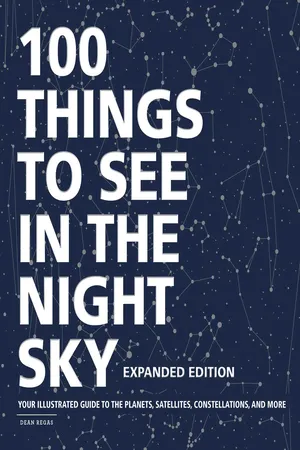
100 Things to See in the Night Sky, Expanded Edition
eBook - ePub

100 Things to See in the Night Sky, Expanded Edition

Your Illustrated Guide to the Planets, Satellites, Constellations, and More

  1. 256 pages
  2. English
  3. ePUB (mobile friendly)
  4. Available on iOS & Android
eBook - ePub

100 Things to See in the Night Sky, Expanded Edition

Your Illustrated Guide to the Planets, Satellites, Constellations, and More

About this book

Discover the amazing wonders of the night sky with this expanded edition to 100 Things to See in the Night Sky, perfect for every amateur stargazer and armchair astronomer!

Keep your feet on the ground and experience the night sky to the fullest by exploring planets, satellites, and constellations with this all-inclusive reference guide to space. 100 Things to See in the Night Sky, Expanded Edition is full of information on the many amazing things you can see with a telescope, or just your naked eye!

From shooting stars to constellations and planets to satellites, this book gives you a clear picture of what you can see on any given night. Learn about the celestial bodies that have captured people’s imaginations for centuries, with specific facts alongside traditional myths and beautifully illustrated photographs and star charts that will help you know where to look for the best view.

With this illuminating guide, you’ll enjoy hours of stargazing, whether you’re travelling, camping, sitting in your back yard, or simply flipping through the beautiful images in this book.
Frequently asked questions

Yes, you can cancel anytime from the Subscription tab in your account settings on the Perlego website. Your subscription will stay active until the end of your current billing period. Learn how to cancel your subscription.
No, books cannot be downloaded as external files, such as PDFs, for use outside of Perlego. However, you can download books within the Perlego app for offline reading on mobile or tablet. Learn more here.
Perlego offers two plans: Essential and Complete
  • Essential is ideal for learners and professionals who enjoy exploring a wide range of subjects. Access the Essential Library with 800,000+ trusted titles and best-sellers across business, personal growth, and the humanities. Includes unlimited reading time and Standard Read Aloud voice.
  • Complete: Perfect for advanced learners and researchers needing full, unrestricted access. Unlock 1.4M+ books across hundreds of subjects, including academic and specialized titles. The Complete Plan also includes advanced features like Premium Read Aloud and Research Assistant.
Both plans are available with monthly, semester, or annual billing cycles.
We are an online textbook subscription service, where you can get access to an entire online library for less than the price of a single book per month. With over 1 million books across 1000+ topics, we’ve got you covered! Learn more here.
Look out for the read-aloud symbol on your next book to see if you can listen to it. The read-aloud tool reads text aloud for you, highlighting the text as it is being read. You can pause it, speed it up and slow it down. Learn more here.
Yes! You can use the Perlego app on both iOS or Android devices to read anytime, anywhere — even offline. Perfect for commutes or when you’re on the go.
Please note we cannot support devices running on iOS 13 and Android 7 or earlier. Learn more about using the app.
Yes, you can access 100 Things to See in the Night Sky, Expanded Edition by Dean Regas in PDF and/or ePUB format, as well as other popular books in Physical Sciences & Astronomy & Astrophysics. We have over one million books available in our catalogue for you to explore.

Information

Part I. The Sun, Moon, and Naked-Eye Planets

01 | THE SUN

CLASSIFICATION: OUR CLOSEST STAR VISIBILITY: EASY
Images
The Sun is our nearest star (about 93 million miles from Earth) and is the major source of light and heat for all the planets, moons, and asteroids in the solar system. At roughly 865,000 miles wide, the Sun is about 1,300,000 times larger than Earth. It is so massive that it holds all of the planets in steady orbits.

SUN SAFETY

Whenever you view the Sun, think before you look. Do not look at the Sun for more than a moment unless you are 100 percent sure you are using safe and proven viewing methods. Never use common homemade filters including CDs, smoked glass, exposed film, X-ray transparencies, Pop-Tarts wrappers, or Mylar balloons. Your vision can be permanently damaged with even short periods of direct exposure to sunlight.
The best way to directly observe the Sun safely with the naked eye is by looking through either a sheet of #14 welder’s glass or specially made eclipse glasses. You can get #14 welder’s glass at welding supply stores, and several companies sell effective eclipse glasses online. Costing between $1 and $5, these items will allow you to observe the Sun’s disc, partial eclipses, and maybe even a large sunspot. If you use the welder’s glass, be sure to use only #14. That is the only shade dark enough to protect your eyesight—anything less is unsafe.
You’ll notice that the Sun seems surprisingly small in the sky when you examine it by looking through #14 welder’s glass or eclipse glasses. The Sun is humongous, but after you block out most of the surrounding glare, it looks like a tiny circle of light. After all, you are looking at the Sun from 93 million miles away! It’s not exactly close to you.
You can also take pictures of the Sun through a sheet of welder’s glass or through eclipse glasses:
  • Place the welder’s glass or eclipse glasses in front of a camera.
  • Aim the camera at the Sun and review the image on your screen.
  • Center the image, adjust the contrast, and snap away.
You’ll have pictures of the Sun!
The welder’s glass or eclipse glasses act like a filter that will reduce the glare and will protect your camera in the same way it protects your eye.

SEE FEATURES ON THE SUN

Now that you have your safe solar-viewing glasses, what can you see? To the naked eye, on a normal day, you can’t make out a lot of detail on the Sun. But sometimes you can pick out larger sunspots or, on very rare occasions, a solar eclipse.
Sunspots are darker, cooler regions on the Sun where magnetic disturbances cause stellar material to erupt from the surface. Through safe glasses, they look like tiny black blemishes on the glowing disc of the Sun. Only large sunspots can be detected with the naked eye, and finding them can be a test of your eyesight. They are more frequent during solar maximum, which is a varied period of time that occurs about every 11 years, when solar activity ramps up. But sunspots can pop up at any time, so it is always worth taking a look. If you are lucky enough to see a sunspot with the naked eye, remember that the spot is larger than Earth!
The best time to observe the Sun is during a solar eclipse. The most common eclipse is a partial solar eclipse, which is when the Moon covers only a portion of the solar disc. It looks like someone took a bite out of the Sun. Although solar eclipses occur about twice a year, they are localized events, which means each eclipse is visible only from certain areas on the globe. For any one location, you may see a solar eclipse about once every 3 to 6 years.
The best upcoming solar eclipses that will be visible from most parts of the United States will occur on:
  • October 14, 2023
  • April 8, 2024
  • January 14, 2029
Use your eclipse glasses to get a safe view of these cool alignments of Sun, Moon, and Earth and admire the fact that astronomers, after watching the heavens for centuries, can now predict them well in advance!

SEE SEVERAL SUNRISES AND SUNSETS

Even though you experience one sunset and one sunrise every day, you may not have considered the complex series of steps that happen during these events. To start, you want to look for several subtle changes around the sky in addition to the Sun.

Sunrises

For a sunrise, simply get up while it is still dark and then watch as the sky slowly brightens. While the Sun is almost ready to rise in the east, look behind you to the west. You will see a slightly darker piece of sky just above the horizon. That is Earth’s shadow. When you look back to the east again you will notice every layer of the atmosphere igniting in different warm tones. The rising but still unseen Sun turns the atmosphere closest to the horizon from deep blue to ruby red in a matter of minutes. The wind may change as the temperature rises in anticipation of the rising Sun. And then, if you have a clear view to the horizon, you will see the top of the Sun peek up above it. It will take a few minutes for the Sun to fully clear itself from the horizon, but when it does then day has broken.

Sunsets

Experiencing a sunset is just as powerful (and you don’t have to get up extra early). The play of light and darkness is reversed as you face west to see the Sun slowly set. The sky gradually turns from light to dark through every color in the rainbow. Just before sunset, turn around and face east to see the shadow of the Earth cast on the lower reaches of the atmosphere. Then face west again and bask in the final rays of sunlight as the Sun dips below the distant horizon. Night has fallen.

SENSE THE SEASONS

You may have heard that “the Sun rises in the east and sets in the west.” Well, that’s mostly accurate. If you watch several sunrises or sunsets over the course of a few months, you will notice that the Sun does not always rise or set in the same place. And you may have seen that the Sun is much higher in the sky during the summer months than it is in the winter. Observing these changes in the position of the Sun is one of the oldest astronomical practices and can be done very easily with the naked eye.
In the following diagram you can see how the Sun moves across the sky in different seasons from any location in the mid-northern latitudes.
  • On the winter solstice (the bottommost arc on the diagram) the Sun rises south of east, cuts low across the southern sky, and then sets south of west.
  • Three months later, on the spring equinox (the middle arc of the diagram), the Sun rises due east, reaches a higher altitude in the south, and sets due west. Notice that the lengths of the Sun’s arcs are different—in spring the Sun rides higher in the sky and stays visible for a much longer period of time than it does in the winter.
  • On the summer solstice (the topmost arc of the diagram) the Sun rises north of east, travels extremely high in the southern sky, and then sets north of west. This is called the longest day because you experience the most minutes of daylight and the least amount of darkness for the year.
Sketch what you see along the horizon; note and date the changes throughout the year. You will quickly learn that we need to modify the rule to instead read, “The Sun rises east-ish and sets west-ish.”
Image

02 | THE MOON

CLASSIFICATION: EARTH’S NATURAL SATELLITE VISIBILITY: EASY
Images
For thousands of years our ancestors have gazed up at the silvery glow of the Moon and tried to make sense of its rhythm and aura. What are the dark and light portions of the Moon? What’s a Harvest Moon? And why does the Moon change shape and size? Memorialized in literature, song, and dance since the dawn of time, the Moon tugs at our romantic nature and inspires our soul.
The Moon is our closest neighbor in space: a ball of rock 2,159 miles in diameter that circles Earth from a distance of about 240,000 miles. It is the easiest and most dynamic object in the sky to view with the naked eye. Not only can you observe the Moon in the night sky during parts of each month, you can often catch sight of it during the daytime. It changes positions from night to night and rises and sets in different places regularly. And for a few days each month, you can’t see it at all.

OBSERVE THE PHASES OF THE MOON

You’ve noticed that the Moon doesn’t look the same every time you look up into the night sky. Each night, it goes through a different phase. The chart on this page illustrates these phases. So what causes all these shapes? The answer is light! The Moon generates no light of its own—it shines with reflected sunlight. Light travels 93 million miles from the Sun, bounces off the surface of the Moon, and then travels another 240,000 miles to reach your eyes. The phase you see depends on where the Moon is in its orbit around Earth. When the Moon is between the Sun and Earth the only part of the Moon that is lit faces the Sun. This is the New Moon phase, and from Earth the Moon appears completely dark. When the Sun, Moon, and Earth form a right angle, you will see only half of the Moon lit (that happens at first and last quarter). And when the Moon is on the opposite side of Earth with respect to the Sun, you will see the entire Moon illuminated. That’s a Full Moon.
It takes the Moon about 29.5 days to go through its entire cycle of phases, and so every night the Moon’s phase changes slightly as different parts of the lunar surface are lit by the Sun, while others plunge into darkness.
Some people incorrectly believe that the phases of the Moon are caused by Earth casting a shadow on it. That makes sense when you see a crescent Moon, but how can a round Earth create a straight-line shadow like with a first quarter Moon, or the curve on a gibbous Moon? Earth can’t make those phases of the Moon that you can see all month.
Observe the Moon every clear night during a month and check out not only how the phase changes but how its location in the sky and time that it is visible changes. Remember, to complete its orbit, each night the Moon moves about one-twenty-ninth the way around Earth. So it will appear to shift farther to the east 12–14 degrees from night to night. Although that’s just a little larger than the width of your fist at arm’s length, the shift is fast (astronomically speaking). This motion of the Moon around Earth also causes the Moon to rise about 50 minutes later each night. That time varies depending on the season and the phase of the Moon, but test it out. Make a Moon journal and sketch the position of the Moon every day at the same time. Soon you may be able to predict where and when the Moon will travel in the future.
Image

DRINK IN SOME EARTHSHINE

Have you ever looked at a crescent Moon and noticed that the dark part of the Moon looks like a faintly glowing, gray ball? This effect is caused by earthshine, where the light of the Sun shines on the Earth and reflects up on the Moon. Earthshine brightens the Moon enough so that you can see all of it against the darkness of the sky. Look for this effect during either a waxing crescent Moon (visible just after sunset) or a waning crescent Moon (visible just before sunrise).

EXPERIENCE THE MOON ILLUSION

Have you notic...

Table of contents

  1. Cover
  2. Title Page
  3. Introduction
  4. How to Use This Book
  5. Part I. The Sun, Moon, and Naked-Eye Planets
  6. Part II. Stars and Constellations
  7. Part III. Beyond Stargazing
  8. About the Author
  9. Index
  10. Copyright