Our ever-increasing dependence on electricity demands improvements in the quality of its supply. The deregulation of electric (and other) utilities, the events of 9/11, and the blackouts in North America, London, and the Italian peninsula evidence this need. This book looks at our current transmission systems and how loop circuits can substantially improve the reliability of transmission lines, essentially to provide a two-way feed to the consumer and insuring continuity of service if a fault develops on the circuit. It also covers distribution systems and includes information on how small generating units can be connected directly to the distribution system in the same manner as in larger cogenerating units.
- 400 pages
- English
- ePUB (mobile friendly)
- Available on iOS & Android
eBook - ePub
Power Transmission & Distribution, Second Edition
About this book
Information
Chapter 1
Introduction, Consumer Characteristics
INTRODUCTION
The system of delivery of electricity to consumers parallels that of most other commodities. From the generating or manufacturing plant, this product is usually delivered in wholesale quantities or via transmission facilities to transmission substations that may be compared to regional warehouses. From there, the products may (or may not necessarily) be further shipped to jobbers over subtransmission lines to distribution substations or local depots. The final journey delivers these products to retailers via distribution systems that supply individual consumers. One important difference in this comparison is the lack of storage capability (for practical purposes) of electricity; every unit of electricity consumed at any moment must be generated at that same moment. A diagram of an electric utility system indicating the division of operations is shown in Figure 1-1. This work concerns the transmission and distribution elements.
Just as many of the larger manufacturing companies began as small enterprises, so, too, did many of the electric utilities. The first commercial electric system was constructed and placed in operation in 1882 by Thomas Alva Edison in New York City. It was a direct current system that served a limited number of consumers in the vicinity of the plant at a nominal voltage of 100 volts. A number of other small systems (also direct current) in urban and suburban areas were supplied from the generating facilities of manufacturing factories. From these maverick systems that, in some instances, grew like Topsy without planning, the large utility systems were to be formed. Interestingly, almost a century later, privately owned generating facilities of industrial and commercial companies were once again to exercise that same function. The sale of their excess energy through electrical connections to utility companies’ transmission and distribution systems is referred to as “cogeneration,” and will be discussed more fully later in this work.
The invention of the transformer in 1883 in England by John Gibbs and Lucien Gaullard, together with the invention of the alternating current induction motor and the development of polyphase circuitry in 1886 by Professor Galileo Ferraris in Turin, opened the way for the adoption of alternating current and the rapid expansion of electrical transmission and distribution systems. Transmission of electric power dates from 1886 when a line was built at Cerchi, near the city of Turin in Italy, to transmit some 100 kilowatts 30 kilometers, employing transformers, to raise and lower a 100 volt source to 2000 volts and back to 100 volts for utilization. In the same year, the first alternating current distribution system in the United States, also using transformers, was put into operation at Great Barrington in Massachusetts: the 100 volt system included two 50 light and four 25 light transformers serving 13 stores, 2 hotels, 3 doctors’ offices, a barber shop, telephone exchange and post office from a 500 volt source.
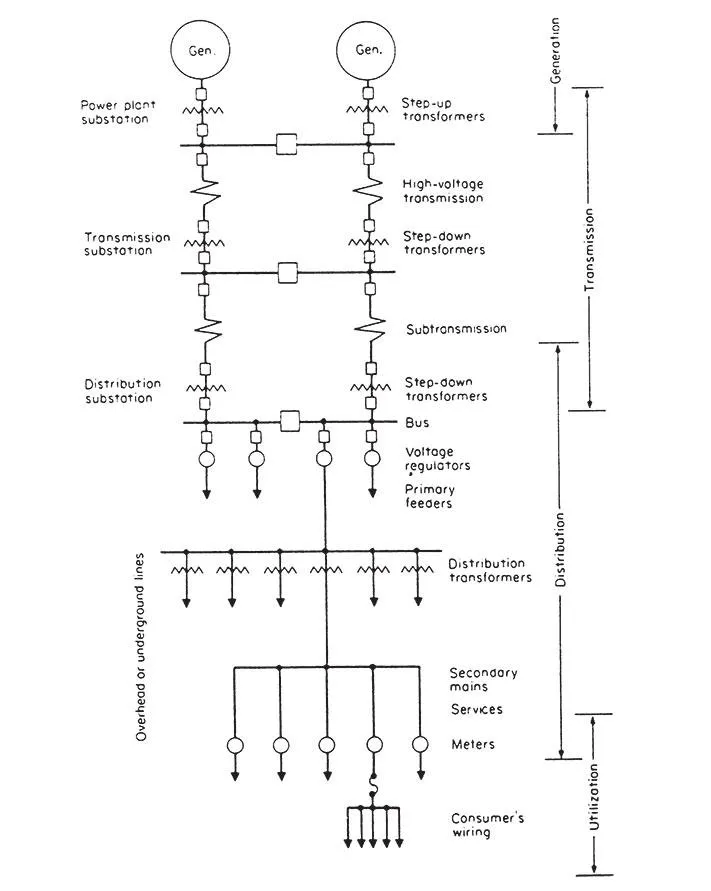
(Courtesy Westinghouse Electric Co.)
The adoption of alternating current, employing transformers, together with the general public’s acceptance of the less than pleasing overhead facilities almost entirely accounts for the unparalleled expansion experienced by the electric industry. The successful combination of transformer and overhead installations exemplifies a basic solution of the electrical, mechanical and economic problems associated with the design of transmission and distribution systems, as well as their construction, maintenance and operation. These three problems, although subject to independent solutions, interact upon each other.
Electrical design considerations are based generally on acceptable values of loss in electrical pressure or voltage drop and those of energy loss. These considerations may be modified to accommodate desired protection, environmental and other requirements. The permissible values determine the size of conductors and the associated insulation requirements. The physical characteristics of the conductors impact on the mechanical designs of such systems.
Mechanical design involves the study of structures and equipment. It includes the selection of proper materials and their combination into structures and systems in such a manner as to meet the electrical design requirements, giving due consideration to matters of strength, safety, temperature variations, length of life, appearance, maintenance, and other related factors.
Economic design includes the investigation of relative costs of two or more possible solutions to the combined electrical and mechanical requirements. The choice is governed (although not necessarily) not by the lowest annual carrying charge on the investment in the systems studied, but by that which is equal (or closest) to the annual cost of losses associated with one of the systems under study. This relationship is known as Kelvin’s Law. Many factors intrude, however, to modify the applicable conditions. These factors pertain generally to safety and environmental requirements as well as provision for possible future demands for electric power, creating changes that may affect the several components involved in the solution to design problems; for example, new technology, revised codes and standards, inflation, new reliability and environmental requirements, etc. The final decision must also satisfy the electrical and mechanical design requirements. These criteria apply to both the transmission and distribution systems.
Referring to the diagram in Figure 1-1, although it has been customary to consider generation, transmission and distribution as three interdependent elements constituting a single enterprise, as one electric utility system, financial and conservation considerations have given rise to consideration of each of the three as separate and distinct enterprises. Acquisition of each of the three by independent parties could be a means of diversifying their investments. Problems of cooperation in the operation of such separately owned systems would affect the consumer, and could possibly cause the construction of duplicate competitive systems.
In the presentation of the material that follows, it will be assumed that the reader is familiar with the essentials of electricity, including vector representation, concerning the properties of both direct and alternating current circuits, including resistance, inductance, capacitance, impedance, and their Ohm’s Law relationships.
Although the usual flow of electricity to the consumer is from the generating plant through the transmission system into the distribution system, the discussion will treat the delivery system in the reverse order: starting with the consumer and working toward the central generating plant.
CONSUMER CHARACTERISTICS
To begin the electrical design of transmission and distribution systems, it is necessary to know the characteristics of the building blocks upon which the design of the systems is predicated; that is, the consumer to be served. Obviously, each consumer cannot be considered independently, but they may be studied as a class and as groups as they affect the final design of the systems.
For convenience, consumers may be broadly classified as residential, commercial, and industrial. The requirements of each type to be determined include:
1. The total consumption of electricity over a period of time, (say) annually.
2. The changes in rate of consumption, (say) hourly, over periods of time: daily, weekly, monthly, annually.
3. The voltage required for the proper operation of the loads to be served; the tolerance permitted in the variation of this voltage, and whether the rapidity of such variations would cause flicker of lights to result.
4. The reliability requirements of the loads to be served, that is, the degree of interruption to service, as well as variations in the three items above, that may be tolerated or permitted.
Electric systems consist essentially of conductors in the form of wire, terminals, blades of switches or circuit breakers, wires in transformers, motors, and other equipment. The criteria on which their designs are based are two:
1. The permissible drop in voltage or pressure of the electricity flowing through them, and
2. The permissible energy loss caused by electricity flowing through them, manifested in the form of heat to be dissipated harmlessly.
From Ohm’s Law, the loss in voltage is equal to the product of the current flowing through a conductor and its resistance:
Energy loss is the product of power and time; power, however, is the product of the voltage imposed on the conductor and the current flowing through it. Again, from Ohm’s Law, this can be derived into the product of the square of the current flowing through the conductor and its resistance:
and energy = Power × Time, in watt-hours or kilowatt-hours.
The heat generated must be dissipated if temperature rise is to be limited to safe values (i.e., before failure results, usually in the insulation surrounding a conductor). Also, the heat generated represents a loss of energy for which there is no economic return, and some reasonable value must be placed on its limits. While standards (and guarantees) usually specify a definite temperature limit, e.g., 50°C, 70°C, etc., these figures are not rigid as temperatures (and designs) are affected by ambient temperatures, duration of high temperature, including those preceding the imposition of the condition causing the undesirably high temperature, effect of wind and other cooling factors, etc. These conditions affect the selection of conductors, transformers, switches, and other facilities comprising the transmission and distribution systems.
The consumer’s connected load, therefore, becomes the starting point for the design of such systems. An examination of “typical” consumer’s connected loads will quickly determine the voltage requirements: 120 volts for lighting and many of the appliances and 240 volts for some of the larger size units; for some large motor loads, ...
Table of contents
- Cover
- Half Title
- Title Page
- Copyright Page
- Dedication
- Table of Contents
- Preface to the Original Edition—1990
- Preface to the Second Edition—2004
- 1 Introduction, Consumer Characteristics
- 2 Distribution System Electrical Design
- 3 Subtransmission System Electrical Design
- 4 Transmission System Electrical Design
- 5 Electrical Protection
- 6 Direct Current Transmission
- 7 Overhead Mechanical Design and Construction
- 8 Underground Mechanical Design and Construction
- 9 Associated Operations
- Appendix
- Index
Trusted by 375,005 students
Access to over 1.5 million titles for a fair monthly price.
Study more efficiently using our study tools.
Frequently asked questions
Yes, you can cancel anytime from the Subscription tab in your account settings on the Perlego website. Your subscription will stay active until the end of your current billing period. Learn how to cancel your subscription
No, books cannot be downloaded as external files, such as PDFs, for use outside of Perlego. However, you can download books within the Perlego app for offline reading on mobile or tablet. Learn how to download books offline
Perlego offers two plans: Essential and Complete
- Essential is ideal for learners and professionals who enjoy exploring a wide range of subjects. Access the Essential Library with 800,000+ trusted titles and best-sellers across business, personal growth, and the humanities. Includes unlimited reading time and Standard Read Aloud voice.
- Complete: Perfect for advanced learners and researchers needing full, unrestricted access. Unlock 1.5M+ books across hundreds of subjects, including academic and specialized titles. The Complete Plan also includes advanced features like Premium Read Aloud and Research Assistant.
We are an online textbook subscription service, where you can get access to an entire online library for less than the price of a single book per month. With over 1.5 million books across 990+ topics, we’ve got you covered! Learn about our mission
Look out for the read-aloud symbol on your next book to see if you can listen to it. The read-aloud tool reads text aloud for you, highlighting the text as it is being read. You can pause it, speed it up and slow it down. Learn more about Read Aloud
Yes! You can use the Perlego app on both iOS and Android devices to read anytime, anywhere — even offline. Perfect for commutes or when you’re on the go.
Please note we cannot support devices running on iOS 13 and Android 7 or earlier. Learn more about using the app
Please note we cannot support devices running on iOS 13 and Android 7 or earlier. Learn more about using the app
Yes, you can access Power Transmission & Distribution, Second Edition by Anthony J. Pansini in PDF and/or ePUB format, as well as other popular books in Technology & Engineering & Electrical Engineering & Telecommunications. We have over 1.5 million books available in our catalogue for you to explore.