- 376 pages
- English
- ePUB (mobile friendly)
- Available on iOS & Android
eBook - ePub
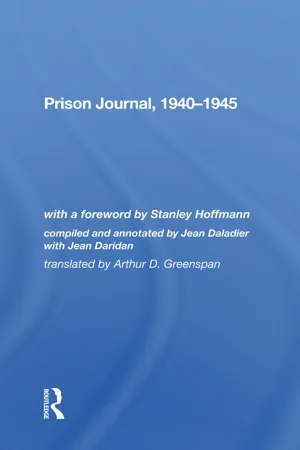
Prison Journal, 19401945
About this book
Even after fifty years, and in spite of the reams of documents now available,it remains difficult-especially in France-to form an objective view of what things were like in the period between the wars and in 1940.The greater, the swifter, the more unexpected the disaster, the less people are willing to deal with it squarely. Once a certain threshold of suffering,shame, and humiliation is reached, actual facts become unimportant,analyses become bothersome. History falls prey to myth and rumor.People refuse to hear any more, but they still need someone to blame. In France, the strangest of bedfellows have come to speak about it in one voice, and the good people have remained mute.
June 1940: The Departure for Morocco
DOI: 10.4324/9780429303012-1
Jean Daladier
The British had offered Daladier refuge in London, but he preferred to leave for Morocco and continue the struggle from there, as France’s leaders in Bordeaux1 had agreed to do. He wrote the following:
“The government had stated that it would set up its base in North Africa and move all government offices there. Some members were to leave via various Mediterranean ports. Others, including myself, were to go to Le Verdon, where we would board the Massilia en route to Casablanca.
“I was anxious to meet with General Noguès.2 I had appointed him Governor-General of Morocco and wanted to encourage him to carry on the fight.
“In Le Verdon, half of the Deputies who had been present in Bordeaux boarded the Massilia, along with General Michel, government personnel, and even Herriot’s suitcases.
“We set sail on June 21, in spite of the German mines and the problems we had with the crew; they wanted to return to their families.
“We learned of the Armistice while at sea. The ship’s commander categorically refused to alter his course and make for England.
“When we arrived in Casablanca, we were forced to remain on board. It was during that time that the official turnaround in France took place. In the radio and press campaigns mounted against us, we were being accused of desertion.
“I finally met Noguès on June 27, in Rabat. ‘The Army didn’t lose the war,’ he said. ‘They never went to war.’ We both thought that it would be possible to carry on the fight from North Africa, as did all the other leaders, even those in Black Africa and the Middle East.
“We had 270,000 men at our command and the capacity to mobilize them rapidly. We had arms, and even 1,800 top-flight warplanes. Airplanes I had ordered from the United States were to be delivered to Morocco, where assembly plants had already been set up. The Franco-British fleet ruled the Mediterranean. Five admirals had come to Casablanca, among them Laborde and Marquis. Darlan3 had asked Noguès to set up a command post for him in Rabat.
“Spain was certain to remain neutral, given the exhausting civil war it had just been through and its need for American aid. On Tunisia’s border with Libya, there were the Mareth fortifications I had had built.
"Noguès had already cabled Bordeaux several times. He was seeking government authorization to break with official policy and fight on, even if the government had to disavow its involvement in the process.4 He agreed to send one final cable; it too went for naught.
On June 30, Members of Parliament were prevented from boarding ship and returning to France. They would not be allowed to do so until July 10, in order to deny them the possibility of voting in Vichy, where Pétain was granted plenary powers."5
1940
DOI: 10.4324/9780429303012-2
September 6, 1940
We were having lunch at La Vernue, deep in the countryside near Vichy. André Borie and his family had been my warm and generous hosts for several days. I said to my friends, “It won’t be long before I am taken into custody,” but they were a little skeptical. “Why would they bother arresting you? The trial is being held right here in Riom.1 The authorities will know exactly where to find you, since you notified the Minister of the Interior yourself.”2
I had been warned two or three days before that I could expect to be arrested. The leaders at Vichy had already made up their minds, and there was no time to lose if I hoped to get away. Nonetheless, in view of General Noguès’s decision not to make a stand in North Africa and the failed British attempts to spirit me to London, I was determined to face the ordeal in France. On September 3, a young inspector from the Sûreté even came to warn me that they would be coming to get me very soon. He offered to take me to Switzerland within a few hours. I thanked him but refused to go.
On September 4, the press published a statement issued by the government in which it claimed “the right to place in administrative detention those individuals deemed dangerous to national security or public safety.”
Nothing happened for the following two days. In fact, my friends at La Vernue were somewhat amused at my having gotten my papers together and carefully arranged them in two leather briefcases.
I harbored no illusions as to the impartiality of this supreme tribunal3 —my sentence would undoubtedly come down directly from Pétain—but I felt I owed the people of this country an explanation. Had France been betrayed and if so by whom? And how? I was also afraid that by staying with Borie, I would be endangering him, but he absolutely refused to let me leave.
We went on with our meal. Suddenly, the little blonde serving girl came running up, all excited. “Madame, several cars have pulled in and are stopping in front of the house.”
Brochet, the Director of the State Police, strode in. Looking important and solemn, he read aloud an order signed by Porte, the Subprefect of Monluçon, who had run for office in the Nièvre as a Popular Front candidate. In accordance with the law of September 4, 1940, and by virtue of the authority vested in Adrien Marquet,4 Minister of the Interior, I was to be placed under house arrest in the château in Chazeron.
I dictated and signed a statement of protest, denouncing them for arbitrarily resurrecting a law intended to punish plots against the nation and acts of sabotage against the defense industry.
With the help of my son Jean and Dr. Mazé,5 and in the presence of a kindly but talkative policeman, I quickly packed two suitcases. I took leave of Mme Borie and her daughters, who had received me in their home and been so gracious and considerate. When I started blaming myself for not having left sooner, they stopped me and hugged me. I told my son Jean to notify his brother, Pierre, and my sister so that they wouldn’t be brutally shaken by reading the news in the morning papers.
We went outside. In spite of the gasoline crisis, there were five cars parked at the door, each of them packed with policemen. So much for the propaganda promoting a return to the land.6
One of the policemen, a pale, round-eyed, fat and fleshy fellow, tried to take a picture. Jean and Dr. Mazé lashed out at him, and he put down his camera.
I would never have guessed I rated a five-car procession. Marquet was doing things up right. We drove through Gannat, Aigueperse, and Châtelguyon, with people stopping in the streets, staring at us as we went by. One of the cops began telling the story of his years on the force. I lit up my pipe and sat back.
When we came into Chazeron, I could make out in the distance the château tower, the crenellated ramparts, and the old black walls surrounded by pine trees, all of it taken over now by ravens and owls for a nesting ground. The gate is rather handsomely crafted, but the courtyard, with its well and a few dilapidated buildings, is overgrown with weeds. The grounds were teeming with state troopers and inspectors from the Sûreté, strolling about and puffing on cigarettes. Dozens of workers were repairing and patching things up, nailing in doors, boarding up windows, and installing lovely, brand new, sharply pointed bars. Their prisoner had arrived before they’d finished readying his prison.
I was told that the illustrious M. Marquet, the Minister of the Interior, had graced this run-down château that the government had requisitioned by visiting it personally.
That was to be his last official function. A few days later, he was removed from office by Pétain and replaced by Peyrouton,7 a fitting reward for having betrayed the government in Bordeaux and having helped Pétain come to power. Word has it that he immediately set out for the Occupied Zone to spew out his rancor and offer his services to the Germans.
I sat down in the courtyard, with a policeman still right behind me. The gate opened and a limousine rolled in. Policemen and troopers ran up to greet it, but it turned out to be just Chavin. Several years ago I had named him Prefect of the Vaucluse and then Prefect in Constantine, after having decorated him with the Légion d'honneur in between. He is now Director of the Sûreté. With a crowd milling around him, our M. Chavin pretended not to see me, even though our eyes met several times. He walked by, passing just a few feet away, on his way to a tour of the château and what passes here for gardens. Then, once he had finished visiting the grounds, he headed back toward the gate at an angle, and doffed his hat in my direction from as far away as he could. I replied by tipping mine.
I was officially welcomed by M. Bartelet, the warden of this Bastille. We chatted for a while. He is a veteran from Lorraine, twice wounded and twice decorated in 1914. Briefly and discreetly, he shared his feelings with me about France’s collapse, our surrendering in Bordeaux, and the path the Vichy government had taken since. Then he headed off to oversee the construction work.
Once the iron bars were finally secured, I moved into my cell, that is, my room. I was given two candles, since they hadn’t finished wiring electricity for lights. A policeman and a state trooper settled in outside my door. I was free again, alone at last with my thoughts.
This is where I shall have to muster my strength. Ever since the capitulation in Bordeaux, life has left little more than an ashen taste in my mouth. In Morocco, when I realized that all was lost, I occasionally had thoughts of putting an end to it.
I’ll have to fight the press, Laval’s8 slimy arrogance, and the Cour Suprême de Justice, even if I have to fight them on my own. I am alone with the lions; it’s up to me to charge forward and do battle without worrying about the outcome, so that the truth can be known.
Table of contents
- Cover
- Half Title
- Title
- Copyright
- Contents
- Foreword
- Preface to the English Edition
- June 1940: The Departure for Morocco
- Appendix A: France’s Principal Modern Weaponry
- Appendix B: The Riom Trial
- Appendix C: Biographical Timeline
- About the Book
- Name Index
Trusted by 375,005 students
Access to over 1.5 million titles for a fair monthly price.
Study more efficiently using our study tools.
Frequently asked questions
Yes, you can cancel anytime from the Subscription tab in your account settings on the Perlego website. Your subscription will stay active until the end of your current billing period. Learn how to cancel your subscription
No, books cannot be downloaded as external files, such as PDFs, for use outside of Perlego. However, you can download books within the Perlego app for offline reading on mobile or tablet. Learn how to download books offline
Perlego offers two plans: Essential and Complete
- Essential is ideal for learners and professionals who enjoy exploring a wide range of subjects. Access the Essential Library with 800,000+ trusted titles and best-sellers across business, personal growth, and the humanities. Includes unlimited reading time and Standard Read Aloud voice.
- Complete: Perfect for advanced learners and researchers needing full, unrestricted access. Unlock 1.5M+ books across hundreds of subjects, including academic and specialized titles. The Complete Plan also includes advanced features like Premium Read Aloud and Research Assistant.
We are an online textbook subscription service, where you can get access to an entire online library for less than the price of a single book per month. With over 1.5 million books across 990+ topics, we’ve got you covered! Learn about our mission
Look out for the read-aloud symbol on your next book to see if you can listen to it. The read-aloud tool reads text aloud for you, highlighting the text as it is being read. You can pause it, speed it up and slow it down. Learn more about Read Aloud
Yes! You can use the Perlego app on both iOS and Android devices to read anytime, anywhere — even offline. Perfect for commutes or when you’re on the go.
Please note we cannot support devices running on iOS 13 and Android 7 or earlier. Learn more about using the app
Please note we cannot support devices running on iOS 13 and Android 7 or earlier. Learn more about using the app
Yes, you can access Prison Journal, 19401945 by Edouard Daladier,Jean Daladier in PDF and/or ePUB format, as well as other popular books in History & World History. We have over 1.5 million books available in our catalogue for you to explore.