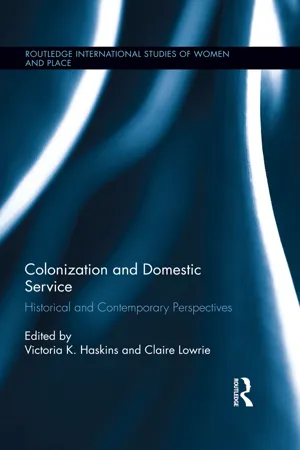
This groundbreaking book brings together two key themes that have not been addressed together previously in any sustained way: domestic service and colonization. Colonization offers a rich and exciting new paradigm for analyzing the phenomenon of domestic labor by non-family workers, paid and otherwise. Colonization is used here in its broadest sense, to refer to the expropriation and exploitation of land and resources by one group over another, and encompassing imperial/extraction and settler modes of colonization, internal colonization, and present-day neo-colonialism. Contributors from diverse fields and disciplines share new and stimulating insights on the various connections between domestic employment and the processes of colonization, both past and present, in a range of original essays dealing with Indonesian, Canadian Aboriginal, Australian Aboriginal, Pacific Islander, African, Jamaican, Indian, Chinese, Anglo-Indian, Sri Lankan, and 'white' domestic servants.
eBook - ePub
Colonization and Domestic Service
Historical and Contemporary Perspectives
- 366 pages
- English
- ePUB (mobile friendly)
- Available on iOS & Android
eBook - ePub
Colonization and Domestic Service
Historical and Contemporary Perspectives
About this book
Information
1
An Historical Perspective
Colonial Continuities in the Global Geography of Domestic Service
The decline and fall of the great formal empires of the modern world, in the aftermath of the Second World War, occurred in tandem with a decline in the importance of domestic service. In the West, the dominant site of imperial metropolitan societies, it was predicted that domestic service might completely disappear as a significant occupation. Such predictions were most common around 1960, when decolonization was at its height (Coser 1973–74: 39). Like many bold predictions, the demise of domestic service was exaggerated. It took new forms and flourished in new environments, just as the supposed end of empire saw transformation into neocolonial and postcolonial forms. The outcome was a new map of global patterns of domestic service, overlaying the new map of global political geography.
However new these two maps might appear, both contain elements from the past, marking the persistence of political boundaries and of social barriers. In particular, it can be asked how far contemporary patterns of domestic service incorporate continuities from colonization that derive from deeply rooted hierarchies of wealth and inequality, and how far these patterns depend on recent social and economic change unrelated to the processes of formal colonization that dominated earlier periods. Existing theories of servant growth make little mention of the process of colonization but focus instead on macroeconomic engines of change, notably inequality, technological change, urbanization, modernization and stages of economic development (Boserup 1970: 103–104; Branca 1975: 130; McBride 1976: 116; Katzman 1978: vii; Cowan 1983). In thinking about associations between colonization and domestic service, a central question to be asked is whether colonization commands the explanatory power sufficient to make it worthy of addition to these theories of servant growth. The question can be asked both of the contemporary world and of periods in the past.
It is worth observing that colonies and domestic servants share some fundamental characteristics. Most obviously, they both come into being through dependence on an existing agent, whether state or household. Without denying agency to colonists or servants, it is the continuing authority of a metropole or master that commands settlement (in colonization) or the employment relation (in domestic service). This applies to all servants, whether found in colonies or elsewhere. Everywhere, servants were part of a larger hierarchy of authority and status that brought together public and domestic spheres. Being a servant in a colony introduced an additional layer of command, the servant-employing colonist being in turn subject to the authority of colonial/imperial power.
Constructing a comprehensive picture of colonization and domestic service in the great sweep of world history is beyond the capacity of this chapter. Systematic data do however exist for a substantial slice of the contemporary world and analysis of these data enables a testing of associations between colonization and domestic service in two major ways. In the first place, it can be asked whether being incorporated into a colonial empire—either as metropole or colony—translates into the existence of a large (or small) domestic service sector in the present. This relationship can be understood either as a continuity bequeathed by the colonial domestic service sector or as an independent product of the structural heritage of colonialism. Further, it can be asked whether the contemporary experience of domestic service differs significantly between states according to the specific types of colonization they experienced.
Several complications surround the specification of these questions. There are problems of definition and problems of data. There are also problems deriving from the relative and changing significance of intervening factors and experience. Many recent scholars have found these problems intractable and preferred approaches that illustrate the human—often individual—experience of people within particular colonial societies, seen through the lens of qualitative cultural history, together with postcolonial and reflexive analysis. Similarly, contemporary labor economists sometimes exclude personal services from their studies because of problems of identification and data sources, and the persistent difficulty of regulating the sector (Bailly, Devetter and Horn 2013: 303).
The approach taken in this chapter is more representative of older studies of domestic service—particularly those undertaken from the 1940s to the 1970s—which followed the path of economic history and depended heavily on quantitative evidence (Stigler 1947). These methods are the central pillars of my own earlier studies of the history of domestic service, in Jamaica (Higman 1989) and Australia (Higman 2002). While acknowledging the difficulties associated with the approach, and recognizing the valuable contributions that have been made by alternative strategies, I maintain the view that attempting to understand the changing global pattern of servant growth in its quantitative dimensions is an important objective. In order to proceed along this path it is necessary first to say something about the ways colonies and servants have been defined and classified.
Classifying Colonies
Colonization is understood as both metaphor and mechanism. Although the metaphorical usage can reveal much about the mechanism, my analysis in this chapter is concerned principally with the process and with the lives of those peoples who formally identified their own contemporary territories as colonies. Today, very few places are described as colonies, whatever their constitutional status (Aldrich and Connell 1998: 2–9). On the other hand, postcolonial critiques of the notion of ‘nation’ are underpinned by the argument that all modern nation-states are indeed products of the process of colonization, whatever their place in the classification and hierarchy of the formal colonial world. Further, the process of ‘colonization’ continued (and continues) long after declarations of formal independence (Burton 2003: 1; Ghosh and Kennedy 2006; Stoler 2006: 35–36). Thus formulations in which metropole and colony are separate entities, with influence and power moving in only one direction, have been overtaken by concepts of multilateral webs in which the colonized play an equally significant role in shaping the colonizer (Stoler 2002: 136). This complex web of colonial–national interactions applies not only to the era of formal colonization but equally to the experience of the past fifty years.
Beginning in the nineteenth century, attempts were often made by imperial political economists to classify colonies into specific types (Merivale 1861: xii; Rawson 1884: 565; Lucas 1887: 1–3). Recent history writing often strongly reflects these early formulations. Wolfgang Reinhard (2011: 3–4), for example, finds three types sufficient: (1) trading posts and military bases; (2) colonies of settlement, which entailed the removal or decimation of Indigenous peoples and the establishment of immigrant populations; and (3) colonies of rule, in which colonizers extracted wealth from existing societies, often with the collaboration of local elites. A more nuanced typology is acknowledged by Bouda Etemad. Firstly, a ‘mixed’ type (represented by Mexico and Peru) where ‘white colonists, numerically a minority but nevertheless in substantial numbers, formed an urban upper-class that lived on the income produced by commercial exchanges and the large landed properties cultivated by subjugated indigenous farmers.’ Colonies of this type were long-lasting and remained dominant until the middle of the eighteenth century; and new examples were later established in Algeria, Southern Rhodesia, Kenya and Angola. Secondly, says Etemad, colonies of ‘occupation’ existed where small colonizing contingents managed large Indigenous populations. The modern version of this type is the ‘dependency.’ Thirdly, ‘plantation’ colonies were developed by the Portuguese, based on sugar and slavery. Fourthly, there were colonies founded on coastal trading posts and fortified military bases. Fifthly, Etemad identifies the ‘settlement colony,’ a type absent from the Spanish empire but developed by the English and French in North America and the Dutch at the Cape. Here Etemad restricts ‘settlement colonies’ to the thirteen colonies of North America, Canada, South Africa, Australia and New Zealand—an attenuated version of older more comprehensive classifications of ‘settlement’ (Etemad 2007: 136–38).
Although classification is less of a preoccupation in the postcolonial world, it is intriguing that a new type—the ‘settler colony’—has recently become common currency. This term was rare before 1960 but has grown in popularity and usage. The more complete term white settler colony has grown at the same rate, but remains uncommon. On the other hand, black settler colony is almost completely absent from the literature. Theoreticians of ‘settler colonialism,’ notably James Belich (2009: 26) and Lorenzo Vera-cini (2010: 6), accept that ‘settlers’ are not necessarily Europeans, but the vast weight of the literature is devoted to their experience. At the same time, not every example of white European colonization has been acknowledged as a settler colony—notably, Ireland is rarely discussed. The term settler colony seems to have emerged not from historical analysis of places formerly known as settlement colonies or colonies of settlement but from rhetoric surrounding the Algerian War, ignited in 1954. It was this bloody conflict that created the image of a unified settler community rooted in struggle and exile—the world of Albert Camus’s L‘Etranger —set in the context of a literal décolonisation that meant the removal of the (European) colon (settler) from the land (Kraft 1961; Shepard 2006: 55–56; Churchill 2010: 101–102). English-language interpretations then gave decolonization a wider meaning—the end of empire—and identified Algeria as a settler colony. Gradually, historians began to attach the term settler colony to (some) older colonial units and, by the 1970s, they were comfortable with the idea of settler society. Settler colonies have been the location of many historical studies of domestic service (including some of the chapters in this volume; see Aird; Ally; Macdonald; McCabe; McCallum; and Robinson).
The analysis in this chapter recognizes four colonial types, and distinguishes these from the colonial powers (the imperial metropoles or colonizing states) and those places that were not colonized in the modern imperial era. The four types used are:
- settler colonies (in which imperial populations occupy and exploit lands taken from Indigenous peoples);
- settlement colonies (in which colonists depend on forced migrant labor to exploit lands taken from Indigenous peoples);
- mandates and protectorates (in which local rulers retain sovereignty, within the domain of an imperial state); and
- occupied colonies (in which limited forms of imperial suzerainty follow military conquest).
The allocation of states to each of these specific categories is set out in Table 1.1. Some states are candidates for allocation to more than one of the categories. The United States, for example, might be either a settler colony or a colonial power; here it has been located with the settler colonies, but tests are made to determine the outcome if the allocation is reversed. States are identified as colonies only if they had a substantial colonial history. Ethiopia, for example, suffered short-lived attempts at colonization but is not here included with the colonies. Large countries, such as the United States, contain within them significant regional blocs. Here, the principal units of analysis are the state and the world-region.
Table 1.1 Domestic Workers by Former Colony/Metropole Type, c.2010


Defining Domestic Servants
The problem of defining who is a servant or domestic worker is fraught with ambiguities and contradictions made even more challenging by change over time, and by cultural and linguistic variations. Indeed, Raffaella Sarti (2005: 340), concluding an extensive review of the terms in Western Europe since the sixteenth century, acknowledges that these problems can appear so overwhelming that scholars are sometimes discouraged from even attempting study of the subject. Whereas service and servant are ancient terms, domestic worker is recent. Formerly, domestic work was simply the set of class-dependent tasks performed by a housewife, together with her daughters and perhaps sons, and other people not considered members of the family. It was the latter who were distinguished from the others by being placed in the social rank of servant. Exceptions occurred, pointing to a shadow area between family and servant, household and kin group. This was not the only kind of service, so it was necessary to call these people domestic servants in order to separate them from farm servants and apprentices, as well as bond servants and indentured servants—and these could all overlap. These contextual and terminological inconsistencies contributed to the understanding of domestic service as a unique type of occupation, defined by its tasks and site as much as its employment relationship (Humfrey 2011: 7).
Tracing the history of these terms across time and cultures is a study in itself. Because the analysis in this chapter is focused on contemporary patterns and depends heavily on data collected by the International Labour Organization (ILO), the definition used is that employed by this agency. In 2011, the ILO’s Convention Concerning Decent Work for Domestic Workers defined domestic work as ‘work performed in or for a household or households’ and domestic worker as ‘any person engaged in domestic work within an employment relationship.’ (For a detailed discussion of the passing of this Convention, see Fish, this volume.) It specifically excluded persons performing domestic work ‘only occasionally or sporadically and not on an occupational basis’ (ILO 2011). It makes no reference to service or servants and avoids the problems that arise when specific tasks are introduced (Simonovsky and Luebker 2011: 2). The ILO definition is also useful in that it omits the condition that the domestic worker should work in the household of a family other than his or her own. Further, the relationship can be formal or informal, legal or illegal. The worker must simply be ‘within an employment relationship.’ The definition makes no mention of residence or the amount of time spent in particular households. This enables it to incorporate the labor of commercial service enterprises that have bourgeoned over the past fifty years, especially in cleaning and personal care. The only condition is that the work be carried out in private households. The growth of this sector has been associated with dramatic changes in the character and social relations of domestic work but these are not matters ...
Table of contents
- Cover
- Title
- Copyright
- Contents
- Figures
- Table
- Acknowledgments
- Introduction: Decolonizing Domestic Service: Introducing a New Agenda
- 1. An Historical Perspective: Colonial Continuities in the Global Geography of Domestic Service
- PART I Anxieties and Intimacies
- PART II Domination and Resistance
- PART III Legacies and Dreams
- Conclusion: Agency, Representation, and Subalternity: Some Concluding Thoughts
- Contributors
- Index
Trusted by 375,005 students
Access to over 1.5 million titles for a fair monthly price.
Study more efficiently using our study tools.
Frequently asked questions
Yes, you can cancel anytime from the Subscription tab in your account settings on the Perlego website. Your subscription will stay active until the end of your current billing period. Learn how to cancel your subscription
No, books cannot be downloaded as external files, such as PDFs, for use outside of Perlego. However, you can download books within the Perlego app for offline reading on mobile or tablet. Learn how to download books offline
Perlego offers two plans: Essential and Complete
- Essential is ideal for learners and professionals who enjoy exploring a wide range of subjects. Access the Essential Library with 800,000+ trusted titles and best-sellers across business, personal growth, and the humanities. Includes unlimited reading time and Standard Read Aloud voice.
- Complete: Perfect for advanced learners and researchers needing full, unrestricted access. Unlock 1.5M+ books across hundreds of subjects, including academic and specialized titles. The Complete Plan also includes advanced features like Premium Read Aloud and Research Assistant.
We are an online textbook subscription service, where you can get access to an entire online library for less than the price of a single book per month. With over 1.5 million books across 990+ topics, we’ve got you covered! Learn about our mission
Look out for the read-aloud symbol on your next book to see if you can listen to it. The read-aloud tool reads text aloud for you, highlighting the text as it is being read. You can pause it, speed it up and slow it down. Learn more about Read Aloud
Yes! You can use the Perlego app on both iOS and Android devices to read anytime, anywhere — even offline. Perfect for commutes or when you’re on the go.
Please note we cannot support devices running on iOS 13 and Android 7 or earlier. Learn more about using the app
Please note we cannot support devices running on iOS 13 and Android 7 or earlier. Learn more about using the app
Yes, you can access Colonization and Domestic Service by Victoria K. Haskins, Claire Lowrie, Victoria K. Haskins,Claire Lowrie in PDF and/or ePUB format, as well as other popular books in Social Sciences & Social History. We have over 1.5 million books available in our catalogue for you to explore.