This book serves as a primer on freight transportation and logistics, providing a general and broad coverage of concepts, mathematical models and methodologies available for freight transportation planning at strategic, tactical and operational levels. It is aimed at graduate students, and is also a reference book for practitioners in the field.
The book includes preliminaries, such as mathematical modeling and optimisation algorithms. The book also features case studies and practical real-life examples to illustrate applications of the concepts and models covered, and to encourage a hands-on and a practical approach. The author has taught and published extensively in the field and draw on state-of-the-art scientific research. He has also been part of a number of practical research projects, which underpin the real life examples in the book.
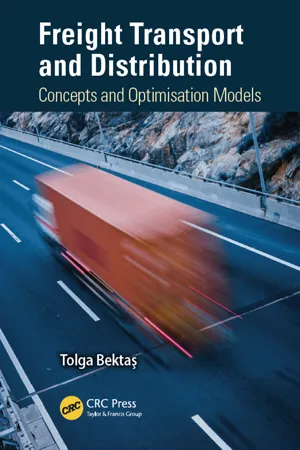
- 267 pages
- English
- ePUB (mobile friendly)
- Available on iOS & Android
eBook - ePub
About this book
Information
Chapter 1
Freight logistics, distribution and transport
The title of this chapter includes three terms, namely logistics, distribution and transport, all of which have a central role in the treatment of the topic, and as will be for the rest of this book. However, the precise meanings of these terms continue to cause some confusion. Various definitions have been put forward in the past which differ considerably. This is, however, understandable not only because their meaning tends to change depending on the industry in which they are applied, or even evolve over time, but also due to the overlap in the elements they cover. In the following, we will attempt to differentiate these terms, not for the purpose of arriving at yet another set of definitions, but to reduce any element of confusion for the reader of the book, at least in the way that they will be used in the remainder of the exposition:
• Transport is the actual movement of goods from one location to another using a means or a vehicle of transport (e.g. trains, trucks, boats) and a transport infrastructure (e.g. roads, railways, canals).
• Distribution often denotes all activities relevant to physical movement of goods, including transportation, but also transhipment and warehousing.
• Logistics is generally used as an overarching term that includes all activities related to the movement and coordination of goods from their source of origin to the final point of delivery, and includes production and distribution. Here, movement does not just correspond to physical movement of goods but also the flow of information.
1.1 Actors
While freight transport and distribution include many elements, including various organisations and people, the three fundamental actors who actively take part in the domain are described here.
1.1.1 Shippers
The demand for freight transportation is generated by shippers. Each shipper will have their own logistics strategy, which includes whether to operate their own fleet or to use an external party to which it will outsource their logistics and distribution activities, as well as choosing the mode(s) of transport. The process through which the shippers will define their logistics activities generally takes a three-level decision structure:
1. The long-term decisions in the first level involve defining strategies in line with their customer network and production activities.
2. The second-level medium-term decisions include levels of inventories at production, warehousing, and distribution facilities, frequency and amount of shipping and flexibility of service.
3. At the short-term level, shippers decide on the attributes of the services required for its shipments, such as maximum rates, transport time, reliability and safety.
In making these decisions, they will consider the availability and the characteristics of the services offered on the market by carriers and intermediaries, such as freight brokers and third-party logistics providers.
1.1.2 Carriers
Carriers are people, businesses or organisations that operate and offer transportation services for shippers. They may either provide a customised service, where a vehicle or a fleet will be dedicated exclusively to a particular customer, or operate on the basis of consolidation, where each vehicle contains several pieces of freight for different customers with possibly different origins and destinations. In the latter case, carriers generally operate their services according to a published timetable, which prescribes routes, schedules and rates they offer.
1.1.3 Intermediaries
In some cases, the shipper operates their own fleets of vehicles and does not require an external carrier to ship goods on their behalf. In this case, the management of the relevant transportation and distribution is done inhouse. If a shipper does not own a fleet, then it may choose to work directly with one or several carriers.
Shippers may alternatively use a freight forwarder, an intermediary person or organisation that acts as a third party and manages the shipments on behalf of the shipper by contracting one or several carriers. They also help to identify a suitable mode or a combination of modes for the shipper. Freight forwarders work closely with shippers and carriers, as well as other entities in the transportation network, such as ports or terminals, particularly if they additionally undertake ancillary services such as customs clearance.
1.2 Modes of transportation
There exist different means of transporting freight over the network, each of which is referred to as a mode of transport. Transportation modes can be differentiated with respect to the type and specification of the vehicle used, the underlying technology, the relevant infrastructure and the nature of the associated operations. The three main modes of transport are air (e.g., cargo planes), land (including road, rail and off-road) and water (e.g., ships in oceans, barges in rivers). Other modes of transport, such as pipelines (e.g., to transport gas) and cable transport (e.g., elevators and cable-cars), also exist.
The term mode can also be used to denote different types of vehicles within a given domain of transport. For example, trucks, vans and bicycles can be seen as three separate modes operating within road transportation due to their distinct features, such as different capacities, capabilities and restrictions. In this example, trucks have the largest capacity but often have restrictions in travelling in urban areas, whereas bicycles are much smaller in capacity but do not suffer from the same type of restrictions as trucks or vans. Brief descriptions of the three main modes of transportation are explained here.
1.2.1 Road
Road has been, and continues to be, the most widely used mode of freight transport, both nationally and globally. One of the main reasons behind its popularity is the ability of road transport to offer a very quick service and often be available on demand.
A wide variety of vehicles are used for road freight transportation, which can be differentiated on the basis of size, capacity, weight and the type of energy used. Vehicle classification on road transportation is generally based on the Gross Vehicle Weight Rating (GVWR), which refers to the maximum allowable total weight of a vehicle including its empty mass, fuel and any load carried. The empty mass of the vehicle, but with fuel and fluids such as engine oil, is named as the curb weight. Vehicle classifications vary from one country to another. In the United States, eight classes exist, with vehicles in the lightest class having a GVWR up to around 3 tonnes, and those in the heaviest class with a GVWR higher than 15 tonnes. In the United Kingdom, more classes exist, with those of at most 3.5 tonnes gross weight described as light goods vehicles (LGVs) and those between 3.5 and 44 tonnes gross weight named as lorries or heavy goods vehicles (HGVs).
Most vehicles used in road freight transportation run on gasoline or diesel engines. Vehicles using alternative sources of fuel or energy have also been developed, such as those running on batteries, biofuels (such as bioalcohol or ethanol), biodiesel, compressed natural gas, hydrogen, and liquefied petroleum gas (LPG), for use in freight distribution. Within urban areas, human-powered vehicles, such as bicycles and tricycles, can also be used for goods deliveries. To overcome the sole dependency on human power, some of the freight bicycles have power assist motors to aid the cyclist.
The road network is composed of motorways (or highways), urban roads, rural roads, lanes or graded roads and includes bridges and tunnels. Traffic on the road network is controlled by means of traffic signals, signs or markings on the pavement. Various legal requirements are imposed on freight vehicles travelling on the road network, which include limitations on vehicle weight, dimensions, mandatory equipment, licences and insurances (Rushton et al., 2014). As for truck drivers, there also exist regulations on driving and working hours, which restrict the duration of driving time and require break and rest periods in long-haul journeys. These regulations aim at reducing driver fatigue, which is known to have adverse affects on road and driver safety. The regulations usually differentiate between on-duty time, which is the time spent working, including driving, waiting, loading and unloading and doing paperwork, and off-duty time, where the driver has no obligation to work. In the United States, for example, these regulations are known as Hours of Service, which limit the maximum consecutive driving time between two rest periods to 11 hours, at which point the driver must be off-duty for at least 10 consecutive hours. Furthermore, a truck driver cannot drive if 8 hours or more have elapsed since the end of the last off-duty period of at least 30 minutes. Similar regulations prevail in other countries, albeit with differences (Goel and Vidal, 2013).
1.2.2 Rail
Rail freight transportation is known for its ability to offer cost-effective long-haul transportation services, primarily, but not exclusively, for bulk cargo. There are two major components of a rail system, namely the rail network infrastructure and freight trains.
The rail network is a large and complex structure composed of nodes and tracks (or track segments) as links between the nodes. The former include yards or terminals where classification or marshalling operations are performed, stations where cargo is picked up from or delivered to and junctions that are signal-controlled points in the rail network to allow trains to switch from one route to another.
Freight trains are composed of one or more locomotives, and several rail wagons (or cars). Locomotives move the train along the tracks by either pulling it from the front or push from the rear and range from the earlier types powered by steam to contemporary ones using electricity, magnetic force or diesel engine. Rail wagons carry the freight and come in a variety of forms, including specialised wagons for carrying particular types of cargo (e.g., autoracks for carrying automobiles or refrigerator cars for temperature-sensitive goods). A train is characterised by its route, origin, destination, intermediate stops, the physical path it travels on and the schedule information that includes departure and arrival times at each station where it stops. Each wagon also has an itinerary that specifies an origin and a destination station and need not correspond to the origin and destination of the train on which it is carried. Wagons may travel on several trains during their journey, usually in groups called blocks. Each block is assigned an origin and a destination, although individual cars in a single block may have different origins and destinations. A block is treated as a single unit for handling purposes. Once formed at its origin yard, a block will not be classified again until it arrives at its destination yard.
Classification or marshalling refers to a set of operations carried out at yards or terminals, where incoming trains are disassembled by decoupling the rail cars and new trains are formed using individual cars or blocks. Bektaş et al. (2009) provide a detailed description of the operations at a classification yard, according to which a train arriving at a yard first enters a receiving area, where the engines are taken away for inspection and maintenance, blocks are separated and cars are inspected. The classification operation begins from this point on and can be performed in two ways, depending on the type of the rail yard. In flat yards, a switching engine is used to push a group of cars out of the receiving tracks onto one of the classification tracks. In hump yards, classification is performed by using an artificially built hill, called the hump, where an engine pushes a group of cars out of the receiving area and up the ramp until it reaches the top of the hill. Due to the pull of the gravitational force, the cars roll down the incline on the other side of the hump, usually one car at a time, and are directed onto one of the classification tracks. Following this operation, each classification track becomes occupied by a group of cars that form the block. Each block then waits until the departure time of its outbound train. When the train is due to leave, they are pulled out of the classification tracks onto the departure tracks and are attached to the train. Following one last inspection of the whole t...
Table of contents
- Cover
- Half Title
- Title Page
- Copyright Page
- Dedication
- Table of Contents
- Foreword
- Preface
- 1 Freight logistics, distribution and transport: Concepts
- 1.1 Actors
- 1.1.1 Shippers
- 1.1.2 Carriers
- 1.1.3 Intermediaries
- 1.2 Modes of transportation
- 1.2.1 Road
- 1.2.2 Rail
- 1.2.3 Air
- 1.2.4 Sea
- 1.2.5 Intermodal transportation
- 1.2.6 Intermodal terminals
- 1.2.6.1 Containerised transport
- 1.3 Choice of carrier and transportation mode
- 1.4 Shipment options
- 1.4.1 Direct and customised shipments
- 1.4.2 Consolidated shipments
- 1.5 Distribution structures
- 1.5.1 Single-echelon
- 1.5.2 Multi-echelon
- References and further reading
- 2 Locationinnetworks
- 2.1 Hub location problems
- 2.2 Common notation
- 2.3 p-Hub median problems
- 2.3.1 Single-allocation p-hub median problem
- 2.3.1.1 Quadratic integer programming formulation
- 2.3.1.2 Integer linear programming formulations
- 2.3.2 Multiple-allocation p-hub median problem
- 2.4 Capacitated hub location problems
- 2.5 Other types of hub location problems
- 2.5.1 p-Hub centre problem
- 2.5.2 Hub covering problem
- 2.6 Congestion in hub location problems
- 2.7 Facility location problems
- 2.7.1 Uncapacitated facility location problem
- 2.7.2 Capacitated facility location problem
- 2.8 Uncertainty in location problems
- 2.8.1 Scenario-based modelling
- 2.8.2 Recourse actions
- 2.9 Practical application: Hub location for time-sensitive cargo deliveries
- References and further reading
- 3 Transportation and service networks
- 3.1 Features of transportation networks
- 3.2 Common notation
- 3.3 Multi-commodity network flow and design
- 3.3.1 Single-commodity network design problem
- 3.3.2 Shortest path problems
- 3.3.2.1 Resource-constrained shortest path problem
- 3.3.2.2 Multi-objective shortest path problem
- 3.3.3 Multi-commodity network design problem
- 3.4 Service network design
- 3.4.1 Time-invariant formulation
- 3.4.2 Time-space network representation
- 3.5 Congestion in network design
- 3.5.1 Modelling delay
- 3.5.2 Network design with node congestion
- 3.6 Practical application: Intermodal rail network service design
- References and further reading
- 4 Routing problems
- 4.1 Routing in freight distribution
- 4.1.1 Network topology
- 4.1.2 Timescales for planning and implementation
- 4.1.3 Customers
- 4.1.4 Time
- 4.1.5 Vehicles
- 4.1.6 Objectives
- 4.2 Travelling salesman problem
- 4.2.1 Asymmetric formulations
- 4.2.2 Subtours and subtour elimination for the ATSP
- 4.2.2.1 Cutset inequalities
- 4.2.2.2 Compact formulations
- 4.2.2.3 Compact node-ordering formulation
- 4.2.2.4 Compact arc-ordering or flow-based formulation
- 4.2.2.5 Compact precedence-based formulation
- 4.2.3 Symmetric formulations
- 4.3 Vehicle routing problem
- 4.3.1 Common notation
- 4.4 Capacitated vehicle routing
- 4.4.1 Two-index formulations
- 4.4.1.1 Cutset inequalities for tour feasibility
- 4.4.1.2 Compact inequalities based on node-ordering for tour feasibility
- 4.4.1.3 Compact inequalities based on arc-ordering for tour feasibility
- 4.4.2 Three-index formulations
- 4.4.3 Set partitioning formulations
- 4.5 Vehicle routing with time windows
- 4.5.1 Soft time windows
- 4.6 Distance-constrained vehicle routing
- 4.7 Uncertainty in vehicle routing problems
- 4.7.1 Recourse models
- 4.7.1.1 Vehicle routing problems with stochastic travel times
- 4.7.2 Chance-constrained models
- 4.8 Dynamic vehicle routing problems
- 4.9 Practical application: Charity collection
- References and further reading
- 5 Integrated routing problems
- 5.1 Location-routing problem
- 5.1.1 Formal problem definition
- 5.1.2 Formulation based on flow
- 5.1.3 Formulation based on two commodities
- 5.2 Inventory-routing problem
- 5.2.1 Formal problem definition
- 5.2.2 Exponential-size formulation
- 5.2.3 Polynomial-size formulation
- 5.3 Production-routing problem
- 5.3.1 Formal problem definition
- 5.3.2 Mathematical modelling
- References and further reading
- 6 Green freight distribution
- 6.1 Introduction
- 6.1.1 Emissions and pollution
- 6.1.2 Noise and vibration
- 6.1.3 Land and resource consumption
- 6.1.4 Toxic effects
- 6.2 Mitigating measures
- 6.3 Quantifying externalities
- 6.3.1 Fuel consumption models
- 6.3.1.1 Emission factor model
- 6.3.1.2 Average speed model
- 6.3.1.3 Instantaneous emissions model
- 6.4 Green freight distribution planning
- 6.4.1 Pollution-routing problems
- 6.4.1.1 Fleet mix, fuel consumption and emissions
- 6.4.2 Speed optimisation on fixed routes
- 6.5 Practical application: Speed optimisation in maritime shipping
- References and further reading
- 7 Collaboration in freight distribution
- 7.1 Cooperative game theory
- 7.1.1 Core
- 7.1.2 Shapley value
- 7.1.3 Banzhaf index
- 7.2 Practical application: Cooperation among freight carriers
- References and further reading
- 8 Methodology
- 8.1 General-purpose solvers
- 8.2 Exact solution techniques
- 8.2.1 Benders decomposition
- 8.2.2 Application to uncapacitated network design
- 8.2.2.1 Benders decomposition using an aggregated formulation
- 8.2.2.2 Benders decomposition using a stronger formulation
- 8.2.3 Lagrangean relaxation
- 8.2.4 Application to uncapacitated network design
- 8.2.4.1 Relaxing the arc constraints
- 8.2.4.2 Relaxing the flow constraints
- 8.3 Heuristic solution techniques
- 8.3.1 Constructive heuristics
- 8.3.2 Neighbourhoods
- 8.3.3 Evaluation function
- 8.3.4 Local search
- 8.3.5 Metaheuristics
- 8.3.5.1 Simulated annealing
- 8.3.5.2 Tabu search
- 8.3.5.3 Variable neighbourhood descent
- 8.3.5.4 Variable neighbourhood search
- 8.3.5.5 Large neighbourhood search
- 8.3.5.6 Adaptive large neighbourhood search
- 8.3.5.7 Iterated local search
- 8.3.5.8 Genetic algorithms
- 8.3.6 Matheuristics
- References and further reading
- References
- Index
Trusted by 375,005 students
Access to over 1.5 million titles for a fair monthly price.
Study more efficiently using our study tools.
Frequently asked questions
Yes, you can cancel anytime from the Subscription tab in your account settings on the Perlego website. Your subscription will stay active until the end of your current billing period. Learn how to cancel your subscription
No, books cannot be downloaded as external files, such as PDFs, for use outside of Perlego. However, you can download books within the Perlego app for offline reading on mobile or tablet. Learn how to download books offline
Perlego offers two plans: Essential and Complete
- Essential is ideal for learners and professionals who enjoy exploring a wide range of subjects. Access the Essential Library with 800,000+ trusted titles and best-sellers across business, personal growth, and the humanities. Includes unlimited reading time and Standard Read Aloud voice.
- Complete: Perfect for advanced learners and researchers needing full, unrestricted access. Unlock 1.5M+ books across hundreds of subjects, including academic and specialized titles. The Complete Plan also includes advanced features like Premium Read Aloud and Research Assistant.
We are an online textbook subscription service, where you can get access to an entire online library for less than the price of a single book per month. With over 1.5 million books across 990+ topics, we’ve got you covered! Learn about our mission
Look out for the read-aloud symbol on your next book to see if you can listen to it. The read-aloud tool reads text aloud for you, highlighting the text as it is being read. You can pause it, speed it up and slow it down. Learn more about Read Aloud
Yes! You can use the Perlego app on both iOS and Android devices to read anytime, anywhere — even offline. Perfect for commutes or when you’re on the go.
Please note we cannot support devices running on iOS 13 and Android 7 or earlier. Learn more about using the app
Please note we cannot support devices running on iOS 13 and Android 7 or earlier. Learn more about using the app
Yes, you can access Freight Transport and Distribution by Tolga Bektas in PDF and/or ePUB format, as well as other popular books in Technology & Engineering & Operations. We have over 1.5 million books available in our catalogue for you to explore.