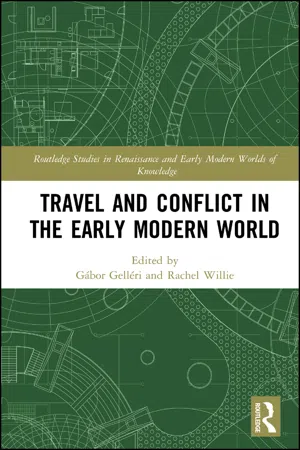
This edited collection examines the meeting points between travel, mobility, and conflict to uncover the experience of travel – whether real or imagined – in the early modern world. Until relatively recently, both domestic travel and voyages to the wider world remained dangerous undertakings. Physical travel, whether initiated by religious conversion and pilgrimage, diplomacy, trade, war, or the desire to encounter other cultures, inevitably heralded disruption: contact zones witnessed cultural encounters that were not always cordial, despite the knowledge acquisition and financial gain that could be reaped from travel. Vast compendia of travel such as Hakluyt's Principla Navigations, Voyages and Discoveries, printed from the late sixteenth century, and Prévost's Histoire Générale des Voyages (1746-1759) underscored European exploration as a marker of European progress, and in so doing showed the tensions that can arise as a consequence of interaction with other cultures. In focusing upon language acquisition and translation, travel and religion, travel and politics, and imaginary travel, the essays in this collection tease out the ways in which travel was both obstructed and enriched by conflict.
eBook - ePub
Travel and Conflict in the Early Modern World
- 276 pages
- English
- ePUB (mobile friendly)
- Available on iOS & Android
eBook - ePub
Travel and Conflict in the Early Modern World
Language, translation, and assimilation
1 Babel as a source of conflict
A case study of two discovery narratives
Scholarship in the field of social attitudes in an intercultural context should encourage us to reread travel literature, and especially discovery narratives, with a new approach. French ethnologist Raymonde Carroll casts an interesting light on the phenomenon.1 In her book, she grounds her analysis on an observation of daily interactions between French and American individuals, the better to highlight “zones of turbulence” around “implicit assumptions that govern our behaviour in spite of ourselves, whatever group we identify with and feel that we belong to”.2 One of the most interesting elements in Carroll’s research is that her investigation deals with individuals whose cultures are very similar (Western culture) and whose linguistic communication is not hindered by obstacles of any sort. The notion she explores, “the invisible obvious” (“évidences invisibles” in the very perceptive French translation), covers all those unsuspected, implicit assumptions that can give rise to incomprehension, misunderstandings, and sometimes even conflicts.3 In her interpretation, “It is possible that these situations [of cultural misunderstandings] were provoked by the strangeness of being in a foreign land, by a certain insecurity or ignorance due to the context”.4
If even an encounter between French and American individuals at the end of the twentieth century is rife with the potential for cultural misunderstandings, thereby making these encounters an excellent research terrain to highlight these situations, we can easily imagine how many questions, conflicts and misunderstandings of all kinds must have arisen from the encounter between European explorers and the inhabitants of faraway lands at the dawn of the modern age. In these encounters, two worlds meet that could never have suspected that the other even existed. What can we know about these exchanges, beyond what the explorers themselves perceived and reported?
Travel literature, especially the kind produced by seamen eager to successfully complete the task assigned to them – extending the span of terrae cognitae on which they can plant the banner of their prince and oftentimes financial backer – can only be considered as a discourse whose first aim is to signify how Europeans represent the world and the way they relate to other cultures when they tell the tale of their first encounters with Native Americans.5
While the difficulty or downright impossibility of linguistic communication appears to be the deciding factor in how these relationships were established, the notion of “cultural misunderstanding” can perhaps help us give a more precise account of how language and what is beyond language interact, during the genesis of antagonistic processes that can lead to conflict. Revisiting two canonical “first encounter” narratives, one from the diary of Columbus’s first journey, the other from Jacques Cartier’s second Canada journey, will be our way of exploring this question.
Transparency: the most elementary form of conflict?
On Friday, 12 October 1492, Columbus and his crew catch a first glimpse of a luxuriant and pleasant land, and of the “gente desnuda” (“naked people”) from the American continent.6 It seems that this first contact with the Native Americans does not spark any doubt or questioning in the admiral. But Columbus is not discovering America: it is his dream he is discovering, a dream nurtured with long study of medieval sources, his gaze firmly trained on Behaim’s world map. In his mind, he is setting sail for the Far East and the Garden of Eden; perhaps he thinks of himself as a “herald of the Apocalypse”, entrusted with a divine mission.7
He is so sure of his objective that he has brought with him Luis de Torres, “que avía bivido con el Adelantado de Murcia y avía sido judío, y sabía diz que ebraico y caldeo y aun algo arávigo”.8 Torres will be the interpreter on the journey and, on these roads that should lead them not very far from earthly paradise, he will be able to put his knowledge of Hebrew to good use. Claude-Gilbert Dubois, considering the Renaissance period, points out how Hebrew enjoys a sort of “first-born right” among languages. In this view, the language spoken in the Garden of Eden must have been very close to Hebrew, and so Luis de Torres should be able to understand those who live so close to Eden.9
Columbus’s project functions as an epistemological framework within which to make sense of the new. In the words of Francisco Morales Padrón, “this false, idealised and paradisiacal geography was Asia, for Colón, and he eagerly tried to convince the kings of Castile that the territories he had discovered were those Marco Polo was talking about”.10 Columbus is sailing towards the Orient, but he is sailing just as much towards a world that is already known, a self-evident world of foregone conclusions, whose meaning has already been surveyed, cross-examined and established by the great texts from antiquity and medieval science.11
From this point of view, the diary of the first journey is a constant surprise for a modern reader. Historiography has invited us to think about intercultural encounters in terms of “novelty”, of “singularity”, that is, in terms of otherness. But for the admiral, everything seems to be transparent and self-explanatory. He lands in the Indies; he talks about the famed land almost as if it was the garden next door. No matter; he knows what he wants, to annex the lands reached for the benefit of the Catholic kings, and his narrative subjects the whole reality he perceives to that programme. How he experiences language is very telling in this respect: Columbus does not speak the language of the Native Americans he meets on the Caribbean islands he reaches, but he understands what they say. Even complex messages, transmitted through signs, a code that is erroneously thought to be universal, are interpreted with no hesitation. Thus, on 13 October 1492, “Y por señas pude entender que, yendo al Sur o bolviendo la isla por el Sur, que estava allí un Rey que tenía grandes vases de oro y tenía muy mucho”.12
In another exchange the next day, he reports that “entendiamos que nos preguntavan si éramos venido[s] del cielo”.13 The utterance itself, the words of the other party, matter less here than its interpretation (“entendíamos”/“we understood”), which justifies months of uncertain and difficult sailing that has been bitterly contested by the crew.14 In a troubling example of his rashness, Columbus hears and simultaneously translates the words of an old man and some other Native Americans, who call out to their tribesmen to join them nearer the boat, “vino uno viejo en el batel dentro, y otros a grandes bozes llamavan todos, hombres y mugeres: ‘Venid a ver los hombres que vinieron del çielo, traedles de comer y de bever’”.15 In the manner of the omniscient novelist, the admiral literally and immediately takes up the words of the Other and ventriloquises them as direct speech. Columbus thus becomes the voice of the Native American, so to speak. The same appropriating attitude governs the interpretation he gives of the landscape, whose constituting elements immediately give rise to a translation in terms of commercial value. Having reached Punta de Mangle on the north coast of Cuba on 25 November, he converts into gold a river in which he sees stones glimmering; in the same way, amazingly tall trees are converted into ships, and other stones he sees on the beach soon become iron and silver.
It is a few more days before the admiral finally concedes that his knowledge is limited, as is the communication that was meant to flow in absolute transparency, “no sé la lengua, y la gente de estas tierras no me entienden, ni yo ni otro que yo tenga a ellos y estos indios que yo traigo, muchas vezes le entiendo una cosa por otra al contrario; ni fio mucho d’ellos, porque muchas vezes an probado a fugir”, he confesses a little while later.16 This is the first time he acknowledges his linguistic incompetence, made manifest in an addendum to the Diary. In the text, a connection is established between the failure to take possession – as evidenced in the attitude of Native Americans who eschew his authority and do not collaborate in his project – and the failure to communicate. To utter is not enough in the end: it will be necessary to go through language, to explain and to convince. Even if in a limited way, the admiral suddenly becomes aware of two things: the tangible realities of languages and the limits to his own power. At the same time that he becomes aware of alterity, Columbus catches a glimpse of the potential for a clash of wills; he has to renounce his fantasy of being all-powerful.
Even though his dream proves to be more powerful than the teachings of this experience, the same question crops up again on 3 December, on the north coast of Cuba. This failed encounter plays out in three steps. The setting is a true paradise, the earth so fertile that “que era gloria vella”,17 and his appraising gaze also rests on indigenous canoes as he notices their extremely clever design. In a village, the meeting with the local tribes is made easier at first by the presence of another Native American brought by Columbus. This marks the end of Act 1: suddenly the Native Americans are scared, perhaps the sign of brewing conflict, but that is not elucidated in the narrative. However, the Diary adds that Columbus manages to seize the crude weapons of the men, through a ruse, “varas [que tienen] al cabo d’ellas un palillo agudo tostado”, by exchanging them against small gifts.18 Is this what precipitates the last act of a meeting that might end in conflict? The admiral is already back in the rowboat when a Native American approaches:
Hizo una grande plática que el Almirante no entendía, salvo que los otros indios de cuando en cuando alçavan las manos al çielo y davan una grande boz. Pensava el Almirante que los aseguravan y que les plazía de su venida, pero vido al indio que consigo traía demudarse la cara y amarillo como la çera, y temblaba mucho, diziendo por señas que el Almirante se fuese fuera del río, que los querían matar, y llegóse a un cristiano que tenía una ballesta armada y mostróla a los indios; y entendió el Almirante que le dezía que los matarían todos, porque aquella ballesta tirava lexos y matava; también tomo una espada y la sacó de la vaina mostrándosela, diziendo lo mismo. Lo cual oído por ellos, dieron todos a huir, quedando todavía temblando el dicho indio de cobardía y poco coraçón.19
Michel Mollat, in his analysis of this passage, emphasises the ambivalence of body language, which is just as difficult to translate as the language itself.20 Tzvetan Todorov comments on the “failures” of this encounter, based on the linguistic and cultural inability to understand, but he also points out that “Columbus does not succeed in communications because he is not interested in them”.21 While the admiral, as usual, projects his own desires onto the attitudes and discourse of the Native Americans, this episode is also interesting for other reasons.22 It makes the Columbine ethos, as constructed in the Diary, very clear: Columbus sees himself as sole master and decider, and intends to remain in this role even when death clearly threatens. As master of the signs, Columbus knows how to interpret the Native American’s sudden pallor, and, master of his emotions, he remains unperturbed. There is an important new element here: for the first time, weapons are mentioned in the narrative, thus hinting at power struggles between the Native Americans and their conquerors. However, these weapons are diverted from their primary function (hurting, killing) and, at this stage, they are still objects to be exchanged, or the signifier of the power of the newly arrived conquerors; this is enough to prevent violence from erupting.
This constant misunderstanding is not a source of conflict yet: it would be possible to refer to a “missed connection” as much as a “missed conflict”. Moreov...
Table of contents
- Cover
- Half Title
- Series Page
- Title Page
- Copyright Page
- Contents
- List of figures
- Acknowledgements
- A note to the reader
- List of abbreviations
- List of contributors
- Introduction: Travel and conflict
- PART I: Language, translation, and assimilation
- PART II: Travel, religion, and the violence of the road
- PART III: War, diplomacy, and dissimulation
- PART IV: The art of travel and imaginary journeys
- Index
Trusted by 375,005 students
Access to over 1.5 million titles for a fair monthly price.
Study more efficiently using our study tools.
Frequently asked questions
Yes, you can cancel anytime from the Subscription tab in your account settings on the Perlego website. Your subscription will stay active until the end of your current billing period. Learn how to cancel your subscription
No, books cannot be downloaded as external files, such as PDFs, for use outside of Perlego. However, you can download books within the Perlego app for offline reading on mobile or tablet. Learn how to download books offline
Perlego offers two plans: Essential and Complete
- Essential is ideal for learners and professionals who enjoy exploring a wide range of subjects. Access the Essential Library with 800,000+ trusted titles and best-sellers across business, personal growth, and the humanities. Includes unlimited reading time and Standard Read Aloud voice.
- Complete: Perfect for advanced learners and researchers needing full, unrestricted access. Unlock 1.5M+ books across hundreds of subjects, including academic and specialized titles. The Complete Plan also includes advanced features like Premium Read Aloud and Research Assistant.
We are an online textbook subscription service, where you can get access to an entire online library for less than the price of a single book per month. With over 1.5 million books across 990+ topics, we’ve got you covered! Learn about our mission
Look out for the read-aloud symbol on your next book to see if you can listen to it. The read-aloud tool reads text aloud for you, highlighting the text as it is being read. You can pause it, speed it up and slow it down. Learn more about Read Aloud
Yes! You can use the Perlego app on both iOS and Android devices to read anytime, anywhere — even offline. Perfect for commutes or when you’re on the go.
Please note we cannot support devices running on iOS 13 and Android 7 or earlier. Learn more about using the app
Please note we cannot support devices running on iOS 13 and Android 7 or earlier. Learn more about using the app
Yes, you can access Travel and Conflict in the Early Modern World by Gábor Gelléri, Rachel Willie, Gábor Gelléri,Rachel Willie in PDF and/or ePUB format, as well as other popular books in History & World History. We have over 1.5 million books available in our catalogue for you to explore.