- 264 pages
- English
- ePUB (mobile friendly)
- Available on iOS & Android
eBook - ePub
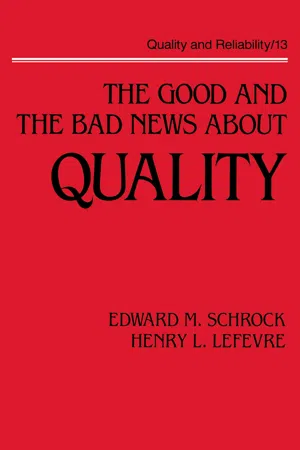
The Good and the Bad News about Quality
About this book
This book provides a vehicle to foster interaction of the elements of the modern approach to quality, including statistical applications, quality and reliability engineering, management, and motivational aspects. It is intended for those in manufacturing, engineering, marketing, and management.
1
The Good and the Bad News About Quality
Have you ever heard a dog purr or a cat bark? It can happen, you know.
Chromosomes and genes work almost perfectly with live household pets. This, however, is not necessarily true with toy animals whose barks and purrs come from mechanical inserts. If the insert for a dog looks the same as the one for a cat, someone is sure to mix them up. Then, a purring dog or a barking cat will probably reach the market place.
Quality conscious toy makers can design inserts that fit into their dogs but not their cats, and the other way around. Then, the toy animals will not confuse their owners with unorthodox sounds.
The good news is that we know how to economically manufacture high quality, reliable products. The bad news is that many manufacturing companies have not learned the good news.
Tragic events such as those associated with the Pinto rear-end crashes, the Bhopal chemical catastrophe, and the Three Mile Island nuclear accident are not inevitable. Steps can be taken to anticipate and initiate corrective action before disaster strikes.
Can companies avoid these quality problems?
Of course!
To do this, however, top management must don the armor of Saint George and slay the seven-headed dragon that gives birth to defects. The seven heads, each representing a management misconception, are listed below.
- Quality control doesn’t need high-level managers.
- All defectives should be removed by inspection.
- Reliable, high-quality products are uneconomical.
- Quality is a departmental function.
- Quality campaigns ensure quality.
- Defects are due to lazy workers.
- Good design and production ensure good products.
These misconceptions won’t guarantee failure but they will make it probable.
DRAGON HEAD 1
Quality Control Doesn’t Need High-Level Managers
Some companies rate their quality control manager between a janitor and the head of their typing pool. Does this imply that quality is Job #1? Would anyone shove an important assignment that far down the chain of command?
Most solutions to quality problems require help from many departments. Few fourth-level managers can ensure this type of team effort. Top rate, third-level managers (directors and junior vice presidents) have a fighting chance. Good, second-level managers (executive vice presidents) usually succeed. Company presidents get the job done.
DRAGON HEAD 2
All Defectives Should Be Removed by Inspection
How many of us can walk on water without knowing where the stones are? Can we expect quality control inspectors to do better?
In real life, an honest effort to find defects might catch 95 percent of them. If the defects are hard to detect, the number could be less than 90 percent. Inspection accuracy depends on the tools available, the inspector’s attitude, the inspection procedures, and the quality characteristics being inspected.
Tools are normally controlled by budget, which in turn is controlled by top management. Never send an inspector dragon hunting with a rusty sword and a flammable suit of armor.
Attitudes are also affected by management. Does the quality manager have to use a correspondence store detective’s disguise to gain access to the front office? Do quality control personnel get as many promotions as residents and alumni of the production department? Do performance evaluations give as much emphasis to quality as they do to production?
Inspection procedures are seldom controlled by the inspector. They are controlled by the quality department.
Quality characteristics relate to the product. There are, however, many ways to inspect a single item. Are inspectors encouraged to help select the tools and techniques that will be used?
Both production operators and quality control inspectors are ingenious at deviating from procedures when they have a “better way” of doing things. Those participating in the planning, however, are less likely to impose their wills on the system after the final decision is made.
DRAGON HEAD 3
Reliable, High-Quality Products Are Uneconomical
Try telling that to the Rolls Royce Company. If Rolls Royce quit producing a quality product, the company would go out of business. Rolls owners buy the car because of its quality. To them, price is secondary.
Makers of less expensive cars, however, still have tough quality requirements. Low price doesn’t give them the license to be shoddy. Whether the product is toothpicks or space ships, it must perform in the manner intended, in the environment to which it will be exposed, for the time required.
DRAGON HEAD 4
Quality Is a Departmental Function
This head of the fearful dragon was conceived by the assumption that quality departments create quality like machines produce parts or magicians create illusions. Don’t believe it.
The quality department’s function is to help other departments coordinate their efforts to produce a quality product. Of course, the product must meet the standards, policies, and objectives set by top management.
The quality department’s expertise lies in developing quality specifications, evaluating quality characteristics, measuring variations, and coordinating corrective action. A quality department’s findings can be helpful if top management uses them. Otherwise, they have no more value than last week’s cup of coffee, dehydrated by cigarette butts.
DRAGON HEAD 5
Quality Campaigns Ensure Quality
Using signs that urge workers to make “better quality” products can be effective if management doesn’t stop there. These actions, however, are detrimental to morale and quality when they are not followed up with management action.
Is management doing all it can to give workers the necessary tools? Does management reward exceptional quality as much as it rewards outstanding production?
Workers quit listening to slogans the moment they differ from management’s actions. This is particularly true in the field of quality. Workers do not strive for quality when volume of production is the only thing that counts toward their next promotion.
DRAGON HEAD 6
Defects Are Due to Lazy Workers
More defects are due to the attitude of managers than to the laziness of workers. Motivation is influenced by many things, and most of them are controlled by management.
How do workers think they are being treated? If people believe they are treated fairly, they normally try to do good work.
Does management skimp on training, raw materials, machinery, lighting, heating, cooling, and tender loving care? If so, workers assume that people in the trenches don’t count, and neither does quality.
DRAGON HEAD 7
Good Design and Production Ensure Good Products
There is no question about the importance of good design and good production. Quality, however, doesn’t end there. A product must be good enough to sell for a profit (marketing). The raw materials must be usable (purchasing). The product must be delivered in good condition (packaging and shipping). Without this support, the world’s best design and manufacturing departments won’t keep a company in business.
All departments in the company must be coordinated to produce a reliable, high-quality product—profitably. Only top management is in a position to direct and oversee the necessary coordination.
TIME OUT FOR HISTORY
Prior to World War II, Japan had a reputation for poor quality products. International competition required that they reverse this image, so they decided to slay the seven-headed dragon that spawns defects.
In order to improve their quality, the Japanese sought help from J. M. Juran, William Edwards Deming, and other quality control authorities from the United States. Our experts visited Japan and lectured to their business and industrial leaders. Our authorities spoke. Their leaders listened.
Since then, these same experts have lectured widely in the United States. They speak like ministers preaching to the choir. Those who really need to hear the message are seldom in the pews.
Now Japan has a better reputation for quality than the land of its tutors.
WHAT JAPAN DID RIGHT
The Japanese did two things that are giving them an edge.
First, the people at the very top of their business and industry listened to the U. S. experts. They recognized their responsibility for controlling quality within their organizations. They realized that control of quality starts at the very top and goes as far as top management insists, but no further. As a consequence, they ensured that their departments coordinated quality activities with each other. They also insisted that the agreements coming from these coordination sessions were implemented.
Second, the Japanese realized that specialized tools, techniques, devices, and procedures were needed to control quality. They mastered these tools, including scientific sampling, quality control charts, distribution curves, and other statistical methods. Now they understand how to evaluate quality and troubleshoot quality problems.
WHEN WILL THE UNITED STATES LEARN?
Many training courses in the broad field of quality control are available throughout the United States. These are generally attended by supervisors, engineers, and inspectors interested in professional growth. They are rarely attended by top management.
If the United States is to regain its position of world leadership in quality, top management must get involved. It must learn the language of quality. It can no longer delega...
Table of contents
- Cover
- Half Title
- Series Page
- Title Page
- Copyright Page
- About the Series
- Preface
- Contents
- 1 The Good and the Bad News About Quality
- 2 Myths and Realities
- 3 Keys to Managing Quality
- 4 Key 1: Knowledge of Customer Requirements
- 5 What Bugs Customers?
- 6 The Ultimate in Displeased Customers
- 7 Learning from the Customer
- 8 Key 2: Anticipating Defects
- 9 Quality Catastrophes
- 10 Management Controllable Defects
- 11 Worker Controllable Defects
- 12 Key 3: Quick Detection of Defects
- 13 Inspecting for Defects
- 14 Reporting Defects
- 15 Key 4: Coordination
- 16 Making Coordination Work
- 17 Coordinators: Who Will Lead?
- 18 Key 5: Effective Problem Solving
- 19 Basic Statistics
- 20 Process Capability
- 21 Which Product Is Best?
- 22 Is the New Way Really Better?
- 23 Frequency Distribution Charts
- 24 Interpreting Control Charts
- 25 Controlling Processes with Pre-Control
- 26 Divide and Conquer
- 27 Understanding Regression Analyses
- 28 Designing Experiments
- 29 Plan Experiments—Don’t Muddle Through
- 30 Traps, Snares, and Pitfalls Along the Way
- 31 Quotable Quotes
- Index
Trusted by 375,005 students
Access to over 1.5 million titles for a fair monthly price.
Study more efficiently using our study tools.
Frequently asked questions
Yes, you can cancel anytime from the Subscription tab in your account settings on the Perlego website. Your subscription will stay active until the end of your current billing period. Learn how to cancel your subscription
No, books cannot be downloaded as external files, such as PDFs, for use outside of Perlego. However, you can download books within the Perlego app for offline reading on mobile or tablet. Learn how to download books offline
Perlego offers two plans: Essential and Complete
- Essential is ideal for learners and professionals who enjoy exploring a wide range of subjects. Access the Essential Library with 800,000+ trusted titles and best-sellers across business, personal growth, and the humanities. Includes unlimited reading time and Standard Read Aloud voice.
- Complete: Perfect for advanced learners and researchers needing full, unrestricted access. Unlock 1.5M+ books across hundreds of subjects, including academic and specialized titles. The Complete Plan also includes advanced features like Premium Read Aloud and Research Assistant.
We are an online textbook subscription service, where you can get access to an entire online library for less than the price of a single book per month. With over 1.5 million books across 990+ topics, we’ve got you covered! Learn about our mission
Look out for the read-aloud symbol on your next book to see if you can listen to it. The read-aloud tool reads text aloud for you, highlighting the text as it is being read. You can pause it, speed it up and slow it down. Learn more about Read Aloud
Yes! You can use the Perlego app on both iOS and Android devices to read anytime, anywhere — even offline. Perfect for commutes or when you’re on the go.
Please note we cannot support devices running on iOS 13 and Android 7 or earlier. Learn more about using the app
Please note we cannot support devices running on iOS 13 and Android 7 or earlier. Learn more about using the app
Yes, you can access The Good and the Bad News about Quality by Edward M. Schrock,Schrock in PDF and/or ePUB format, as well as other popular books in Business & Operations. We have over 1.5 million books available in our catalogue for you to explore.