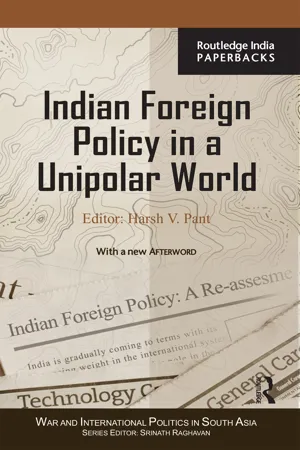
Indian Foreign Policy in a Unipolar World
eBook - ePub

Indian Foreign Policy in a Unipolar World

  1. 388 pages
  2. English
  3. ePUB (mobile friendly)
  4. Available on iOS & Android
eBook - ePub

Indian Foreign Policy in a Unipolar World

About this book

India's foreign policy, out of the structural confines of the Cold War strategic framework, has become more expansive in defining its priorities over the last few years. With the rise of its economic and military capabilities and strategic interests, India has shaped a diplomacy that is much more aggressive in the pursuit of those interests. Tracing the trajectory of India's foreign policy in the 21st century, this book examines the factors that have shaped the Indian response towards this emerging international security environment. Including a new Afterword, this updated volume looks at the major influences that have shaped India's foreign policy in recent years, in the context of its engagements with strategically important regions across the globe, and its relations with major global powers.

The volume will prove invaluable to those studying politics and international relations, diplomatic and political history, defence and military studies, and South Asian studies.

Trusted by 375,005 students

Access to over 1.5 million titles for a fair monthly price.

Study more efficiently using our study tools.

Information

Year
2020
Print ISBN
9780367200992
eBook ISBN
9781000083958

1
Introduction

HARSH V. PANT
By all reckoning, India has arrived on the world stage. No longer a mere bystander to the actions of other powers, India is gradually coming to terms with its increasing weight in contemporary international politics. It is being viewed as a major pole in the configuration of the emerging global balance of power by outsiders as well as Indians themselves. The US Secretary of State Condoleezza Rice boldly declaims that the US is ‘willing and ready to assist in the growth of India’s global power … which [the US] sees as largely positive’.1 And Indian strategists are no longer shy in proclaiming India to be one of the six members of the emerging global balance of power.2
1 ‘India a Growing Global Power’, The Times of India (New Delhi), May 29, 2005.
2 K. Subrahmanyam, ‘Wanted Leaders with a Vision’, The Tribune (Chandigarh), September 24, 2005.
If the global balance of power is indeed shifting from the Atlantic to the Pacific, then the rise of India, along with China, is clearly an indisputable reality that few can dare to dismiss any longer. As a consequence, India is now being invited to the G-8 summits, is being called upon to shoulder global responsibilities—from the challenges of nuclear proliferation to the instability in the Persian Gulf and is increasingly being viewed as more than merely a ‘South Asian’ power. From a nation that was mortgaging its gold reserves in 1990 to one whose foreign exchange reserves are overfull, from a nation that was marginal in the global distribution of economic might to one that is steadily emerging as one of the centres of modern global economy, India has indeed come a long way. Its economy is one of the fastest growing in the world; it is a nuclear weapon state, a status that is being grudgingly accepted by the world; its armed forces are highly professional, on their way towards rapid modernisation; and its vibrant democratic institutions, with the world’s second-largest Muslim population, are attracting global attention at a time when promotion of democracy is being viewed as a remedy for much of what is wrong with a large part of the world. However, the most significant attribute of today’s India is its attempt to carve out a foreign policy that is much more confident about India’s rising stature in the international system.
According to the US National Intelligence Council report, ‘Mapping the Global Future’, by 2020, the international community will have to confront the military, political and economic dimensions of the rise of China and India.3 This report has likened the emergence of these countries in the early 21st century to the rise of Germany in the 19th and America in the 20th, with impacts potentially as dramatic. The CIA has labelled India the key ‘swing state’ in international politics and predicts that, by 2015, India will emerge as the fourth most important power in the international system. According to the assessment of Goldman Sachs, by 2040, the four largest economies will be China, the US, India and Japan.4 India will overtake the G-6 economies faster than previously expected and its GDP, in all likelihood, will surpass that of the US before 2050, making it the second-largest economy after China. After decades of marginalisation due to the vagaries of Cold War, its own obsolescent model of economic management and the seemingly never-ending tensions with Pakistan, India is finally coming into its own with a self-confidence that comes with growing capabilities. Its global and regional ambitions are rising and it is showing an aggressiveness in its foreign policy, which had not been its forte before.
3 The report is available at http://www.cia.gov/nic/NIC_globaltrend2020.html (accessed on December 20, 2007).
4 The report is available at http://www2.goldmansachs.com/insight/research/reports/99.pdf(accessed on December 20, 2007).
This transformation since the end of the Cold War has been the result of a number of factors. All through the Cold War years, India saw itself as the leader of the Third World, even as the Third World group of states existed more in myth than in reality. While the idea of a non-aligned foreign policy may have been devised to prevent Indian foreign policy from becoming hostage to the Cold War rivalry between the US and the former Soviet Union, in practical terms it led to a certain ideological rigidity that prevented India from protecting and enhancing its vital interests in an anarchical international environment. As the Cold War drew to a close, India was forced to reorient its economic and foreign policies to the changing global realities and in less than two decades seems on the cusp of achieving the status of a ‘great power’.
While some proclaimed the end of history with the fall of the Berlin Wall, in many ways it was the beginning of history for Indian foreign policy, free as it was from the structural constraints of a bipolar world order. It lost its political, diplomatic and military ally with the demise of the Soviet Union and its economy was on the threshold of bankruptcy. There was domestic political uncertainty with weak governments unable to last for a full five-year term as the plethora of internal security challenges were becoming more prominent. The ignominy of having to physically lift bullion to obtain credit pushed India against the ropes and the national psyche was at its most vulnerable. It was against this background that the minority government of late P.V. Narasimha Rao had to formulate its economic and foreign policy, to preserve Indian interests in a radically new global environment. And slowly, but surely, began the process that continues to unfold till date as India tries to redefine its place in the international system in consonance with its existing and potential power capabilities.
Both India and the international system are undergoing profound changes, complicating the interplay between them. On the one hand, the rise of India is bound to alter the international structure in the near future, while on the other, external systemic constraints are increasingly becoming central in shaping India’s international behaviour. As in the case of most other nations, the sources of Indian foreign policy are manifold, ranging from the international system to economic interests and to domestic political pressures and institutions. This volume, while taking into account all the sources, focuses primarily on the impact of emerging structural realities of the international system on Indian foreign policy. As India moves from the periphery of the international system to its centre, India’s structural position in the international system will be the most important variable in defining the trajectory of its foreign policy.

Rising Powers and Their Foreign Policies

According to the realist tradition in International Relations, it is the international systemic constraints that determine the foreign policy behaviour of states. While individual or domestic political variables may influence the policy at the margins, it is the structure of the international system that sets the terms for its conduct across time and space. Realists contend that ‘the pressures of [international] competition weigh more heavily than ideological preferences or internal political pressures’.5 In his seminal work on structural realism, Kenneth Waltz has argued that his is a theory of international politics, not of foreign policy, because structural realism tries to explain the outcomes of state interactions. Theories of foreign policy would seek to explain the behaviour of individual states in the external realm.6 According to Waltz, foreign policy does not constitute an autonomous realm, because it is driven by both external and internal factors and so there is no point in trying to find a theoretical explanation for foreign policy. A theory of international politics shows how the interaction of states generates a structure which then constrains states, rewarding or punishing them for taking certain actions. Thus it explains why states similarly placed in the system behave similarly despite the differences among them. For Waltz, to explain how any single state will respond to the constraints imposed by the international structure requires a theory of foreign policy. A theory of foreign policy, therefore, explains why states similarly placed in the international system do not behave similarly, thereby underlining the differences in the internal make-up of states as explanations for the differences.7
5 Kenneth N. Waltz, ‘A Response to My Critics’, in Robert O. Keohane, ed., Neorealism and its Critics (New York: Columbia University Press, 1986), p. 329.
6 Kenneth N. Waltz, Theory of International Politics (Reading, Mass.: Addison-Wesley, 1979), pp. 71–72.
7 Kenneth N. Waltz, ‘International Politics is Not Foreign Policy’, Security Studies 6:1 (Autumn 1996), pp. 54–55.
However, despite his emphatic rejection of the use of structural realism as a theory of foreign policy, he has proceeded to explain specific foreign policy behaviour of states using his theoretical framework. He has argued, for example, that the ‘foreign policies of nations are affected in important ways by the placement of countries in the international–political system or more simply by their relative power’.8 Others have also pointed out that his work contains a number of examples of specific foreign policies attributable to systemic factors and have concluded that neo-realist theories can be employed as theories of foreign policy.9 As a consequence, various scholars have explained foreign policy bahaviour of states by updating and systematising Waltz’s basic argument, concluding that a state’s position in the international system and its relative material power capabilities are the most important drivers of its foreign policy.10 In the words of Fareed Zakaria, ‘a good theory of foreign policy should first ask what effect the international system has on national behaviour, because the most powerful generalisable characteristic of a state in international relations is its relative position in the international system’.11
8 Kenneth N. Waltz, ‘America as a Model for the World? A Foreign Policy Perspective’, PS: Political Science and Politics 24:4 (December 1991), p. 667.
9 Colin Elman, ‘Horses for Courses: Why Not Neorealist Theories of Foreign Policy’, Security Studies 6:1 (Autumn 1996), p. 10.
10 See, for example, Thomas J. Christenson, Useful Adversaries: Grand Strategy, Domestic Mobilisation, and Sino-American Conflict, 1947–1958 (Princeton: Princeton University Press, 1996); Randall L. Schweller, Deadly Imbalances: Tripolarity and Hitler’s Strategy of World Conquest (New York: Columbia University Press, 1998); William C. Wohlforth, The Elusive Balance: Power and Perceptions during the Cold War (Ithaca, NY: Cornell University Press, 1993); and Fareed Zakaria, From Wealth to Power: The Unusual Origins of America’s World Role (Princeton: Princeton University Press, 1998).
11 Fareed Zakaria, ‘Realism and Domestic Politics: A Review Essay’, International Security 17:1 (Summer 1992), p. 197.
How states respond to relative material rise or decline has long been central to understanding the forces that shape international politics. As has been argued, ‘similar security policies recur throughout history and across the international system in states that, whatever their differences, occupy similar positions in the international system […] The security policies of very strong states are different from those of very weak ones, and both differ from those of states that are neither very strong nor very weak’.12 Structural constraints, in other words, force states towards a particular set of foreign policies in line with their relative position in the international system. And as that position undergoes a change, so will change the foreign policy of that state changes as well. As Robert Gilpin explains, ‘a more wealthy and a more powerful state…will select a larger bundle of security and welfare goals than a less wealthy and less powerful state’,13 thereby trying to use the tools at its disposal to gain control over its strategic environment. A state, therefore, will become more ambitious in defining the scale and scope of its foreign policy as its relative material power capabilities increase and vice versa.
12 Michael Mandelbaum, The Fates of Nations:The Search for National Security in the Nineteenth and Twentieth Centuries (Cambridge: Cambridge University Press, 1988), pp. 2, 4.
13 Robert Gilpin, War and Change in World Politics (Cambridge: Cambridge University Press, 1981), pp. 22–23, 94–95.
According to Hans Morgenthau, the interests of a state are shaped by its power.14 An increase in a state’s relative power capabilities will result in a concomitant increase in its interests in the realm of foreign policy. And as it will rise in inter-state hierarchy, it will ‘try to expand its economic, political and territorial control; it will try to change the international system in accordance with its own interests’.15 Rising powers in the international system will try to change the statu...

Table of contents

  1. Cover
  2. Half Title
  3. Series Page
  4. Title Page
  5. Copyright Page
  6. Dedication Page
  7. Contents
  8. Preface
  9. 1. Introduction
  10. PART I: Major Themes in Indian Foreign Policy
  11. PART II: India and Major Global Powers
  12. PART III: India's Regional Policy
  13. Bibliography
  14. Notes on Contributors
  15. Index

Frequently asked questions

Yes, you can cancel anytime from the Subscription tab in your account settings on the Perlego website. Your subscription will stay active until the end of your current billing period. Learn how to cancel your subscription
No, books cannot be downloaded as external files, such as PDFs, for use outside of Perlego. However, you can download books within the Perlego app for offline reading on mobile or tablet. Learn how to download books offline
Perlego offers two plans: Essential and Complete
  • Essential is ideal for learners and professionals who enjoy exploring a wide range of subjects. Access the Essential Library with 800,000+ trusted titles and best-sellers across business, personal growth, and the humanities. Includes unlimited reading time and Standard Read Aloud voice.
  • Complete: Perfect for advanced learners and researchers needing full, unrestricted access. Unlock 1.5M+ books across hundreds of subjects, including academic and specialized titles. The Complete Plan also includes advanced features like Premium Read Aloud and Research Assistant.
Both plans are available with monthly, semester, or annual billing cycles.
We are an online textbook subscription service, where you can get access to an entire online library for less than the price of a single book per month. With over 1.5 million books across 990+ topics, we’ve got you covered! Learn about our mission
Look out for the read-aloud symbol on your next book to see if you can listen to it. The read-aloud tool reads text aloud for you, highlighting the text as it is being read. You can pause it, speed it up and slow it down. Learn more about Read Aloud
Yes! You can use the Perlego app on both iOS and Android devices to read anytime, anywhere — even offline. Perfect for commutes or when you’re on the go.
Please note we cannot support devices running on iOS 13 and Android 7 or earlier. Learn more about using the app
Yes, you can access Indian Foreign Policy in a Unipolar World by Harsh V. Pant in PDF and/or ePUB format, as well as other popular books in Politics & International Relations & 21st Century History. We have over 1.5 million books available in our catalogue for you to explore.