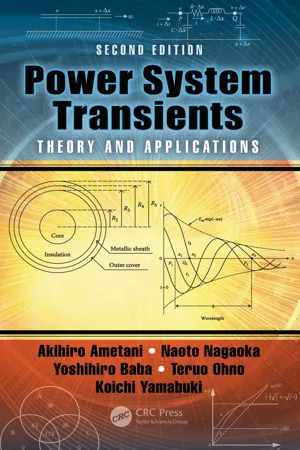
This new edition covers a wide area from transients in power systems—including the basic theory, analytical calculations, EMTP simulations, computations by numerical electromagnetic analysis methods, and field test results—to electromagnetic disturbances in the field on EMC and control engineering. Not only does it show how a transient on a single-phase line can be explained from a physical viewpoint, but it then explains how it can be solved analytically by an electric circuit theory. Approximate formulas, which can be calculated by a pocket calculator, are presented so that a transient can be analytically evaluated by a simple hand calculation. Since a real power line is three-phase, this book includes a theory that deals with a multi-phase line for practical application. In addition, methods for tackling a real transient in a power system are introduced. This new edition contains three completely revised and updated chapters, as well as two new chapters on grounding and numerical methods.
eBook - ePub
Power System Transients
Theory and Applications, Second Edition
- 574 pages
- English
- ePUB (mobile friendly)
- Available on iOS & Android
eBook - ePub
Power System Transients
Theory and Applications, Second Edition
About this book
Information
1
Theory of Distributed-Parameter Circuits and Impedance/Admittance Formulas
1.1 Introduction
When investigating transient and high-frequency steady-state phenomena, conductors such as a transmission line, a machine winding, and a measuring wire demonstrate a distributed-parameter nature. Well-known, lumped-parameter circuits are an approximation of a distributed-parameter circuit for describing a low-frequency, steady-state phenomenon of the conductor. That is, a current in a conductor, even a short conductor, needs time to travel from its sending end to its remote end because of its finite propagation velocity (300 m/µs in a free space). From this fact, it should be clear that a differential equation expressing the behavior of current and voltage along the conductor involves variables of distance x and time t or frequency f. Thus, it becomes a partial differential equation. However, a lumped-parameter circuit is expressed by an ordinary differential equation since no concept of the length or the traveling time exists. This is the most significant difference between the distributed-parameter circuit and the lumped-parameter circuit.
In this chapter, a theory of distributed-parameter circuits is explained starting from the approximate impedance and admittance formulas of an overhead conductor. The derivation of the approximate formulas is described from the viewpoint...
Table of contents
- Cover
- Half Title
- Title Page
- Copyright Page
- Contents
- Preface
- Authors
- List of Symbols
- List of Acronyms
- International Standards
- 1 Theory of Distributed-Parameter Circuits and Impedance/Admittance Formulas
- 2 Transients on Overhead Lines
- 3 Transients on Cable Systems
- 4 Transient and Dynamic Characteristics of New Energy Systems
- 5 Numerical Electromagnetic Analysis Methods and Their Application in Transient Analyses
- 6 Electromagnetic Disturbances in Power Systems and Customer Homes
- 7 Grounding
- 8 Problems and Application Limits of Numerical Simulations
- Index
Trusted by 375,005 students
Access to over 1.5 million titles for a fair monthly price.
Study more efficiently using our study tools.
Frequently asked questions
Yes, you can cancel anytime from the Subscription tab in your account settings on the Perlego website. Your subscription will stay active until the end of your current billing period. Learn how to cancel your subscription
No, books cannot be downloaded as external files, such as PDFs, for use outside of Perlego. However, you can download books within the Perlego app for offline reading on mobile or tablet. Learn how to download books offline
Perlego offers two plans: Essential and Complete
- Essential is ideal for learners and professionals who enjoy exploring a wide range of subjects. Access the Essential Library with 800,000+ trusted titles and best-sellers across business, personal growth, and the humanities. Includes unlimited reading time and Standard Read Aloud voice.
- Complete: Perfect for advanced learners and researchers needing full, unrestricted access. Unlock 1.5M+ books across hundreds of subjects, including academic and specialized titles. The Complete Plan also includes advanced features like Premium Read Aloud and Research Assistant.
We are an online textbook subscription service, where you can get access to an entire online library for less than the price of a single book per month. With over 1.5 million books across 990+ topics, we’ve got you covered! Learn about our mission
Look out for the read-aloud symbol on your next book to see if you can listen to it. The read-aloud tool reads text aloud for you, highlighting the text as it is being read. You can pause it, speed it up and slow it down. Learn more about Read Aloud
Yes! You can use the Perlego app on both iOS and Android devices to read anytime, anywhere — even offline. Perfect for commutes or when you’re on the go.
Please note we cannot support devices running on iOS 13 and Android 7 or earlier. Learn more about using the app
Please note we cannot support devices running on iOS 13 and Android 7 or earlier. Learn more about using the app
Yes, you can access Power System Transients by Akihiro Ametani,Naoto Nagaoka,Yoshihiro Baba,Teruo Ohno,Koichi Yamabuki in PDF and/or ePUB format, as well as other popular books in Technology & Engineering & Electrical Engineering & Telecommunications. We have over 1.5 million books available in our catalogue for you to explore.